
CONGREGAZIONE DELLA MISSIONE. – A congregation of secular priests with private and perpetual vows, founded in Paris by S. Vincenzo de' Paoli in 1625. In France and also in Italy, the members of the congregation are ordinarily called Lazzaristi, after the ancient priory of S. Lazzaro; in America, Vincenziani; in Spain, Padres Paules. The archbishop of Paris approved it on 24 Apr. 1626. Urban VIII, with the bull Salvatoris nostri of 12 Jan. 1632, gave pontifical sanction to the new institute. On 8 Jan. 1632 Vincenzo took possession of the priory of S. Lazzaro, offered to him by the prior Adriano Le Bon, which became the mother house and the center of the Vincentian works.
I. ORGANIZATION
The new institute grew rapidly. The work multiplied and its activities expanded; but the precise form of the community had not been determined, because the founder wanted to await the sanction of experience, and twice, in 1642 and 1651, he convened the older priests for this purpose. The fundamental point was always that the C. should not constitute a religious Order, since the missionaries had to be free from every bond in order to devote themselves to the apostolate. In this regard he obtained from Alexander VII approval of the vows (the three Ordinary vows, plus the fourth, of consecrating oneself for life to the apostolic ministry) by the brief Ex commissa nobis of 22 October 1655. So that no one might ever think of changing the nature of the community, he also eliminated from its terminology and practices everything that might recall a religious Order.The novitiate (two years) was called the internal seminary (to distinguish it from external or diocesan seminaries); the dress and manner of life were those of the secular clergy. He prescribed no particular austerities. The exercises of piety were those that a good priest performs each day to nourish his spiritual life. After thirty years of trial, Vincenzo decided to promulgate the rules of the « Little Company ». He distributed the booklet at the meeting of 17 May 1658. From them are derived the elements that characterize its life, spirit, and works.
The C. is composed of priests and laymen (coadjutor brothers) and has a threefold purpose: personal sanctification; preaching the Gospel to the poor, especially in the countryside (hence the motto Evangelizare pauperibus misit me, which, in the emblem of the C., surrounds the preaching Savior); and the formation of the clergy. According to the founder, the missions must be distinguished by the simple form of their preaching and must be given free of charge. For this reason Vincenzo did not wish to accept the foundation of any house without sufficient capital to ensure that it would not be a burden on the populations evangelized.
The government of the C. is very simple. At its head is a superior general elected for life, with 4 assistants of different nations, a procurator, and a secretary general. Several houses are united into a religious province under the direction of a visitor assisted by a council of 4 or 5 members and a procurator. Each house is presided over by a superior likewise assisted by his own council. The highest authority in the C. belongs to the general assembly (the « General Chapter » of religious Orders), which meets every 12 years, or more frequently if necessary, and is composed of the members of the central council, the visitors, and two delegates from each province. It is responsible for electing the superior general
and the assistants, making important decisions concerning disciplinary matters, etc. The decrees of the general assemblies are binding on the entire C. During the generalate of Renato Alméras (1661-72), the so-called « great Constitutions » were drawn up, approved in 1668 by the archbishop of Paris, Harduin de Peréfixe. Alméras was also the author of the Constitutiones selectae, a compendium of the preceding Constitutions, approved by Clement X on 2 June 1670 by the brief Ex iniuncto nobis. During the long government
of Giovanni Bonnet (1711-35), the difficult period of Jansenism occurred. The C. remained firmly attached to the Holy See, and when the heresy was condemned, Bonnet was unshakable. He expelled from the Company men who were, nevertheless, distinguished, such as Himbert and Philopald, demanding absolute obedience from his members. The principles and rights of the Apostolic See were effectively defended by the superior of the seminary of Avignon, Vittorio Soardi, in the treatise De suprema Romani Pontificis auctoritate (1747).
Felice Cayla, superior general from 1788 to 1800, as a deputy of the clergy to the National Assembly in 1792 voted against the Civil Constitution, which brought him exile and persecution upon his community. The missionaries, like their superior, remained faithful to the Church. The consequences were terrible. At the seminary of S. Firmino (the former Bons Eufants college), Giuseppe François and Enrico Gruyer were massacred (1792; beatified in 1926), Pier Renato Rogue (1796; beatified in 1934) and another 10 were guillotined, 7 died in prison, and 5 were deported; all the houses were closed and the members (824) dispersed. Cayla fled to Rome, where he died on 12 February 1800.
The nineteenth century saw the revival and expansion of the C. throughout the world, especially through the work of Giovanni Battista Etienne, superior general from 1843 to 1874, one of its most eminent figures and almost a second founder.
II. DIFFUSION OF THE C
At the death of the founder (27 September 1660), the C. counted 23 houses in France, 53 by the end of the 17th century, rising to 98 in 1792. After the Revolution, which destroyed them, life gradually resumed. In 1816 the C. had already reopened 16 houses, which soon increased to 57. Despite the severe blow inflicted by the suppressive laws of 1903, they are today flourishing with vitality both in the homeland and in the Foreign Missions.In 1646, at the request of Innocent X, St. Vincenzo sent his missionaries to Ireland, but Cromwell’s persecution in 1648 paralysed their activity and dispersed them. Ireland, Scotland and England saw the priests of the Mission again in the 19th century. At the request of Queen Luisa Maria
Gonzaga, St. Vincenzo sent his sons to Poland in 1651, where they opened several houses. The various partitions of the country repeatedly disrupted the organizational structure and apostolic activity of the missionaries, so that by 1866 only the houses of Cescovia and Culm remained. Today the Polish province is one of the most flourishing, with about forty houses in the homeland, Romania, Brazil, the United States and China.
In Spain they were called by Cardinal Benedetto de Sala, bishop of Barcelona. Progress was rapid, to the point of requiring the establishment of an autonomous province in 1774. Dispersed during the Revolution of 1835, they returned there after the Concordat of 1850. Suppressed again in 1868, they resumed their life seven years later. In the Revolution of 1936 the C. gave about forty martyrs. Today the « Padres Paules » have more than 50 houses, and each year provide a good number of apostolic workers to England, the diocese of Cuttak in India (1922), the United States, Puerto Rico, Venezuela, Peru, Bolivia, Chile and Honduras.
The other provinces of Europe are those of Belgium (1856), which supports the mission of the Congo (1926); Yugoslavia (1852); Germany (1853), from which, owing to the laws of the Kulturkampf, the missionaries were exiled in 1872 as « affiliated with the Jesuits » and shortly thereafter resumed— as they have today, after the recent war—with indomitable courage their apostolic work; Austria (1853); Holland (1880), extensively engaged in the mission of Java, in the diocese of Yougpinfu in China and in various residences in Brazil; Greece (1887); Hungary (1898), where the Sons of St. Vincenzo have organized a magnificent network of charitable works; Romania (1902); Denmark (1903); Czechoslovakia, recently founded (1929) and already full of vitality, despite its political and religious difficulties; and Albania (1940), a mission that had already flourished greatly and was then cut short by the expulsion of the missionaries in 1945.
The Foreign Missions occupy a privileged place in the C. St. Vincenzo sent missionaries to Barbary (1645) and Madagascar (1648). The latter was abandoned in 1674, but the missionaries returned there in 1896, assuming the direction of the vicariate of Fort Dauphin, which they still retain. Not a few missionaries left their lives in Barbary: some as martyrs of the faith, others exhausted by work and hardship; but the mission was never abandoned.
In 1656 St. Vincenzo, urged by Rome, sent missionaries to Lebanon, from where they subsequently extended into Syria, Palestine and Egypt.
In 1841 Persia, through the efforts of Eugenio Borè, later superior general, opened its doors to Vincentian apostolate. The superior of the C. from 1840 to 1875 also held the title of apostolic prefect, and from 1875 to 1918 that of apostolic delegate. The last Vincentian to hold that office was Msgr. Sontag, who fell victim to the Kurds with three confrères on 27 July 1918.
The first priest of the C. to go to China, in 1697, was Luigi Antonio Appiani. He was joined by Giovanni Mullener (1673–1742), and both settled in Sutcluen. In 1710 Teodorico Pedrini arrived there, a skilled musician who rendered great services to the mission at the emperor’s court. The work of penetration gained further impetus after 1773. Today they administer 12 dioceses. Several missionaries became renowned there for their virtue and intelligence. Armando David (1826–1900) distinguished himself through his discoveries in natural history. The travel books of Evaristo Huc (1813–60) and Giuseppe Gabet (1808–53) in Tibet have
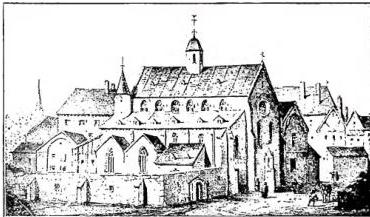
CONGREGATION OF THE MISSION – The old Saint-Lazare (17th century), the first mother house of the Congregation of the Mission – Paris.
CONGR. DELLA MISSIONE - CONGR. DELLA RESURR. DI N.S.G.C.
marked an era. Two of the martyrs, Francesco Régis Clet (1748–1820) and Giovanni Gabriele Perbore (1802–40), have been raised to the honors of the altars. In 1780 they took over the direction of the seminary of Goa, where they remained until 1830. In 1922 they accepted the mission of Cuttak, which was raised to a diocese in 1938. More recent are the flourishing mission of Java (1928) and the beginnings of those in Annam (1938) and Japan (1948).
In Africa, besides the missions of Barbary and Madagascar, the name of b. Giustino de Jacobis (1800–60) remains associated with Abyssinia; he arrived there with other confrères in 1839 and spent his entire life there. Among his disciples was a martyr, b. Ghebre Michael (1788–1855). At his death he left flourishing Christian communities and magnificent works, including the Immaculate Conception seminary of Guala and a fine group of indigenous priests. The mission continued through alternating fortunes and enormous difficulties, and today, besides safeguarding De Jacobis’s tomb at Hebô, it has houses in various parts of the Ethiopian Empire. Another flourishing mission in Africa is the Belgian Congo (1926).
The origins of the C. in America are linked to another Italian, Felice De Andreis (1778–1820), who arrived there with other confrères in 1816 and settled in St-Louis. There are now two provinces in America, with more than 40 houses and 600 members, devoted to directing 12 seminaries, 3 universities, some thirty parishes, missions, and retreat work. Canada received the Vincentian missionaries in 1933. Mexico promises a sure recovery after the persecution of 1926. All the nations of Latin America have broadly welcomed the Sons of S. Vincenzo during the last century: Cuba (1847), Guatemala (1862), Puerto Rico (1873), Costa Rica and Panama (1877), El Salvador (1898), Honduras (1910), Nicaragua (1935); in addition, Brazil (1819), with approximately 50 houses, Chile (1853), Peru (1858), Argentina (1859), where the missionaries have been entrusted with the famous national shrine of Our Lady of Lujan, Ecuador and Colombia (1870), Paraguay (1880), Uruguay (1884), Venezuela (1932), and Bolivia (1933). Finally, the Philippines (1862), where the Vincentian missionaries direct almost all the seminaries, Australia (1855), and New Zealand (1934).
III. THE C. IN ITALY. — The first missionary sent by S. Vincenzo to Italy in 1638 was Luigi Lebreton, charged with obtaining the pope’s approval of the C.; he opened its first house in Rome in 1641. As their numbers increased, the missionaries spread through the dioceses around Rome, bringing about a marvelous revival of religious life. Through the munificence of the duchess d’Aiguillon and Card. Bagni, a «House of the Mission» arose at Montecitorio in 1659 for retreats for the clergy and especially for candidates for ordination. Alessandro VII encouraged them and prescribed in 1662 that no candidate for ordination might receive Holy Orders without first making a retreat of at least 10 days at the «Mission».
Innocenzo XII extended the obligation of a retreat every three years to the parish priests of Rome in 1699. From 1659 to 1814, the missionaries of S. Vincenzo had the spiritual direction of the College of Propaganda Fide, and from 1703 to 1738 that of the Accademia dei Nobili ecclesiastici. In 1646 Stefano Blatiron (1614–57) founded the house of Genoa at the request of Card. Stefano Durazzo. Through the efforts of the marquis of Pianezze, first minister of Piedmont, the missionaries settled in Turin in 1655 and, thirteen years later, through the initiative of the priest Giovanni B. Balsamo, in Naples.
The foundations in Italy continued to grow at an increasing pace in the following centuries, eventually reaching 80. In Piacenza, Card. Giulio Alberoni founded the Alberoni College in 1732 for the poor seminaries of the diocese; it still continues the munificence of its founder. In 1703 the sole Italian province was divided into two: Rome and Lombardy; after 1815 that of Naples was added, with 40 houses. The house in Rome, the seat of the Pontifical liturgical academy since 1840, disseminates the study of the liturgy through the journal Ephemerides liturgicae (founded in 1887 by Calcedonio Mancini); Piacenza contributes to the knowledge of philosophy and theology through Divus Thomas (founded in 1880). These works are complemented by the Foreign Missions: the diocese of Kian in China, the mission of Tigrai in Ethiopia, and that of Korça in Albania. The Italian provinces also have various houses in the United States of America for the assistance of Italian emigrants.
Italy has given distinguished men in virtue and apostolic zeal. Besides the b. Giustino de Jacobis, Giuseppe Rosati, Felice de Andreis, Marcantonio Durando, Vincenzo Spaccapietra and, closer to our own time, Giovanni B. Manzella, the «apostle of Sardinia», should be remembered.
Special mention must be made of Giovanni Boccardi, astronomer, born at Castelmauro (Campobasso) on 20 June 1859 and died at Savona (where he had retired in 1923) on 21 October 1936; he entered the C. della M. in 1879. As soon as he became a priest (1884), he was sent to the East to teach mathematics at the colleges of Salonico and Smirne. During this period he began his first studies in astronomy. Returning to his homeland (1892), after several years of teaching at Acireale, he went to the observatory of the Collegio Romano (1897) to learn the practical methods of calculating planetary orbits; in 1898 he was appointed to the Specola Vaticana, and two years later (1900), in order to perfect his training, he went to the «Bureau des Longitudes» in Paris and to Berlin. On 10 November of the same year he was appointed assistant and head of section at the observatory of Catania. In 1903, with his appointment as director of the observatory and professor of astronomy at the University of Turin (1903–1923), the period of his greatest scientific activity began. He renewed and transferred the old observatory from Palazzo Madama to Pino Torinese (1910–1913). Among his most important discoveries are: the observation of the phenomenon he called equazione di trasparenza; the tide of the earth’s crust caused by lunar attraction; the diurnal variation of latitude; and new methods for solving the transcendental equations of Kepler and Gauss. In addition, he had to his credit 30,000 celestial observations, two star catalogues, 14 volumes, and 409 memoirs, notes, and articles summarizing scientific research. From 1905 he worked on the Annuario astronomico, through which he brought Italy into the work of the Effemeridi astronomiche. The first among Italians, he became a member of the «Bureau des Longitudes» of Paris (1921) and of the «Washington Academy of Sciences» (1928). In 1906 he founded the «Società astronomica italiana» and the «Rivista di astronomia»; but when, owing to the intrigues of Freemasonry, these two institutions deviated from their scientific purpose, he abandoned them and established (1911) the society «Urania» and the journal Saggi di astronomia popolare, which he directed until 1917 (cf. Annali d. missione, 44 [1937], pp. 37–48 and 475–504, with a list of the works).
Several notable and important associations depend upon the C., such as the Dames della Carità, the Figlie di Maria Immacolata, etc. Directly connected with the C. is, by an institution sanctioned by pontifical authority, the Compagnia delle Figlie della Carità, whose superior is the same superior general as that of the C.
As of 1 January 1949, the C. was divided into 37 provinces, with 456 houses, 5299 members, 105 seminaries, 90 retreat houses, 170 parishes, and 150 schools.
293 CONGR. DELLA RESURR. DI N.S.G.C. - CONGR. DEL S.MO REDENTORE 294
through the work of Bogdan (Adecodato) Janski, a Pole, who, having repented of Saint-Simonism, had devoted himself to the apostolate among his fellow countrymen, living in community with Pietro Semenenko, Girolamo Kajsiewicz, and other disciples. Semenenko and Kajsiewicz were sent to Rome in 1837 to study theology there; he himself came in 1840 and died there on 2 July of that same year. His companions and disciples continued his work, and on 27 March 1842, the day of the Resurrection of Jesus Christ, the rule having already been drawn up, Semenenko was chosen as the first superior general, and the first religious vows were professed in the catacombs of S. Sebastiano.
The C., which spread through Poland and other countries, received the decree of praise on 9 October 1860 and was approved on 10 March 1888. The constitutions were definitively approved on 5 March 1902. Its purpose is the apostolic ministry in parishes and colleges, permeating education with religious truths and informing the whole moral and civil life of the young. The following distinguished themselves: Fr. P. Semenenko, as a theologian and ascetical writer; Fr. Kajsiewicz, as a preacher; Fr. Kalinka, as a historian of Poland; Fr. Pawlicki, as a historian of philosophy and an apologist; Fr. L. Funken, as a pedagogue; Fr. E. Funken, as a poet; and Fr. Smolikowski, as a historian of the C. and an ascetical writer. The C., widespread in Italy, Poland, Switzerland, Bulgaria, and America, now numbers 41 houses with more than 600 religious.