
CECOSLOVAKIA. -
I. GEOGRAPHY
The Czechoslovak state was born in October 1918 from the dismemberment of the Austro-Hungarian monarchy and organized itself as a unitary, representative republic, formed by the following countries: Bohemia (52,062 km²) with 6,700,000 inhabitants, Moravia (22,221 km²) and Silesia (4,271 km²) with 3,300,000 inhabitants, formerly Austrian territories; Slovakia (49,006 km²) with 3,000,000 inhabitants and Carpathian Ruthenia, also called Subcarpathian Ruthenia (Carpathian Ruthenia, 12,617 km²) with 600,000 inhabitants, belonging to the Crown of Hungary, and a small strip of Upper Germanic Silesia (316 km²). When its independence was proclaimed, Czechoslovakia thus encompassed 140,493 km² with 13,600,000 inhabitants, which by the beginning of 1938 had risen to 14,700,000, and undoubtedly constituted, among all the new states formed from the collapse of the dual monarchy, the one economically most stable and viable.The German defeat in the Second World War led, in May 1945, to the reconstitution of the Czechoslovak state within the 1937 borders; but in July of the same year, the U.S.S.R., whose troops occupied the country, annexed Carpathian Ruthenia (12,617 km² with 725,000 inhabitants) to Ukraine, so that the Republic of Czechoslovakia today extends over 127,765 km² with 13,000,000 inhabitants. The ethnic composition of the state has profoundly changed due to war losses and the expulsion of the Germans, but fully reliable figures are not yet available in this regard.
The geographical structure of the Czechoslovak state highlights its character as a transition between the highly industrialized countries of Central Europe and those still typically agricultural of Eastern Europe. The great variety of aptitudes of the natural and historical regions that compose it—only 36% of the population in Bohemia is dedicated to agriculture,
while industry is far less developed, and with a completely different character (craftsmanship), in Moravia and Silesia, and Slovakia is outright an agricultural country—guarantees Czechoslovakia a certain economic solidity, as evidenced by the fact that, once the turmoil of war had passed, equilibrium rapidly tends to re-establish itself and the economic balance has again become active. It is not easy, however, to foresee what consequences may arise from the integration of the Czechoslovak state into the Soviet political-economic system.
Within its new borders, Czechoslovakia retains, in essence, its excellent industrial infrastructure, which benefits, in a devastated Europe, from the eliminated German competition. The population density (105 inhabitants per km² in 1946) has increased compared to the pre-war period; the capital, Prague, has become a metropolis (nearly one million inhabitants at the same date), and four urban centers now exceed 100,000 inhabitants: Brno (267), capital of Moravia, Moravská Ostrava (176), Bratislava (or Pressburg, 138), former capital of the independent Slovak state, and Plzeň in Bohemia.
The population is overwhelmingly (more than two-thirds) Catholic of the Latin rite. Other Christian churches account for 15%, Jews for 2.6%, and the non-religious for 5.2%. These figures are prior to the Second World War.
II. HISTORY
The history of Czechoslovakia begins on 28 October 1918, when civil and military powers were assumed by the "National Committee": from the defeat of the Central Powers and the collapse of Austria-Hungary, the Czechoslovak Republic had indeed emerged. Numerous Czechoslovak "legionaries" had fought alongside the Entente troops, and the new State thus found itself among the victors.
From the outset, the new State had to overcome not a few resistances, constituted by the large German and Magyar minorities included within its borders: even among the Slovak population, oppositions emerged, partly due to autonomist tendencies, partly to political and religious motives. Strong social unrest was caused by the particular post-war situation and economic difficulties connected with the dismemberment of the Austro-Hungarian Empire. However, the democratic regime soon strengthened. Communist extremism diminished, and even the significant allogenous minorities were, at least in part, integrated into the political life of the State, participating in the government.
Masaryk and Beneš were the most prominent figures in Czechoslovak political life. The Czech national movement, however, was permeated in some of its currents by anti-Catholic tendencies: this attitude brought together Hussite traditions, historical reminiscences, and elements of contingent politics. Thus, a strong tension arose between the Holy See and the Czechoslovak government following the latter's participation in the commemorations of Hus (1925).
In a democratic climate, strongly imbued with socialist reformism and secularism, Czechoslovakia, supported by the French alliance and economically prosperous due to the country's considerable wealth, enjoyed a long period of peace. This situation changed profoundly with the resurgence of German power and the rapid rise of National Socialism.
The gradual withdrawal of French policy in Eastern Europe was not compensated by the new Czechoslovak friendship with the U.S.S.R., which was primarily concerned with its own particular problems. In the territories inhabited by the German population, a violent agitation for annexation to the Greater Reich began under the leadership of K. Henlein. Even in Slovakia, opposition to the Prague government became harsher and more intransigent. In the autumn of 1938, following the Munich Agreements and their developments, Czechoslovakia, from a multinational State, had become a State composed of Czechs and Slovaks: Germany occupied almost all the territories inhabited by Germans; Hungary pushed its borders northward, and on 4 April 1939, it annexed all of Carpathian Ruthenia. Poland also annexed a piece of Silesia.
The Czechoslovakia that emerged from the Munich Agreements had, however, a short life. Some local incidents between Czechs and Germans served as a pretext for Hitler to deal the final blow to Czechoslovakia, while pro-Nazi currents in Slovakia openly sought to create an independent Slovak State. Meanwhile, Hitler summoned the President of the Czechoslovak Republic, E. Hácha: the weak president was forced to "spontaneously" place the fate of the Czech people in the hands of the German Führer. German troops occupied the Czech capital on 15 March 1939. Simultaneously, Slovakia, under the leadership of Tiso, Tuka, and Mach, became an independent State under German protectorate.
The Czechoslovak government expelled almost all Germans and Hungarians living in its territory. Under the high direction of Beneš, a coalition government was formed.
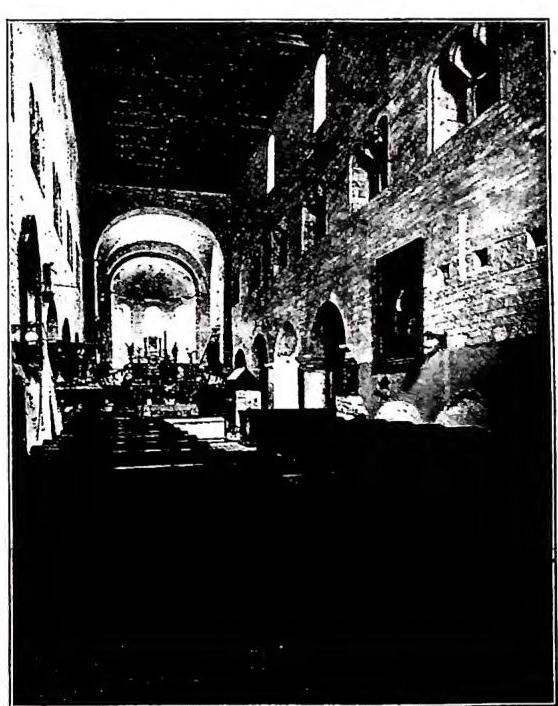
CECOSLOVACCHIA - Interior of the Church of St. George (mid-12th century) - Prague.
For some time, it seemed that, in terms of foreign and domestic policy, the Czechoslovak government could maintain a certain middle ground between Russia and the West. However, Russian pressure became increasingly relentless, culminating in the demand that Czechoslovakia not adhere to the Marshall Plan. The Communists gradually seized all the main levers of power, under the pretext of "defending democracy." The 1946 elections had left the Communists in a clear minority (they were even soundly defeated in Slovakia). But in February 1948, they violently seized power: this act of force roughly coincided with the tragic death, under mysterious circumstances, of the son of the first president of the Czechoslovak Republic, Jan Masaryk.
Once a totalitarian regime was established, opposition parties were suppressed, and Czechoslovakia fully entered the political climate of Eastern Europe. A violent anti-religious campaign was unleashed against the Church. Already in 1925, the honors decreed to the heretic Jan Hus had created difficulties between the republic's government and the Holy See, later resolved in 1928 through a Modus vivendi accepted by both parties (cf. AAS, 20 [1928], pp. 65-66). But now the totalitarian government not only violated the Modus vivendi but went much further with the nationalization of schools, the suppression of the Catholic press, and the oppression of genuine Catholic Action, organizing instead a schismatic one. Against these and other violations of the Church's rights, the voice of the entire episcopate rose, particularly against the thinly veiled attempt to provoke a religious schism. The schismatic Catholic Action was condemned by the Holy See on June 20, 1949 (AAS, 41 [1949]). Czechoslovakia now has two metropolitan sees (Prague and Olomouc) and 10 episcopal sees (Budějovice, Hradec Králové, Litoměřice, Brno, Neosolio, Nitra, Prešov of the Ruthenians, Scepusio, Cassovia, Rosnavia). Additionally, there are two apostolic administrations: that of Trnava and that of the parishes of the diocese of Szatmár located in Slovakia.
The oldest Czech literary documents date from the Christian era. Under Prince Moravian Rastislav, Constantine and Methodius arrived from Byzantium, bringing Eastern customs and the Slavic ecclesiastical language (a Bulgarian dialect from the region of Thessalonica). Constantine created the Glagolitic alphabet based on the Greek minuscule script, and Methodius’ disciples, thirty years later, developed the Cyrillic alphabet from the Greek majuscule. Of the translations of liturgical books and parts of Scripture into Old Slavonic, the Kyjevské listy (from the place where they were found) have survived, representing a Slavic translation of Latin Mass books. The so-called Pražské zlomky, a translation of a Greek Mass book, date back to the 11th century (Sázava Monastery). The Czech origin of these documents is indicated by certain Bohemianisms (e.g., the Czech e instead of the Old Slavonic št: noc instead of nošt). After Methodius’ death (885), his disciples were persecuted and moved to Croatia and Bulgaria. The Slavic liturgy gradually disappeared, persisting only in the Sázava Monastery. Subsequently, under Western influence, Latin became not only the liturgical language in Bohemia but also the language of scholarship and literature. Kosmas’ Kronika, written in Latin, was composed by the dean of the Prague chapter (d. 1125) and narrates events from the Tower of Babel to the author’s time. Kosmas drew inspiration from the style of Roman annalists and, in the manner of Livy, inserted invented speeches. The first attempts at a literature in Czech were glosses on church texts and hymns such as Hospodine, pomiluj ny ("Lord, have mercy on us"), which, according to Jakobson, dates back to the 11th century, and the Píseň Svatováclavská (of a later date), addressed to the patron saint of the Czech land.
One of the central works of the Czech Middle Ages is the Alexandrie. Following French (Gautier de Châtillon) and German (Ulrich von Eschenbach) models, an unknown author composed a Czech Alexandrie around 1310. He portrayed Alexander as a Christian king fighting against the infidels, his warriors as a chivalric host in the spirit of the Crusaders. Another chronicle of great interest is that of Dalimil, which reveals a patriotic impulse against the Germanization of the country attempted by the last Přemyslids.
The German element had penetrated public life and destiny: even Wenceslas II wrote poetry in German. The author of the chronicle (Dalimil is a fictitious name) sought to warn the nobility of his time with examples from the past, having Czech princes deliver patriotic tirades. Despite his distrust of foreign customs, he wrote his chronicle in verse, following the example of German chronicles. Medieval Czech drama also arose from church rites. Gospel dialogues were performed dramatically. Several fragments have survived, including the drama of the Three Marys, Passion plays, and, in the secular genre, the Mastičkář (The Quack), in which a charlatan offers ointments and praises them in fairground fashion (a parody of the quackery of certain physicians, possibly influenced by French models).
The reign of Charles IV (1346–78) marked the peak of Bohemian Gothic culture. He founded the university (1348), promoted the arts, and cherished the "dear Czech language." From this period date the didactic verse composition Nová rada (New Counsel) by Smil Flaška z Pardubic and the anonymous debate Podkoní a žák (The Groom and the Student). The sovereign’s interest in the past spurred many annalists to work, and Charles IV himself wrote his biography in Latin. One of the first students of the Prague university, Tomáš Štítný ze Štítného (1335–1405), wrote on religious topics no longer in Latin but in a Czech enriched with popular expressions, attempting to popularize Christian doctrine. His work Řeči besední (Conversations), for example, takes the form of a dialogue between father and son and discusses God, the mysteries of faith, redemption, and repentance. Most of Štítný’s writings, so medieval and typically scholastic, are derived or translated from Latin texts. With his ethical and preaching fervor, he paved the way for Hus.
Jan Hus (1369–1415) wrote theological treatises in Latin that were essentially paraphrases of Wyclif’s radical theories, but he is more important as a writer in the Czech language. He reformed orthography, promoted Czech religious singing, introducing it into churches, and set an example of the new written language, based on the living speech of the people. After Hus’ death, the ascetic spirit of his followers assigned religious and educational tasks to literature. The Bible and moralizing writings and postils became the center of interest. The Hussites cultivated religious singing in Hus’ footsteps. From this period dates the chorale Kdož jste Boží bojovníci (Ye Who Are God’s Warriors), usually attributed to the leader Jan Žižka z Trocnova. A great utopian reformer was Petr Chelčický (d. 1460), author of Postila and Sieť víry pravé (The Net of True Faith). According to Chelčický, the good Christian does not fight, not even in self-defense, and rejects science as a diabolical invention. Chelčický advocated a return to evangelical simplicity, opposed the union of temporal and spiritual powers, proclaimed non-resistance to evil, and even condemned the Hussite wars. Some have seen in his thought a foreshadowing of Tolstoyan theories. With his rural-based radicalism, Chelčický distrusted merchants and exalted the work of the peasant.
Later, Humanism brought Bohemia back onto the European stage, out of the isolation imposed by the Hussite movement. A typical example of Bohemian Humanism was Viktorin Kornel ze Všehrd (d. 1520).
During the reigns of Ferdinand I and Maximilian II (1526–1576), Václav Hájek z Libočan (d. 1558) stood out as the author of a chronicle with a Catholic orientation, full of imaginary episodes and fictitious events, a book that became one of the Romantics’ favorite readings. Jan Blahoslav (1523–71) translated the New Testament, worked on grammar, and wrote the first Czech theoretical book on singing. From the reign of Rudolf II (1576–1620) should be mentioned the Kralická Bible, a translation by scholars in which the written language was codified in a felicitous balance of popular speech and literary forms. The historian and publisher Daniel Adam z Veleslavína (d. 1599), however, wrote in a Latinate style, still under the influence of Humanism.
After the Battle of White Mountain (8 November 1620), Bohemian literature entered a period of crisis. In exile lived and worked Jan Amos Komenský (1592–1670), whose writings can be divided into two groups: treatises of religious content (such as Labyrint světa a ráj srdce) and pedagogical works. Komenský sought to unite all human disciplines and knowledge, hitherto dispersed, into an organic whole of encyclopedic character, which he called pansophia. During the Thirty Years’ War, Komenský dreamed of harmony among all peoples and world peace. Among the priests who aimed to bring Bohemia back into the fold of the Church were some with patriotic tendencies, such as the Jesuit Bohuslav Balbín (d. 1688), a benefactor of the Czech language. Other Jesuits should also be remembered for their contributions to popular religious poetry (B. Bridel, F. Kadlinský), the homiletic works of Fabián Veselý and Leopold Fabricius, and later the new edition of the Bible, known as the Bible svatováclavská, produced by the Jesuits M. Šteyer, J. Konstanc, and J. Barner. For the upper classes, Czech became a dead language. The šlechta (nobility) used German, and scholars used German or Latin; only the peasants preserved their native tongue.
the empire" to Enlightenment and reformist tendencies. The first prominent figure of the Czech revival is Josef Dobrovský (1753-1829), philologist and patriarch of Slavic studies, author of the Ausführliches Lehrgebäude der böhmischen Sprache, the Deutschböhmisches Wörterbuch, and the Geschichte der böhmischen Sprache und Literatur. He wrote primarily in German and Latin and, as a true Enlightenment thinker, displayed skepticism toward the future of the Bohemian language, convinced that Czech culture was merely a monument of the past, worthy of scientific investigation but no longer capable of producing literature of European stature. For this reason, he was labeled a "Half-Bohemian" (Poločech) and a "Germanizing Slav" (slavisierender Deutsche) by the Romantic generation, which recognized its leader in Josef Jungmann (1773-1847). Jungmann, through his translations of Milton and Chateaubriand, laid the foundations of poetic language and the new Czech prose and compiled a Bohemian-German dictionary in five volumes.
Among the figures of the first Romantic school, Matěj Milota Zdrad Polák is remembered as the author of the descriptive poem Vznešenost přírody (The Sublimity of Nature).
(fot. J. Štenc)
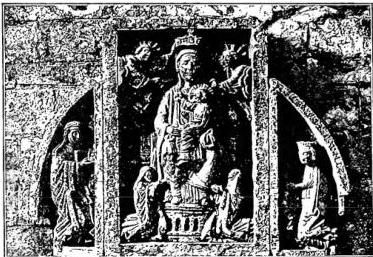
CZECHOSLOVAKIA - Madonna Enthroned with Donors. Relief in the Church of St. George (ca. 1225) - Prague.
(The Sublimity of Nature); Jan Kollár (1793-1852), who in his poem Slávy dcera (The Daughter of Slava), composed in sonnets, drew inspiration from Dante and Petrarch, imagining a journey through the ancient lands inhabited by the Slavs up to an imaginary heaven and a Slavic Acheron; František Ladislav Čelakovský (1799-1862), who, following the Herderian model, collected folk songs from all Slavic countries in three volumes and created, in the style of popular song, remarkable lyrical miniatures in Ohlas písní ruských (Echo of Russian Songs) and Ohlas písní českých (Echo of Czech Songs); Václav Hanka (1791-1861), who, together with Josef Linda (d. 1834), fabricated a colossal forgery of "manuscripts" (Rukopis Králové-dvorský and Zelenohorský), attributed to very distant eras (the time of Samo, the supposed defeat of the Tatars near Olomouc, etc.). A scholar of great stature was the Slovak Pavel Josef Šafářík (1795-1861), who, with his Slovanské starožitnosti, founded Slavic archaeology, also preparing the ground for historians, among whom František Palacký (1798-1876) stood out as the champion, author of Dějiny národu českého v Čechách i v Moravě (History of the Czech People in Bohemia and Moravia), in which the spirit of the Enlightenment blends with Romantic enthusiasms. Among the many followers of Čelakovský, imitators of popular song, Josef Jaroslav Langer is remembered for his satires Bohdanecký rukopis (Manuscript of Bohdaneč) and Den v Kocourkově (A Day in Kocourkov), in which he mocked his native land and its provincial customs. Among the Catholics of the Revival period, F. J. Vavák, F. M. Pálcl, and the priests B. M. Kulda, B. Jablonský, and F. Sušil, a great biblical exegete and collector of Moravian folk songs, are worthy of mention. Romantic drama in Bohemia boasts the names of Václav Klement Klicpera (d. 1859) and Josef Kajetán Tyl (1808-56). The greatest poet of the first quarter of the century is Karel Hynek Mácha (1810-1836), who, influenced by Byron, marked the beginning of the new Czech poetry with his poem Máj (May), rich in melodic suggestions and dramatic tension. The first Czech journalist of national significance was Karel Havlíček Borovský (1821-56), who created Bohemian political satire in his three poems Křest svatého Vladimíra (The Baptism of St. Vladimir), Tyrolské Elegie (Tyrolean Elegies), and Král Lávra (King Lavra). Following the path opened by Čelakovský, Karel Jaromír Erben (1811-70) composed his Kytice (The Bouquet), a collection of ballads drawing from Slavic mythology and the Christian morality of the people.
The first great Bohemian woman writer was Božena Němcová (1820-62), who, in addition to valuable folkloric works and various short stories, composed the enchanting family chronicle Babička (The Grandmother), a series of scenes from popular life and nature. In 1858, a new poetic generation gathered around the almanac Máj: among its members were
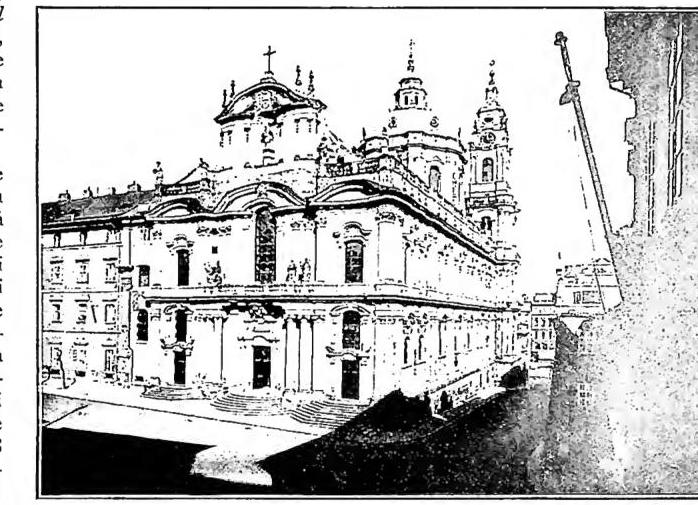
CZECHOSLOVAKIA - Exterior of the Church of St. Nicholas in Malá Strana. Work by Christoph and Ignaz Kilian Dientzenhofer (1703-55) - Prague.
and Lev Lvovic (d. 1871) and Karel Hlaváček (d. 1898). Symbolism was represented by the mystic Otakar Březina (1868-1929) and Impressionism by Antonín Sova, poet of the landscape of southern Bohemia. In the first decades of the twentieth century, the initiator of the new Czech criticism, F. X. Šalda (1867-1937), the poets Viktor Dyk (1877-1931), Stanislav Kazimír Neumann (1875-1947), Karel Toman (1877-1946), Otakar Theer (d. 1917), and the novelist Božena Benešová (1873-1936) emerged. After the First World War, avant-garde tendencies spread, such as "Poetism" (echoing Surrealism), represented especially by Vítězslav Nezval and Jaroslav Seifert. Among the other poets of European stature who emerged in recent decades, Jiří Wolker (1900-24), Josef Hora (d. 1945), František Halas, and Vladimír Holan deserve mention. Among prose writers: Jaroslav Hašek, the eccentric author of the adventures of "The Good Soldier Švejk," Karel Čapek (1890-1938), writer of utopian novels, detective stories, and travel impressions, Vladislav Vančura (1891-1943), who grounded his novels in the cult of the word and harked back to the prose model of the humanists, and finally the Catholic writer of broad scope Jaroslav Durych (b. 1886). Among contemporaries, some representatives of the Catholic current deserve to be named; in the field of poetry: Josef Zahradníček, Jakub Deml, Jan Dokulil, Jan Lazecký, Václav Renč, Albert Vyskočil; in the field of prose: Karel Šulc, Jan Čep.
V. the collections of Eastern Europe (from 1921) and of the Rivista di letterature slave (from 1926)
J. V. Novák-A. Novák, Přehledné dějiny české literatury, 3rd ed., 1922; Pallas-Zelinka, Obrazové dějiny literatury české, 1926; Váša-Gregor, Katechismus dějin české literatury, 1927; L. Salvini, Il corallo di s. Venceslao, La poesia religiosa presso gli Slavi, I. Brescia 1942; A. Novák, České písemnictví a patří perspektivy, 3rd ed., 1947; J. B. Čapek, Profil české poezie a prozy od roku 1918, 1947; id., Záření ducha a slova, 1948.Angelo Maria Ripollino
IV. SLOVAK LITERATURE
Slovak literature is recent, insofar as a true literary language began only with A. Bernolák (1762-1813), a Catholic priest. Bernolák established the fundamental rules of Slovak orthography in a study entitled Linguae slavicae per regnum Hungariae usitatae compendiosa simul et facilis ortographia (1787). In 1795, Bernolák founded in Trnava a literary association, the Erudita societas slovacca, around which the entire Catholic cultural and spiritual world gathered. The separation of the Slovak literary language from the Czech one signified the detachment of the great majority of the population, composed of Catholics. A determined will to draw closer to the people lay at the foundation of this assertion of linguistic and national autonomy. The first Slovak poet, Jan Hollý (v. 1785-1849), was a priest: he was also a skilled translator of the Aeneid and wrote poems imbued with Pan-Slavic ideas.At the origin of the Slovak linguistic secession, there also emerged the will to defend against governmental attempts at Magyarization, the intention to affirm a "Slovak" consciousness, as opposed to a "Czechoslovak" conception, deemed abstract and not corresponding to historical, moral, and linguistic reality.
A characteristic exponent of the Slovak literary "Risorgimento" can be considered Ľudovít Štúr (1815-1856). The language he used diverged from that of Bernolák. With his poetry, several inspirations drawn from folk songs were affirmed; to this tone of Romanticism with a predominantly folkloric background, another Romanticism with a historical-political background was counterposed: in short, with Štúr and his disciples, the penetration into Slovakia of "Slavophile" Russian ideas began: the Slavic world in general and Russia in particular were contrasted with the West; in the Slavic world, one sought to see youthful creative freshness, religious depth, a peaceful and democratic spirit; following Herder, a radiant future was predicted for the Slavic world, while the West, in the eyes of these enthusiastic "Slavs," through hasty Romantic schematizations of Russo-schismatic origin, appeared more or less irreparably fallen into hedonism and materialism. Even in the face of the Western and "European" Prague, an accent of more marked Slavic autochthonism was sought to be emphasized. Among Štúr's disciples and followers, Samo Chalupka (1812-1883) deserves particular mention. A notable poet, he was sometimes able to be so. The restless Janko Král (1822-1876), an exponent of typically nineteenth-century patriotic and revolutionary tendencies and also characteristic for certain "avant-garde" hints in his lyric poetry, which appeared, in a certain way, "pre-Impressionist," was also a remarkable poet. Great fame was achieved by Jan Botto (1829-1881), author of a poem entitled Smrt' Jánosíková (The Death of Jánosík). In the exaltation of Jánosík (a brigand romantically idealized), Botto succeeded in felicitously blending various elements of folk poetry. Andrej Sládkovič (pseudonym of Braxatoris, 1820-1872), while reconnecting to some tendencies of Štúr, vigorously and originally sensed the Slovak landscape and folk traditions, surpassing the limits of folklorism and provincial art. Svetozar Hurban Vajanský (1847-1916), an interesting and sometimes paradoxical figure of politician and writer, instead underlines, by resuming and in a certain way modernizing them, the Slavophile hints of Štúr: an enthusiastic admirer of Tsarist Russia, he spared no barbs for democratic and bourgeois Prague. In his stories of Slovak life, vigorous elements are not lacking. Among Catholics, the literary and cultural movement led by F. R. OSVALDO, SANTO (v.), which in a certain way reconnects to Bernolák, deserves particular mention. However, two writers hold particular importance in modern Slovak literature: Pavel Ország Hviezdoslav (1849-1921) and Martin Kukučín (1860-1928). The former possessed a broad horizon of Western culture and was also a passionate student of Dante. Among his works, a robust and lively epic-lyric piece is remembered: Hájnikova žena (The Gamekeeper's Wife), as well as his religious songs. Martin Kukučín (pseudonym of Matej Bencúr) is the most notable of Slovak novelists and short-story writers: his novels reflect, with European sensitivity, characteristic aspects of Slovak life. One of his most ambitious novels is inspired by Dalmatian life.
A notable cultural activity (literary, artistic, linguistic, folkloric) was carried out for several decades by the Matica Slovenská, the principal center of the Slovak national awakening, based in Turčiansky Svätý Martin. The Matica Slovenská experienced particular development after the formation of the Czechoslovak state (1918). In the field of Catholic culture, the Society of St. Adalbert (Spolok Svätého Vojtecha), founded in 1870, exercised particular importance.
In the period between the two world wars, Milo Urban, born in 1904, gained considerable fame, author of a broad work, Živý bič (The Living Whip), a narrative of the life of a Slovak village during the First World War. Already after 1918, a Marxist tendency began to emerge in part of Slovak literature. To the "fathers" of Sla-
(fot. J. Štenc)
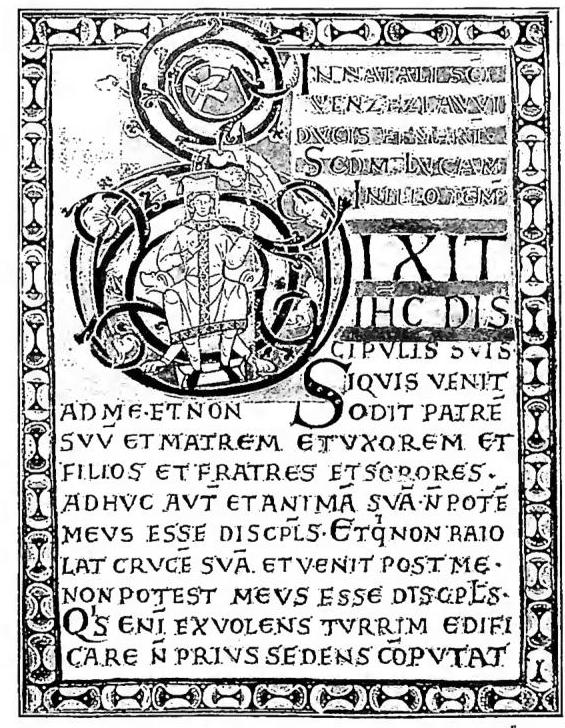
CZECHOSLOVAKIA - The Coronation Evangelary. Illuminated initial with St. Wenceslas (ca. 1083). Prague, University Library.
The end of the Second World War, however, was to have strong repercussions on the literary and cultural life of Slovakia as well. The Marxist current, though remaining a minority, strengthened, managing to occupy important leadership positions in the educational, cultural, and journalistic fields. This position of predominance has further strengthened in recent times, following political events that have placed Czechoslovakia within the Soviet orbit. Due to communist pressure, which has ultimately suppressed all independent literary tendencies, numerous Czech and Slovak writers have been forced to abandon their homeland. Among the latter, the aforementioned Hronsky is remembered, who, during his stay in Italy, artistically drew inspiration from the Roman environment, as well as F. Hrušovský, M. Šprinc, K. Strmeň, and S. Mečiar. Various Slovak literary publications appear in the United States.
V. ART
The earliest artistic manifestations in the territory of the Czechoslovak Republic are linked to Christianity. However, of the first Latin mission, arriving from the West, as well as of the mission of SS. Cyril and Methodius, who came from the Levant in 863, no artistic monuments remain, only literary references to churches likely built of wood. It appears that the first masonry church was erected (between 926 and 929) by Prince St. Venceslao: a relatively large rotunda with four apses. This building, an important Carolingian architectural monument, represented for the country not only the church of the saintly prince’s residence but also the resting place of his remains and, after 973, the cathedral of the Bishop of Prague, serving as the prototype of the Christian church. Indeed, in the following period, churches built on this model were erected by feudal lords and, later, even in villages. Toward the end of the 10th century, with the foundation of the monastery of St. George, the first three-aisled church with galleries arose in Prague. The further development of Romanesque architecture enriched the Bohemian territory with both centrally planned churches and single- or three-aisled churches, often of considerable size.In Slovakia, too, a significant number of churches bearing the marks of the Romanesque era arose in the 12th century. Romanesque art continued to dominate there during the following century.
Around the mid-13th century, the pioneers of Gothic architecture, the Cistercian monks, arrived in the territory. After 1300, Gothic forms became commonly used both in churches administered by the mendicant Orders and in others being built in the cities. In Bohemia, the apogee of Gothic is represented by the construction of the cathedral of St. Vitus.
CZECHOSLOVAKIA — Madonna Enthroned with Archbishop Donor (c. 1350) — Berlin, State Museum.
in Prague. Charles IV entrusted this undertaking in 1344 to the French architect Matthias of Arras and, after his death in 1352, to Peter Parler, who introduced the Flamboyant style into his edifice. This style reached its peak in the church of St. Barbara in Kutná Hora and was used until the mid-sixteenth century; indeed, even at the end of that century, buildings in the late Gothic style continued to rise. In Slovakia, Gothic architecture triumphed in the church of St. Elizabeth in Košice (15th century).
Sculpture, whose earliest manifestations in Bohemia date back to the 12th century, reached a remarkably high level there in the second half of the 14th century, particularly through the work of the masters employed at Prague Cathedral. Their works include the statue of St. Wenceslas, the tombs of the kings of Bohemia, and the busts in the triforium of the Cathedral.
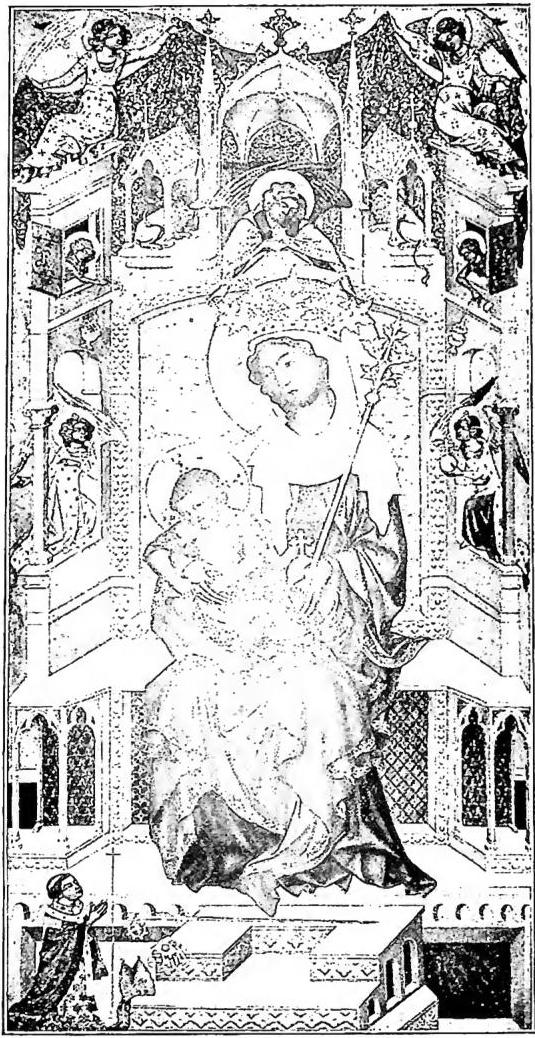
During the reign of King Charles IV, in the second half of the 14th century, the arts flourished widely in Bohemia; however, this was abruptly interrupted in 1420 by the Hussite wars, during which frequent outbreaks of true iconoclasm occurred.
Once peace returned, a period of late Gothic revival followed until the early 17th century, when the first manifestations of the Baroque style appeared. The extraordinary diffusion of this style is primarily due to Italian architects who worked in the region, such as those belonging to the Luraghi and Orsi families, and to the architects of the Jesuit Order. Essentially through their efforts, after the Battle of White Mountain (in 1620), new churches and colleges arose. Among the particularly significant artists of that period, the Romanized architect Giovanni Battista Mathey (1630-95) should be mentioned. The flourishing of sacred architecture in the Baroque period was also greatly contributed to by Christoph Dientzenhofer (v. d. 1722) and his son Kilian Ignaz (v. 1690-1751), who, however, after an initial period in which he followed Guarini, adopted Borrominian forms. A curious interpretation of Gothic forms is offered by Jan Santini (1667-1723). Among the host of excellent sculptors of the Baroque period, Ferdinand Maximilian Brokoff (1688-1731) and Matthias Bernhard Braun (1684-1738) stand out. Among the painters in Bohemia, Karel Škréta, trained in Italy (1610-74), Petr Brandl (1668-1735), and the fresco painter Václav Vavřinec Reiner (1689-1743) are remembered; in Moravia, Jan Jiří Etgens (1693-1754) and Josef Jan Winckler (1743-1807).
Meanwhile, in Slovakia, a series of masters worked, Donner (v.), whose activity took place there between 1728 and 1739.
The Nazarene school found its most prominent representative in the painter F. Tkadlík (1786-1840) and had a certain influence on the work of the sculptor Václav Levý (1820-70), trained in Rome. The greatest Bohemian painter of the last century, Josef Mánes (1820-71), contributed to church decoration, and the most celebrated sculptor of this era, Josef Václav Myslbek (1844-1922), modeled the monumental group of St. Wenceslas in Prague’s main square, a Crucifix of exquisite realism, and the magnificent kneeling figure of Cardinal Schwarzenberg.
František Kysela (1881-1941) began the narrative stained-glass windows of Prague Cathedral, later continued by Max Švabinský, one of the most renowned living Czechoslovak artists (b. 1873). In the decorative arts, J. Fantan was prolific, and in sacred painting, Felix Jenewein (1857-1905). Among modern architects, Camillo Hilbert (1869-1932) gained renown in the field of sacred art;
more recently, Josef Gočár (1880-1945), inspired by modern constructivism, designed the church of St. Wenceslas in Prague. The name of the sculptor Ignác Weirich (1856-1916) is also well known in Rome.
VI. EDUCATIONAL SYSTEM
The school system in the years 1918-38 was divided into Czech, Slovak, German, Hungarian, Polish, and Ruthenian sections. Comenius (v.) did not form the foundation of education in their entirety, as religious instruction—the cornerstone of Comenius' system—was reduced to a secondary and non-compulsory subject. This created a gap, which was intended to be filled by the teaching of the "doctrine of civil living," aimed at morally and politically shaping pupils in the first three years of school. There was no single textbook for this subject, and broad freedom was granted in the selection of teaching materials. The study of experimental psychology was encouraged, and an "Institute of Human Labor" was established to investigate the effectiveness of selection methods in secondary schools. Secondary education was meant to select the future ruling class while also shaping character. To better assess the pupil's character, five-day camps were set up in Prague and Brno, where the pupil was examined from all angles. Attempts were also made to determine inclinations through psycho-technical tests. Prague hosted a Ukrainian University for exiled Ukrainians. Mukačevo, Užhorod, and Malý Berezný were centers of the Uniate Church, which aimed to educate intellectuals and clergy who would one day promote the revival of the Ukrainian people in Russia and Poland. The school was not to lose contact with the family, and thus "student committees" and "parents' councils" were established; to maintain contact with the world of manual labor, the latter became a primary subject in the first two years of school.
In the years 1945-49, the school system abandoned its previous orientation to become increasingly politically partisan. Communist doctrine gained ever greater influence. The popularization of education was implemented, the Russian language was introduced at all school levels, a complete renewal of textbooks was planned, and the reprinting of old texts was provisional. Particular attention was given to preschool education, which was divided into infant nurseries (from six weeks to three years) and kindergartens (from three to seven years); compulsory school attendance was extended to age fifteen (
V. BOEMIA; SLOVACCHIA)
See Tavy. LXXIII-LXXIV.BIBL.:
For the period 1918-38: J. Hendrich, Dějiny školství v Československu, Prague 1937; id., Výchova a škola v Československu, Prague 1938; F. Hýbl, Škola a život, Prague 1936; J. Uher, Psychologie a škola, Prague 1935; id., Škola práce, Prague 1936; V. Příhoda, Psychologie dítěte, Prague 1936; id., Vývojová psychologie, Prague 1947; for the period 1945-49: official publications of the Ministry of Education of the Czechoslovak Republic, Prague 1945-49; Zákony a nařízení o školství, Prague 1948; Výchova a vzdělání v lidově demokratickém Československu, Prague 1949.
Miroslav Štampf