NITRA, DIOCESI DI

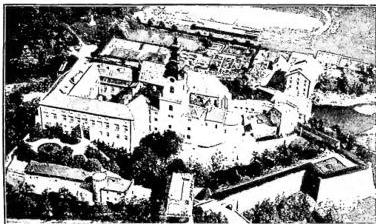
NITRA, DIOCESE OF. - A diocese in Slovakia, established in 880 as a suffragan of the metropolitan see of Pannonia, when Pope John VIII sent St Methodius, the Apostle of the Slavs, as his legate to these regions. Then, in the upheavals of the 10th century, it disappeared and was restored around the year 1024 as a suffragan of the metropolitan see of Strigonia, remaining under this jurisdiction until 1937, when it became immediately subject to the Holy See. Politically, it belonged to Hungary until 1918, after which it passed to Czechoslovakia.

The cathedral has always been located in the castle of the princes of Nitra, but after the principality ceased to exist, the castle also became the residence of the bishop, and it remains so to this day. A Christian church was built in the castle of Nitra around the year 833. It is debated whether the current structure dates back to the 9th century. Here, the saints Andrew Svorad Zoerardus and Benedict, Benedictine monks who were killed in 1012 at Skalka, were buried; they are now the patrons of the cathedral. Beside the small church, Bishop Meško had a large Gothic cathedral built in 1328, which was then decorated in Baroque style in 1732.

Among the bishops of Nitra, the most notable are: Meško, of the Polish Piast princes (1328–34); Zacharias Mošovský (Mosóczy; 1582–87), a noted humanist; Augustine Roskoványi (q.v.; 1859–92); and Charles Kmetko (q.v.; 1920–48).

Statistics: area: 5,239 sq. km.; out of 506,959 inhabitants, 465,323 are Catholic; 151 parishes, 277 diocesan priests, 14 male religious houses with 192 religious, 38 female religious houses with 653 religious.

Bibl.: J. Kompánek, N., Ružomberok 1895; A. Stransky, Dejiny biskupstva nizianskeho od najstarších dôb až do konca stredoveku (History of the Diocese of Nitra from Earliest Times to the End of the Middle Ages), Tirnava 1933; J. Hodál, Kostol Privinovo v Nitre (The Church of Privina in Nitra), Nitra 1933; Schematismus cleri diocesani Nitriensis pro anno 1947, 1947.

Michele Lacko

Article illustration
NICE, DIOCESE OF. - A city and diocese, the capital of the prefecture of the department of the Alpes-Maritimes in France.

The diocese extends over the entire civil department of the Alpes-Maritimes. It has 525,000 inhabitants, of whom 350,000 are Catholic, distributed across 240 parishes served by 330 diocesan priests and 90 regular clergy, one seminary, 19 male religious communities, and 123 female religious communities (Ann. Pont., 1951, p. 290).

It is the ancient *Nitria* of pre-Roman origin; the hill overlooking the Baie des Anges was occupied by Greek colonists from Marseilles, and the port developed commercially. The magistrates of Marseilles were represented at Nice by an official called *episcopus* (CIL, V, 7914); but Nice was known only as a port. At the same time, Cemelium, a Ligurian settlement of the Vediante tribe, flourished under the Romans, who replaced the indigenous population. Thus Cemelium thrived from the time of Augustus to Diocletian, who moved the capital to Ebrodunum (CIL, V, p. 903). Cemelium was destroyed by the Saxons in 573 (St Gregory of Tours, in *Hist. Franc.*, IV, 42). It had an amphitheater and baths (G. De Angelis d'Ossat, *Un disegno di S. Gallo relativo alle terme di Cimella presso N.*, in *Riv. di studi liguri*, I [1942], pp. 20–24). Excavations were carried out in 1791, 1860–80, and 1943. Cemelium disappeared in the 12th century.

The first known bishop is Amanzio, present at the Council of Aquileia in 381. Pope Leo I, after 450, united the sees of Cimiez and Nice. Shortly after the Roman Council of 19 November 462, Pope Hilary separated them again, but soon restored their union in 465; indeed, Bishop Magnus signed as *episcopus Cemelensis et Nicaensis* at the Council of Orléans in 549, and at the Synod of Arles in 554 as *episcopus Cemelensis*, because Nice was still considered, as in Hilary’s time, a *castellum*, while Cimiez was a *civitas*. Only after the Lombards destroyed Cimiez did Nice become the seat of the *civitas* and the diocese. Other known bishops were Ostadius, mentioned by Gregory of Tours around the year 581 (*Hist. Franc.*, VI, 6), Catullinus around 585, and Abraham, present at the Council of Paris in 614. Nice was ceded by Victor Emmanuel II to France on 24 March 1860. The bishop of Nice holds the title of Count of Drap. Within its territory lie the suppressed dioceses of Antibes, Cimiez, Grasse, Sospel, and Vence. The diocese is a suffragan of Aix.

The ancient cathedral was dedicated to the Assumption of the Blessed Virgin Mary; however, after suffering war damage, it was transferred in the 17th century to the church of St Reparata. In 1949, Pius XII restored the ancient Marian title to the cathedral, decreeing that the sacred building be dedicated to the Blessed Virgin Mary assumed into heaven and to St Reparata, virgin and martyr, elevating it to the dignity of a minor basilica (AAS, 33 [1950], pp. 545–47). Other churches include: the church of St Jacques, the parish church for Italians, from the late 17th century; Notre-Dame, in Gothic style (1880–1890); St Augustine (17th century); St Francis of Paola (1736), in local Baroque style. The abbey of St Pons, near Cimiez (8th–9th century), is attributed to Charlemagne (R. Latouche, *Nice et Cimiez*, in *Mélanges F. Lot*, Paris 1925; C. Salvetti, *Essai historique sur l'abbaye de St-Pons de Nice*, Nice 1925). Fourteen kilometers from Nice is the much-venerated sanctuary of Our Lady of Laghet, at 340 meters above sea level, in a Umbrian-like landscape.

Among the museums are: the Museum of Ancient and Modern Arts or Musée Jules Chéret, housed since 1927 in the former Villa Thomson; the Masséna Museum or Musée du Vieux Nice, in the Rivoli Palace, from the late 19th century.

For Cemelium, the first known bishop is Valerian, present at the Councils of Riez (439) and Vaison (442). The Christian community is attested by two inscriptions found there (CIL, V, 7977–78). The abbey, founded at the end of the 8th century, was annexed to the church, which later became the cathedral, where a treasure of coins ranging from Merovingian to Carolingian was discovered. At Grasse, the ancient cathedral (Notre-Dame) dates from the late 12th century and marks the beginning of Gothic architecture in Provence. It is built of limestone, has three naves without a transept, and shows Lombard influences. At Sospel, only the Romanesque-Lombard bell tower remains of the ancient cathedral of St Michael. Vence, a suppressed diocese since 1790, had among its bishops St Veran (d. 492), St Lambert (d. 1154), Alessandro Farnese (later Pope Paul III), Msgr. Godeaux, and Msgr. Guiran. The ancient cathedral is from the 12th century, while the tribune and minor naves date from the 17th century. It preserves the tombs of the saintly bishops Veran (in a 5th-century sarcophagus) and Lambert.

Following the peace treaty with Italy, the populations of Tenda, Briga, San Dalmazzo, Piena, and Mollières were detached from the dioceses of Ventimiglia and Cuneo and annexed to that of Nice.

Bibl.: Eubel, I, pp. 363–64; II, p. 202; III, p. 257; V, p. 285; L. Duchesne, *La civitas Rigomangensium et l'évêché de Nice*, in *Mém. de la Soc. nation. des antiquaires de France*, 43 (1883), pp. 36–46; A. Morel Fatio–A. Chabouillet, *Catalogue raisonné de la collect. de deniers mérovingiens du VIIe et VIIIe siècles de la trouvaille de Cimiez*, Paris 1890; L. De Kerval, *Le couvent des Frères mineurs et le sanctuaire de Notre-Dame de Cimiez*, Nice 1901; H. Delehaye, *St Basus évêque martyr honoré à Nice*, in *Anal. Boll.*, 50 (1932), pp. 295–310; A. Latouche, *Hist. du Comité de Nice*, Paris 1932; N. Lamboglia, *Liguria Romana*, Alassio 1939, pp. 35–80; id., *Nice et Cimiez (Ve–XIe siècle)*, in *Mélanges F. Lot*, 1925–33, pp. 331–38; M. L. Cappatti, *Cimiez dans l'histoire*, Nice 1943, pp. 9–96; P. M. Duval, *Rapport préliminaire sur les fouilles de Cemenelum (Cimiez)*, 1943, in *Gallia*, 1946, pp. 77–136.