
STRIGONIA (ESZTERGOM, GRAN), ARCHDIOCESE of. — City and archdiocese in Hungary. The archdiocese has an area of 7,706 sq km and a population of 1,236,392 inhabitants, of whom 818,773 are Catholics, distributed among 167 parishes with 394 churches. It has 520 secular priests and 671 ex-religious compelled by the anti-religious laws to leave their convents. In addition, in 158 religious houses approximately 250 nuns devoted themselves to the education of the young and to works of Christian charity. Following the agreement imposed upon the Hungarian episcopate by the Communist government (1950), after the infamous condemnation of Cardinal Giuseppe Mindszenty (1949), all religious Orders, except for six male and two female convents with their respective schools, were suppressed.
Approximately 250 priests and catechists work in catechetical instruction in elementary and secondary schools. Until the nationalization of the Catholic schools, which took place in 1948, more than 10,000 students attended the institutions conducted by the Orders and religious congregations.
The metropolitan see of S., founded by s. Stefano, first king of Hungary and organizer of the Hungarian Church, dates back to 999, the year preceding the coronation of the holy King. He divided the country into two ecclesiastical provinces: S. and Calocza. S. was not destined merely to become a metropolitan see, but — as later emerges from an act of Carlo I — mater et caput of all the churches of Hungary. This concept is also expressed in the Legenda Maior of s. Stefano and was codified in 1550 as Article XVIII of Hungarian legislation. Its privileged position is also apparent in the choice of the metropolitan see: S. was the first capital of the Kingdom constituted and organized by s. Stefano, the center of the first stable political foundation in the Danube basin after the migration of peoples into Europe. The holy King made the royal citadel of S. the residence of the archbishop. S. remained the see of the extensive archdiocese until the end of the sixteenth century; but when the Turks occupied S. in 1543, under Archbishop Paolo Varady (1526–29), the see was transferred to Nagyszombat (Tirnava) and did not return before 1820, under the rule of Archbishop Alessandro Rudnay (1819–31).
The first in the succession of archbishops was the Benedictine Anastasio (d. 1036), and the first cardinal among the archbishops was Stefano Vancha (1252–68). The title of Primate of Hungary and Legata natus of the Holy See was first granted to Giovanni Kanizsay (1387–1418) by Pope Bonifazio IX; from the time of the famous Cardinal Tommaso Bakocz (1497–1518), the two dignities were always attached to the see of S. In 1714 Archbishop Agostino Keresztely (1707–25) obtained for himself and his successors also the title of imperial prince.
The title of Primate of Hungary is not merely an honorary title, but also entails a certain jurisdiction. The first mention of the Archbishop of S. as primate dates from the time of King s. Ladislao (1077–95), on the occasion of the foundation of the bishopric of Zagabria. The principal rights of the primate at that time were the coronation of the king and the convocation of the national synod. To express his jurisdiction, the primate could have the cross carried before him throughout the country. Over the centuries the rights and privileges multiplied; according to the Synod of Nagyszombat in 1630, under the presidencies of Cardinal Pietro Pazmany, Archbishop of S. and head of the Catholic reform in Hungary, the relationship of the Archbishop of S. to the other archbishops of the country is equivalent to that of an archbishop to his suffragan bishops. This juridical position was repeatedly confirmed in the official rescripts of the Holy See (Bonifazio IX, Niccolò V, Leone X) and was recognized in the bull founding the archbishopric of Eger (Agria) in 1804. Although the bull exempted the new archbishopric from the metropolitan jurisdiction of S., it fully confirmed the same primatial jurisdiction. The Archbishop of S. exercises primatial jurisdiction in Hungary: his tribunal is the superior court of appeal for the archiepiscopal tribunals, and the primate has the right of visitation even in monasteries exempt from ordinary episcopal jurisdiction. The primate, according to Magyar common law, founded upon the ancient constitution, is chancellor of the kingdom, the king’s first counsellor, keeper of the great seal, and also a member of the supreme tribunal of the kingdom. He crowns the king.
The ecclesiastical province of S. extended over most of historic Hungary. Of the ten bishoprics founded by s. Stefano, Győr (Giavarino), Vác (Vacia), Pécs (Cinque Chiese), Veszprém (Veszprimia), Eger (Agria) — and, from the eleventh century, also the bishopric of Nyitra (Nitra), formed from the northern part of the archdiocese — were under the jurisdiction of the Archbishop of S. Following the new territorial arrangement of the dioceses of Hungary in the eighteenth century, the following new suffragan sees were added to the earlier ones: Székes-
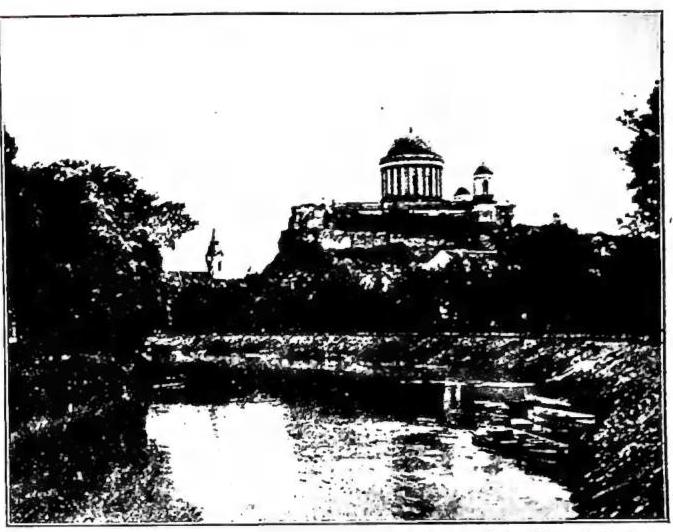
The spiritual center of the archdiocese was the cathedral church built by s. Stefano. After its destruction and subsequent reconstruction in the 12th and 14th centuries, during the time of the archbishop Dionigi Szecsi (1440–65), the Cathedral was completely restored. In 1507 Tommaso Bakocz had a chapel added, built by Andrea Ferrucci da Fiesole. This chapel is the finest monument of the Renaissance in Hungary. During the Turkish invasion and occupation in the 16th and 17th centuries, most of the Cathedral was destroyed. The new Basilica was consecrated in 1856 under the archbishop Giovanni Scitovszky. In 1882 Giovanni Simor had the archiepiscopal palace built and founded the Christian Museum there, endowed with a rich collection of drawings, paintings, sculptures, tapestries, and ceramics, as well as a numismatic and archaeological collection, thus documenting the interest of the archbishops of S. in art and culture.
Until the First World War, the archdiocese of S. was the largest in Hungary. The new ecclesiastical organization following the Treaty of Trianon removed 393 of its 482 parishes. With these, the apostolic administration of Nagyszombat (Tirnava) was organized in Czechoslovakia. Budapest also belongs to the archdiocese as an archiepiscopal vicariate. Between the two wars, as a result of the rapid growth of the capital’s population, it became necessary to reorganize the parishes. Within a few years, 36 new parish centers were built. At present there are approximately 100 public churches and chapels in Budapest; before their suppression, officially carried out in 1950, all the most important Orders and religious congregations also had convents there.
The archiepiscopal seminary, the first seminary in Hungary, was founded by Nicola Olah (1554–68) at Nagyszombat and was transferred after the expulsion of the Turks from S. In addition, there is a central seminary in Budapest for all the dioceses of Hungary. Under the supervision of the archbishop of S. is also the Pazmaneum, a Hungarian seminary in Vienna, founded by the celebrated archbishop of the Catholic Reformation, Cardinal Pietro Pazmany, and the « Institutum Ecclesiasticum Hungarorum in Urbe ». Hungary’s only theological Faculty, whose chancellor is always the primate cardinal, is located in Budapest and is currently separate from the State University under the Communist government.