
UNGHERIA. – An inland state of Danubian Europe, bordered by Czechoslovakia, the Soviet Union, Romania, Yugoslavia, and Austria.
I. GEOGRAPHY
The present territory (93,011 sq. km.) is less than one-third that of the Kingdom of U. before the First World War and represents the area inhabited compactly by the Hungarians, a population of eastern origin (Magyars, Ugric-Finnic peoples, mixed with Turco-Mongols), originally nomadic, which first appeared in Europe in the 9th century, then settled in the steppe, converted to Christianity, and decisively embraced European civilization; it nevertheless remains clearly differentiated from the neighboring populations, if only on account of its language (agglutinative).The country corresponds to the basin of the middle Danube and its tributary, the Tisza, and consists of a vast plain (Alföld = low country), between the Danube and Transylvania, the bed of an ancient lake basin across which the rivers wander in sluggish meanders and which, toward the E., owing to increasing aridity, becomes a genuine steppe, the puszta. On the right bank of the river, by contrast, extends an undulating
region (Baconian Forest), which likewise opens into valleys and depressions, one of them occupied by Lake Balaton; a region not very rich in water, but fertile and suited to agriculture.
U. is a country of rich and varied agriculture (cereals, potatoes, sugar beets, tobacco, vines, oil-bearing plants), with flourishing livestock raising (2 million head of cattle, 3 million pigs, and 631,000 horses, the latter renowned for their speed and endurance). The products of both provide the basis for an industry which, owing to the scarcity of energy sources, was formerly subject to severe limitations. But the intensive exploitation of reserves already known (petroleum and coal), and still more the recent discovery of natural-gas reserves, have enabled further expansion, despite the limited quantity and variety of available raw materials (apart from foodstuffs, only bauxite and iron ores). Today this industry is not lacking in importance, especially in certain branches (textiles, chemicals, metallurgy, rubber, etc.), which permit an export surplus.
The population (9.3 million inhabitants, 10 per sq. km., as in 1941) lives in agricultural centers: large urban agglomerations are few. The largest of these is the capital, Budapest (1.1 million inhabitants, including the suburbs), on the Danube, followed by Szeged (135,000 inhabitants) and Debrecen (126,000 inhabitants), near the Yugoslav and Romanian borders.
Since 1946, U. has been a “people’s” Republic, now under direct Soviet control.
| Regions | Area in sq. km. | Census population 1941 (in thousands of inhabitants) | Principal centers (population in thousands of inhabitants) |
|---|---|---|---|
| Transdanubia | 36,682 | 2777.6 | Pécs (80) |
| Low Plain | 42,365 | 5316.6 | Budapest (1165) |
| Upper Hungary | 13,964 | 1195.4 | Eger (32) |
| Hungary (territory in 1948) | 93,011 | 9289.6 |
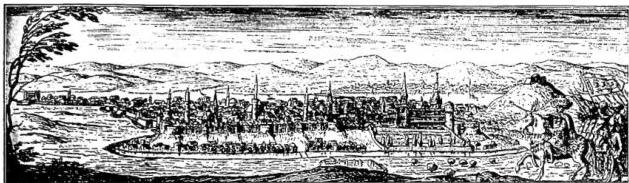
(from G. Dumont, Storia delle battaglie unite dal Serenissimo Principe Francesco Eugenio di Savoia, Venezia, E.P.)
UNGHERIA - Veduta di Buda (1737).
II. CIVIL HISTORY
The Danubian provinces of the ancient Roman Empire, first ravaged by the Goths, traversed by the Huns in the 5th century, then by the Avars in the 7th–8th centuries, and partly dominated by the Carolingians in their western portion, seemed toward the end of the 9th century capable of offering the Slavs an opportunity to establish a permanent dominion there, when a group of Hungarian tribes (Magyars of Ugric-Finnic origin [v.]) burst forth from the Carpathians and divided the northern Slavs from the southern. They thrust themselves between them, destroyed the Moravian kingdom of Svatopluk, defeated German resistance in the western Alpine region and, through the southern Karst, entered Italy in 899; taking advantage of the weakness and dissensions of the Italian Kingdom, they were able, on several occasions, to cross the entire Po Valley, penetrating into central Italy as far as Tuscia and reaching southern France.Terrible are the accounts left by contemporaries of the ferocity of these barbarians, who fought on horseback and, in their raids, cared only to plunder. They did the same in Germany, until King Henry I and then Otto I succeeded in confronting them and definitively driving them back toward the Danubian territories around the middle of the 10th century. They were no longer seen in Italy either. For their part, those tribes, initially led by occasional chiefs, without unity or restraint, immersed in a rudimentary paganism that kept them far from every form of civilization, could not fail, as the years passed, to be influenced by the Slavs they dominated, the Byzantine Empire, and the religious and feudal organization of Germany and Italy. At their head there appears a descendant of Arpad, Prince Géza (973–97), who succeeded in giving unity to his people and directing them toward Western civilization, while maintaining peace with the Saxon House, then the arbiter of Europe, after its victories over the northern Slavs and the Italian Kingdom. But the merit of giving laws and organization to the people belongs to St. Stephen (v.), Géza’s son. By marrying Gisela, daughter of the Emperor Henry II, he was able to secure lasting peace in the West, overcome tenacious internal resistance, and receive missionaries who helped him bring about the conversion of his people to Christianity and give it a constitution that continued in its essential features through the following centuries; as a pledge of its independence from other nations, he placed his kingdom under the Apostolic See.
At his death (1038), a fierce reaction by the strictly pagan party endangered the institutions of St. Stephen and gave rise to a period of internal dissension, until, with St. Ladislaus ([v.] 1077–95), there was a revival in the civil life of the kingdom. Having overcome its internal dangers, it was able to secure dominion between the Drava and the Sava and the Danube in 1089, and then over Croatia, ravaged by internal struggles, in 1091. From then on this kingdom followed the fortunes of U. Ladislaus also deserved credit for defending the fortunes of his people in the struggles in the east against the Pechenegs and the Cumans, barbarous pagans. His successor Coloman completed Ladislaus’s work by subjecting the Dalmatian cities and islands, thereby exposing his kingdom to wars with Venice that were repeatedly resumed over three centuries, with varying outcomes. He was also concerned to improve the kingdom’s institutions, which, owing to recurring internal difficulties and defensive wars, evolved only slowly toward a higher form of civilization. Nor were relations with the Church always easy, in connection with the great struggles between the Papacy and the Empire. There is evidence of national Councils at Strigonia in 1103–1104 in defense of ecclesiastical power. Another Council was held in 1111 in the presence of the King and the nobles by the Archbishop of Spalato, for the division of the dioceses and to prevent laymen from conferring ecclesiastical offices. At the Council of Strigonia in 1114, Archbishop Lorenzo still had to tolerate married priests, prohibit pagan customs, prevent Christians from becoming the servants of Jews, and prevent churches from being bought and sold. He also recommended that the clergy use the Latin language in family life, which, until 1848, was also the language of the court and the tribunals. A little later, in 1169, Archbishop Luca had to admonish Stephen III not to confer ecclesiastical offices through simony and not to usurp the property of the churches. It was in the second half of that century that the struggle against the Byzantine Empire, which sought to enslave U., became more violent; it ended only with the temporary establishment of the Latin Empire there. Meanwhile, new developments in the history of the Magyar people were taking shape. King Andrew II (1205–35), who had led a crusading expedition to Egypt (1217) in defense of the Kingdom of Jerusalem, had to address the new internal needs of his kingdom, brought about by social difficulties and the movement of the classes. The considerable immigration of Frenchmen, Saxons, Bohemians, and Poles on one side, and Croats on the other, had led to the colonization of new lands and a change in relations between the classes. In 1222, with a Golden Bull, the King established the rights of the new nobles vis-à-vis the old nobility and introduced royal finances to compensate for the estates widely distributed among the supporters of the monarchy. But the progress of civil life seemed destined this time to be destroyed by the great Tartar invasion of 1241, under King Bela IV (1235–70), when the King himself, unable to resist, had to withdraw into Dalmatia, leaving the country at the mercy of the invader. Fortunately, the Tartars withdrew the following year, and it was the King’s arduous task to reorganize the kingdom and repair the damage suffered. German, Flemish, and Italian immigrants helped repopulate the kingdom, while Saxons settled in Transylvania.
With the death of Andrew III, the Arpad dynasty came to an end (1301), and a troubled period of interregnum began, during which the factions were free to overpower one another and the country’s internal weakness became apparent. It was dominated by an oligarchy of nobles who had long aimed at making themselves almost independent of sovereign power, waging war on their own account among themselves and against the foreign princes bordering their territories; until the legate Cardinal Gentile of Montefiore succeeded in having Charles Robert of Anjou, son of Charles Martel, himself the son of Charles II, King of Naples, recognized as sovereign in 1308 (cf. Dante, Parad., VIII, 58 sgg.). The Arpads, in fact, had already repeatedly entered into matrimonial relations with the various ruling dynasties of the surrounding countries, and Charles II of Anjou had married a Magyar princess, Maria, sister of Ladislaus IV (d. 1290).
The reign of Carlo Roberto (1308–42) and that of his son Luigi (1342–82) mark a glorious period in the history of U. The former, with great skill and energy, succeeded in subduing the rebellious nobility and restoring sovereign authority, reorganizing the army, and maintaining Hungarian hegemony against the Habsburgs of Austria and against Serbia; the latter, whom the Hungarians called “the Great” and who was also proclaimed king of Poland in 1370, continued the reforms begun by his father, regulating internal law on the basis of a tower feudalism distributed among the Orders which, together with the sovereign, constituted the S. Crown of U. He concerned himself with the development of culture in the kingdom and founded the University of Cinquechiese (Pécs) in 1367; he imposed the sovereignty of U. upon Bosnia, Serbia, Bulgaria, Wallachia, and Moldavia, and subjugated Halics and Lodomeria. Through his expeditions against the kingdom of Naples he avenged the death of his younger brother Andrea, killed in 1345 with the complicity of Queen Giovanna, whose husband he was; he subsequently intervened in the dissensions of the Veneto and took part, together with Genoa, in the struggle against Venice to secure possession of Dalmatia, which was contested. But his death rekindled internal disputes: his daughter Maria succeeded to the kingdom under the government of her mother Elisabetta; an attempt by Carlo III of Durazzo (also an Angevin) in 1385 to conquer the throne of U. ended with his murder at Buda (27 February 1386); until, in 1387, the government of the kingdom passed into the hands of Maria’s husband, Sigismondo of Luxembourg, who on 21 July 1410 was elected king of Germany and subsequently, in 1410, succeeded his brother Venceslao to the kingdom of Bohemia. These events, as well as the wars in northern Italy at the beginning of the fifteenth century, the subsequent efforts on behalf of the Council of Constance and the extinction of the schism, and the ensuing war against the Hussites, distracted Sigismondo from the direct government of U., precisely at a decisive moment in its history. The Turks, having crossed the Bosporus and left Constantinople behind, penetrated into the Balkans and established themselves at Philippopolis in 1363 and then at Adrianople, creating a new and extremely grave danger on the southern flank to Magyar supremacy. Indeed, Sigismondo, who advanced against them with the aid of the finest European knights, was defeated at Nicopolis in 1306 and, although he nevertheless restored his authority in Bosnia and other southern provinces, was forced around 1420 to leave the possession of the Dalmatian cities to Venice; nor was he ever able to prevent Turks and renegade Christians from repeatedly raiding along the Drava and the Sava, as far as the Austrian duchies and against Bosnia.
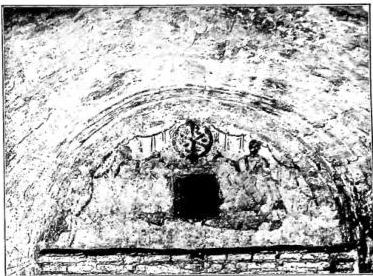
(to the surprise of Prof. E. Joni)
UNGHERIA – Two saints acclaiming the «Signum Christi». Fresco from the end of the 4th century – Cinquechiese (Pécs), hypogeum near the Cathedral.
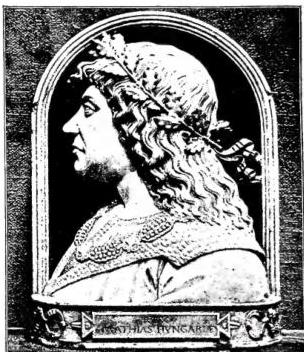
of Hunyadi, and under him U. enjoyed a long period of splendor, marked above all by the progress of humanistic culture, by the favor shown to books and the arts, and by contacts between the most distinguished minds and the Italian humanists, to which the King’s marriage to Beatrice, daughter of Ferdinando d’Aragona, king of Naples, was not unrelated. But finally Mattia was induced to declare war against Poland, against Giorgio Podobrody, the Hussite king of Bohemia, and lastly against the Emperor Federico III, which led him in 1485 to occupy Vienna. Thus, after his death in 1490, Ladislao II of Poland, who succeeded him, was forced to renounce Mattia’s conquests, being incapable of overcoming the disorganization of the kingdom, once again brought about by disputes between the greater and lesser nobility, to which was added in 1514 the revolt, also social in character, of the Crusaders, who were supposed to provide for the defense of the kingdom against the Turks. Luigi II, who had succeeded his father in 1516, could not prevent the Turks from conquering Belgrade in 1521, and in 1526 he himself fell, together with a large part of the nobility and clergy, on the plains of Mohács. This marked the end of Hungarian independence, Turkish predominance in the Danubian plain, and the humiliation and enslavement of the people, abandoned to their fate. Luigi had married Maria, niece of Massimiliano, King of the Romans; hence the kingdom should have passed to his nephew Ferdinando d’Asburgo. But it was not desired to renounce the right of freely electing the king, and the never-extinguished anti-German party supported Giovanni Zopolya, prince of Transylvania (1526–40), who hastened to place himself under the protection of the Turks. They thus had a good opportunity to advance against Vienna in 1529 and 1532; they succeeded in taking Buda in 1541 and in definitively dominating the conquered country, governing it harshly. U. was thus divided under three dominations: that of the Turks, that of the Habsburgs, and Transylvania. This latter region, reorganized by the Pauline friar Giorgio Martinuzzi, created cardinal in 1551, and then governed from 1571 by the Báthory, under Stefano Bocskay resumed its alliance with the Turks, waging war against the Emperor Rodolfo, who was compelled to conclude peace treaties (1606). These disagreements, fostered by religious dissensions, made relations more difficult during the Thirty Years’ War, when the uprisings of the Transylvanian princes Gabriele Bethlen and Giorgio Rákoczi I, allied with the powers hostile to the Empire, prevented the Habsburg sovereigns from providing for their kingdom of U., which, moreover, was sinking into utter ruin because of the Turks’ oppressive tyranny. A first sign of recovery appeared when the Austrian general Montecuccoli defeated the Turks on the Raab in 1664; but
Within the state’s borders, in fact, besides the German immigrants and the Slovaks, two different nationalities were by then in ferment in opposition to the exclusive power held by the Magyar nation, which nevertheless constituted a considerable numerical minority: the Romanian nation, which had begun to assert its rights in Transylvania as early as 1744 through the efforts of Bishop Micu (v.), and the Croatian nation, which even before the emergence of the Pan-Slavist movement (v. PANLASLAVISMO; SLAVOPILIA) asserted itself with anti-Magyar tendencies. It was the Croatian ban G. Jelláfié who placed himself at the head of this movement, initially with a pro-Austrian tendency.
For its part, Hungary was by then evolving toward higher forms of national expression and, especially through the efforts of Count Stefano Széchenyi, aspired, with its Diet (1833–36), to implement internal reforms more suited to the new times; not least among these was the use of the Magyar language instead of Latin in the administration, over which it entered into conflict with the Croats. The KOSSUTH, LAJOS (v.) led in 1848 to greater reforms and to demands for greater independence, through the creation of a Hungarian parliament and, finally, the severing of the link with Austria, with the declaration that the Austrian dynasty had forfeited the throne. But in 1849 the insurrection was suppressed by Austro-Russian troops, and the concessions that had just been granted were withdrawn; Croatia was separated from Hungary and placed under the direct authority of the Austrian Empire, like Dalmatia. But after the defeat at Sadova in 1866, Austria felt the need to draw closer to Hungary, and negotiations with the Hungarian liberal leader Francesco Deák led to the establishment of what was called the dual monarchy, with two distinct states and two parliaments under a single sovereign; the ministries of Foreign Affairs, War, and Common Affairs—particularly those concerning the apportionment of expenses—also remained common. Transylvania remained incorporated into Hungary without a special administrative arrangement, while particular agreements were established with Croatia, a nearly autonomous state. Thereafter Francesco Giuseppe was able to be crowned king of Hungary according to the ancient ceremonial on 8 June 1867. The resulting peace made possible Hungary’s truly remarkable cultural and economic development, but did not resolve the nationality question; at the end of the 1914–18 war, Hungary was constituted as a republic (31 October 1918), followed on 21 March 1919 by the Bolshevik revolution led by the Jew Béla Kun, which reduced everything to ruin but lasted only until 31 July.
Admiral Nicola Horthy succeeded, with the help of the peasants, in reconstituting the kingdom, of which he himself was proclaimed regent, though the victors insisted that the Habsburgs be excluded from II. The Treaty of Trianon of 4 July 1920 sealed Hungary’s fate, depriving it of 71.5% of its territory and two-thirds of its former population.
At the outbreak of the war in 1939, the Regent found himself on the side of the Axis, with Germany and Italy, in order to obtain their support for Hungarian territorial claims; but when, in the spring of 1944, Soviet troops were at the gates of Romania, the Regent was summoned on 19 March to Hitler’s headquarters, and on the 21st Hitler had Hungary occupied by German troops; on 31 October, after an attempt at an armistice, he was accused of treason by the Germans and interned in Bavaria. Hungary, invaded by Soviet troops, was subjected to the worst forms of oppression and incorporated into the Soviet sphere of influence, in accordance with the agreements concluded among the Allies, and was therefore forced to endure a communist government.
III. ECCLESIASTICAL HISTORY AND RELATIONS WITH THE HOLY SEE
The Hungarian Church traces its origins to King St. Stephen, because nothing remained in the country of the institutions of Christian antiquity, nor had those sketched out by St. Methodius withstood the invasion; his disciples had in fact interrupted his work by withdrawing toward Bulgaria.The hierarchical organization remained essentially as the King, aided by German and Italian missionaries, had established and generously endowed it; while an integral part, so to speak, was formed by the Benedictine monasteries founded at that time, especially that of St. Martin on Mount Pannoniae (Pannonhalma), the birthplace of St. Martin, not far from Győr, which rose to become the head of Hungarian monasticism; the archbishop of Strigonia always held an effective primacy within the nation, even after the metropolitan see of Colocza had been established. Given these premises, it is hardly surprising that a particular sense of dependence toward the sovereign developed among the Hungarian episcopate, regarding him as a patron from whom appointments to the various offices proceeded, and that this episcopate formed a compact body with the nation, in which it constituted the first estate together with the abbots and provosts of the collegiate churches. Religious legislation conformed to the ancient canons of the Church and to those prescriptions that had been added through the Frankish capitularies and the German councils. Yet investiture with ring and pastoral staff never existed in U.; nevertheless, throughout the centuries there were no shortage of complaints about the excessive interference of the sovereigns in ecclesiastical affairs. It is certain, in any case, that the frequent disputes over succession to the Kingdom during the rule of the Árpáds and the numerous wars against external enemies often had a disastrous influence on religious life and ecclesiastical discipline. The conversion of the Cumans, repeatedly attempted, was likewise impeded, so that it could be considered complete only under King Louis. In the 13th century Ugron, bishop of Colocza, led a crusade against the Bogomils, who sought to spread from Bosnia into U.
To develop the work of the first Benedictines, the Cistercians and the Premonstratensian Canons Regular, largely of German origin, were added in the second half of the 12th century.
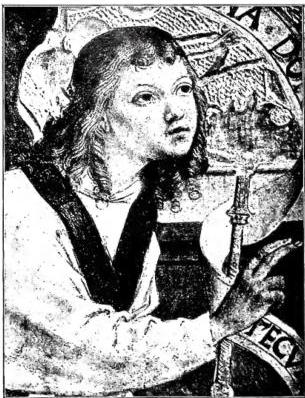
(from L. Palinkás, Il Rinascimento ungherese, Budapest 1918, plate 23)
HUNGARY - The Archangel Gabriel. Detail of the Annunciation painted by Michele Kassai (1516) for the altar of the Visitation of Mary in Kassa.
During the Great Western Schism, Hungary sided with Pope Urban VI; it was King Sigismund who, having embraced the cause of John XXIII and later the Council of Constance, drew Hungary along with him.
The German wars sparked by Lutheranism and the Turkish invasions provided an opportunity for Protestant penetration in Transylvania. This occurred with the complicity of the prince, in opposition to the religious policy of the Habsburgs, allowing a true organized Lutheran Church to be established in 1542, particularly among the immigrant Germans, followed by a Calvinist Church that held its synods in Csenger in 1557 and in Debrecen in 1567. A third, less widespread confession was established by the Socinian Unitarians through the work of Giorgio Biandrata.
Calvinism took deep root among the Magyar nobility as well, facilitated by the dire religious conditions of the country, to the extent that few noble families remained Catholic at a certain time. The fanaticism characteristic of the Reformed, as evidenced by the martyrs of Košice (v.) in 1619, and their collusion of political interests with the Turks, who had an interest in keeping Christians divided, well explain such successes; meanwhile, the Catholic hierarchy had lost its best elements in the wars of resistance (the primate Ladislao Szalkái fell at Mohács on 29 August 1526) and with them the ability to provide for the education of the clergy and the assistance of the regular clergy. Meanwhile, the Treaties of Vienna of 1606 and 1608 ensured full freedom of worship and organization for dissenters, which they exploited to commit violence against Catholics, feeling supported as they were by foreign princes or powers.
The Turkish occupation prevented the primate archbishop
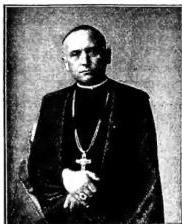
HUNGARY - Portrait of Cardinal Giuseppe Mindszenty, tried by the "People's Tribunal" of Budapest on 8 February 1949 and sentenced to life imprisonment.
prepared the resurgence of Hungarian Catholicism in opposition to the relentless Calvinist propaganda, which recurred with varying intensity depending on political circumstances. Conversely, conversions to Islam in Hungary were few.
The revival of Catholicism was rapid and impressive, also thanks to the broad movement toward union with Rome by Byzantine-rite communities, particularly among the Ruthenians and Romanians of Transylvania, encouraged by Archbishop Leopoldo Carlo Kollonicz (1695–1707). This led to the establishment of the bishopric of Făgăraș in 1721. Due to the interest of Queen Maria Theresa, the bishoprics of Mukachevo (Munkács) in Subcarpathia were instituted in 1771, and for the Romanians of Transylvania, that of Gran Varadino (Oradea Mare, Nagyvárad) in 1777, while for the Croats, that of Crisio (Križevci, Kreutz) was also established in 1777. From the territory of Esztergom, the new sees of Rožňava (Rozsnyó), Spiš (Szepes, Zips), and Banská Bystrica (Besztercebánya, Neusohl) were separated in 1776, now in Czechoslovakia. The need was also felt to increase the number of Hungarian dioceses by establishing in 1777, within the territory of Győr and Veszprém, the new dioceses of Szombathely (Steinamanger) and Székesfehérvár (Albareale). Francis I, in 1804, erected the two new dioceses of Košice (Kassa, Cassovia), now in Czechoslovakia, and Satu Mare (Szatmár), now in Romania, subjecting them to the new metropolitan see of Eger (Erlau, Agria). In 1818, he established for the Ruthenians the diocese of Prešov (Eperjes, Fragopolitana), now in Czechoslovakia. Two other Eastern-rite dioceses were erected under Francis Joseph in 1853: those of Lugoj and Cluj-Napoca (Kolozsvár, Claudiopoli-Armenopoli), subject to the new metropolitan see of Făgăraș (Alba Iulia, Blaj). Later came Hajdúdorog in 1912 and Timișoara (Temesvár) in 1930.
The Concordat concluded in 1855 between Austria and the Holy See was considered valid for Hungary as well; but with the
of Esztergom to remain in his see, and together with the Chapter, to find refuge in Trnava (Nagyszombat) in Slovakia. Moreover, the see itself remained vacant for 23 years, from June 1573 to June 1596. Other sees in Hungary found themselves in similar conditions. Meanwhile, in Trnava, the Jesuits effectively operated the college entrusted to them for the preservation of culture and the formation of the Hungarian clergy: and already Archbishop Francesco Forgách (1607–16), Pázmány (v.)
1868, when political freedom was granted to Hungary, a restrictive policy began to the detriment of the Church's freedom, in obedience to the false liberalism that was spreading across Europe. It started with schools and the children of mixed marriages, then moved on to the introduction of civil marriage (1869), the prohibition of publishing the papal bull on infallibility, and the placet in 1870. This followed the prevailing sentiments in the Vienna Chancellery and the influences of German Kulturkampf propaganda. Minister Alexander Wekerle became notorious for intensifying, in 1894–95, the previous oppressive laws, introducing divorce, the official recognition of Jews in the Kingdom, and favoring Protestant Churches. The Church responded by more effectively organizing its forces through appropriate popular and youth organizations and by demanding greater autonomy in the educational and administrative spheres.
A new reorganization of ecclesiastical circumscriptions, obtained following the Vienna Arbitration of November 1939 and August 1940, did not last long due to the Russian invasion of 1945. The apostolic nuncio was expelled, and in 1946, the Hungarian Church was again reduced to the borders assigned to Hungary in 1920. The communist government installed in Hungary soon demonstrated its hostility toward the Church and attempted to subjugate it to its own interests: it declared that it would not recognize prelates not appointed with its approval, that is, those whom the Holy See had nominated; it sentenced Cardinal Mindszenty, Archbishop of Esztergom, and Monsignor Grósz, Archbishop of Kalocsa, to life imprisonment; it appointed trusted priests as vicars general and chancellors in the episcopal curias, imposing a lay commissioner in each, appointed by the state office for ecclesiastical affairs; under the pretext of agrarian reform, it stripped the Church of its forest and nearly all its agricultural properties, dissolved the religious Orders and Congregations, with few exceptions, confiscating all their assets; it suppressed almost all Catholic schools run by religious, limited the number of seminaries and religious academies, and stifled the Catholic press. Thus, an ecclesiastical regime was established, practically aimed at annihilating all religious freedom and activity in favor of atheistic communism.
Ecclesiastical Circumscriptions. - In 1953, Hungarian territory was divided into the archdioceses of EGER (Erlau, Agria), which has suffragan dioceses in Czechoslovakia; of KALOCSA (Colocza), with the suffragan diocese of CSANÁD; of ESZTERGOM (Gran, Strigonia), with the suffragan dioceses of SZÉKESFEHÉRVÁR (Albareale), PÉCS (Fünfkirchen, Cinquichiese), GYŐR (Giavarino), HAJDÚDOROG (of Byzantine rite), SZOMBATHELY (Sabaria), VÁC (Vacia), VESZPRÉM (Veszprimia); the ABBEY NULLIUS OF ST. MARTIN ON MOUNT PANNONIA (Pannonhalma), at the head of the Hungarian Benedictine congregation, and the apostolic exarchate for the Ruthenian parishes of Byzantine rite in Miskolc.
IV. HUNGARIAN RITE
It is an ethnic branch of the Byzantine rite according to its Ruthenian form. Its sole distinctive feature is the liturgical language, which, despite the apostolic constitution Christifidelium of 8 June 1912 (AAS, 4 [1912], pp. 432-33), is in fact Hungarian.The following editions of liturgical books are known: Liturgy of St. John Chrysostom (Ungvár 1795; Debreczen 1882); Book of Prayers and Hymns (ibid. 1862 and others); Selected Epistles and Gospels (Eger 1882; Ungvár 1902, more complete edition); Euchologion (Debreczen 1883; Ungvár 1907; Nyíregyháza 1927); Liturgy of St. Basil and of the Presanctified (ibid. 1889); Liturgicon (complete, Nyíregyháza 1920); Calendar with Typical Notes (ibid. 1917); Anthologion for the Feasts of September and October (Szatmár-Németi 1905); Horologion (the Great; 2 vols., Miskolc 1938); I. Boksay and F. Malinis, Collection of Liturgical Hymns with Musical Notation (Ungvár 1906).
V. LITERATURE
1. The pagan era (until 1000). — No written documents of the poetry from the pagan period have survived, despite the fact that Hungarians knew, before the Latin alphabet, a script carved on rods.Without constituting a true epic poem, heroic songs flourished about the deeds of ancestors and the military exploits of great contemporary captains, which the minstrels sang in the first person, frequently employing alliteration and the repetition of words and concepts. These songs formed two main cycles: the Hunnic-Hungarian saga cycle and the cycle of the conquest of the homeland. There is also evidence of the existence of folk songs, and traces of magical formulas have survived, likely originating from shamanistic cults. These heroic songs, folk songs, and magical formulas were accompanied by singing, monodic though instrumentally accompanied, based on the pentatonic scale.
2. The Middle Ages (until the end of the 1400s). — With conversion to Christianity, Hungarians integrated into the Christian community of Europe with the help of the Church and, more precisely, of the religious Orders: the Benedictines initially, followed by the Dominicans and Franciscans. Throughout the Middle Ages, literature in Latin prevailed in Hungary, cultivated, in the 11th century, predominantly by foreign ecclesiastics. At the beginning of this literature stands the Deliberatio supra hymnum trium puerorum by the Venetian Benedictine St. Gerard, who became bishop of Csanád (d. 1046). Taking the Book of Daniel as his starting point (the fate of Daniel and his companions provided him with a symbol for that of Christian missionaries among pagan Hungarians), he used that "hymn of creatures" to meditate on all creation and to offer neophyte Christians a complete Christian Weltanschauung.
The Deliberatio laid the foundations for that long flourishing which in Hungarian literary history is called the "literature of codices." These codices, written in Latin and often literally bound to cathedral and convent libraries, contained the Holy Scriptures, the Sacraments, the lives of the saints, and, later, also collections of sacred prayers. They also preserve the first traces of the vernacular: translations often inserted into the original codex of sermons that the priest had to interpret for Hungarian faithful, or of hymns that were to be sung in the vernacular. The first Hungarian literary text dates to the early 13th century and is a Funeral Oration. In it, the language, despite certain difficulties—primarily orthographic and less so grammatical—is well understood by Hungarians today. Subsequent texts from the early 14th century include a Máriastiralom inspired by the Planctus Sanctae Mariae of Geoffrey of Saint Victor; the Glosses of Alba Julia, translations of sermon outlines; the Königsberg Fragment, a prose version of a hymn to the Virgin, and others of lesser importance. The Tartar invasion (1241) and the Turkish domination of the 16th and 17th centuries caused too many losses to the Hungarian book heritage, but even the few known examples reveal, in comparison with their models, an expressive vigor and constructive sagacity that surpass the originals. Limiting the examination of Latin texts to those
of specific Hungarian interest, one recalls the Institutio morum ad Emericum ducem, contemporary with the Deliberatio, attributed to St. Stephen, which contains teachings for the hereditary prince on the art of governance, in which political conduct is entirely based on Christian morality. Around 1070 begins, with the Legenda s. Zoerardi et s. Benedicti by Bishop St. Maurus, the series of Vitae of Hungarian saints. During the era of the Arpa-
(from E. Petri, Geographie de la Hongrie, Budapest 1858)
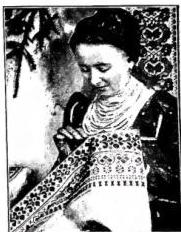
HUNGARY – Bulyák Embroidery.
During the era of the Árpád (1001-1301) and Angevin (much of the 14th century) kings, chroniclers—official court historiographers—drew from pagan sagas, reworking their material according to dynastic interests and contaminating it with Western motifs. The series of chronicles begins at the end of the 12th century with the Gesta Hungarorum by the anonymous chronicler—Magister P., a Hungarian Benedictine educated in Paris—which recounts the history of the conquest of the homeland. The chronicle of the same title by Simon Kézai (1284) introduces the concept of Hunnic-Hungarian continuity into Hungarian historiography. The Viennese Illustrated Chronicle, by Márk Kálti (1358), carries the narrative up to the reign of Charles Robert (1309-42), while János Küküllei dedicated his work (1390) to the deeds of Louis the Great (1342-82). Close to historiography are the Epistola magistri Rogerii super destructionem regni Hungariae per Tartaros facta (1244), by a Beneventan priest who was an eyewitness to the Tartar invasion and their prisoner for a year, and, dedicated to the same event, a Planctus destructionis regni Ungariae per Tartaros, an elegy by an unknown author. Nor are hymns to Hungarian saints lacking in the 14th century, written by anonymous Magyar poets in Latin.
To the first half of the 15th century belongs the first entirely Hungarian codex: the Vita s. Francisci, compiled from an Actus beati Francisci, the Speculum perfectionis, and the Vita of St. Francis by St. Bonaventure. In three codices, around 1466, the first partial translations of the Bible also appear, erroneously considered a Hussite initiative: the Gospels, Psalms, the books of Ruth, Judith, Esther, Baruch, Daniel, the twelve minor prophets, and the Maccabees. In the second half of the century, the first Hungarian elegy also appears: Gergely deák éneke Both Jánosról ["The Song of Deák Gregory on János Both"]. Deák, as a deacon, signifies a scholar skilled in Latin and the art of writing. The elegy arose when Both, an ambassador of Matthias Corvinus to Constantinople, was detained by the sultan and disappeared. The first epic poem, Szabács viadala ("The Capture of Szabács," 1476), also appears. In the realm of popular poetry, the repertoire of minstrels, which had gradually absorbed the lives of the holy Hungarian kings and the deeds of the Árpáds, is enriched with motifs drawn from conflicts between the nation and its foreign-born rulers (Sigismund, Charles Robert), or during the glorious reign of Louis the Great, who had fully assimilated into the nation; thus arise the tales of the Zách, Kont, Lőrinc Tar, and Miklós Toldi. However, it is Latin literature that animates the first printing press established in Buda in 1473, and its first product is a Chronica Hungarorum, a compilation by an unknown author based on earlier chronicles. Fifteen years later, the Chronicle of János Thurzó is published in Brno, the only one among medieval Hungarian chroniclers who was not a cleric, which would later serve as a source for the humanist history of Hungary by
---
3. Lutheran Reformation and Catholic Restoration. – The catastrophe of Mohács (1526) and the subsequent national discord over the monarch led to division. This also fractured the unitary development of literature, and the spread of the Protestant Reformation only deepened the division of minds, already tormented by the peasant revolt of 1514 and its harsh repression. The plaintive Prayer to the Virgin by András Vásárhelyi (1508) and the satirical Cantilena by Ferenc Apáti (1526) foresee and fear these evils, and even the first Hungarian hexameter, from 1521, speaks of the decline of Rome.
Meanwhile, the spread of printing did not delay the activity of translators, and in the first three decades of the 16th century, numerous Marian legends, saints' lives, the legends of Barlaam and Josaphat, and of St. Alexius were translated from Latin; while that of Blessed Margaret of Hungary was composed directly in the Hungarian language (1510). This vast activity also enriched poetry: thus, with the long legend of St. Catherine of Alexandria, comprising over 400 octosyllabic verses with rhyming couplets, the hymn to the Crucifix, and the hymn to St. Ladislaus the King, to cite only the most notable examples. Bible translation also continued; beginning with the followers of Erasmus, who prepared some partial versions with their master’s commentary. Benedek Komjáti translated the Epistles of St. Paul in 1533, and Gábor Pesti the Gospels in 1536. János Sylvester, a Lutheran, translated the entire New Testament, prefacing it with a dedication to the reader in resounding Hungarian distichs (1541). After numerous other partial translations, the Calvinist Gáspár Károli offered the first complete version (1590). The influence of this Hungarian Bible was great, especially in literature, and its traces are still found in some modern poets.
In the second half of the 16th century and the first half of the 17th, much of Hungarian printing concerned religious polemics. Initially, Protestants prevailed in the three currents—Lutheran, Calvinist, and Unitarian—until 1580. The action of the Bishop of Pécs, Miklós Telegdi, marked the begi-
The resurgence of Catholicism began with the efforts of Bishop Miklós Telegdi of Pécs. The controversy was not limited to the discussion of dogmas but extended to the search for historical responsibility for the country's miserable conditions. As a literary reflection of these disputes, the vernacular language refined and enriched itself, the personalities of writers became more distinct, preparing the ground for a flourishing of predominantly religious lyric poetry. The tones of this poetry were rather somber: Calvinist predestination and the Protestant preachers' preference for the Old Testament were the causes, along with the grim conditions of the dismembered country. Another source of inspiration for poetry was the continuous struggle of Hungarian soldiers in the border territories against the Turk. This sector found its greatest exponent in the minstrel Sebestyén Tinódi (ca. 1506-56), who published his collection of songs under the title Chronica in 1554. A third source was constituted by love verses, the so-called flower songs, which, due to the austerity of the times, could not attain the honor of print. The one who managed to unite all three aspects, becoming the first true Hungarian lyric poet, was Baron Valentino Balassi (1551-94). A soldier-poet endowed with vast culture, knowledgeable in classical literatures and fluent in Italian, Czech, and Turkish, he led a very eventful life. Born a Lutheran, he converted to Catholicism. He died from a wound sustained in battle against the Turk, and in his final days, he translated the Psalms. His religious songs reached 42 editions over the centuries. His military and love songs circulated in manuscript form with great influence on the development of Hungarian poetry, also thanks to the new forms created by Balassi.
More than in the written lyric of the 16th century, the sentiment of love prevailed in narrative. The verse novellas (széphistóriák, or "beautiful stories") were, with two exceptions, translations—particularly from Boccaccio, but through Latin versions. The same was true in narrative prose. The deeds of István Munkoczi, a kind of picaresque novella, is the only original work; all others are translations from Latin or German. The first translation of a classical drama also appeared: Elettina by Péter Bornemissza (1558), to whom is attributed the dialogued satire The Betrayal of Menyhárt Balassi (1569), five acts on the story of one of the most sordid adventurers of the time. In pastoral drama, there is only a fragment, Credulus and Giulia, modeled on Italian works and attributed to Bálint Balassi.
The Society of Jesus, introduced in Hungary in 1561, managed a printing press in Nagyszombat by 1577; in 1635, Pázmány (v.), also a Jesuit, founded the University there (later transferred to Budapest). These were the figures and means that, under the guidance of Pázmány's exceptional genius, led to the triumph of the Counter-Reformation in Hungary, transforming the country once again into a Regnum Marianum. Among Pázmány's followers, the Jesuit György Káldi excelled as the first among Hungarian Catholics to provide a complete translation of the Bible (1626), still in use today. Canon Mihály Veresmárti (1572-1645) contributed to Hungarian literature the first work in the genre of conversion stories. Protestants also continued their translation activities. The Psalterium Ungaricum (1607), by Albert Szenci Molnár, based on French and German versions set to music by Goudimel, remains in use in Protestant worship. János Apácai Csere, also a Protestant, following in the footsteps of Descartes, wrote the first Hungarian philosophical compendium (Magyar logikácsha), and with his Magyar Encyclopedia (1655), a vast compilation translated from Latin manuals, laid the foundations of the Hungarian scientific language. These two writers were active in the Principality of Transylvania, which remained the last bastion of Protestantism, thanks in part to the princes who had Protestant religious songs collected and published under the title Greater Gradual (1636), completing the earlier collection, the Little Gradual of 1592. The Transylvanian court contributed to the growth of literature with the autobiography of Prince János Kemény (1607-62) and that of Chancellor Miklós Bethlen (1642-1716). On the Catholic side, in 1651, the Jesuit Benedek Szőlősy published the collection Cantus catholici, featuring the finest hymns.
the religious Catholic songs, setting an example that would be followed in 1674 by the homonymous collection of Bishop Ferenc Szegedi, in 1676 by the Cantonale catolicum of the Franciscan János Kájoni, in 1693 by the Psalms of Canon István Illyés, and in 1695 by the Lyra coelestia of Canon György Náray. A second collection of verses was also published in 1651 by the poet-commander and statesman Miklós Zrínyi under the title: Adrial tengernek Syrenaja: "The Siren of the Adriatic," which includes the Szigeti beszedelen (Obsidio Szigetiana), the first heroic-religious poem of Hungarian literature, whose subject is the Sultan's siege in 1566 against the fortress of Szigetvár defended by an ancestor of the poet, where the historical element merges organically with the miraculous through the poet's living faith. Miklós Zrínyi (1620-64), a disciple of Pázmány, became Ban of Croatia at just 27 years old. To complete his studies, Pázmány sent him to Italy, and Zrínyi deepened his knowledge of literature there. In his political-military works, all directed against Turkish domination, the influence of Machiavelli can be traced, while in his pastorally inspired lyrics, that of Marino, and in the Obsidio, the influence of Tasso is evident. In the form (stanzas of four rhymed dodecasyllabic verses) and style he created, László Listius sang the history of the Battle of Mohács under the title Magyar Márs (1653). The second great poet of the seventeenth century, István Gyöngyösi (1624-1704), narrows the scope of the heroic poem: in him, religious sentiment is clothed in mythological decoration and loses intensity; historical events, instead of being national, are reduced in him to family, and often marital, proportions, which offers him the pretext to shift poetic interest from the heroic to the amorous. Such are, for example, the poem Márssal társalkodó Murányi Vénus ("The Venus of Murány Allied with Mars") and the song on the marriage of Imre Thököly and Ilona Zrínyi, as well as a part of the Memoria of János Kemény. Even more evident is the erotic intent beneath moralizing appearances in Csalárd Cupido ("Treacherous Cupid"). Not devoid of mythological contaminations, but sincere and convincing, are his meditations on the Mysteries of the Rosary, Rózsákozór, rich in expressive means ranging from naive popular style to crude verism. As for the technical mastery of versification, Gyöngyösi's art marks a significant advance over that of Zrínyi. In the seventeenth century, narrative prose and theater do not go beyond translations or elaborations of foreign models. Artistic lyricism finds among its practitioners some continuators of the Balassi tradition; among these, János Rímai, though he does not equal the model in lyrical power, is worthy of standing beside him for the variety of his inspiration. Péter Beniczky, who in his religious songs draws inspiration from Pázmány's prayer book, and István Koháry, who writes most of his verses in prison, limit themselves to religious and patriotic poetry; Ferenc Barakonyi and the baroness Kata Szidónia Petrócz, to amorous and religious poetry. Popular lyricism—or rather, that due to unknown authors but by no means lacking in learning—still circulates in manuscript. A collection of erotic and satirical verses is the Vásárhelyi daloskönyv ("Songbook of Vásárhely"). Toward the end of the century, the poetry of the kuruc then arises. The kuruc (from crux: from the revolt of the peasants in 1514, originally recruited for a Crusade against the Turks) were the insurgents against the Habsburgs, whether they were the persecuted after the discovery of the Wesselényi conspiracy or the soldiers of Imre Thököly and Ferenc Rákóczi II. The themes of such poetry are hatred of the Germans, joy or sorrow for battles won or lost, concern for the fate of the homeland, which often turns into ardent prayers, and, finally, the expression of a long-repressed but exuberant vitality and cheerfulness in moments of truce. The poetry of the kuruc reaches its greatest flourishing in the first decade of the eighteenth century.
4. The Eighteenth Century
Except for the last decades, the eighteenth century is considered a period of decline in national literature. In reality, the generating centers of literature come to be located, at the beginning of the century, in the Rákóczi emigration and, at the end of the century, in the Hungarian noble environment of the Vienna court; while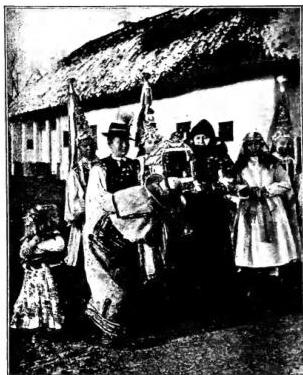
(from E. de Miklós, La Hongrie pittoresque. Budapest 1933, p. 153) A Christmas scene in a Hungarian village.
After the first attempts in the field of periodical press—the Ephemerides Latinae by the Jesuit Márton Szentiványi (Nagyszombat, 1675-1710) and the Mercurius by Prince Rákóczi (1705-10), both aimed at foreign public opinion—and after the first, more or less ephemeral initiatives to offer Hungarian readers newspapers written in Latin or German—such as the Nuova Posonienia (1721), the Ofnerischer Mercurius (1731), and the Pressburger Zeitung (1765)—the first Hungarian-language newspapers emerged in the eighteenth century: the Magyar Hírmondó in Pozsony in 1780, which from 1787 also published a literary supplement, the Magyar Mercurius in Pest in 1787, the Magyar-kurir in Vienna in 1786, the Erdélyi Magyar Hírvevő in Transylvania in 1790, and others.
The three major printing houses of the country—Nagyszombat, Budapest, Debrecen—printed a large number of scientific books, mostly in Latin, which helped to make Hungarian history, legal life, etc., known abroad, as well as to organically integrate Hungary into the European intellectual currents of the time. Comparative linguistics and literary history arose through the work of János Sajnovics and Dávid Cvittinger, respectively, while the flourishing of historiography continued: the Jesuit Gábor Hevenesy, with his collection of sources in 140 manuscript volumes, laid the foundations of Hungarian ecclesiastical history, while György Pray, also a Jesuit, carried out, with his archival research, the drafting of the Annales veteres and Annales Regum Hungariae. The Historia critica by István Katona S. J., in 43 volumes, is the most voluminous historiographical work known to Hungarian literature.
A bridge between scientific and literary prose is constituted by the moral works of the Jesuit Ferenc Faludi (1704-1779), adaptations—through Italian, French, and German translations—of works by the Englishman Darell, the Spaniard Gracian, and others, which represent as many stages in a preventive struggle against the Enlightenment. Ahead of Herder himself, Faludi was the first scholar of popular poetry. While introducing numerous Western forms into his lyrics (including the sonnet and other Italian forms—a fact due to his five-year stay in Rome as confessor to Hungarian pilgrims), he anticipated with his neologisms the linguistic renewal of the end of the century. Baron László Amadé (1703-64) is the other lyric poet who enriched the forms of Hungarian poetry with his versatility, but his predominantly amorous and morally unserious production marks the first phenomenon of secularization in Hungarian literature. Pál Rádai, on the other hand, as a singer of conjugal love, inaugurated a lyrical direction that would later become traditional and find its highest expression in the lyrics of Sándor Kisfaludy and Sándor Petőfi.
The Enlightenment current in Hungarian literature emerged at the court of Maria Theresa, among the young nobles who in Vienna were part of the Queen’s special bodyguard; the first in this current was György Bessenyei, who imprinted upon it a nationalist direction, nor was his Enlightenment free from a profound struggle between nationalist doubt and an inner need for religious faith. More an animator of cultural initiatives than a true creative artist, Bessenyei (1747-1811) nevertheless left precious traces—in tragedy, comedy, epic and didactic poetry, the political novel, etc.—that would be followed in the course of the nineteenth century by artists greater than himself, just as the greater statesmen of nineteenth-century Hungary would bring to completion cultural initiatives that Bessenyei had gradually outlined in his numerous pamphlets. That group of writers who took their name from Bessenyei and worked toward the realization of his program—to advance the nation by cultivating the national language—especially through translations from French, soon gained followers in the homeland and, expanding further, preserved the nationalist program while losing its initial Enlightenment inspiration. The cause, however, must also be sought in the bloody repression of the Jacobin conspiracy led by the cleric Ignác Martinovics, in which numerous writers were also involved and consequently sentenced to more or less lengthy imprisonment.
From the seed sown by Bessenyei, various directions arose depending on the ancient or modern Hungarian or foreign models that inspired them. Thus emerged the Latinizing trend, the Germanizing current, the conservative national school, and the Italian influence, until all these sources converged in the more complex personalities of Kazinczy and Kölcsey.
The initiators of the Latinizing trend were the Jesuit Dávid Baróti (1739-1819), the Piarist Miklós Révai (1749-1807), and the Jesuit József Rájnis (1741-1812); its most accomplished continuator was the Pauline Benedek Virág; only the perfecter and last representative of this school, the Lutheran Dániel Berzsenyi (1776-1836), was a layman. The main merit of the three precursors was to have clarified, through heated polemics, the problems of Hungarian prosody, to have faithfully translated a series of classical and sometimes humanist authors, and to have definitively introduced into Hungarian poetry all classical meters, along with many forms of thought from the Greek world and ancient and Baroque Latinity, enriching the Magyar poetic language. Virág put ancient meters at the service of patriotic topicality, giving popularity to the Latinizing trend. From Berzsenyi, Horatian forms, concision, and psychology are taken up and lived with profound Christian faith. The peaks of his religious and patriotic poetry are respectively the odes Fohászkodás ("Prayer") and A magyarokhoz ("To the Hungarians").
Among the proponents of the conservative national school, the Piarist András Dugonics (1704-1818), the general József Gvadányi, of Italian origin (1725-1801), and the botanist Mihály Fazekas (1766-1828) excel. Dugonics, "the father of the Hungarian novel," translated the Homeric poems and the Aeneid into alexandrines and wrote a series of historical novels, among which Etelka was the first "bestseller" in Hungarian literature. Dugonics owed his great popularity to his fervent nationalism. Gvadányi, in a satirical-moralizing poem, Egy falusi notárius budai utazása ("The Journey to Buda of a Country Notary," 1790), praises the ancient national virtues and condemns the imitation of foreign fashions; in the poem Routé Pál ("Paolo Fracassa"), he narrates the story of a plebeian adventurer. Mihály Fazekas, with the comic poem Ludas Matyi ("Matthias of the Geese"), offers, through the tale of a serf’s triple revenge against a landowner, one of the first social themes in Hungarian literature.
BIBL.:
For the general history of Hungarian literature: G. BÁRÓTI SZABÓ, A magyar költészet tüköre, Pest 1833; J. ERDÉLYI, Magyar irodalomtörténet, Pest 1866; J. HORVÁTH, A magyar irodalom története, Budapest 1934; A. SCHÖPFLIN, Historia critica regni Hungariae, Vienna 1778-84; I. SZÖGI, A magyar irodalom története, Budapest 1905. For the 18th century: J. SZINNYEI, A magyar irodalom története a XVIII. században, Budapest 1889; G. BÁRÓTI SZABÓ, A magyar verselés története, Pest 1835; A. SCHÖPFLIN, Historia critica regni Hungariae, cit.; J. HORVÁTH, A magyar irodalom története, cit.; I. SZÖGI, A magyar irodalom története, cit. For the Rákóczi emigration: L. SZÁDECZKY, Rákóczi Ferencz és kora, Budapest 1910; J. SZINNYEI, A magyar irodalom története a XVIII. században, cit.; K. SZABÓ, Rákóczi Ferencz és kora, Budapest 1876. For Kelemen Mikes: K. SZABÓ, Mikes Kelemen, Budapest 1879; J. SZINNYEI, A magyar irodalom története a XVIII. században, cit. For Ferenc Faludi: J. SZINNYEI, A magyar irodalom története a XVIII. században, cit.; J. HORVÁTH, A magyar irodalom története, cit. For György Bessenyei: J. SZINNYEI, A magyar irodalom története a XVIII. században, cit.; J. HORVÁTH, A magyar irodalom története, cit.; I. SZÖGI, A magyar irodalom története, cit. For the Latinizing trend: J. SZINNYEI, A magyar irodalom története a XVIII. században, cit.; J. HORVÁTH, A magyar irodalom története, cit.; I. SZÖGI, A magyar irodalom története, cit. For the conservative national school: J. SZINNYEI, A magyar irodalom története a XVIII. században, cit.; J. HORVÁTH, A magyar irodalom története, cit.; I. SZÖGI, A magyar irodalom története, cit.
— G. GALBIATI
Close to the national trend yet transcending its school-bound limits stand Sándor Kisfaludy and Mihály Csokonai Vitéz. S. Kisfaludy (1777-1844), an officer stationed in Milan and later a prisoner of war in Provence, came into contact with Petrarch’s poetry and, under the influence of the Canzoniere, wrote the two books of Himfy szerelmei ("The Loves of Himfy: Lament of Love and Happy Love"). In the first, Kisfaludy does not go beyond Petrarchan themes; in the second, however, he sings of conjugal love. A more complex and tragic figure, who lived in poverty and died prematurely, was Csokonai (1773-1805), whose poetic personality ranges from the delicacy of the songs for Lilla—the most ethereal and musical in Hungarian lyric poetry—through the humorous success of the mock-heroic poem Dorottya ("Dorotka, or the Ladies at Carnival"), to the philosophical depth of A lélek halhatatlanságáról ("On the Immortality of the Soul"). He translated works by Tasso, Metastasio, and Guarini.
In the Germanizing trend, the most prominent writers are Gedeon Ráday (1713-92), Gábor Dává (1768-1796), the Pauline Ferenc Verseghy (1775-1822), János Batsányi (1763-1845), and József Kármán (1769-95). In the poetry of Ráday and Verseghy, rhyme and meter appear paired for the first time; Dává is the first melancholic-sentimental voice; Batsányi, initially a revolutionary poet and later a bitter pessimist, is the first theorist in Hungary of artistic translation; Kármán transplants the sentimental novel into Hungarian literature with Fanni hagyományai ("Fanni’s Memoirs"). Literary life in the modern sense of the word begins in Hungary with the activity of Ferenc Kazinczy (1759-1831). Through the publication of literary journals and, above all, his correspondence with all Hungarian writers, poets, and scholars—later collected in 21 volumes—he became the organizer of Hungarian literary life. The controversy that arose following the activity of the neologists, to which Kazinczy himself contributed greatly, especially with his translations from Sallust, Shakespeare, Molière, Goethe, and Lessing, only heightened public interest in literature. Though his poetic creation remains secondary to his organizational and innovative activity, it is nonetheless marked by a highly refined stylistic sense and sure taste. Kazinczy’s companion in linguistic renewal and his follower in poetic direction was Ferenc Kölcsey (1790-1838), a precursor of Hungarian literary criticism and a great political and academic orator, formed on the examples of classical rhetoric. He is the author of the Hymnus (Hungarian national anthem), in which, as in his other civic poems, lyrical inspiration unites with philosophical depth in the interpretation of history.
5. The Nineteenth Century. — This is the golden age of Hungarian literature. The initiatives of organization, linguistic renewal, and poetic creation that matured in the eighteenth century culminate in national Romanticism, which for Hungary constitutes a particularly propitious historical moment in which political and cultural factors inspire and reinforce one another. Nor is it possible in this period to draw a clear distinction between men of letters and statesmen, so deeply does the fervor of national resurgence engage the best intellectuals; already, for example, in the novelist and Minister of Education Eötvös, the man of letters cannot be separated from the statesman. This period extends from 1820 until Petőfi’s debut in 1844 and is dominated by the figures of the poet Vörösmarty, the playwright Kisfaludy, and the novelist Eötvös. A new social consciousness, from which emerged in the national assemblies a series of economic and social reforms—due primarily to the initiative of Count Széchenyi, yet felt and accepted by a public favorably prepared by the activity of men of letters—erupts under Kossuth’s influence into an indomitable drive toward complete national independence. While political progress, culminating in 1848 with the full emancipation of serfs and then in the War of Independence—won by Austria with Russian aid—suffered a long setback during the period of absolutism (1849-67), literary life continued its course, dominated by the figures of the poets Arany and Tompa, the novelists Kemény and Jókai, and the critic Gyulai.
Only in the last two decades of the century did the creative effort of the national genius relax into epigonism, though without overly softening in the intimist atmosphere of the fin de siècle.
The literary activity of Count István Széchenyi (1791-1860), whom posterity ranks as "the greatest Hungarian," ranges from the practical manual A lovakról ("On Horses") to the hallucinatory satire against Viennese absolutism (Blick); his most important works are the volumes Hitel ("Credit"), Világ ("World"), and Stádium, as well as his polemic with Kossuth through periodicals and the volume Kelet népe ("People of the East"), while his diaries constitute a document of the highest value, revealing a soul and an era. The literary fame of Lajos Kossuth (v. KOSSUTH) is tied to his parliamentary and propagandistic speeches.
No less a precursor in historical foresight was Baron Miklós Wesselényi, who with his Szózat ("Appeal") drew the world’s attention as early as 1843 to the growing Slavic danger. Speeches and newspaper articles preserve the sober and rational style of Ferenc Deák, the "sage of the homeland," advocate of the Compromise with Austria. But the most philosophically profound political work of nineteenth-century Hungary remains Eötvös’s fundamental essay On the Influence of the Dominant Ideas of the Nineteenth Century on the State, in Hungarian and German, in which the principles of the French Revolution and other political principles of the era (nationalism, centralism, regionalism, etc.) are dissected and presented in their historical and future realization with acuity and foresight.
The contribution that awareness of ancient glory could make to the formation of a new national mentality was assured to the Hungarians by their greatest Romantic poet, Mihály Vörösmarty (1800-55). He renewed and almost recreated the Hungarian heroic poem with Zalánfutása ("The Flight of Zalán") and other minor poems; with his historical dramas, he immersed the dawn of national history in a Shakespearean atmosphere and reached philosophical depths in the fairy-tale drama Csongor és Tünde; he enriched and intensified lyric poetry and, above all, secured the definitive triumph of linguistic renewal. Lesser in linguistic power but no less important in literary activity was the playwright Károly Kisfaludy (1788-1830), who, while in his historical dramas and social comedies he popularized the new aspects of national consciousness, with the founding of the journal Aurora—the first truly widespread and read literary journal in Hungary—made the capital of the kingdom the center of literary life. A more talented tragedian than he was József Katona (1791-1830), who created with Bánk Bán the representative national tragedy, though fortune smiled upon him only posthumously.
If the historical novel owes its great nineteenth-century popularity to the felicitous vein of Baron Miklós Jósika...
Hungary’s historical novel owes its nineteenth-century popularity to the felicitous vein of Baron Miklós Jósika (1794-1865), yet it attains national significance in the work of Baron József Eötvös (1813-71). His four novels—A harthauzi (The Carthusian), A falu jegyzője (The Village Notary), Magyarország – 1514 – ben (Hungary in 1514), and Nővérek (The Sisters)—are all thesis-driven. The Carthusian, a psychological novel about the search for happiness, teaches that only selfishness fails to find happiness on earth. The Village Notary presents a comprehensive catalogue of feudal abuses in local administration, arguing for the ineluctable necessity of centralization. In Hungary in 1514, the social reformer speaks through history to point the nation toward its other great ineluctable task: the emancipation of serfs. The last, The Sisters, demonstrates through the divergent fates of two identical beings the decisive importance of education; here, Eötvös the education minister delivers to his compatriots the most vital lesson from his lofty chair.
The golden age of Hungarian literature, its national classicism, arises from grafting the populist tendency onto the trunk of Romanticism. Petőfi, Arany, and Madách are universally acknowledged figures, though not widely known. Sándor Petőfi (1823-49), Hungary’s greatest lyric poet, cultivated every poetic genre—narrative, patriotic, and domestic lyric—yet he may be at his greatest as a poet of landscape, where he combines impressionistic hypersensitivity with an almost primitive simplicity of tone. Permeated by a vivid social conscience and continually stirred by a revolutionary temperament, Petőfi was at the same time a man of profound moral integrity, a naturaliter christiana soul. In this respect, he resembles János Arany (1817-82), a notary and teacher in a modest agricultural town who later became secretary-general of the Hungarian Academy in the capital. Arany translated Tasso, Shakespeare, and the complete works of Aristophanes, yet he wrote no plays; he was a lyric poet, but one of reflection rather than passion. He reached the highest peaks of his art in narrative poetry: in the heroic-popular trilogy Toldi, in the poems on the origins of Hunnic-Magyar history Buda halála (The Death of Buda), and in numerous ballads of Nordic type. Mihály Tompa (1817-68), an elegiac and allegorical poet, found his most felicitous accents in the years following the War of Independence, when his poems brought consolation to many patriots: A gólyához (To the Stork), A madár fiaihoz (The Bird to Its Young). During the oppressive years of absolutism, the bulk of the literary activity of the novelist Baron Zsigmond Kemény (1814-75) also unfolded. In his novels, which focus on episodes from Transylvanian history, he achieves a rare power in reviving the animating spirits of different past eras. With over 100 volumes of novels and short stories, Mór Jókai (1825-1904) is Hungary’s most prolific, imaginative, and captivating storyteller, though not the deepest or most morally grounded. Imre Madách (1823-64), with his historical-philosophical drama Az ember tragédiája (The Tragedy of Man), resolves the search for meaning in history through a Christian pessimism.
The creative work of Hungarian poets and writers during this golden age was effectively supported by the critical efforts of József Bajza (1804-58) and Pál Gyulai (1825-1909), who were poets themselves.
6. The Twentieth Century. – The writers who emerge at the dawn of our century draw their origins from various currents: realism, naturalism, symbolism. In the 1800s, Hungarian literature reached the intensity of Western literatures; with the twentieth century, it aligns with them in perfect simultaneity. Poetic translation becomes a crucially important national literary category without detriment to the originality of Hungarian writers. Numerous literary journals arise: the conservative Új Idők (New Times) and Napkelet (Orient), the Catholic Élet (Life), and the progressive A Hét (The Week) and Nyugat (West), in whose pages sharp yet invigorating polemics flare between conservatives and Westernizers. The First World War does not inflict excessive damage on Hungarian literary life, for on the one hand, it revives patriotic literary forms through irredentism, while on the other, thanks to the activity of writers gathered around the journal Bódlyá Helikon, it gives rise to a Transylvanian literature imbued with a particular fervor. Against the decline in taste, the most important literary journal, Nyugat, reacts under the long editorship of Mihály Babits, who gifted Hungarians with a magnificent translation of the Divine Comedy and numerous medieval sacred hymns. Immorality or amorality is found only among the mediocre; the greatest writers, even if more or less distant from Christianity, are religious souls who reveal their inner turmoil before the Divine: this is the case with the symbolist-Nietzschean Endre Ady (1877-1937) and Dezső Kosztolányi (1885-1937), who evolves from a crepuscular poet into a modern Stoic; or, in the younger generation, Attila József (1905-37), who rises from Marxist origins to become a singer of universal love, and Sándor Weöres (b. 1913), a surrealist whose struggle between Indo-Buddhist ideologies and Christianity remains ongoing.
The important group of sociographers, through patient work of survey and literary documentation, has championed agrarian reform in the eyes of the national public. The leading figure among them is the poet Gyula Illyés, though their spiritual lineage undoubtedly derives from the realist novelist Zsigmond Móricz (1879-1941) and Dezső Szabó (1879-1945), a verist and stylistic Romantic. In contrast to the gradual secularization of Hungarian literature in the nineteenth century, the first half of the twentieth century is marked by a reverse process, both through the intensification of religious spirit and the growing participation of ecclesiastics in intellectual and literary life. The apologist Ottokár Prohászka, Bishop of Székesfehérvár (1858-1927), the orator Tihamér Tóth (1889-1936), and the dogmatic theologian Antal Schütz O.P. (b. 1880) exerted a decisive influence on the spiritual formation of Hungary’s new generations. The priest-poets Lajos Harsányi (b. 1883), Sándor Sik (b. 1889), and László Mécs (b. 1893) are at the forefront of twentieth-century Hungarian poetry. All these moral values may one day serve to mend the rupture that the Second World War has produced in the development of Hungarian literature.
BIBL.:
For the general history of Hungarian literature: G. BÁRÓCZI, A magyar irodalom története, Budapest 1939; G. BONFANTINI, Storia della letteratura ungherese, Milano 1936; A. CSERESNYÉS, A magyar irodalom története, Budapest 1934; L. LEGRADY, Geschichte der ungarischen Literatur, Berlin 1906; J. HONT, A magyar irodalom története, Budapest 1934; A. SCHÖPFLIN, A magyar irodalom története, Budapest 1923-25; A. TALLIÁN, A magyar irodalom története, Budapest 1935. For the nineteenth century: P. GYULAI, A magyar irodalom a XIX. században, Budapest 1896; J. BAYER, A magyar irodalom története a XIX. században, Budapest 1906; A. SCHÖPFLIN, A magyar irodalom a XIX. században, Budapest 1913. For the twentieth century: M. BABITS, A magyar irodalom története, Budapest 1934; L. NÉMETH, A magyar irodalom a XX. században, Budapest 1936; A. SCHÖPFLIN, A magyar irodalom a XX. században, Budapest 1937. For individual authors: see the respective entries in this encyclopedia.
G. BONFANTINI
VI. ARCHAEOLOGY
Present-day Hungary comprises parts of Valeria, Pannonia Prima, and Pannonia Secunda. In 378, the region of Sabaria was plagued by Arianism (St. Ambrose, De fide, II, 140: PL 16, 613). In Valeria, the cemetery of Sopianae, today Pécs, is well known. Episcopal sees existed in Sopianae, Scarbantia, and Sabaria in Pannonia Prima. Here, we shall consider all of Pannonia, without regard for the current political division.In Sirmium, the Syrian Martyrology records on April 6 the bishop Irenaeus (BHG, 2nd ed., 948), mentioned on August 23 in the Synaxarium of Constantinople and in the Passio Pollionis (BHL, 6869); then on April 9, Demetrius, who may be the martyr of Thessalonica; on July 20, Secundus, as in the Hieronymian Martyrology, which also lists him on July 15; on February 23, the martyr Syneros (BHL, 7595, as Passio s. Sereni). In the cemetery of Sirmium, two inscriptions were found with "ad beatum Synerotem" and "ad domnum Synerotem" (CIL, III, 10232-33; G. B. De Rossi, in Bull. arch. crist., 4th series, 3 [1884-85], pp. 144-48). On March 26 and May 11, Montanus is recorded, who also appears in the Passio Pollionis (BHL, 6869); on March 26, some codices of the Hieronymian Martyrology instead give Munatius, and the Bernese codex recalls him together with his wife Maxima, describing him as a presbyter "de Singidionis" and adding that, after being thrown into the river, his body was found six miles downstream. On December 25, Anastasia is recorded, whose relics were transferred from Sirmium to Constantinople (Theodore the Reader: PG 86, 216).
In Cibalae, the martyr Pollio, primicerius of the readers, is venerated; in the Hieronymian Martyrology, he appears on April 28 and May 29, as in the Passio, which also recalls a bishop Eusebius martyred on the same day many years earlier (BHL, 6869). During Marcus Aurelius' campaign against the Quadi near Cotinium in 174, the miracle of the rain occurred following the prayers of the Christian soldiers of the "Legio XII Fulminata" (v.). From Sabaria, the birthplace of St. Tours (v.), comes the martyr bishop St. Quirinus, later translated to Rome "in Catacumbas." Pannonian are the celebrated Four Crowned Martyrs from the imperial "Comitatus," translated in the 5th century to the cemetery "inter duas lauros" (v.). A three-naved Christian basilica was identified at Fenékpuszta, two at Kékkút, one with three naves and the other with a complex of rooms (L. Nagy, I ricordi cristiano-romani trovati recentemente in U., in Atti del III Congresso internaz. di arch. crist., Rome 1934, pp. 298-99, figs. 3 and 4). Beyond the well-known hypogeum of Five Churches (Pécs) with paintings from the late 4th century, a Christian cemetery was discovered at Kisdiós-puszta near Zala (L. Nagy, in Archaeologiai Értesítő, 45 [1931], pp. 29-32). "Cellae trichorae" came to light in old Buda at Sirmium, at Sárisáp near Strigonium, and at Kisdiós-puszta in the center of the aforementioned cemetery. From Sirmium, there is a fragment of an inscription of a bishop (CIL, III, 14310, 2). Among the Christian inscriptions of Sabaria, one mentions the reconstruction of a "crypta vi ignis exusta" (ibid., 3183), another of a "Nammius Quintus, custos cymiteri" (ibid., 4222), and another of two Christian pilgrim painters who died in Sabaria (ibid., 7222). Also from Sabaria are the Christian inscriptions of a "civis Graecus ex regione Ladicensi in Deo vivas" (ibid., 4222); two with the formulas "in Domnio bone memorie" and "bone memorie in Deo vivatis" (ibid., 4217-18); a "Florentius infans" who "requiem acceptit in Deo Petre nostro et Christo eius" (ibid., 4221); "Aspalia fidelis, Gaudentius ex praepositus Silvarum Dominicarum et Crescentia parentes fideles" who made the tomb also for themselves (ibid., 4219). At Alt-Sziszeg, the inscription of a Felicissima with two Aᵍo. In 1938, near the garden of the Seminary in Sabaria, a Christian basilica resurfaced, with part of its mosaic floor and an ancient Roman road upon which a "cella trichora" was built (S. Paulovics, "Basilica ad Scarabatensem portam" di S. Quirino in Sawaria, in Atti del IV Congr. internaz. di Arch. crist., II, Vatican City 1948, pp. 49-63). In ancient Lugio, today Dunaszekcső, the base of a glass cup in gold was found, depicting a soldier and his wife with the inscription "semper gaudestia in nomine Dei" (L. Nagy, in Theologiai Szemle, 5 [1929], pp. 158-63). Many clay lamps with the "Signum Christi" or the letters were found in various places. At Bonyhád, a Christogram was discovered on a bronze disk over 23 cm in diameter, now in the National Museum of Budapest. From Sabaria comes a clay lamp with St. Menas. Numerous bronze relief plates intended to adorn caskets contain pagan scenes alternating with Christian ones, as in those from Császár and Szentendre, the ancient "Ulcisa castra," where, for example, Daniel among the lions, the resurrection of Jairus' daughter, the multiplication of the loaves, and then a Hercules are depicted, along with the inscription "Invicto Constantino felici triumphanti." In one from Intercisa, now in the Ethnographic Museum of Berlin, alongside the Good Shepherd is the Emperor on horseback (G. Supka, Frühchristliche Kästchenbeschläge aus Ungarn, in Römische Quartalschrift, 27 [1913], p. 162 ff.).
VII. ART
The artistic cultures that developed in the territories of the Danube basin, later occupied by the Hungarians, prior to their arrival were those typical of the various peoples who had inhabited the region in successive phases: Huns, Scythians, Avars, Lombards; cultures that, locally, had grafted onto the remnants of that which had developed in Dacia and Pannonia during the time of Roman dominion.It was St. Stephen, first king of the Hungarians (997-1038), who, by converting his people to the Christian faith, also oriented their taste toward the West, as evidenced by the few remains of the constructions dating back to his era in Alba Regia (Székesfehérvár) and Alba Julia (Gyulafehérvár).
Then, during the Romanesque period between the 12th and 13th centuries, important churches were built, particularly in Pannonia in the ancient capital of Strigonia (Esztergom), of which more or less altered remains survive, testifying to the introduction into the territory of architectural elements of Lombard and French taste. But it was precisely at the beginning of the 13th century that Gothic forms also began to appear in Hungary. These were imported especially by the Cistercian, Cluniac, and Premonstratensian monks who had great abbeys in the territory. Among the French architects then active in Hungary, Villars de Honnecourt, author of the cathedral of St. Elizabeth in Kassa (Košice), should be particularly noted. Churches of French-derived Gothic forms were also built at that time in Buda, Pozsony (Pressburg), Győr, Kesmark, Tyrnau, and Trencsén (13th-14th centuries). Gothic forms are also seen in the cathedral of Rosenau and later in the chapel of St. Michael in Kassa.
The latter is in late Gothic (flamboyant) style and dates to the 15th century, while the fine Episcopal Palace of Kuttenberg was built between 1470 and 1506.
Meanwhile, direct artistic relations with Italy were also intensifying. These began when the Angevin princes of Naples ruled the Hungarians during the 14th century and then continued throughout the Renaissance. Niccolò di Tommaso, a Florentine painter, worked during the 14th century in the palatine chapel of Esztergom, while in the museum of that city are preserved panels painted by Thomas of Kolozsvár (Cluj) — the foremost exponent of Hungarian painting at the beginning of the 15th century — whose works show elements derived from Italian art and particularly from Gentile da Fabriano, among whose pupils was a Hungarian named Michele. Moreover, it is known that Masolino da Panicale worked in Hungary around 1430 and that, some time later, Michele Pannonio from Ferrara introduced elements of Italian taste into Hungary. Subsequently, the Hungarian master who signed his works with an M. S. clearly shows strong Umbrian influences among the elements of his formation. In any case, it is evident that during the 15th century, it was Italian Renaissance art that assumed a decisive prevalence in Hungary. This reflected the precise will of Matthias Corvinus, who reigned over the Hungarians from 1458 to 1490. In his time, great works were undertaken throughout Hungary. While Pellegrino da Fermo and Benedetto da Maiano worked for the king in Buda Castle, other Italian artists, such as Aristotele Fioravanti, Camicia Ghiemanti, and Baccio Cellini, also worked for him; in Florence, he commissioned works from Verrocchio and Filippino Lippi, painters, from Cristoforo Romano, sculptor, and from Altavante and Gherardo, miniaturists.
The fashion for Renaissance forms continued in Hungary even after the death of King Matthias. This is evidenced by the chapel annexed to the Cathedral of Esztergom (Gran), built in 1507 for the primate Thomas Bakócz by Andrea Ferrucci da Fiesole.
By then, Hungarian architects were already adapting imported Renaissance forms to their own taste. This is seen in buildings, even of minor importance, in the territories of Szepes and Sáros, where stylistic forms echoing Italian Renaissance themes evolved in a minor key well into the 18th century.
However, the Turkish invasion (1526) had interrupted that migratory flow of Italian Renaissance artists into Hungary. It was not resumed until the northern regions came under Habsburg dominion at the end of the 16th century, and it became more intense in the 17th century when some Italians active in the neighboring German territories, such as the Carlone dynasty of Lombard origin, worked in Hungary. Alongside them, Austrian artists of more or less Italianized culture were also active. Thus, later, when the entire Hungarian territory was liberated from the Turks, the reconstruction or new construction of churches and castles proceeded. In addition to Italian architects, the Bibiena family worked in the region as decorators, while numerous works were built and decorated by German architects such as Lukas von Hildebrandt and Melchior Hefele, and painters like Maulbertsch, Dorfmeister, Troger, and Bergl, whose culture was essentially Italian, indeed Venetian, in character. Among the neoclassical architects who worked most extensively in Hungary at the beginning of the 19th century, giving a new character to the capital of Budapest, the Viennese Michele Pollak (1773-1885) should be particularly noted, brother of that Ludovico who worked so extensively in Milan during the same period. Alongside him, Giuseppe Hild, Federico Feszty, Michele Péchy, and Mattia Zitterbarth should also be mentioned.
Among Hungarian sculptors of the first half of the 19th century, István Ferenczy (1792-1856), who had been a pupil of Thorvaldsen in Rome, should be particularly recalled. Other notable Hungarian sculptors of the 19th century were Miklós Izsó (1831-75) and János Fadrusz (1858-1903), the latter the author, among other works, of the honorary statue of Matthias Corvinus in Kolozsvár (Cluj) and of Maria Theresa in Bratislava.
It should also be noted that, while Hungarian painters of the 19th century largely followed the tastes of the Austrian and Italian academies, the Hungarian Károly Markó (1791-1860) moved during the first half of the 19th century to Florence to paint landscapes of Romantic character, not without elegant refinement. In Florence, a large group of painters depended on him, including his sons and nephews, who continued his manner until nearly the end of the century.
Contemporaneously and subsequently, a local artistic current was asserting itself in Hungarian territory, in which elements of the ever-flourishing and picturesque local folk art merged with others derived from the so-called Viennese Secession and still others linked to the most modern expressions of international taste. The most significant and original contemporary artists working in Hungary also belong to this current.
VIII. SCHOOL SYSTEM
As early as 1945, plans were made for a democratic reform of the Hungarian school system, encompassing the entire educational structure while preserving what was justified by experience and filling gaps with new methods and programs more aligned with communist ideology. The first step was taken in 1946 with the establishment of the General School.1. The General School. — This institution combines the four elementary grades and the four middle school grades, previously distinct, into a new unified school, compulsory for all, lasting 8 years, from ages 6 to 14. The aim of the reform, as stated by the Minister in the preamble to the programs, is to provide students with «a unified basic education; to enable them for further instruction and self-education in any field, and to form a conscious and moral member for the life of the Hungarian community». The curriculum initially included both compulsory and elective subjects, allowing ample opportunity to choose, alongside a unified basic education, those disciplines that had sparked greater interest in students. However, in 1949, elective subjects were significantly reduced in hours and number; among those eliminated were Latin and modern languages, while the study of the Russian language remained compulsory. In the same year, religious instruction also ceased to be mandatory in the General School.
5. Secondary Education
According to the program outlined by decree in 1948, secondary education comprises three main groups of schools, two of which are subdivided into various types, tailored to the future orientations of students. a) The first group, or «gimnázium», consists of a single type of school, for boys and girls, lasting 4 years, roughly corresponding to our liceo, and divided into three parallel sections: 1) classical section, featuring the study of Latin and one modern language; 2) modern languages section, without Latin but with two modern languages; 3) sciences section, without Latin, with one modern language and a broader development of scientific subjects. At the end of the fourth year, students take the maturità exam before an internal commission; the diploma grants access, for the classical section, to all university faculties; for the sciences section, only to the faculties of medicine, physics, and chemistry, and to higher technical studies. b) The second group includes the following school types: 1) 4-year industrial secondary school, with two sections: mechanical and chemical; 2) 4-year commercial secondary school; 3) 4-year agricultural secondary school; 4) 4-year horticultural secondary school, with a program similar to the agricultural school but with special horticulture subjects; 5) 5-year male and female teacher training secondary school; 6) 3-year secondary school for the training of kindergarten teachers, plus 1 year of internship; 7) 4-year male and female «liceum» with a practical orientation: knowledge of economics, particularly domestic, fundamental notions of family and child education.c) The third group, of artistic orientation, was to include the following types: 1) secondary school of fine arts; 2) secondary school for the training of film artists; 3) secondary school for the training of theater artists; 4) secondary school of music.
However, as early as 1949, this panorama of secondary education underwent several modifications: reduction of the curriculum, deemed overloaded, intensification of the study of Marxist-Leninist ideology, and the struggle against clericalism and chauvinism. Furthermore, all secondary schools would take the name of «ginnasi», and the same subjects would be distributed differently.
Higher Education. — According to the 1950 reform programs (still subject to further partial reforms in individual branches), higher education comprises universities and higher schools. a) Universities of technical sciences: 1) Technical Sciences of Engineering in Budapest (mechanical, road, electrical, hydraulic, civil, and chemical engineering); 2) Technical Sciences of Heavy Industry in Miskolc (with 3 sections: mining, foundries, machinery); 3) Technical Sciences in Sopron (with 2 sections: forestry and surveying); 4) Technical Sciences of Heavy Chemical Industry (chemical engineering). b) Hungarian University of Economic Sciences in Budapest (with specializations in industry, commerce, agricultural economics, general economic sciences, and teacher training for secondary schools). c) Universities of studies: 1) in Budapest (with 3 faculties: sciences, philosophy, law); 2) in Szeged (with 4 faculties: natural sciences, philosophy, law, medicine); 3) in Pécs (with 3 faculties: natural sciences, law, medicine); 4) in Debrecen (with 3 faculties: natural sciences, philosophy, medicine). d) University of Agricultural Sciences in Budapest (with 3 faculties: veterinary, agricultural economics, horticulture). e) Higher schools: 1) of Business and Commerce in Budapest (with 3 specializations: business management, domestic and foreign trade); 2) of Technology in Budapest (textile mechanics, coal mining, leather chemistry, etc.); 3) of Pedagogy in Budapest, Szeged, Eger, Pécs (languages, sciences, physical education, etc.); 4) of Fine Arts in Budapest (painting, frescoes and graphic arts, sculpture, drawing); 5) of Decorative Arts in Budapest (interior decoration, ceramics, scenography, etc.); 6) of Music in Budapest (composition, conducting, various instruments); 7) of Dramatic Arts in Budapest (acting, theater and film direction); 8) of Physical Education in Budapest.
Universities and higher schools as a whole are primarily valued for their practical purposes.
Supporting institutions for better school performance and general cultural formation include the Institute for Popular Culture (1946) and the Institute for Popular Culture Films (1947), to which were gradually added scholarship grants, student welfare provisions, and study facilitations for workers. — Vedi tavv. LXXVII-LXXVIII.
It parallels the generalizing tendency of theoretical sciences and the standardizing tendency of applied sciences. In production, unification results in the determination of commodity and construction types, as well as in measures and measurement systems; in exchanges, it manifests through the unification of commercial customs and contract clauses. In Italy, the establishment of a Committee for Industrial and Mechanical Unification (UNIM) dates back to 1921, later transformed into UNI (Unificazione nell'Industria) and finally (1946) into the Italian National Unification Body, a national organization federated with similar ones in the ISO (International Standard Organization), based in Geneva.
Contractual unification is achieved by so-called public services, the foremost example of which is the Universal Postal Union (v. UNIONI AMMINISTRATIVE); and processes of unification affect law (international, commercial, maritime, and private; the protection of intellectual property, etc.), economic and social policy (customs lists and tariffs, welfare and assistance, labor contracts, markets, currencies, armaments, etc.). The general purpose of all unifications is greater simplicity and correctness in economic life, and, by reflection, in social life, through the concentration of services and the increased efficiency of bureaucratic and exchange-related work.