
TURCO-MONGOLI. — I. The Turkic peoples have spread throughout Asia and Europe. In south-eastern Europe there are the Ottoman Turks of Anatolia, the only ones to have preserved the Turkish language, but culturally they have undergone Mediterranean influences and have been Islamized. Of the ancient Bulgarians of the Volga (Russia) and the Balkans, only anthropological types can be identified, since they have lost their originally Turkic language and culture. In south-western Asia there are many Turkic tribes: the Kara-Kirghisi (Black Kirghiz), the Kazacchi, the Kirei, the Kara-Kalpaki (Black Caps), the Usbecchi, the Taranci, the Sarti, the Aserbagiani, and the Turcomanni—tribes that speak Turkic languages but have been Islamized, and of which only some are still made up of nomadic shepherds, the others having beco-
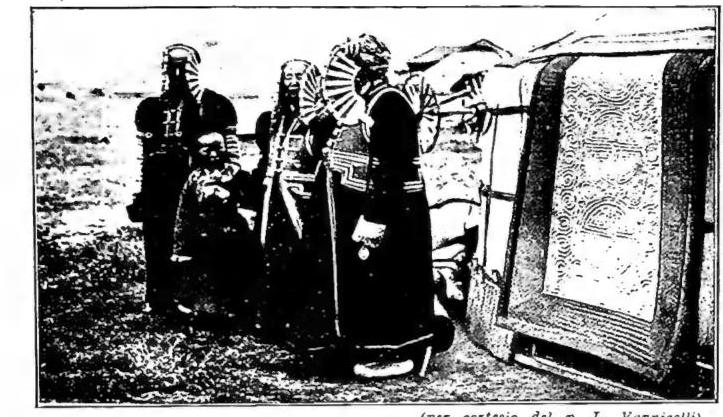
The Turks who have preserved their language and much of their original culture are the Turkic tribes of Central Asia, found to the north and south of the Altai Mountains and in the plains of the upper course of the Yenissei and its tributaries. They have been divided into four groups: 1) the Tatars of the southern Altai, also called Telengut, with four subgroups; 2) the Tatars of the northern Altai, with five subgroups; 3) the Tatars of Abam, with seven subgroups; 4) the Sojoli or Sojoni-Caragassi, also called Tuba or Uriankhai, with six subgroups. The linguistically purest Turks are the Telengut, who derive from the ancient Tukile Turks and the Uighurs, including the blond Tingling and the Hakas Kirghisi. Some of these groups are Turkicized Samoyeds or Yenisseians, or mixtures of Turkic tribes with Yenisseians, such as the Turks of Abacan; others are completely russified, such as the Tšelim Tatars, or Islamized, such as the Barabba Tatars. Originally, the economy of the Turks was based chiefly on horse breeding, from which they obtained milk, meat, hides, and means of transport; they knew neither goat- nor pig-breeding, nor agriculture. Today, however, a large herd of livestock, for example among the Kirghisi, may comprise eight or ten thousand horses, twenty thousand goats and cattle, one thousand camels, and fifty thousand sheep. The Turks, devoted to pastoralism, lead a nomadic life in the steppes and a somewhat sedentary one in the abundant pastures of the Altai Mountains, rightly called the shepherds’ paradise. They are transhumant; the year is divided into two parts, summer and winter. Formerly, like the Indo-Europeans, they used to make large fires producing much smoke, to protect themselves and their livestock from insects (horseflies and mosquitoes) and diseases. Their weapons were the reflex bow and arrow; later they developed cavalry and used the war chariot, both of which were of great military and political importance. The house was an underground dwelling, but at the same time, or soon thereafter, the tent also existed. The Turks in general care little for purely physical labor. Since the economy was chiefly masculine and required many people to manage the large herds, it led to the formation of the extended family under unified direction. After marriage, the sons remain under the authority of their father, and, upon his death, pass under the authority of the elder brother, the firstborn son; this is the so-called right of primogeniture. Many male children are desired; the woman is in a socially, legally, and economically inferior position and has no right of ownership, although her dowry cannot be disposed of without her consent.
There is an accentuation of the patria potestas, which often becomes despotic and gives the patriarch a kind of majestic bearing within the family, even toward his wife. Marriage is monogamous, though not exclusively so today; nevertheless, from the legends of the primitive heroes of the tribe it appears to have been regarded as the ideal form of marriage. This fully justifies the movement of modern Turkey to restore its people to this pre-Islamic ideal of monogamy. Marriage requires the bride’s integrity, to such an extent that proof of her virginity is also demanded. If the test should reveal the contrary, the marriage is considered invalid, the family believes itself dishonored, and the bridegroom—for example, among the Kirghisi, enraged—kills his own horse, destroys the bridal tent, and insults the family, especially the bride’s parents. Marriage is a purchase of the bride, but she receives a dowry from her family, which mitigates this character. Kinship by blood is highly developed and forms the basis of exogamy; for example, kinship by marriage may end at the first collateral degree. The Yacuti, for example, are grouped into clans (aga-usa), nasleg, and ulus. A clan sometimes consists of only a few individuals, and at other times of several hundred. A nasleg comprises from one to more than thirty clans. The ulus is often formed by several nasleg. The entire clan is jointly responsible for a homicide committed by one of its members; it is obliged either to exact blood revenge or to pay compensation. Blood revenge was sometimes hereditary for many generations. An injury inflicted by one person of the clan upon another person of the same clan is not punished; when, however, there is a homicide, the murderer is tied to a tree in the forest and left to die of hunger. The order of precedence within the kinship is keenly felt: the assembly, for example, of an ulus consists of three circles. In the first circle sit the clan chiefs (bis-nus-toyons) and the sesiny; in the second, the nobles (toyons) and warriors (batirs); in the third, the people and the young. Each clan is grouped behind its representative in the first circle.
The Turks passed from hunting to livestock breeding; among them there are no indications of matriarchy or totemism. In nomadic Turkish society, a division into ranks, called “white bones” and “black bones,” has been observed. As long as the Turks remained nomadic, they showed no tendency toward state life or the formation of states, but remained organized in extended families and clans (gentes). Only among the Altai Turks has the initiation of youth been noted; it is reduced, however, to the rite of cutting the forelock of pubescent males and is individual in character; nothing is done for young women. The Turks are strongly inclined toward narrative art. They have heroic legends, rhapsodies, and epic songs of great length. Their religion is based on belief in and worship of God, a supreme personal being, creator of heaven, earth, man, and all things, called Tengri (God of heaven) or Heaven; animals, especially the horse, are consecrated or offered in sacrifice to him. In spring, which may be compared for nomadic shepherds to harvest time, the first-fruits sacrifice is offered to the God of heaven; it consists in offering fresh mare’s milk and fresh grass or moss. The God of heaven is held to stand in special relations with the sun, the moon, thunder, and lightning. Today there is a white and a black shamanism, but originally every form of shamanism was absent, as was also belief in subterranean divinities (the deities of the earth). Dualism, consisting in belief in benevolent deities of light, imagined as dwelling above, and malevolent deities of darkness, placed below on the earth, came from the south together with shamanism. In ancient times there were two mythological beings, similar to the Dioscuri of the Indo-Europeans, who were conceived as standing in special relations with the stars, the horse, and the peg; the east was regarded as the sacred cardinal point; there was a particular cult of ancestors and heroes, while the cult of the bear was absent. Among the Altai Turks, representations of the Somo are made; they represent the souls of the nine ancestors, charged with protecting their descendants. The monotheistic religion of the God of heaven was so strong and profound that among the present-day Yugur, descendants of the ancient Uighurs, it has not only not been destroyed by Buddhist Lamaism but has also exerted a great influence upon II.
II. The Mongols, from mong-hol (valiant?), the proper name of a horde of Genghis Khan, which in 1189 was given to the entire nation, are divided into many groups, based on consanguineous kinship, the principal ones being the Buriats, the Khalka, the Sunit, the Gahar (in the steppes of the Gobi), the Oled (Eleuts, Oirat, Uroti), the Turgut (Alashan), the Ordos, the Tangut (in the upper basin of Kuku-nor), and the Sciaro (in Lop-nor). The culture of the Mongols is similar to that of the Turks. Since the thirteenth century they have been Lamaists. There are some groups, especially marginal ones, devoted to agriculture. Like the Turks, the ancient Mongols had a religion founded on belief in and worship of the God of heaven; today, however, it is observed that they lack the idea of a Supreme Being and believe in several spiritual beings who, for example among the Buriats, are divided into classes, each having its own chief. The higher spirits dwell in heaven and are called Tengeri; Tengeri, Tengeri are ninety-nine in number, and each has its own name. Those of the west are called Baruni, those of the east Zuni. The Baruni are good and more numerous than the others, numbering 55, and are called White Tengeri (Sangani Tengeri); the Zuni are evil, are called Yellow Tengeri (Kharun Tengeri), and number forty-four. Even today, however, there are some Mongolian groups that preserve alive the faith in the God of heaven.
III. The T
M. peoples have remained famous in history as strong, terrible warriors and founders of vast empires and great dynasties. In the Middle Ages they were united in Central Asia into a powerful nation by Genghis Khan, a ferocious leader, defined as the scourge of humanity, born ca. 1155–1156. They became the terror of Europe, reaching as far as Germany and Hungary; they invaded almost all of Asia, reaching Japan and ruling over peoples of high civilization, such as the Chinese and Indians. Particularly worthy of mention are the three khanates founded by them in Persia, Turkestan (Chagatai), and southern Russia (Kipchak). The T.-M. unquestionably form a group of peoples related by language and culture (today a very complex culture), and are called Altaic peoples. From the beginning, however, the Turks were, as has been said, typically horse breeders, while the Mongols appear in an intermediate position, since on the one hand they are genuine breeders of horses and camels, while on the other they possess a mythology in which the ox is deeply rooted; the Buriats, for example, recognize as their mythical ancestor a bull-shaped being called Bucha nojon babà. The Mongols therefore present themselves as a composite of various racial and cultural elements. Anthropologically, the T.-M. are two distinct races: the Turks are of the Turanid race, belonging to the Europids; the Mongols are of the Tungid race of the Mongolids, according to Biasutti’s anthropological classification. Von Eickstedt notes something Mongolid in the Turanid race, since it was situated near the place of differentiation of the races and in proximity to the Paleomongolids.Linguistically, the Tungus and Manchurians, the Koreans and Japanese, the Uralic peoples (Ugro-Finns), according to Trombetti and others, and the Aleutians and Eskimos, according to W. Schmidt, have also been classified with the T.-M. in the Altaic stock, thus forming the Uralo-Altaic group. There are, however, scholars who do not yet consider the internal affinity not only of the Uralo-Altaic group but even of the Altaic group itself to have been sufficiently demonstrated, since they do not regard the inclusion of Korean and Japanese in it as securely proven.