Also known as:
Greek: Διόσκουροι;
Castor and Pollux, Dioskouroi;
Latin: Tyndaridae
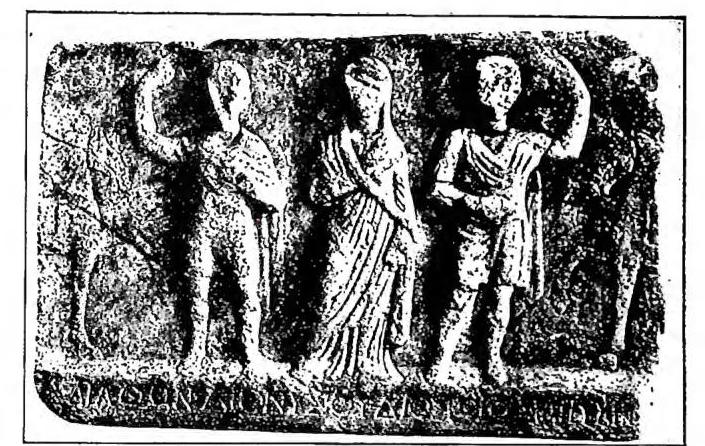
DIOSCURI - The d. with a female figure in the center (2nd century AD). Istanbul, museum.
DIOSCURI (Didachúra). - Greek divinities: they were twins, Castor and Pollux, young and very beautiful, sons of Zeus and of Leda, brothers of Helen, but, according to others, only Pollux was the son of Zeus and immortal.
Their nature is debated: they would be gods of light, or of light and darkness, or two heroes of Laconia substituted for the twins of Zeus, or Mycenaean household divinities of the kings of Sparta. The cult is especially localized in Sparta and its territory (the sanctuary of Therapne being famous) and in its colonies. From Sparta come numerous reliefs depicting the D. on either side of a female xoanon with a tall polos on the head and fillets in the hands, an evident depiction of Helen. Outside Sparta the D. replaced pairs of local divinities; in historical times they often merged with the Cabiri, the Curetes, the Corybantes, etc. For Homer, Castor was a tamer of horses, Pollux the inventor of boxing. They were gods who saved people in the dangers of war, of travel, of the sea, of illnesses. Their symbols are the βόχανα, of uncertain meaning, horses, or two amphorae, two stars, two Phrygian caps. Widespread among the myths about the D. are the participation in the expedition of the Argonauts and the abduction of the Leucippides.
Bibliography4 worksBethe, s. v. in Pauly-Wissowa, V, t. coll. 1087-1123; G. Bendinelli, s. v. in Enc. Ital., XII (1931), p. 949 agg.; M. Nilsson, Gesch. der Gr
BIBL.: Bethe, s. v. in Pauly-Wissowa, V, t. coll. 1087-1123; G. Bendinelli, s. v. in Enc. Ital., XII (1931), p. 949 agg.; M. Nilsson, Gesch. der Griech. Rel., I, Munich 1941, p. 380 agg. For the Spartan reliefs: N. M. Tod and A. J. B. Wace, A Catalogue of the Sparta Museum, Oxford 1906, p. 113 agg. For the cult in Italy, G. Giannelli, Culti e miti della Magna Grecia, Florence 1924, passim; Fr. Altheim, Griechische Götter im alten Rom. (Religionsgesch. Versuche und Vorarb., 22, 1), Giessen 1930.
Banti, Luisa. “Dioscuri (ΔΙΔΑΧΟΎΡΑ).” In Enciclopedia Cattolica, vol. IV, col. 1682. Città del Vaticano: Ente per l’Enciclopedia Cattolica e per il Libro Cattolico, 1950. https://azioneromana.com/article/dioscuri-didakhoura.
MLA
Banti, Luisa. “Dioscuri (ΔΙΔΑΧΟΎΡΑ).” Enciclopedia Cattolica, vol. IV, Ente per l’Enciclopedia Cattolica e per il Libro Cattolico, 1950, col. 1682. Azione Romana, https://azioneromana.com/article/dioscuri-didakhoura.
BibTeX
@incollection{ec4_dioscuri_didakhoura,
  author    = {Banti, Luisa},
  title     = {Dioscuri (ΔΙΔΑΧΟΎΡΑ)},
  booktitle = {Enciclopedia Cattolica},
  volume    = {IV},
  pages     = {1682},
  note      = {Cited by column},
  publisher = {Ente per l’Enciclopedia Cattolica e per il Libro Cattolico},
  address   = {Città del Vaticano},
  year      = {1950},
  url       = {https://azioneromana.com/article/dioscuri-didakhoura}
}
One of some 20,000 entries brought back from the twelve printed volumes (1948–54). Spotted something? Help us improve it.
Click or scroll to zoom · drag to pan · Esc to close