
CONSANGUINEITÀ (Latin consanguinitas; Greek ὀμειμότης = being of the same blood).
I. BIOLOGY
According to its etymological and literal meaning, c. is the attribute of individuals having the same blood and essentially expresses, in accordance with the findings of modern genetics, the biological relationship existing between individuals to whom the same genetic endowment (in whole or in part) has been transmitted hereditarily (that is, the same complex of hereditary factors, or genes, which produce the characteristics). In other words, biologically, all those belonging to the same kindred in the genetic sense (or stock or lineage), that is, to the whole of a single family, together with all its ascendants and descendants, are consanguineous. In 1927 van Bemmelen (as reported by R. R. Gates) proposed using the term « kinship » to indicate all the descendants of a particular « pair ».In nature, the same genetic endowment may be transmitted wholly or partially. Total transmission occurs in individuals born of the same parent through asexual reproduction, or through parthenogenetic reproduction (without fertilization of the egg), or through sexual autogamous reproduction (self-fertilization), as occurs in plants and lower animals. All individuals generated by these forms of reproduction have an identical genetic endowment and are therefore totally consanguineous; they are consequently regarded as genetically pure. Partial transmission of the same genetic endowment, on the other hand, occurs in individuals generated by cross-fertilization (allogamy), that is, by the union of the sex cells of two individuals of different sexes, as occurs in higher plants and animals and in human beings. All individuals born through allogamy have, among themselves, a genetic endowment that is only partially identical, deriving half from the paternal and half from the maternal endowment; they are therefore only partially consanguineous and are regarded as genetically hybrid. Nevertheless, it may happen—whether naturally, as in the case of uniovular twins, that is, those resulting from the division of a single fertilized egg, or artificially, through repeated consanguineous matings, which are forbidden in human beings—that even among those born through cross-fertilization there exists an identity of their respective genetic endowments.
Finally, the term c. is also used in geology (on the proposal of Iddings in 1802) to indicate the chemical and mineralogical commonality existing among eruptive rocks deriving from the same magma and constituting a single « petrographic province ».
II. CONSANGUINEOUS MATINGS
The forms of allogamous sexual reproduction (proper to plants, higher animals, and human beings), which is realized, that is, through the crossing of two individuals of different sexes (parents), are distinguished as endogamous and exogamous, according as the two parents do (endogamy) or do not (exogamy) belong to the same kinship group or, in a broader sense, in the case of human beings only, to the same caste or the same marriage class (primitive peoples).Consanguineous matings are therefore endogamous reproductions, the most elementary form of which is the union between brother and sister.
History reminds us that consanguineous marriages were practiced in antiquity to preserve the purity of the blood and genealogical traditions, especially in royal families, among which those of the Incas in Peru and the Pharaohs in Egypt may be mentioned. Herodotus and Strabo relate that consanguineous marriages were permitted among the Medes, the Persians, etc.
Ethnology informs us that matings between brothers and sisters are still common (as Corso reports) in various places, among the higher social classes and in the royal families of Baghirmi, Darfor, Siam, Ceylon, Hawaii, etc. Among many primitive peoples, however, union between blood relatives is a tabu (prohibition); the tribes are divided into two sections, each called a marriage class, which may be subdivided into subgroups called phratries, each of which may in turn be subdivided into clans, within which the members regard one another as brothers and may not marry one another. It may happen, nevertheless, where matriarchy exists, as among the Iroquois, that a man of a given clan, having married two women from two different clans, has children who, belonging to two different clans, may mate with one another. Among other primitive peoples (the Akicua and other ethnic groups of Africa), violation of the tabu, committed through the marriage of two blood relatives who did not know that they were related, may be remedied by magical procedures that symbolically kill the bond of kinship and render the union of that couple no longer forbidden.
Small ethnic groups characterized by a high degree of endogamy are also found in Europe—in Switzerland, Sweden, etc.—and generally in areas of geographical isolation, such as alpine and rural regions, etc.
III. ETHNOGRAPHY
Can the prohibition of marriage between blood relatives, sanctioned in the legislation of civilized nations, represented in the taboos of primitive peoples, and evidently determined by reasons of a social, moral, and political order, also be supported by reasons of a biological order?In plants and higher animals, ever since past centuries, breeders, empirically, after obtaining new varieties through special crossings, succeeded in maintaining them by means of repeated, successive, strictly endogamous reproductions (that is, by mating the offspring of the same pair with one another), which rendered certain particularly sought-after characteristics increasingly pure and evident for utilitarian and commercial purposes, such as, for example, the capacity for greater production of milk, eggs, or wool, greater speed in running, and so forth. In this way breeds were progressively stabilized and subsequently became famous, such as the Durham and Hereford cattle breeds, the English thoroughbred horse breed, the Ancon sheep breeds of Massachusetts (with short legs that do not allow them to jump fences), and so forth. These results demonstrated that consanguineous matings make stable and continually manifest those characteristics which otherwise, through non-consanguineous crossings, would have remained latent (recessive), that is, unmanifest and therefore unusable. Accordingly, as the advances of modern genetics have increasingly confirmed, consanguineous matings, by increasing the probability of combinations of identical genes, make the manifestation of the corresponding characteristics more frequent.
This might perhaps explain the phenomenon observed in plants and known as “hybrid luxuriance or heterosis,” consisting in the greater robustness of individuals generated by exogamous crossings, compared with the weakness of those originating through self-fertilization; with heterosis, in fact, any unfavorable recessive genes have a greater probability of not occurring together and therefore more frequently remain latent. On the other hand, crossing closely related but different species, when fertile, may produce infertile individuals, as occurs with the mule. Nevertheless, the intimate mechanism of the phenomenon of heterosis is still much debated and, according to Gates, there is no strictly genetic proof that it occurs in the human species.
In humans, marriages between blood relatives have been the subject of numerous investigations, whose conclusions are not always consistent; some are reported here by way of example.
Elderton (1911), studying marriages between cousins in England, found that consanguineous mating did not necessarily lead to higher infant mortality, whereas it was found with decidedly greater frequency among the parents of albinos, deaf-mutes, and the mentally defective. She therefore concluded that there existed in the community a very large number of latent defects (recessive genes).
Murphy (1924) described a family that emigrated from Germany to Pennsylvania in 1731. The original emigrant left 24 children, one of whom settled in North Carolina in 1797. The families remained prolific and, over four generations, there were seven marriages between first cousins. No physical abnormalities were found among the descendants, and only one had slightly deficient intelligence; high infant mortality and a mortality rate decidedly higher than that of the general population were, however, noted.
Mohr and Wriedt (1928), as reported by Gianferrari and Cantoni, “reported the case of an aborted fetus whose upper extremities were amputated, with skeletal alterations in the lower limbs and an inguinal hernia; the parents were first cousins.”
Bell (1940), following an investigation of 49,000 patients in hospitals in England and Wales, found that the children of blood relatives constituted 0.97 percent and the children of first cousins 0.61 percent—percentages that seem too low.
Rondoni (1947) gives the example of “our great biologist Golgi, who lived in full physical and mental efficiency to an advanced age and was the son of cousins.” Furthermore, in reporting the case of Turkalj-Aschner, who is said to have observed a harmful effect of marriage between cousins even in the second generation (a woman with severe skeletal anomalies and mental deficiency was the daughter of a father born of a marriage between cousins: a gene that remained latent in the father?), Rondoni writes, in comment, verbatim: “yet even this author would not entirely proscribe marriages between blood relatives if there are no hereditary diseases in the lineage and if, indeed, a eugenic advantage is to be expected (high intellectual gifts).”
And Rössle, who investigated the lesions and causes of death in individuals with varying degrees of c., wrote: “no people has declined through an increase in hereditary diseases, but rather through impairments due to other causes,” and “those families do not have hanging over them as many swords of Damocles as one might expect from the study of genetics books” (reported by Rondoni).
In summary, in humans, contrary to what was believed in the past, it is now generally acknowledged that the danger to descendants of unions between blood relatives does not lie in c. considered in itself, but in the possible existence of familial defects which, through a consanguineous union, might be brought into expression or aggravated, whereas through a non-consanguineous union they might remain latent or be milder. Consanguineous matings, therefore, by accentuating dominant characteristics (Mohr) or revealing recessive ones present in a given genealogical stock, are not the determining and inevitable cause of degenerative manifestations in descendants, but only the means that strengthen or reveal hereditary characteristics, whether favorable or unfavorable.
Accordingly, all diseases regarded as certainly or presumably hereditary which, whether manifest or latent, pre-existed in a given family stock may be implicated in consanguineous matings. In modern times, these matings are, moreover, taken into account in determining whether the pathogenic genes of a given disease are dominant (that is, they always produce the disease, which therefore does not skip generations and occurs with a frequency independent of c.), or recessive (that is, they produce the disease only when the corresponding dominant gene [allele] is absent from the proband’s genetic endowment—in other words, when such recessive genes have been transmitted, as is also commonly said, in double dose [V. GENETICA]). The pathological manifestations produced by them therefore skip generations and are more frequent among the descendants of blood relatives than in the remainder of the population.
It should be borne in mind, however, that the same anomaly or morbid condition may display different hereditary patterns in different stocks (sometimes dominant, sometimes recessive, sometimes sex-linked recessive), although within the same stock the pattern is always the same.
To cite a few examples, one may mention: universal albinism (absence of pigment in the skin, hair, and irises), which represents a classic example of an anomaly with a recessive character, for which c. of the parents was found in 35–50 percent of those affected and, according to Sanders (1938), in the Netherlands, at a rate 15 times greater than in the general population; retinitis pigmentosa or pigmentary retinal dystrophy (the presence of pigment patches in the retina with progressive reduction of central vision), which may appear with a simple recessive character (with a high rate of c. among the ancestors of those affected) and, more rarely, with a dominant character or a sex-linked recessive character (affecting males); it may be associated with deaf-mutism (Usher syndrome) and with various other malformations and oligophrenia (Laurence-Moon-Bardet-Biedl syndrome); and the list could continue until it included all hereditary diseases, to which reference is made.
Venerando Correnti
IV. LAW
The body of legal relations among blood relatives, being an emanation of natural divine law, could not escape the authority of positive law, whether divine or human. It must therefore be examined under the threefold aspect of natural divine law, positive divine law, and positive human law.Natural law affects the legal relations among persons related by blood in its broadest general principles.
The whole body of reciprocal rights and duties among blood relatives, in which their legal relations consist and which may be summarized in the threefold mutual relationship of reverence, dependence, and assistance, derives from the virtue of piety.
The legal implications of c. find, first of all, in positive divine law general statements of principle, directly dependent upon and applying natural law, and serving respectively as the basis for the norms established by positive human law.
First among these is the fourth precept of the Decalogue: Honora patrem tuum et matrem tuam (Ex. 20:12; Deut. 5:16, etc.). St. Thomas explains the broad scope of the divine precept (Sum. theol., 1°-2°, 100, 5, ad 4); so broad, indeed, that the sum of the reciprocal rights and duties among blood relatives can be deduced from II. Moreover, the divine law itself contains norms that apply this deduction in all its breadth, both with regard to the body of relatives as a whole (1 Tim. 5:8) and with regard to the sum of the rights and duties of c. (Mt. 15:3-6). There are also innumerable other statements and applications concerning particular cases (cf., for example, Lev. 18:6 ff.).
Given the generality and indeterminacy of natural and positive divine law, positive human law found the way open to deduce more detailed and precise applications. For this reason, both in Roman law and in canon and civil law, there is a system of norms much better suited to the various requirements of social life, according to their respective purposes and areas of competence.
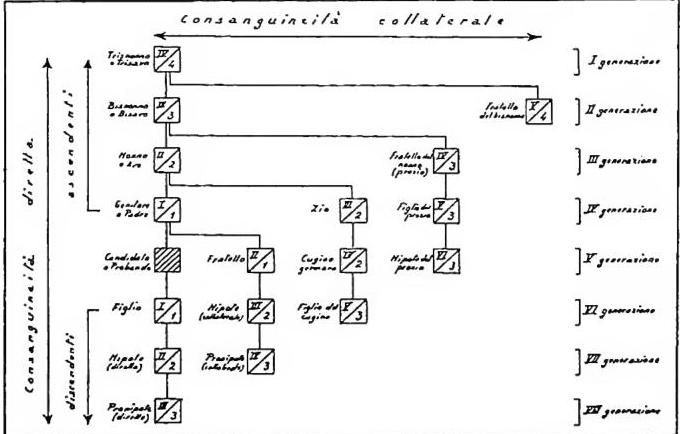
In c., a distinction is made between the direct line (ascending or descending) and the collateral or oblique line; and, in each line, between the degrees.
Those related in the direct line are persons who descend one from another (e.g., children, parents, grandparents, etc.); those related in the collateral or oblique line, on the other hand, are persons who, although descending from the same person, do not descend one from another (brothers, uncle and nephew, cousins, etc.). Degrees in the direct line are calculated (and have always been calculated) by determining how many persons separate the two relatives, while excluding one of the two from the calculation: thus, for example, father and son are related in the first degree, grandfather and grandson in the second degree, great-grandfather and great-grandson in the third degree, and so on (cf. CIC, can. 96 § 2; Pius XII, motu proprio «Crebrae allatae», 22 February 1949, can. 66 § 4 n. 2; art. 76 of the Italian Civil Code).
For calculating degrees in the oblique line, two different systems are known.
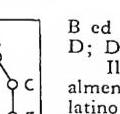
The first (the Roman method), now used in civil law everywhere and in Eastern canon law, calculates degrees by adding the distances of each of the two blood relatives from the common ancestor (cf. art. 76 of the Italian Civil Code; Pius XII, motu proprio «Crebrae allatae», 22 February 1949, can. 66 § 4 n. 3). Thus, two brothers are related in the second degree, each being one degree removed from their father, who is the common ancestor; uncle and nephew are related in the third degree, since the former is one degree and the latter two degrees removed from the ancestor, that is, from the former’s father and the latter’s grandfather; two cousins are related in the fourth degree, each being two degrees removed from their common grandfather. Thus, for example, bearing in mind the diagram reproduced below, B and C are related in the first degree to A; D and E are related in the second degree to A; B and C are related in the second degree to each other;
It should also be noted that civil laws generally establish that c. is not recognized beyond a certain degree (in Italy, through and including the sixth, “except for certain specially determined effects”: art. 77 of the Italian Civil Code). In canon law there is no general rule, but the limit likewise exists: specifically, a factual limit in c. in the direct line, which can scarcely have practical relevance beyond the second or third degree; and legal limits for c. in the oblique line, limits that nevertheless vary with respect to each of the legal effects of c. (the most remote degree to which one of these effects is attributed, namely that of creating an impediment to marriage, is the third degree in Latin law and the sixth in Eastern law: CIC, can. 1076 § 2; Pius XII, cited motu proprio, can. 66 § 2).
Leaving aside the effects of c. with regard to the acquisition of citizenship or domicile (v.), parental authority (v.), and guardianship, and considering c. as a matrimonial impediment, it is held that the impediment is certainly of natural law in the first degree of the direct line, and probably also in all the other degrees of that line and in the first degree of the collateral line. In any event, positive human law has always had, and continues to have, precise and exhaustive norms on the matter, certainly derived, at least in part, from divine law, both natural and positive.
The Church, which in the first centuries accepted the impediment as diriment (v. IMPEDIMENTI) within the limits of Mosaic legislation (Lev. 18:6; Deut. 27:20) and Roman law (I, 1, 10), that is, between ascendants and descendants, brothers and sisters, and aunts and nephews, gradually extended it, beginning in the fourth century, through legislation that was not always uniform in different places and was not always very clear (among other things, there was doubt as to whether, in the collateral line, beyond the fourth degree the impediment was diriment or merely prohibitive). In the Latin Church, Innocent III, in can. 50 of the Fourth Lateran Council (1215), abolished the impediment in the collateral line beyond the fourth degree (can. 8, X, 4, 14); this rule remained in force until 1918, since the Council of Trent rejected proposals to restrict the impediment. In the Eastern Church, the history of the impediment of c. in the oblique line differs greatly from one rite to another: in recent centuries, almost all the rites have recognized the impediment up to the seventh or eighth degree according to the Eastern method of calculation.
The CIC now establishes, for the Latin Church, the prohibition and nullity of marriage between relatives, whether legitimate or natural, in the direct line at any degree, and in the collateral or oblique line through and including the third degree (can. 1076 §§ 1–2). In Eastern canon law, the impediment in the direct line likewise extends indefinitely, while in the oblique line it extends through and including the sixth degree, to be calculated according to the different method already described (Pius XII, cited motu proprio, can. 66 §§ 1–2).
The impediment of consanguinity is double, triple, etc., in the case of consanguinity in the collateral line deriving from two, three, etc. common ancestors (CIC, can. 1076 § 2; Pius XII, motu proprio cited, can. 66 § 2).
Three graphic examples of double consanguinity are given here. In the first example (fig. 1), since H is the son of E and F, G and H have both A and B as common ancestors; they are therefore related to each other in the second Latin canonical degree or in the fourth Eastern (or civil) canonical degree through the ancestor B, whereas they are related in the third Latin canonical degree or in the sixth Eastern (or civil) canonical degree through the ancestor B. In the second example (fig. 2), in which E is the son of B and D, and F is the son of C and D, E and F have both A and D as common ancestors; they are related to each other in the first Latin canonical degree or in the second Eastern (or civil) canonical degree through the ancestor B (siblings), whereas they are related in the second Latin canonical degree or in the fourth Eastern (or civil) canonical degree through the ancestor A (cousins). Finally, in the third example (fig. 3), in which G is the son of B and E, and H is the son of C and F, G and H are related to each other twice in the second Latin canonical degree or in the fourth Eastern (or civil) canonical degree, once through the ancestor A and once through the ancestor D.
If the existence of the impediment is doubtful, because it is not known whether the two persons who are to contract marriage are related or not, or in what degree, the marriage may be lawfully celebrated, provided it is certain that they are neither related in the direct line nor brother and sister (CIC, can. 1076 § 3; Pius XII, motu proprio cited), so that there is no danger of transgressing divine law.
A dispensation from the impediment of consanguinity may be granted only when it is not of divine law, that is, only in the collateral line, and provided that the parties are not brother and sister. A dispensation is granted for any reasonable cause when the consanguinity is in the third degree under the law of the Latin Church, or in the sixth degree under that of the Eastern Church, since in this case it is an impediment of a lesser degree (CIC, can. 1042 § 2 n. 1; Pius XII, motu proprio cited, can. 31 § 1 n. 1); it is granted less readily in the closer degrees, and only for a grave cause between an uncle (or aunt) and a niece (cf. S. Congr. Sacram., Instruction, 1 Aug. 1931).
The Italian Civil Code prohibits marriage between all ascendants and descendants in the direct line, whether legitimate or natural; and in the collateral line between legitimate or natural sisters and brothers, and also between an uncle and his niece, and an aunt and her nephew (art. 87). It should be noted, however, that, for marriages contracted before the Church, the State recognizes canon law also on this point, whereas the provisions of the Civil Code apply only to civil marriages and to those of non-Catholics (cf. art. 82 of the Civil Code).
Among the numerous personal effects of
Regarding exclusion from certain offices, the provision concerning the office of judge is characteristic; it is found both in Roman law (D. 2, 1. 10), in canon law (CIC, can. 1613 § 1), and in civil law (art. 51 ff. of the Code of Civil Procedure and art. 62 ff. of the Code of Criminal Procedure).
Traces of limitations, or rules for the assessment of the judicial testimony of blood relatives, already existed in Roman law; they are, however, more precisely established in canon law (CIC, cann. 1755 § 2 n. 2; 1757 § 3 n. 3; 1974, 2027 § 1) and in civil law (arts. 247 and 246 of the Code of Civil Procedure; art. 350 of the Code of Criminal Procedure).
Finally, c. is a constituent element of certain crimes, such as incest (CIC, cann. 2357 § 1; 2359 § 2; art. 546 of the Penal Code) and parricide (art. 577 of the Penal Code); or an aggravating circumstance in several others (cf. Penal Code, arts. 519 n. 2, 531 n. 2, 605 n. 1, etc.), while in one case it is instead an exculpatory circumstance (Penal Code, art. 649).
c. is relevant, among other things, to the right and corresponding duty to the means of subsistence (v. ALIMENTI), to the administration of property, but especially to successions (v. ACCESSIONE).
Leaving aside for the moment any reference to the distinction between legitimate and illegitimate or natural c., it should be noted that the former derives from generation effected within marriage, the latter from generation outside marriage.
From the juridical point of view, the preference accorded to legitimate c. is evident; if, nevertheless, illegitimate c., although possessing no title to legitimacy, not even natural legitimacy (cf. Sum. theol., 3° suppl., 68, 1), must and can receive sufficient protection and assistance (cf. ibid., 2-3), this explains why positive law has always recognized or granted it a fairly extensive juridical relevance (v. AFFILIAZIONE).
In addition to natural c., based on community of blood, the law has always recognized other kinds of analogous bonds, based on legal or spiritual relationships (v. AFFINITÀ; AGNAZIONE; COGNAZIONE).