
MONGOLIA.
-
I. THE COUNTRY
A vast and ill-defined region of Central Asia, lying between southern Siberia, Dzungaria, Sin Kiang, Nanshan, China, and Manchuria. Politically, a distinction must be made between the so-called internal M., which proclaimed its independence in 1933, was organized in 1937 by the Japanese into a federal State (Meng Kiang) controlled by them until 1945, and then returned to China, of which it had formed part since the advent of the Ching (1644); and external M., corresponding to the Bagude Nairandacho Mongol Arat Olos, or “Republic of the Mongol People,” established in 1911, placed under Russian protectorate in 1914, and, after 1921, brought within the Soviet orbit, with a state organization modelled on that of its powerful neighbour.
The Mongolian Republic has a territory of 1.5 million sq. km., inhabited by fewer than 1 million inhabitants, all Mongols, with the exception of 7 thousand Chinese and about 90 thousand Russians. The country, consisting of the northern part of the great Gobi Desert and of the mountainous regions (Altai, Khangai) that separate it from Siberia, is essentially suited to nomadic or semi-nomadic pastoralism. Its livestock resources consist chiefly of sheep (13 million head); there are also 4 million goats, 2 million cattle, and 1.7 million horses, yielding wool and hides, which are exchanged for the few manufactured goods needed to meet modest local requirements. The Soviets, who in fact control the country and administer its trade, have nevertheless introduced certain industries, concentrated in the capital, Ulan Bator (Urga, 50 thousand inhabitants), which is connected by regular air service to Verkhne Udinsk (Ulan Ude), capital of the Autonomous Republic of the Buriat Mongols belonging to the U.S.S.R.
II. HISTORY
The Mongols constitute a branch of the Altaic race, related to the Turks and the Tungus: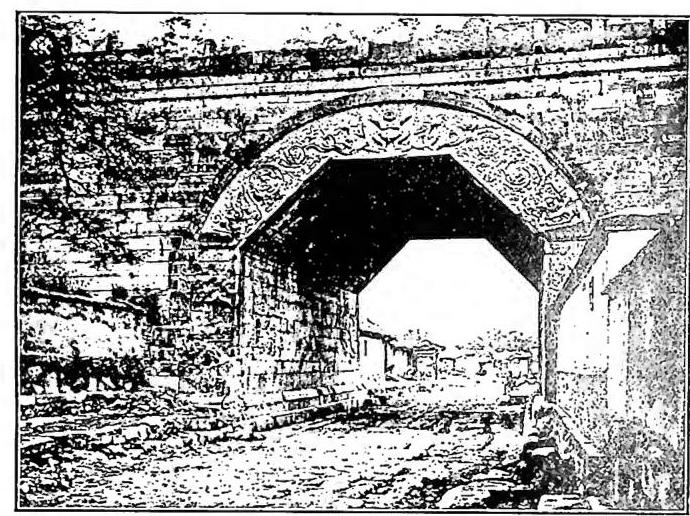
Having brought all the Mongols together under his authority, in 1209 he led them to the conquest of China, giving the struggle the character of a national war to avenge the ancestors defeated by the Kin. In 1213 they finally succeeded in crossing the Great Wall, and in 1215 they occupied Beijing; afterward they occupied northern China as far as the Hoang-Ho (1225). But Gengis Khan left these operations to his lieutenants; in 1218 he began the attack on the Empire of the Qara-Khitai, and in 1219 invaded the Empire of the Khwārizmian Turks. Afghanistan and Ḥurāsān were reduced to deserts; the flourishing cities of Balh, Merw, Nišāpūr, and Herāt were destroyed and the populations completely massacred. The Mongols were savage shepherds and hunters at the first stage of civil development; they were unfamiliar with agricultural life and even more so with urban life; and their ideal was to destroy the sown fields and transform the lands into grazing steppes. To this they added the most vulgar cruelty and held human life in the utmost contempt. Gengis Khan died on 18 Aug. 1227, during a renewed phase of the struggle in China. He stood above the moral level of his people; he was sensible, he possessed the
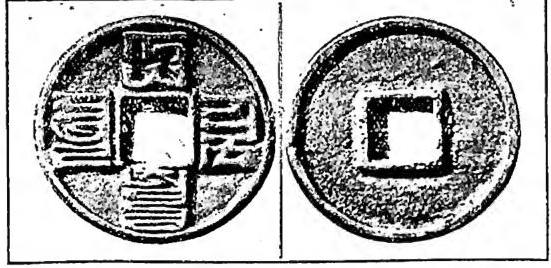
MONGOLIA – Coin bearing Mongolian script, issued under the emperor Wutsong (China) – Paris, Deveria collection.
(from R. Bonaparte, Documents de l'époque mongole des XIIIe et XIVe siècles, Paris 1855, inv. II, no. 8)
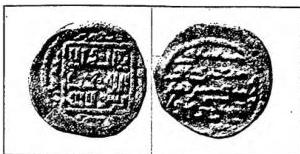
MONGOLIA - Coin of King Abakha. Inscription in “Uighur” and Arabic letters (1265–82) - Paris, National Library, Cabinet of Medals.
sense of responsibility in government, and was also capable of noble sentiments. He had found Mongol society in a state of complete anarchy; he left it orderly and peaceful, thanks to his fair and rigorous justice. As early as the Kuriltai of 1206, Gengis Khan had proclaimed his yassaq, a code of regulations for all his subjects: the death penalty for the most serious crimes, such as theft, lying, adultery, etc.; disobedience, both in peace and in war, was declared a crime punishable by law. Gengis’s yassaq transformed the M. and for centuries influenced all the peoples of the Mongol Empire. In order to organize his conquests, he therefore resorted to already semi-civilized Mongol elements such as the Kereiti, among whom Nestorian Christianity had long been widespread, although enveloped in veils of animistic and superstitious origin.
After Möngkä’s death in 1259, the Genghis Khanid Empire fragmented under the weight of its own immensity. Qubilai had himself proclaimed Kagkan, but established himself in China, and his Empire came under Chinese influence: the Venetian travelers Polo were witnesses to this phenomenon, and Marco Polo recorded his impressions of the Mongol Empire in his Milione—
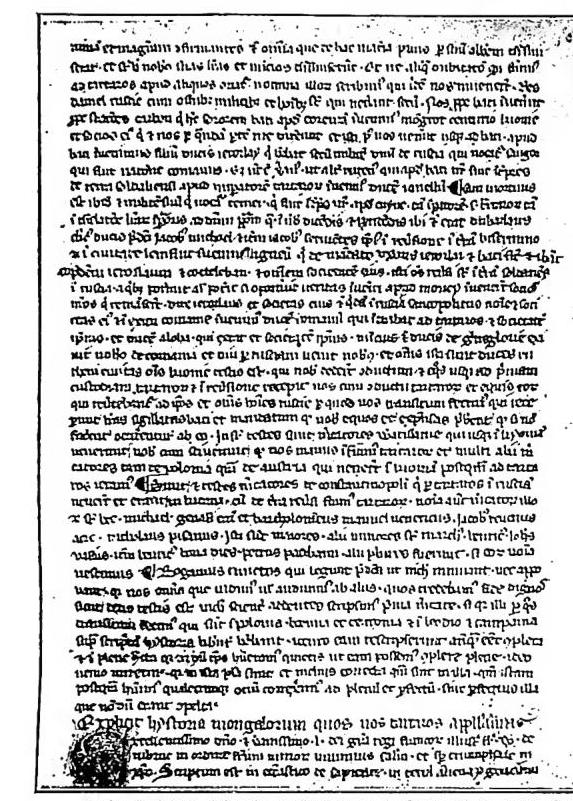
(from G. Pulli, Viaggio a Tartari di I. Giovanni da Pian del Carpine, Milan 1899, (av. between pp. 1273).)
MONGOLIA – Explicit of the Historia Mongalorum by Fr. Giovanni da Pian del Carpine (first half of the 14th century) – Leiden, university library, cod. 104, fol. 150v.
Chinese. In the old Mongolian lands, an empire was formed by another Kagkan, Alloughan; thus in Persia the Empire of Abāghā was formed; in the Russian plains, the Empire of the Qipcāq, or Golden Horde, of Bāth. These various khanates underwent differing religious influences. While Confucianism predominated in China, Islam predominated in Mongolia and Russia.
During the second half of the 13th century and in the 14th century, the papacy fervently attempted to convert the Mongol peoples to Christianity. Thus, in 1305, the Franciscan Giovanni di Montecorvino went to Qubilai’s capital (Khanbaliq-Peking) with letters from Nicholas IV; he built churches in Peking, of which he became archbishop, and established a Chinese Christian community. In 1314 Odorico da Pordenone set out from Venice for Khanbaliq and remained there until 1328.
Christianity declined in China when, during the second half of the 14th century, the Chinese reaction led by the Ming prevailed over the Mongols. In M. and in Persia, Christianity found strong support among the princes, but Islam gradually prevailed. In the 14th century, as the various Mongol empires (China, M., Persia, Qiptachq) disintegrated and through the internal struggles, principalities of little importance were formed.
The new Empire created at the end of the 14th century by a Turk from a Muslim family of Transoxiana, Tamūr-Lāng, was Mongol only in appearance and was linked with the Genghis Khan tradition only externally. Born on 18 April 1336 near Kiš, he took part in the struggles of the princes of Transoxiana; in 1363 he drove out the Mongols, in 1370 he had himself proclaimed king at Balp, and in 1388 took the title of sultan, presenting himself as the successor of Genghis Khan while behaving as a Muslim. He launched himself into the conquest of all the regions in which the Genghisid principalities had disintegrated. Uwārizm, Turkestan, and Irān were successively conquered; in 1391 he invaded the Qipcāq, in 1398 he invaded India as far as Delhi, then attacked Egyptian Syria, and subsequently the Ottoman sultanate of Anatolia, capturing Sultan Bajazet at Ankara (1400); however, he died during the expedition against China (1403). Tamūr Lāng’s activity was fragmentary: everywhere he massacred and destroyed, but did not organize, unlike Genghis Khan, for whom, alongside the destruction, one cannot forget the opening of so much of Asia to commerce and the linking of M. with Europe on the one hand and with China on the other. By the end of the 15th century, the last Timurids were no more than minor princes of Transoxiana and Khurāsān.
III. EVANGELIZATION
With the collapse of the Mongol dynasty in China in 1368, the Franciscan mission also came to an end, and M., having become a vassal state of China, remained closed to Christianity until the 18th century. Jesuit missionaries accompanying the emperor Kang-hsi had already arrived there toward the end of the 17th century, but actual Christian communities were formed only in the 18th century by Chinese Christians who had taken refuge there or had been exiled. Ministry among them was carried out, at least temporarily and intermittently, by Jesuits of the court of Pechino, by their successors, the Lazarists, and by Chinese priests of the Franciscan mission of Shensi. In 1829 the Chinese Lazarist Mattia Hsue settled in Siwantze; the city subsequently became the center of the Lazarist mission and of the diocese of Pechino itself, which transferred its seminary there. In 1835 the Lazarist Giuseppe Marziale Mouly arrived there; in 1840 he was appointed the first apostolic vicar of the newly re-established vicariate of M. At that time there were approximately 2,000 Chinese Catholics.In 1865 the first missionaries of the recently founded Belgian Society of the Immaculate Heart of Mary of Scheut arrived; the vicariate of M. had been entrusted to it in 1864. In 1874 they began missionary work among the true Mongols, the Ordos of western M. Since the faithful had reached approximately 15,000 in 1883, M. was divided into three vicariates: southwestern, eastern, and central. During the Boxer uprising, Monsignor Ferdinando Hamer, 9 Scheut fathers, 2 indigenous priests, and approximately 3,000 Christians were massacred. Subsequently the mission made great progress, above all among the Chinese population, and less among the Mongols. The mission is restricted to Inner M. Outer M. was detached in 1922 as an independent mission of Urga, but since Outer M. had fallen under Soviet influence, the missionaries could not enter II. Inner M. currently comprises 5 dioceses and 1 apostolic prefecture: archdiocese of Suiyūan (in 1883 an apostolic vicariate under the name of Southwestern M., divided in 1922 into two vicariates: Ninghia and Suiyūan, a diocese in 1946); diocese of Ninghia (an apostolic vicariate in 1922, a diocese in 1946); diocese of Siwantze (in 1840 an apostolic vicariate under the name of M.; in 1883 under the name of Central M.; in 1922 under the name of Chagar; in 1924 under the name of Siwantze, a diocese in 1946); diocese of Tsing (an apostolic vicariate in 1929, separated from Siwantze, entrusted to the Chinese secular clergy, a diocese in 1946); diocese of Jehol (in 1883 an apostolic vicariate under the name of Eastern M.; in 1924 under the name of Jehol, a diocese in 1946); apostolic prefecture of Chihfeng (established in 1932, separated from Jehol, entrusted to the Chinese clergy).