
HEART OF MARY, CULT OF. — The questions relating to the cult of the H. of M. can be reduced to two fundamental ones: its legitimacy and its historical development.
I. LEGITIMACY OF THE CULT RENDERED TO THE HEART OF MARY
This was contested, as was the cult rendered to the Heart of Jesus, especially by the Jansenists of the seventeenth century, who denounced this cult as new, erroneous, and highly dangerous, resorting to every means to prevent it, especially ridicule.To understand properly the legitimacy of this
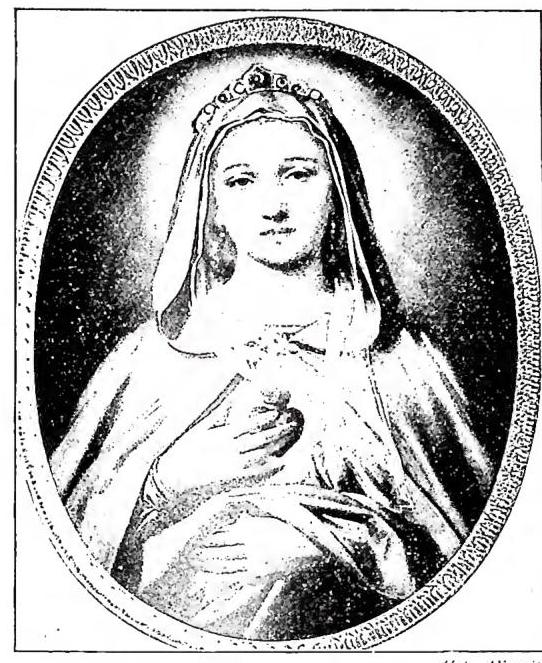
II. HISTORY OF THE CULT RENDERED TO THE C. OF M. — A twofold cycle may be distinguished: the traditional and the legal.
The first cycle, the traditional one, extends from the beginnings to 1640 and may be subdivided into three periods: biblical, patristic, and transitional. The biblical period embraces the first century of the Christian era, that is, the time in which the Gospel of St. Luke was written, in which devotion to the C. of M. is contained as in a germ. Twice the Gospel makes express mention of the C. of M., presenting it to us as a treasury in which the deeds and sayings of Christ were collected: «Mary,» writes St. Luke, «kept all these things carefully, pondering them in the secret of her heart» (Lk. 2:19). And elsewhere: «And his mother kept all these things in her heart» (Lk. 2:51).
The patristic period embraces the time of the Fathers, in whose writings various allusions to the C. of M. are found. St. Ephrem, Prudentius, Hesychius, St. Fulgentius, etc., indeed allude to II. Other patristic allusions may be found collected in Books VII and IX of the work Le Coeur admirable de la très sacrée mère de Dieu by St. Giovanni Eudes (3 vols., Caen 1681). The transitional period begins in the 13th century, with pseudo-Bernard, with Riccardo da S. Lorenzo (d. after 1254), and particularly with Ernesto di Praga (1296–1364), who composed extensive praises of the C. of M. Special mention is also deserved by St. Matilde, St. Geltrude, St. Brigida of Sweden, Gerson, St. Lorenzo Giustiniani, Niccolò Saliceto, and, above all, St. Bernardino da Siena, hailed by some as «the Doctor of the Immaculate C. of M.» because of his ingenious commentary on the seven words of Mary reported by the Gospels. All these, with words, images, and comparisons full of refinement, exalted the C. of M. The 16th century, despite the turbulent disturbances of which it was prey, did not succeed in turning the gaze of scholars and saints away from the Merciful C. of M. Giovanni Lanspergio, St. Pietro Canisio, Luigi di Blois, Luigi di Granada, St. Francesco di Sales, Fr. F. Poiré, and Cardinal P. de Bérulle, through their writings, kept the flame of this delicate devotion burning in human hearts and prepared its full flowering.
The second cycle, the legal one, that is, of public worship, extends from 1640 to the present day. It too may be subdivided into two periods: preparation and triumph. The period of preparation (1650–1805) is marked by the transition from private devotion to public devotion. The first traces of this public worship are found in Naples in the Confraternity of the C. of M., founded in 1640 by Fr. Vincenzo Guinigi, of the Clerics Regular of the Mother of God (cf. S. Bongi, Dissertazione sopra il culto del S. C. di M., pp. 54–59). Also worthy of mention for their activity in this regard are Fr. Ignazio Del Nente (1642) and Fr. Antonio Barbieux (1661). But the one who promoted liturgical devotion to the C. of M. was St. Giovanni Eudes (1601–80), as is clear from the explicit declarations of Leo XIII (3 Jan. 1903) and Pius X (11 Apr. 1909); indeed, Pius X calls him «father,» «doctor,» and the first «apostle» of devotion and particularly of liturgical worship of the Most Sacred Hearts of Jesus and Mary, to whom he wished the religious of his Congregation to be consecrated in a special way.
The period of triumph extends from 1855 to 1944. The causes that paved the way for it, besides the institution of the feast of the C. of M. as early as 1805, were the following: 1) the confraternities of the C. of M., increasingly flourishing and today comprising 19 million members; 2) many religious congregations founded under that title, eight for men and very many for women, of which 36 are of pontifical right and innumerable others of diocesan right. In 1914, on the occasion of the reform of the Roman Missal, the feast of the C. of M. was transferred from the body of the missal to the appendix, among the feasts «pro aliquibus locis». Many petitions, promoted especially by the missionary Sons of the Immaculate C. of M. (Claretians), were submitted to the Holy See, imploring the extension of this feast to the whole Church. On 31 October (and then solemnly on 8 December 1942 in the Vatican Basilica), Pope Pius XII consecrated the Church and the human race to the Immaculate C. of M. As a perpetual remembrance of this solemn act, on 4 March 1944, by the decree Cultus liturgicus (AAS, 37 [1945], pp. 50 ff.), the Pontiff extended the feast of the Immaculate C. of M. to the entire Church, assigning it 22 August, the octave of the Assumption, with double rite of the second class.