
FULGENZIO di RUSPE, saint. – African bishop of the fifth–sixth century. He was one of the most eminent figures among the bishops of his time for his pastoral and theological activity, aimed at defending and elucidating Catholic doctrine against the Arians and Semi-Pelagians, while taking up the legacy of St. Augustine.
I. LIFE
His life is known chiefly from the biography written about Ferrando (v.). B. ca. 467 at Telepte in the province of Byzacena in Africa. From his mother Mariana, who was widowed at an early age, he received a profound religious education and a thorough cultural formation: he spoke Greek perfectly and knew all of Homer by heart.While still young, he was appointed tax procurator. Already devoted to a fervent Christian life, he was led by reading a sermon of St. Agostino on Psalm 36 to embrace the monastic life, which he practised exemplary, amid many vicissitudes, in various places in Africa, in Sicily, and then again in Africa. In 500 he was in Rome. Returning to Africa, he was ordained a priest and then, overcoming his reluctance, bishop of the small town of Ruspe, probably in 507. As a bishop too he continued his austere way of life. Shortly thereafter the Vandal king Trusamondo, a supporter of Arianism, exiled him, together with sixty other bishops, to Sardinia. Exile did not diminish his activity: he founded a monastery at Cagliari, worked intensely in the care of souls, and soon became the moral leader of the exiled bishops, on whose behalf he drafted their collective letters. As a champion of the faith, around 515 they sent him to Trusamondo, who had invited the foremost defender of Catholicism to Carthage. There he resumed his ministry and refuted two Arian writings sent to him by the King, as well as others by a bishop and a priest. Sent back into exile after a couple of years, he returned from it in 523, when Trusamondo was succeeded by Ilderico, who was well disposed toward the Catholics; he was received in triumph. D. 2 January 532 or 533.
II. WRITINGS
The attribution to F. of R. of the Mythologiae, which allegorically explain the myths, and of other profane works, written by another Fulgentius who was also African, does not seem well founded. His works that are certainly authentic are polemical-dogmatic treatises, letters, and sermons.In various treatises he combats Arianism: a) Contra Arianos liber unus, a brief response to ten objections by Trasamundus concerning Trinitarian doctrine; b) Ad Thrasamundum regem Vandalorum libri tres, a response to new questions, particularly concerning the Incarnation and the Redemption; c) Contra sermonem fastidiosi Ariani ad Victorem liber unus, on the Trinity and the Incarnation, written, in a very lively tone, after his return from exile, against a monk and Catholic priest who had gone over to Arianism; d) Contra Fabianum libri decem, in which he corrects a false account of a disputation he had held with that Arian; 39 fragments remain; e) De Trinitate ad Felicem notarium liber unus; f) De fide, seu de regula verae fidei ad Petrum liber unus, virtually a handbook of Catholic doctrine; g) De Incarnatione Filii Dei et villum animalium auctore ad Scarilum liber unus, on two disparate subjects; h) Pushma abecedarius. The following have been lost: Adversus Pintum (an Arian bishop) liber unus; *De
(courtesy of Msgr. J. P. Finkes)
FULLA, DIOCESE of — Reliquary containing an arm of St. Boniface — Cathedral.
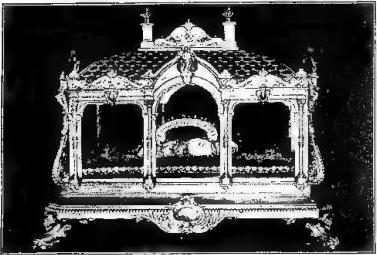
The authentic sermons, about a dozen, comprise exegetical homilies, panegyrics, and moral discourses. He also composed sermons to be recited by others. Even in his oratorical style F. follows in Augustine’s footsteps, though remaining far below him in depth of thought and vivacity of tone, with his constant use of parallelism, particularly antithetical parallelism, with final assonance—a characteristic, moreover, of the greater part of Christian oratory in these centuries. Stiglmayr attributes the Athanasian Creed to F.
III. DOCTRINE
The historical significance of F. lies not in the value of his speculation, but in the fidelity with which he expounds, defends, and disseminates Augustinian doctrine.1. The Most Holy Trinity
With regard to the Trinity, he was led by practical necessities to refute the objections of a surviving Arianism, a task which the great masters of the fourth century had carried out admirably. He does not follow Augustine in speculative profundity, which did not arouse the interest of his opponents. Christology is expounded with the precision brought to it by the controversies of the fifth century, and in close relation to soteriology. In the doctrine of Grace F. remains rigorously faithful to his master, even in those parts that were not received into the common body of doctrine. Thus he teaches that in the Trinity there is identity of nature and diversity of persons (C. Arianos, 1; C. serm. fastid., 7-9); the attributes of one person also belong to the others, except for the properties relating to the terms Father, Son, and Holy Spirit (Ep. 14, 2-14). The Church invokes and offers sacrifice to the entire Trinity (C. Fab.,frgg. 31, 34). The Son is begotten according to eternal birth from the Father, created according to temporal birth from a handmaid (C. Arianos, 3; De fide, 7-24; Ad Thrasam., II, 6), equal to the Father (C. Arianos, 5, 6, 8; C. Fabrianum, frg. 36), not only beside the Father but in the Father, as the word is in the mind, as counsel is in the heart (Ad Monim., III), as the Father is boundless and eternal (Ad Thrasam., II), distinct from the Holy Spirit (C. Arianos, 7), who is God, equal to the Father and the Son (ibid., 10; Ad Monim., II, 6-12; C. Fab., frgg. 25-27; Ep. 14, 35-38). In Jesus Christ there are two natures in one person (Ep. 8, 26; Ad Thrasam., I, 8-20; III, 2, 6-7 etc. 16). The Word became flesh not only in the Virgin but from the Virgin (Ep. 17, 5), who conceived and gave birth to the very Word of God, insofar as he became flesh from her (ibid. 9), through virginal conception and birth (ibid. 12). God was not confounded with man; therefore the divine nature remained impassible (Ad Thrasam., III, 1-2; C. serm. fastid., 11-20). Nevertheless, one must say that “one person of the Trinity suffered” (Ep. 17); it may be said that Christ’s divinity suffered, with “in the flesh” understood (Ep. 14, 15-24). Christ’s soul has full knowledge of his divinity (ibid. 26-31), and is perfectly incorruptible; his body is weak and subject to death (Ep. 18, 9). Only the Son became incarnate (De Incarn., 1-23). God predestines the elect to glory and righteousness, the reprobate to punishment but not to sin; divine punishment strikes the sinner’s evil deeds, which proceed from pride; by this God does not constrain the human will (Ad Monim., I, 7, 13, 22-25). Predestination is purely gratuitous, as the example of children who die immediately after birth shows (De verit. praedest., I, 1-30), and they too will pass into eternal fire, although with a much lesser punishment than adults (ibid., 31; De fide, 68). Predestination is immutable and eternal (De verit. praed., III, 1-7, 13-14), but it does not exclude prayer and good works (ibid., 9-12; De fide, 40-44). God’s universal salvific will is to be understood only in the sense that God drew the elect from every nation, age, and class (De verit. praedest., III, Ep. 15, 15). Predestination manifests God’s mercy toward the elect, without there being any possibility of accusing him of injustice toward the others; in any event, it is an inscrutable mystery (ibid., I, 28).