
ADAMO. — The first man created by God and father of the human race.
SUMMARY:
1. Holy Scripture
2. Rabbinic Literature
3. Christian Archaeology
4. Popular Poetry
5. Iconography
6. Testament of A
7. Life of A. and Eva.7. HOLY SCRIPTURE
Father of the human race. The name ádhám means “man”; it denotes both the human species (Gen. 1:26) and the first man, progenitor of the human family.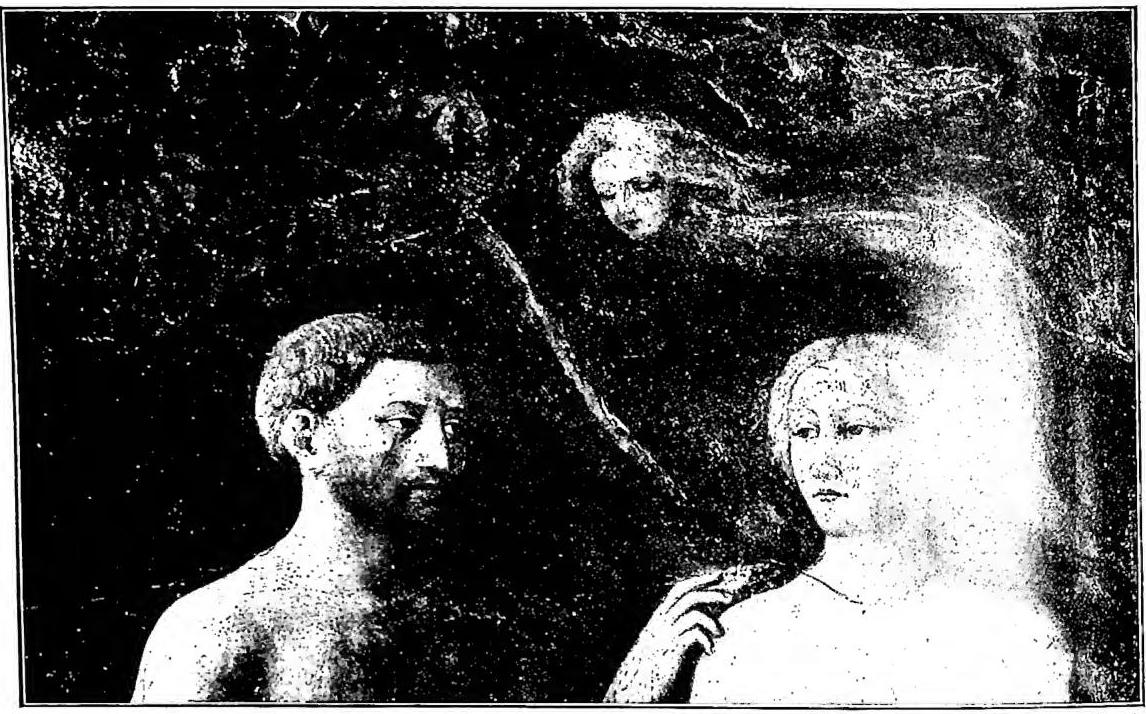
ADAMO ED EVA — Fresco by Masolino in the Brancacci Chapel — Florence, Church of the Carmine.
(photo Alinari)
adam “servant.” The Bible connects the name with ādhāmāh “earth” (Gen. 2, 5-7): Adamo would therefore be one who, in his origin, existence, and destiny, is related to the earth (v. ADAPA).
8. Creation of A
In Gen. two accounts present the creation of A. According to the first (1, 26-31), A. is created by God on the sixth day, after the animals: he is the crowning achievement of creation. God says: “Let us make man in our image, according to our likeness,” not because he is taking counsel with creatures, e.g. with the angels, as Origen supposes, following Philo (Opific. 24), since the angels are not mentioned in the context. Nor can one speak of vestiges of polytheism, which is excluded by the entire account, characteristically monotheistic. God is speaking to himself: the use of the plural (“of internal multiplication”) presupposes such a fullness of being that God can deliberate with himself. The mystery of the Trinity is not thereby revealed, but it is certainly given its best explanation (cf. J. Lebreton, Les origines du dogme de la Trinité, 4th ed., Paris 1919, pp. 507-12). Here ādhām, without the article, indicates the human species. Filled with wonder, the inspired author exclaims: “And God created man in his own image, in the image of God he created him; male and female he created them” (Gen. 1, 27). The formation of man is expressed by the verb bārā, used in the Hebrew qal and nif'al forms to indicate a direct action or intervention by God (v. CREAZIONE).Man’s likeness to God is spiritual. God is pure spirit; and since, in visible creation, man alone is made in the image of God, this image consists in what essentially distinguishes man from animals and plants, namely, his rational and spiritual nature (v. UOMO).
Transformism (v.), when applied to man, appears either in an absolute (materialistic) sense or in a relative (spiritualistic) sense. The former denies the existence of the spiritual soul, explaining man solely through evolution along the scale of beings; according to the latter, the body, before being informed by God with the soul, would have been slowly prepared through evolution under the influence of secondary causes. Sacred Scripture excludes absolute transformism and does not support the mitigated form; indeed, it multiplies, one might say deliberately (cf. V. 27), the data implying the idea of a direct and special intervention by God, both for the soul and for the body. The Fathers of the Church, including s. Agostino (De Genesi ad litteram, IX, 16-18: PL 34, 404-408), and the theologians have always taught the doctrine of the immediate creation or formation of man’s body. On 30 June 1909, the Biblical Commission declared that the literal historical sense cannot be called into question where the particular creation of man is discussed. “As for knowing whether in fact... God made use of an animal’s body to form the body of the first man, this is a question arising not from exegesis but from anthropology” (L. Pirot, in DBs., I ed. 64). Now, “the many investigations — Pius XII appropriately warned (AAS, 33 [1941], p. 506; Discorsi e radiomessaggi di S. S. Pio XII, Milan 1942, p. 273) — carried out by paleontology, biology, and morphology into problems concerning the origins of man have so far yielded nothing positively clear and certain.” chronology (v.), it is readily admitted that anthropology, insofar as the age of man is concerned, may require up to tens of thousands of years; since the Bible does not present an explicit chronological system, or at least not a complete one in its data, every Catholic is permitted, for serious reasons, to depart from the chronology that seems to be presented by the present sacred text, which assigns the human race an age ranging between 5700 years (calculation based on the Hebrew text) and 6400 (calculation based on the Alexandrian version); cf. R. Köppel, Homo Neandertalensis, in Biblica, 17 (1936), pp. 85-93, and V. Marcozzi, Il Sinanthropus Pekinensis, in La Civiltà Catt., (1942, 1), pp. 409-11 (v. EVOLUZIONISMO CULTURALE; PALEONTOLOGIA).
The phrase “male and female he created them” emphasizes that God created the two sexes. According to God’s ordinance, plants were the food of men and domestic animals (Gen. 1, 20). This indication is general in nature: only primary sustenance is being presented; it is evident that carnivorous animals already existed at that time.
The second account in Gen. 2, 5-7 abstracts from time and concerns solely the manner. The preceding account is taken up again and enriched with details, including anthropomorphic coloring: “Then the Lord formed man — an individual — from the dust of the ground (or from the mud of the earth moistened by dew) and breathed into his nostrils (from which breath is manifested) the breath of life, and thereby man became a living soul.” With the anthropomorphic language of V. 7, the doctrine of Gen. 1, 26 ff. is expressed. By an act of the divine will, man is created in the image and likeness of God. His vital breath indeed comes from God, who infused it into the body. The immateriality and immortality of the human soul clearly emerge from our text in the light of others, such as Eccle. 12, 7 (v. ANIMA).
A. earthly paradise (v.) (Gen. 2, 8-17), “a garden in Eden — a region not well defined — in the East” (ibid., 2, 8). The king of creation, however, was still alone. God said: “It is not good that man should be alone; I will make him a helper suited to him” (v. 19): this was Eva. From A., plunged into a deep sleep, God took a rib and formed a woman from II. She was brought to A., who exclaimed: “This time she is bone of my bones and flesh of my flesh; she shall be called woman (issāh), because she was taken from man (is).” The very origins of the human race consecrate the marital union and establish society upon the family (Gen. 2, 20 ff.).
The final observation of the sacred account — “they were both naked, Adamo and his woman, and yet they felt no shame” (Gen. 2, 25) — is a fleeting reference to the original integrity
(v.) of the first parents. God created man, enriching him with the properties and activities proper to the corporeal and spiritual natures that constitute him: the senses, the intellect, and the will. But he did not limit himself to these natural gifts; divine liberality further bestowed upon the first man certain gifts not owed to his nature, or preternatural gifts. Enriched with these gifts, man, more than any other creature, had the right and duty to call God by the name of Father. But God’s goodness, which desired him as his own adopted son, clothed him with a gift superior to all the others, grace (v.). Gen. 1, 26 also virtually includes the doctrine of the elevation of the first man to the supernatural state, which took place at the very moment of creation or afterward (v. GIUSTIZIA ORIGINALE).
3. Fall of A. (Gen. 3). — In paradise A. was king of creation, rich in the greatest earthly happiness. God, however, wished to subject the progenitor to a test. “Eat of every tree of paradise,” he commanded him, “but do not eat of the tree of the knowledge of good and evil, because on whatever day you eat of it, you shall die” (Gen. 2, 16-17). The precept was strict but easy to observe. Satan approached Eva in order to make her sin and then induce her husband to fall into guilt (Gen. 3, 1-5). Deceived, “the woman... took a fruit and ate it, and also gave some to her husband beside her, and he too ate of it” (Gen. 3, 6). Thus the first sin was committed, and the harmony of creation was destroyed. By sinning, A., as progenitor of humanity, harmed not only himself but also his descendants (v. PECCATO ORIGINALE).
The punishment (Gen. 3:8–24) was not long in coming. God came to call A. to account for his conduct and punished the guilt: he cursed the devil and the serpent of which he had made use, drove the first parents from paradise toward the earth, now barren and alien, henceforth subject to pain and death. Besides Cain, Abel, and Seth, A. had various sons and daughters (Gen. 4; 5:4). In Sap. 10:1, we read that Wisdom protected A. even before he had Eve as his companion, and then, through penance, brought him out of the sin into which he had fallen. The Fathers, from s. Ireneo (Adv. Haer., III, 23; PG 7, 960) to s. Agostino (Epist. 164 ad Evod., 3; PL 33, 711), hold that A. expiated his guilt through penance and did not fall again. The Byzantine Church honors him with public worship (feast of ss. Adamo and Eva, 19 Dec.). He died at the age of 930 (Gen. 5:5). According to ancient legends, he was buried near the earthly paradise; it has seemed that s. Girolamo, in the translation of Jos. 14:15 (Vulgate), speaks of Hebron; many Fathers held that A.’s body was buried beneath the rock of Calvary (Origene, In Matth., 126; PG 13, 1777; s. Atanasio, De passione et cruce Domini, 12; PG, 27, 207; s. Ambrogio, In Lucam, X, 114; PL 15, 1832).
“Biblical data, when compared—as G. Ricciotti writes in Enc. Ital., I, p. 471—with other accounts of the origins of man, reveal the following particulars: 1) the immediacy of A.’s origin, with any intervention of demigods, aeons, or heroes excluded; 2) man’s kingship over nature; 3) the intimate correlation between man and woman; 4) the fall of the first couple and of their descendants.” On the character of the biblical narrative, V. GENESI.
9. The new (or second) A
At the very moment in which God was rigorously punishing the sin of the first parents, his mercy promised the Redeemer (Gen. 3:15; V. PROTOEVANGELO): this is the announcement of the coming new A., who would crush the head of sin. The Redeemer is recalled by this name especially by s. Paolo in I Cor. 15:20–22 and 45–49, and in Rom. 5:12–21.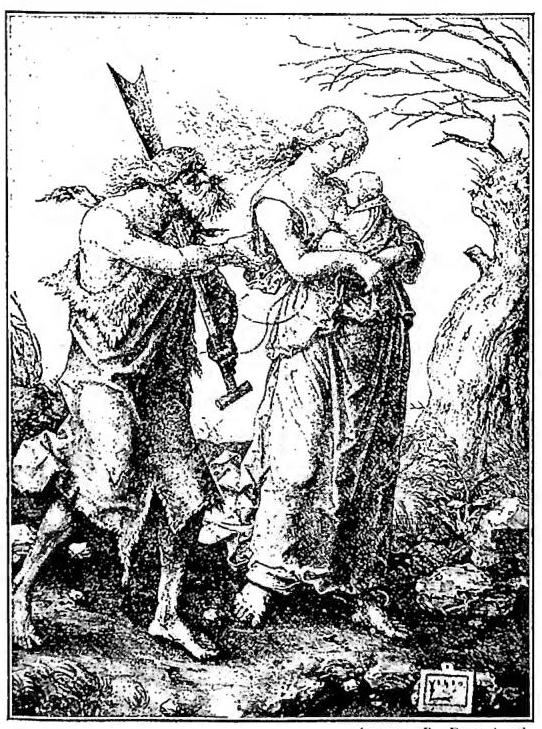
(propr. D. Degenhart)
ADAMO AND EVA — The condemnation to labor. Engraving by Luca da Leida (16th century).
5. Traditions concerning A. - The traditions of the most ancient peoples have preserved, concerning the origin and fall of the first man, the Mosaic account in more or less distorted form. Of interest is the comparison with the Assyro-Babylonians (cf. J. Plessis, Babylone et la Bible, in DBs, I, pp. 714-45).
Around the biblical account there soon arose a flowering of Jewish legends. From the first century B.C. to the third century A.D., many legends constitute the principal subject of various apocryphal books, sometimes enlarged by Christian interpolations. This literature is summarized by J. B. Frey, in DBs, I, cols. 101-34. A broad tradition concerning A. is also found in the Qur’an.
Among the abundant legendary outpouring, noteworthy is that narrated by the book The Cave of Treasures (a Christian book of the fifth or sixth century, in Syriac, which makes use of earlier Jewish materials; V. n. 6, Testament of A.), according to which A., expelled from the earthly paradise, deposited in a cave the gold, frankincense, and myrrh of the Magi, and was later buried there. Noah is said to have carried A.’s bones and the treasure into the ark; they were subsequently transported to the center of the earth, or Calvary, which received them by opening in the form of a cross. Thus the blood of Christ Crucified purified the first man from original sin.
10. BABBINICAL LITERATURE
In the various midrašim A. is called «the first man» (adām hārišān) or «primordial» (qidmāh). According to the haggadic legends, A. was created from the beginning formless (golēm) and, according to some, did not receive the human soul until the completion of the creative work, whereas according to others the soul was created from the beginning because «the spirit of God was hovering» (Gen. 1, 2). The letters of his name summarize the four cardinal points: ἀνατολή (east), θύσις (west), ἄρχτος (north), μεσπυβρία (south). The dust from which A.’s body was formed was taken from the site of the altar; others maintain that it was of various colors and taken from various places, so that every part of the earth might receive him after death (Philo, De creat., 47). A.’s development took place through twelve stages (an astral number): gathering of the material substratum, the formless outline (golēm), formation of the limbs, gift of the soul, erect posture, assignment of names to the creatures, receiving Eve, etc. (Sanhedrin, 38 b). The members of his family numbered seven (a sacred number): A. and Eve, Cain with one sister, Abel with two twin sisters.A. and Eve were created already twenty years old. (Num. Rabbā, 12, 10). When A. first rose to his feet, he looked upward and downward, saw his stature extending from one end of the world to the other, and sang Ps. 104, 24. In view of the sins of human beings, the Lord hesitated whether or not to create A.; the angels and the virtues also doubted, but charity and mercy prevailed. The angels wished to worship A., and therefore the Lord plunged him into a deep sleep, thereby signifying that he was a perishable being. According to another legend (in the Slavic Henoch, in the Qur’an, and elsewhere; cf. Enc. Iud., I, 764), the archangel Michael invites the angels to worship A. because of his likeness to God; all obey except Satan, who as punishment is cast from heaven into the abyss.
A. was created alone in order to signify that the life of each individual is worth as much as that of the entire human race, and also so that no man might say to another: My ancestor is worth more than yours (Mišnāh, Sanhedrīn, IV, 5, and elsewhere). He was handsome, with a shining heel, as strong as Samson, as tall as Saul, etc. (Pirgé R. Eliezer, 53), and circumcised. As soon as he was created, he was brought into Paradise; thus the reward preceded good works (Gen. rabá, 15, 4). There he found ten pavilions, the most modest of gold (B. Batrā, 75 a), and two districts: Gan (Garden) and Eden. A. lived in the former; no human eye ever saw the latter (Berakhāt, 34 b). There are various opinions concerning A.’s garments. They were luminous like pearls, like the lights of many lanterns, and smooth like the fingernails (Gen. rabá, 20, 29); or they were the vestments of the High Priest, which were later inherited by Seth and after him by Methuselah (Num. rabá, 4, 8); once every seventy years a healthy man in A.’s garments rides to Rome on the shoulders of a cripple (Abodāhcarā, 11 b).
11. CHRISTIAN ARCHAEOLOGY
Ancient Christian art first created, in both painting and sculpture, the scene of the sin of the first parents, setting the deplorable consequences of original sin against the salvation wrought by Christ. A. and Eve, naked and in various attitudes, have the tree and the serpent between them. The fruit, when specified, is the fig or the apple. The scene is found on glass, in terracottas, and in a fresco at Dura-Europos. From the Constantinian period onward, the scene appears of God handing A. ears of grain and Eve a sheep, symbols of labor, or rather of food; references to the interrogation or expulsion from paradise are rare. The cycle was soon completed with the scene of creation, in which A. is stretched on the ground while Eve is created by the Word or by the Most Holy Trinity. The dogmatic purposes that determined the selection of the cycle seem beyond doubt. Ivories and miniatures, from the fifth century onward, offer fuller development: A. appears among the animals of paradise, Eve is led to A., contrition, concealment and interrogation, expulsion from paradise, and the birth of a son. The ampullae of Monza present A. and Eve at the foot of the cross.12. POPULAR POETRY
The poem entitled Il fallo originale ossia Adamo cacciato dal Paradiso terrestre, ottave di G. Francesco Tamburini, fra gli Arcadi di Roma Eumeo Tritonio (Baroni, Lucca 1831), a half-literary and half-popular production, has been reprinted several times.13. ICONOGRAPHY
The iconography of A. and Eve may be said to have been definitively established as early as the 10th century. The first representation of the creation of Eve is found on a 2nd-century sarcophagus in the basilica of S. Paolo fuori le mura. Of great importance is that on the 12th-century bronze door of S. Zeno in Verona. The creation of A. frequently occurs in illuminated manuscripts, which served as models for the mosaics of the basilica of S. Marco in Venice and those of Monreale. The composition of the scene offers few variations: the Eternal extends an arm toward A., giving him life, while beside him Eve emerges from A.’s side, depicted asleep and lying down. Funerary art and the mosaics of S. Marco portray the Eternal in the act of modelling A.’s figure. Jacopo della Quercia interpreted the creation of man dramatically, and was followed, as regards the general conception, by Michelangelo on the vault of the Sistine chapel; in these two examples the artists’ powerful personalities prevail over the iconographic tradition.A. and Eve, in the scene of the original sin, are found for the first time in the second catacomb of S. Gennaro in Naples. The composition of the scene remained unchanged for centuries: in the centre, a tree from which the serpent winds forth, and A. and Eve on either side; at times the serpent has a woman’s face. In the Vienna Genesis (5th century), the serpent is not present in the scene of the sin.
The scene of the expulsion is depicted on the bronze portal of the church of Hildesheim (11th century), but the first representation that is vividly, humanly dramatic is Masaccio’s in the Brancacci chapel of the Carmine church in Florence.
The story of A. and Eve remained popular in the 17th and 18th centuries, but the artists of this period, and especially the earlier northern artists, such as Cranach, Holbein and Dürer, generally confined themselves to representing, together or separately, only the figures of A. and Eve.
Even in more recent artists, as well as among contemporaries, the iconography has undergone no substantial modifications. — Vedi Tav. XXII.
14. TESTAMENT OF A
An apocryphal work (from the 5th or 6th century), of which three fragments survive in Syriac (Patrol. Syriaca, I, 2). The Testament of A. was included in the manuscripts of the Syriac compilation The Cave of Treasures, but it is not clear whether it was originally incorporated into this work or into a book bearing A.’s name.The first fragment, the most important, relates the individual hours of the day and night to the beings who praise the Creator; for the tenth hour of the day and the seventh of the night, it mentions the rite of mixing oil and water to cure the sick or those suffering from insomnia, with a reference to the descent of the Holy Spirit upon the baptismal water. This “horarium” is found in expanded form in Greek astrological manuscripts, which attribute it to the famous Apollonius of Tyana; it was published by F. Nau (Patrol. Syr., I, II, p. 1363 ff.: Paris manuscript) and by F. Boll (Catalogus codicum astrologicorum graecorum, VII, p. 177: Berlin manuscript). On the importance of this writing in Islamic religion cf. I. Goldziher, in Archiv für Religionswissenschaft, 8 (1906), p. 301 ff. It would seem—in contrast to F. Nau—that the attribution of the “horarium” to Apollonius is the work of Byzantine authors, perhaps caused by an ecclesiastical condemnation of the Testament (or Penitence?) of A. According to George Syncellus (ed. G. Dindorf, I, Bonn 1829, p. 646), Apollonius taught the kingdom of Christ.
The second fragment of the Testament of A. contains a prophecy of the kingdom of Christ spoken by A. It is evident from its content that it is related to the Cave of Treasures and to the books called “of A.”
The third fragment—of lesser interest—deals with the nine Orders of angels, but is not influenced by the writings of pseudo-Dionysius. According to Theophilus Cedrenus, I, 41: PG 121, 41, it seems that fragments 1 and 2 also formed part of a writing entitled Penitence of A., which additionally contained revelations concerning the angel of penitence Uriel, the guardian angels (Gregoroi), and penitence. The relations between the “Testament of A.” and the “Penitence of A.” are unclear. The relation between the Apocalypse of A. cited in a marginal note to codex C of the Epistola Barnabae, 2, 10, and the Testament of A. likewise remains obscure (cf. M. R. James, Apocrypha anecdota, Cambridge 1893, p. 145).
7. LIFE OF A. AND EVE. — An apocryphal book preserved in several languages. It is a disorganized collection of traditions concerning A. and Eve, of diverse origin. The Latin text begins with the account of the penitence of A. and Eve.
The theme was also known to Jewish literature (cf. H. L. Strack-P. Billerbeck, Kommentar zum Neuen Testament aus Talmud und Midrash, III, Munich 1926, p. 478; L. Ginzberg, Legends of the Jews, V, Philadelphia 1927, p. 114 ff.) and to the Samaritans (J. A. Montgomery, The Samaritans, Philadelphia 1907, p. 224). But the form of the penitence (A. and Eve remain immersed up to their necks in the water) seems to reflect a penitential practice of the Celtic Church (cf. L. Gougaud, Les chrétiennes celtiques, Paris 1911, p. 100; id., Christianity in Celtic Lands, London 1932, p. 95 ff.; id., Ascetic Immersion in Devotional and Ascetical Practices of the Middle Age, pp. 159-78); the description of the penitence would therefore be the work of a Christian. The Ethiopic text of the apocryphon seems not to know the immersion; the Slavonic text, however, does.
The devil’s dialogue with A., in which Satan’s fall is recounted (ch. 13 ff.), must be of Jewish origin, because it presupposes the idea that the angels were created according to the image of God, a Jewish belief opposed by the Fathers of the Church. Chs. 18-24 constitute a separate passage dealing with Eve’s childbirth. Chs. 25-28 contain the abduction to paradise and A.’s prayer. The text must derive from a Hebrew source (ch. 29 “paradisus iustitiae,” that is, “for the just” [Enoch 50, 23 and 60, 82]. Of A. it is said that “figurazione cordis et corporis mei factus es” (Latin text, apud Mozley, p. 136, 9). Adam’s prayer is the culminating point of the work. It is followed (Mozley, p. 136, 22 ff.) by a prophecy of A., which is not explained by the ascent to paradise, but by the food of the tree of knowledge: the apocalypse may be ancient, but has nothing to do with the Gnostic apocalypses of A. mentioned by Epiphanius, Haer., 26, 8, 1 (ed. Holl, I, p. 284, 13).
Col cap. 30 comincia il testo che parla dell'olio per curare la malattia di A. L'identificazione dell'« albero della vita » con l'olivo non sembra trovarsi altrove nella letteratura giudaica; solo l'Enoch slavo, 8 (rec. B) identifica l'albero della conoscenza con l'olivo. Si tratta dunque probabilmente di un testo cristiano. Il cap. 39, poi, è un esorcismo. La morte di A. (cap. 46 sg.) viene pure da fonte cristiana. L'ascensione di A. è stata più tardi sviluppata in altri testi (p. es. Apocalisse di Bartolomeo presso E. A. W. Budge, Coptic Apocrypha, p. 197 sg.; anche testi mandei la conoscono). Gli accenni ad usi sepolcrali cristiani sono chiari. Il cap. 53 è citazione da un libro di Enoch, e il cap. 54 proviene dal Libro dei Giubilei. I capp. 55, 56, 57 erano tutti pezzi separati, come dimostra la tradizione dei manoscritti.
sen 1900 (Estr. Festschrift Stade): la sua tesi di una fonte gnostica è però insostenibile. Testi in lingua georgiana: W. Lüdtke, in Zeitschrift für alttestamentl. Wissenschaft, 38 (1919-20), p. 155 sg. Testi tedeschi: H. Vollmer, Ein deutsches Adambuch. Schulprogramm, Amburgo 1908. Testi polacchi, boemi, ecc. presso V. Jagic, loc. cit.
C. Fuchs, Das Leben Adams und Evas, in E. Kautrach, Apokryphen und Pseudopographen des Alten Testaments, II, Tubinga 1900, p. 306-28, ha affermato che l'originale sarebbe stato ebraico, e similmente W. Meyer ed altri. Più cauto è E. Schürer, Geschichte des jüdischen Volkes im Zeitalter Jesus, III, 4ª ed., Lipsia 1909, p. 399. W. Bousser data l'opera al tempo fra la costruzione del Tempio di Gerusalemme e la sua distruzione (Die Religion des Judentums im späibellenistischen Zeitalter, 3ª ed., Tubinga 1926, p. 23); tesi molto arrischiata, basata su un testo corrotto. Queste ipotesi si urano poi col fatto che la Vita di A. non possiede una unità letteraria.
Lo scritto siriano La caverna dei tesori (A. Goetze, Die Schatschähe, Überlieferung und Quellen, Heidelberg 1922, p. 42) ha pochi rapporti con la Vita di A. Per l'uso di una Vita di A. nella cronografia bizantina, cf. H. Gelser, S. Julius Africanus und die byzantinische Chronographie, Lipsia 1898, pp. 265 sg., 269 sg. 273. Erik Petersen