
MANUSCRIPT TRADITION. — In the common sense, this is the body of manuscripts that contribute to reconstructing an ancient literary work in a form as close as possible to the original. It must immediately be specified, however, that the concept of manuscript tradition also applies to documentary texts, and that the criterion by which manuscripts are investigated and assessed extends to the ediciones principes and to other printed editions if they reproduce lost manuscripts. Manuscript tradition is also designated as “direct tradition,” to distinguish it from indirect tradition, based on all the complementary testimonies (quotations, references, parallel texts, at times also translations, etc.) which, in harmony or in conflict with the manuscript tradition, make it possible to establish the exact reading of a passage.
An organic assessment of manuscript tradition for the purposes of textual criticism was reached only in the last century with C. LACHMANN, KARL (v.), who, although he partly adopted criteria already developed by others, especially with regard to the Greek text of the New Testament, may be regarded as the first codifier of the method of editing: his rules, despite bearing the mark of an excessive mechanicalness (the fruit of a justified reaction against the subjectivism that had prevailed since ancient philology, but which had by then been almost consecrated by the teaching of R. Bentley [(662-1742]), had the merit of clearly distinguishing, in the work of editing, the stage of recensio from that of emendatio and of setting the former on the path of systematic procedure. The subsequent achievements of philology corrected, refined, and in part also destroyed the Lachmannian canons; but the new ferment originated with him. No critical editor today can dispense with reconstructing, in its historical development, the manuscript tradition of the text he publishes.
I. THE PHASES OF THE M. T. — From the author’s original to the surviving manuscripts of a work, one normally passes through a series of intermediate links, whose reciprocal relationships vary from case to case: only in documentary tradition does it happen with some frequency that the original is preserved, or at least that copies survive which descend from it recta via. In book texts, on the other hand, which are by their nature intended for dissemination, such favorable conditions occur only exceptionally. Once the work has left the hands of its author or editor, copies multiply in a short time, reach public libraries and private homes, and in turn serve as models for subsequent copies; historical events, fortuitous circumstances, and trends in taste, after some time, bring about a gradual thinning of the copies in circulation, sometimes to the point of total disappearance, at other times reducing them to a small number of exemplars, occasionally only one; new trends, changed historical conditions, and unexpected discoveries lead, after several generations, to the disinterment of the surviving copies and the production of new exemplars from them, and the manuscripts preserved today may belong to one or another phase of these alternating vicissitudes in the fortunes of the work, may derive from one or more models, stand in a relationship of direct descent to one another, represent various parallel traditions, or even be the result of interferences between one and the other. It is therefore clear that every text has its own M. T., which cannot be reduced to a common factor with those of other texts. Its formation is indeed influenced by phenomena of a general character, such as, for example, the ten-
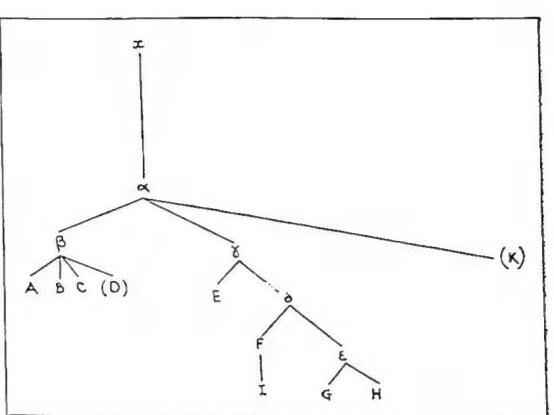
TRADIZIONE MANOSCRITTA – Hypothetical stemma of a secondary tradition according to Mass; x, author’s original; a, archetype; β and γ, subarchetypes; δ and ε, progenitors of two branches within the γ family; A, B, C, surviving witnesses of β; E, F, G, H, I, surviving witnesses of γ; D and K, lost witnesses.
dency, characteristic of the school, to bring particular texts together in anthologies, to extract excerpta, to constitute corpora of works in which a common connection can be discerned, to separate from the other authors and writings those consecrated by official canons; or likewise the phenomenon of codification, or that of transliteration from continuous majuscule script into minuscule; or again the ἐκδόξους of the grammarians, etc.; but these phenomena, even though they are found both in the Eastern and in the Western world, do not occur simultaneously or with the same characteristics in all regions, and are instead connected more closely with the history of the culture of each country, so that the m. t. of a text cannot be reconstructed without locating its various phases. Certain coincidences may occur among texts of the same nature when they concern phenomena linked to a literary “genre”: thus large-scale historical works tend, at a certain point, to disappear, yielding their place to epitomes that are easier to read; legal collections that have fallen into disuse yield their place to current compilations; continuous commentaries on poetic works take the form of marginal annotations in the manuscripts of those very works, where they become mingled with glosses and scholia deriving from other commentaries, etc. But the process of these transformations remains distinct in each individual case, and the manuscripts handed down do not testify to the same stage of development for every “genre.” It therefore remains necessary to reconstruct the m. t. of a work individually (at times, even of its individual parts), proceeding from the surviving codices back to the author’s original, or at least to a phase as close to it as possible.
II. RECONSTRUCTION OF THE MANUSCRIPT TRADITION
The first task of the recensent is to discover the relationships among the surviving witnesses of the tradition: except in the limiting case in which the preserved codex is reduced to a single one, he must establish whether and which of the manuscripts at his disposal descend from a single source, and group them into families through an examination of their agreements and divergences. The fundamental principle of this operation is that agreement in a genuine reading does not constitute proof of kinship; rather, kinship is manifested through the parallelism of corruptions (especially the so-called cruces or monstra, that is, passages or words that make no sense), interpolations, common lacunae or transpositions, etc. One must nevertheless bear in mind both that isolated agreements may have entered a family through collation with a representative of another family, without implying direct descent (this applies even more to coincidences in extrinsic elements, such as the division of the text, the subscription of codices, etc.), and that presumed common corruptions may have arisen independently in two or more manuscripts, especially when they are of mechanical origin or represent trivializations. Forthis purpose, on the one hand, it is useful to reconstruct (through an examination of particular letter substitutions, the extent of lacunae, etc.) the external characteristics of the lost exemplar of each codex under consideration—that is, the type and arrangement of the writing, the number of lines on each folio and of letters in each line, etc.; on the other hand, knowledge of the successive phases into which the copyist’s work is divided is useful (reading the exemplar, retaining the passage read in memory, mentally dictating the passage to himself, writing it out), each of which may be a source of material errors of a determinate nature. Once the various kinship groups of the codices have been accurately distinguished, it is possible to apply the principle of the eliminatio codicum descriptorum, by which both apographs of preserved exemplars and late witnesses of traditions represented by older prototypes are disregarded, provided that other readings have not entered them through horizontal transmission. Establishing this condition obviously requires an examination of the manuscripts on a very broad basis, not restricted to the simple cruces. Lachmann’s presumption, by which he rejected humanistic codices as deteriores because they were supposedly certainly interpolated, has proved fallacious in many cases, and more recent methodology has established among its principles that a greater or lesser number of interpolations is not sufficient to deny authority to a manuscript or to a printed edition whose sources have not all been preserved: «whoever refuses to make use of interpolated witnesses risks losing the genuine tradition as well» (G. Pasquali, cited in the bibliography).
III. THE ARCHETYPE
The use of this term among philologists is not yet sufficiently rigorous, so that its definition cannot correspond to all the meanings to which it is adapted from one occasion to the next; the most recent is that of Dain (v. BIBLICA), who defines the archetype as “the oldest witness to the tradition to which the text of an author is entrusted in the form in which it has been transmitted to us.” Dain nevertheless introduces a distinction between the archetype proper and what he calls «le plus-proche-commun-a»: the former would be a unicum, a manuscript deposited in an official library; the latter, a copy of it which would have given rise, by often complex and more or less direct lines of transmission, to all the surviving representatives of the manuscript tradition. In reality, this qualification, which narrows the meaning of archetype, does not seem capable of being adopted as a general rule: for many authors of antiquity, especially Latin authors, «le plus-proche-commun-a» goes back to a period when their work circulated from hand to hand, was found in the bookseller’s shop as well as in the private library, and one cannot presume by definition that it was a copy of a text officially deposited. It is therefore advisable to eliminate this distinction, reserving the examination, in each individual case, of whether or not a “subarchetype” exists. The following observations arise from the definition given above: 1) the archetype may be represented by a manuscript that has come down to us, but more often it must be reconstructed through its ramifications; 2) it may coincide with the author’s original, but this is an extremely rare case, especially in antiquity; 3) if the manuscript tradition cannot be reduced to a unified form, that is, if it has more than one form (open recension), there is likewise more than one archetype; 4) the archetype is the stage closest to the original that can be reached by means of recensio; beyond it, normally, only conjecture can provide assistance, at the stage of emendatio, drawing on considerations that go beyond the simple evaluation of the manuscript tradition (historical criticism, glottology, grammar, metrics, and often subjective aesthetic sensibility); 5) these same criteria necessarily constitute the sole guide in choosing one archetype rather than another in the case of open recension;(from M. Tulli Ciceronis Cato Maior, ed. A. Barriera, in Corpus Paracianum, M. Torino s.d., p. 3)
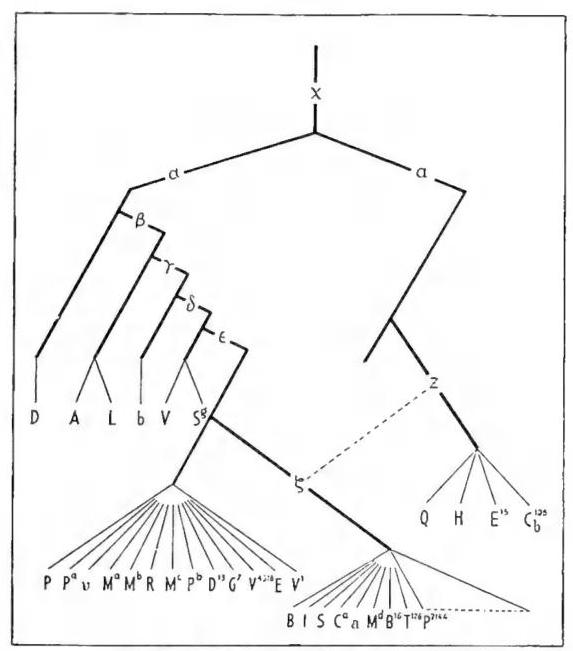
TRADIZIONE MANOSCRITTA - Stemma codicum of the manuscript tradition of Cicero’s Cato Maior according to A. Barriera. The descendants of 5 represent deteriorated manuscripts, among which those marked only by dots are of humanistic date.
6) only with the contribution of a particularly rich indirect tradition is it possible to reconstruct (in part) a “pre-archetype.”
What has been set forth thus far does not coincide with the statement made by G. Pasquali in the most brilliant of his works (v. BIBLICA), where he summarized its results in the preface: “The medieval tradition of Greek and Latin texts does not always go back to an archetype that is itself medieval or belongs to the later period of antiquity.” But the contradiction is only apparent and arises precisely from a different definition of the term “archetype”; whereas for Dain, as we have seen, an open recension admits several archetypes, for Pasquali, as earlier for Lachmann, archetype is only the single source, “a single exemplar already disfigured by errors and lacunae.” What is essentially important is that the manuscript tradition of a text, in the earliest phase to which it is possible to trace it, may appear either unitary (whether it descends directly and at a short remove from the author’s exemplar, or even coincides with it, or whether a single exemplar has proved productive from a certain period onward), or multiple, already branching into many traditions, each of which has had its own descent.
Just as the grouping of manuscripts into families leads to the reconstruction of the progenitor, so comparison of the various progenitors leads to recognition of the archetype. The importance attributed to the various operations by which an attempt is made to establish the genealogical tree of the codices is therefore evident, as is the explanation of the various attempts to formulate them within increasingly precise laws in order to guarantee their objectivity. Among the more recent ones, those of A. C. Clark and Dom E. Quentin should be recalled: the former based on the numerical calculation of the letters in omissions (provided, however, that these are not due to homoeoteleuton) and in dittographies; the latter on the relationship linking the codices of a ternary group with regard to the frequency of agreement or disagreement for each variant, and consequently on that existing between the “intermediate” codex among the first three and another, and so on. In reality, both of them, but especially the latter, merely theorize, through a complicated mechanism, the principle of comparison in the inferior reading,
which, if used with exacting care, remains the quickest and most reliable criterion for determining the relationships among the various manuscripts.
IV. ANCIENT VARIANTS
Once the archetype has been reached, it sometimes happens that one finds that it does not represent a stable text, but at several points bears witness to variants between which the tradition had already oscillated, before the work of serious copyists intervened to alter the text. The phenomenon occurs particularly in works that enjoyed wide circulation from the outset, in which the multiplicity of readings precisely reflects the public’s familiarity with that text; quotations from memory, rhythmic correspondences, and expressions that have entered proverbial usage easily determine unconscious changes: the fact that such variants are found together in the archetype normally indicates the existence of a pre-archetype represented by an ancient edition, which had incorporated the testimonies of parallel traditions, for the most part distinguishing them by critical signs that were later lost. In some cases (very rare in antiquity, more frequent in medieval texts or recensions), such variants may go back directly to the author, reflect two different versions, both sanctioned by an edition, or have been expressed, while uncertainty over the choice persisted, in the single original draft, which the public had appropriated before the author’s decision definitively condemned one or the other. In this case, it is not possible to select a variant by means of recensio, and even at the stage of emendatio the choice will be objectively legitimate only when external evidence emerges in favor of one or the other.V. THE «STEMMA CODICUM»
The m. t. of a text thus unfolds through various stages, which may be schematically summarized as follows: author’s original, pre-archetype, archetype, founders of the various families, terminal branches. On the basis of the results of the research, the stemma codicum then takes shape, that is, the graphic representation of the relationships of kinship between the surviving witnesses and the earlier stages to which they enable us to trace them. It makes it possible to assess at a glance the place of each codex in the transmission of the text and thus constitutes an important criterion in the search for the correct readings: it does not, however, eliminate the intervention, case by case, of individual critical judgment. Between one stage and another of the m. t. there may be a very brief interval of time, just as entire centuries may intervene; each subsequent exemplar, while rarely correcting the mechanical errors of its model, always adds new ones and sometimes consciously modifies the text according to the taste of the period; it may, moreover, incorporate genuine readings by another route. Reconstructing the history of the m. t. for a given text therefore does not mean renouncing the editor’s painstaking accuracy, but simply means investigating and arranging the elements indispensable for identifying the alterations undergone by that text and their origin; it also means penetrating the taste of the various periods and regions relevant to this history, entering into the cultural tendencies,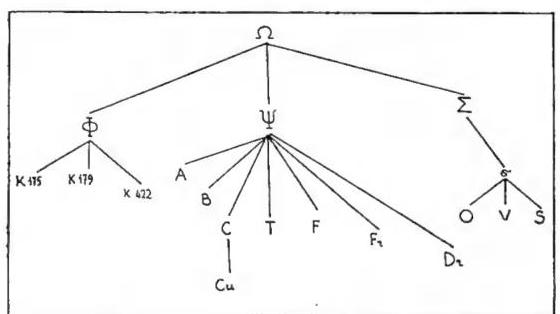
TRADIZIONE MANOSCRITTA - Stemmatum of the principal manuscripts of the Rule of s. Benedetto (excluding the Textus receptus): 0 original of the Saint; Ψ copy of the original commissioned by Carlomagno; Α faithful apograph of the copy of Carlomagno made by the monks Tattone and Grimaldo (cod. S. Gallo 914); Φ archetype of the Cassinese tradition; Σ archetype of the interpolated tradition.
in literary sensibility, in the ability of men and milieus separated from an author by centuries to understand and relive that author. - Vedi tav. XLII.