
ZENONE, bishop of VERONA, saint. — Ecclesiastical writer of the 4th century. Of African origin, from Mauretania or more probably Numidia, he completed his rhetorical studies at Carthage, as may be inferred from the Sermones attributed to him.
The designation Tractatus, by which the manuscript tradition transmitted the Sermones, led him to be regarded as a bishop, since Z.’s homilies were delivered on occasions when it belonged to the bishop to speak to the faithful, as at the dedication of a basilica, in the conferral of Baptism, and during the Easter liturgy. Z.’s residence in Italy and the episcopal see of Verona that he held were already assigned by Flavio Biondo (1482) and St. Bernardino da Siena (ca. 1490) to the 4th century. Modern writers have confirmed this opinion with arguments drawn from the Sermones: 1) modes of expression common to other writers of the 4th century, especially Lactantius and St. Hilary of Poitiers; 2) heresies that Z. combats, such as those of Arius, Audius, Helvidius, etc.; 3) descriptions of barbarian incursions; 4) the hyperbolic assertion that the Christian religion already occupies the whole world; 5) the observation that the Basilica he had built appeared, on the day of its dedication, too small for the throng of the faithful.
The consistent Veronese tradition places Z. eighth in the succession of bishops. From St. Ambrose’s letter to Siagrius, Z.’s third successor, it may be concluded that he was a contemporary of the great Doctor of the Church of Milan. In seeking to establish more precisely the chronological date of his episcopate, the brothers Pietro and Girolamo Ballerini, who published the first edition of the Sermones in 1739, placed it between 362 and 380 and, later, P. Monceaux between 8 Dec. 362 and 12 Apr. 371 or 372.
Z. should not be counted among the martyrs, as a foreign tradition would have it, a tradition that began with St. Gregory the Great (Dialog, III, 19). The local tradition of the 8th century rightly says that he died in a time of peace.
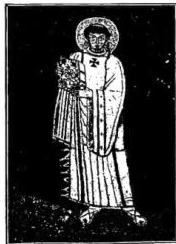
Considering the esteem enjoyed by Z. among his contemporaries and posterity, one is astonished by the silence of St. Jerome, St. Isidore of Seville, and Gennadius of Marseille; nor can one explain the neglect shown toward his literary activity by St. Ambrose, Petronius, one of Z.’s successors, and St. Gregory the Great. The first testimony to Z. as a writer is that of Raterius, bishop of Verona in the 10th century, who cites him three times in the sermon De Juda et Thamar. At the beginning of the 14th century, Giovanni, mansionarius of the church of Verona, recorded Z.’s name eighth in the episcopal succession of that city in his Historia Imperialia and recalled several of his Sermones. Through the aforementioned Giovanni, around the middle of the same century, de Natalibus (v.) came to know them; in his Catalogus Sanctorum, the latter lists 76 of them. Knowledge of Z.’s literary activity does not seem to have crossed the boundaries of the Church for which the Sermones were written. Confirmation of this is provided by the manuscript tradition preserved in the Remense codex of 770–75, written for the Church of Verona but donated by Hincmar of Reims, around 840, to the Library of S. Remigio. This codex contains 103 Sermones, of which the Ballerini recognized only 93: 16 longer ones and 77 shorter ones, more in the nature of outlines. In the Sermones, Z. conducts a vigorous struggle against dying paganism, Arianism, and the disorders that had infiltrated his Church. As an orator, he demonstrates sound rhetorical preparation, but his language reveals the influence of the African authors who preceded him.
His theological doctrine offers fine testimonies concerning the Trinity and Mariology. Z.’s Sermones are a very rich source for the study of Christian antiquity, both in its liturgical manifestations and in the constitution of communities.
The Roman Martyrology recalls Z.’s deposition on 12 Apr. as a martyr, improperly so called, and his episcopal consecration on 8 Dec., originally the date of the dedication of the church of St. Z. (cf. Martyr. Romanum, pp. 135, 573; V. Fainelli, Codice diplomatico Veronese, I, Venezia 1940, no. 74, pp. 92–94).