
ISIDORO di SIVIGLIA, saint. –
I. LIFE
Born ca. 560, died in 636. Son of an illustrious Hispano-Roman family (although his mother was perhaps of Gothic stock) that gave the Church and Spain three bishops—Leandro, Fulgenzio, Isidoro—and a nun, Fiorentina, all saints. S. I. was born in Seville, where his father Severiano had moved a short time earlier from Cartagena. When their parents died, Leandro, metropolitan of Seville, became for the youngest of his siblings, I., both father and teacher. Later, in 601, I. was to succeed him in the see and in the prestige of his school, as well as becoming a brilliant and incorruptible luminary—as s. Braulio of Zaragoza called him.He was, in fact, the reservoir into which the currents of ancient learning flowed, to be distributed through a harmonious system. His work is not original; but, as an exact understanding of the past and its systematic adaptation to succeeding generations, it makes I., as has rightly been said, one of the most prominent figures in the whole of universal literature.
As bishop, I. presided over the Second Council of Seville (619), at which he opposed and succeeded in converting a Syrian bishop
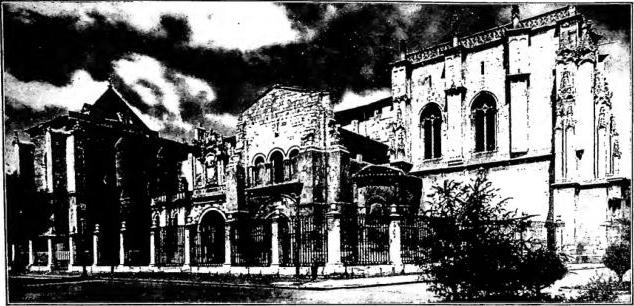
(courtesy of the Embassy of Spain)
II. WORKS
With encyclopedic ambition, I. embraced the entire field of human knowledge. Two catalogues of his works serve to reconstruct his literary heritage, which grew over time: the first is the Praenotatio Librorum divi I. (PL 81, 16–17), composed by St. Braulio of Saragossa; the second is chapter 9 of the De viris inlustribus by St. Ildefonsus of Toledo.Among his works belong to dogmatic theology: the Sententiarum libri III, which form, so to speak, the first Summa theologica, a genre destined to survive so gloriously; the De fide catholica contra Iudaeos, dedicated to his sister Fiorentina, a work of messianic apologetics, later translated into Old German at the end of the eighth century. To biblical theology belong the Quaestiones in Vetus Testamentum, a work of biblical typology; the Prooemiorum liber unus, introductory notes on the scriptural canon; the De ortu et obitu patrum, a biographical account of biblical figures; the De numeris qui in Sacra Scriptura occurrunt, a mystical interpretation of the numbers found in Sacred Scripture; and the Allegoriae quaedam Sacrae Scripturae, concerning the numbers and figures of the Old and New Testaments. To the liturgy and ecclesiastical discipline belong the De ecclesiasticis Officiis, on worship and ministers, the Symbol and the Sacraments, and the Regula monachorum, notable for the delicacy I. displays toward the weak and for his advice concerning reading and study. The Synonimorum libri duo, which deal with penitential asceticism and which St. Ildefonsus called librum lamentationis, are instead ascetic in character. In the sphere of secular sciences are the Differentiarum libri duo, a lexicon of synonyms of things and words; the De natura rerum, dedicated to King Sisebutus; and the De ordine creaturarum, a treatise on cosmography, meteorology, and other natural sciences. In the historical genre are the Chronica maior, a universal history which, continuing those of Julius Africanus, Eusebius of Caesarea, Jerome, and Victor, reaches the year 615; the Historia Gothorum, with appendices on the Vandals and the Suebi, which opens with the enthusiastic dithyramb De laude Spaniae; the De viris inlustribus, a continuation of the similar works of St. Jerome and Gennadius, but with particular regard to Spanish figures; and the De haeresibus, a brief history of heresies. Encyclopedic in character, on the other hand, are the Etymologiae, which in 20 volumes contain everything that could be known in the seventh century concerning grammar and medicine, theology and mineralogy, precious stones, agriculture and the construction of vessels, warfare and domestic labor—all arranged according to an admirable system. St. I. spent several years compiling this work, which at his death was still incomplete. Its division into books is due to St. Braulio.
Language dominates the entire conception of the work. The procedure is etymological; and, taking the opportunity to explain the etymology of each word, I. often proceeds by ear, following the practice of the ancient rhetoricians and grammarians. Here he unfolds the full richness of his knowledge: an entire volume of Migne’s Patrologia, which arouses surprise and wonder in the modern reader on account of the erudition and perseverance that must be attributed to the man who produced such a work.
The sources of this great mosaic, which modern philology is attempting to analyze, are innumerable. Many are second-hand—not from the encyclopedic arsenal of Suetonius, which never existed, but from various compendia and glossaries that are being identified day by day; the number of authors used is extraordinary. Philology and grammar, literary history, archaeology, and other disciplines derive great benefit from the study of the Etymologiae.
His epistolary collection, very limited in size, consists of 11 letters. Seven of these constitute the correspondence between I. and St. Braulio: a document of great interest for the study of the relationship between these two great men, and one that allows us to witness the gradual composition of the Etymologiae. The 27 Epigrammata in elegiac couplets, which adorned his library—sometimes beneath the busts of authors celebrated at the time—as well as his pharmacy and his Scriptorium, constitute an interesting contribution to the history of culture. Their authenticity, denied or called into question by some, is today, after the studies of H. Beeson, beyond dispute.
This collection of his works, now recognized as authentic, undoubtedly does not exhaust the abundance of his literary heritage, and modern research is laboring to identify some of the “many other little works” to which St. Braulio alludes in his Praenotatio. Nevertheless, certain works recently attributed to him do not belong to him: the Commonitiuncula ad sororem, attributed to him by Anspach (Script. eccles. Hisp. lat., III, El Escorial 1935), which is instead later than St. I., as Father A. Vaccari has demonstrated. Also later than the Doctor of Spain is the Liber de variis quaestionibus, published as an Isidorian work in the same collection by Anspach and Father Vega: examination of the work prompts one rather to seek its author in the Adoptionist Felix of Urgel.
The literary production of St. I., as has been said, lacks originality. Its doctrinal value lies in its sources. It has been said that every one of his assertions has a definite source; this judgment appears increasingly true as philological studies of his works progress. The composition is a mosaic or an inlaid work, in which phrases, maxims, and insertions from very many authors are interwoven and intersected, ingeniously combined and adapted to the contours of the argument in each particular case. Although he possessed personal and direct knowledge of what he asserted, whenever a ready-made formulation by an ancient author was available to express his thought, he used it (cf., for example, in the De viris inlustribus), rather than offering his own judgment in different words.
He rarely names the authors upon whom he draws. They are usually the Holy Fathers, especially in writings of an ecclesiastical character. Pagan authors are used more extensively in the Etymologiae and in works on secular sciences. Although he does not limit himself to extracting material from a single author, but instead draws on various authors for each subject, it is nevertheless certain that he relies especially on classical authors.
Thus, in book I of the Differentiose, his principal source is the De orthographia of Agretius, a grammarian of the fifth century; in the De natura rerum, the Hexacmeron of St. Ambrose, the Receptiones of pseudo-Clement in Rufinus’s translation, and the pagans Hyginus, Solinus, and Servius; in the De numeris, the seven books De arithmetica of Martianus Capella (late fourth century) and various writings of St. Augustine on biblical symbolism; the Sententiae are an extract from the Moralia of St. Gregory; the Regula monachorum derives essentially from Cassian and St. Benedict; and the Tituli of the library, finally, are scattered with numerous and interesting reminiscences of Martial.
The dissemination of his work was extraordinary, both in its rapidity and in its extent. His codices carried culture from Spain to France and from there, through the Irish monks, to all of Christendom. French writers include Isidorian quotations as early as the seventh century. Aldhelm, in his Epistola ad Acircium (685–705), used the De natura rerum in the very century in which it was composed. The De fide catholica was translated into German at Murbach in the eighth century. The Sententiae too were already being copied in the seventh century; manuscripts from Bobbio of that century and of the eighth are still preserved in Milan. The dissemination of the Etymologiae is truly remarkable: scarcely a century after the death of its author, 54 copies of the work had already crossed the Pyrenees. Today approximately a thousand manuscript codices are preserved. This suggests that as many as 10,000 may have existed in the Middle Ages: one of the celebrated “publishing successes” in history.
S. I. fu, come già si disse, l'educatore del medioevo, e i suoi libri furono testo obbligatorio nelle scuole. Gli archivi conservano ancor oggi un gran numero di estratti, di adattamenti, di frammenti presi dalle sue opere a fini scolastici. Le sue definizioni e i suoi aforismi giuridici, coniati in modo preciso e definitivo, furono introdotti nelle collezioni canoniche e si apprendevano a memoria, come prescriveva Giovanni di Salisbury. Se l'utilizzo fonti antiche, dovunque lo si copiò e plagiò senza riguardo. Beda compendiò nella sua Chronica di I., e nel suo De Temporibus il De natura rerum. Uno Scottus sconosciuto, del sec. VIII, ricalcò i suoi Versus de alphabeto sui Tituli dello spagnolo. Latchen (ca. 660), per quanto irlandese, compendiò il De ortu et obitu patrum nei suoi Dicta Isidori in libro de vita et exitu prophetarum. Il De institutione clericorum, di Rabano Mauro, nel sec. IX, include, senza confessarlo, capitoli su capitoli testualmente copiati da I. Il medioevo studiò e pensò sotto il segno di I., animato dallo spirito di lui.
Il fondo antico tradizionale si unisce a doti di chiarezza e metodo che tutto riducono a sistema luminoso e mettono ordine in tutto ciò che tratta. Stile terso, sobrio, elegante nella sua semplicità, in ciò che mantiene di personale; precisione di concetti e concisione di termini, che cesella l'espressione, consa-
crandola in perpetuità; e, allorché si ispira a fonti antiche, abile sagacia nella selezione degli autori classici.
Infine, da tutta l'opera di I. traspare l'uomo: carattere bello ed elevato, trasfigurato dalla santità; vibrante di entusiasmo per tutti i sentimenti di pietà, di umanità, di patriottismo, giunge sino ad effusioni di tenerezza nelle sue lettere familiari. Le quali, per quanto siano poche, danno un ritratto che invano si cercherebbe nelle sue esposizioni impersonali delle Etymologiae e nel De ecclesiasticis officiis.
Studi: la migliore bibliografia aggiornata è in B. Altaner, Patrologie, Friburgo in Br. 1930. Studi generali: M. Manitius, Gesch. der lat. Liter. des Mittelalters, I, Monaco 1911, pp. 52-70; Z. García Villada, Historia eclesiástica de España, II, II, Madrid 1933, pp. 197-229; F. Pérez de Urbel, Las letras en la época visigoda, nella Historia de España diretta da P. Menéndez y Pidal, ivi 1940, pp. 379-431; G. Madoz, Escritores de la época visigótica, nella Historia general de las literaturas hispánicas, diretta da G. Díaz Playa, Barcellona 1940, pp. 114-40.
Sulle questioni dell'autenticità: A. Vaccani, Un trattato ascetico attribuito a s. Girolamo, in Milanque Cavallera, Tolosa 1948, pp. 147-62 (sulla Commonitiuncula ad sororem); G. Madoz, Una obra de Félix de Urgel falsamente adjudicada a s. I. de Sevilla, in Estudios eclesiásticos, 23 (1949), pp. 147-68. Sullo stato delle ricerche intorno s. I., V. B. Altaner, Der Stand der Isidorforschung. Ein britischer Bericht über die seit 1910 erschienene Literatur, in Misc. Isid., Roma 1936, pp. 1-32; per la cronologia, J. A. de Aldama, Indicaciones sobre la cronología de las obras de s. I., ibid., pp. 57-89; sulla sopravvivenza isidoriana, E. Anspach, Das Fortleben Isidors vom VII. bis IX. Jahrhundert, ibid., pp. 323-56.
Monografie: In Miscellanea Isidoriana, Roma 1936, un insieme di studi isidoriani, di vari specialisti, riguardo alla cronologia e alla valorizzazione delle opere dello spagnolo. Per l'aspetto canonico, P. Séjourné, Le dernier Père de l'Église, 1st Isidore de Séville, Parigi 1929. Sulla sua azione nei concili, G. Madoz, El floriligio patristico del II Concilio de Sevilla, in Misc. Isid., pp. 177-220; id., Le symbole du IV Concile de Tolide, in Rev. d'hist. ecclés., 39 (1938), pp. 5-20. Per la sua Regula monachorum, R. Klee, Die Regula monachorum Isidori von Sevilla und ihr Verhältnis zu den übrigen abendländischen Mönchsregeln jener Zeit, Marburg 1909. Per le lettere, R. Geiselmann, Die Abendmahllehre an der Wende der christ. Spätantike zum Frühmittelalter, Monaco 1933. Sulla spiritualità, J. Mullins, The spiritual Life according to s. I. of Seville, Washington 1940. Giuseppe Madoz