
VEGA, ANDRES DE

Image from page 741
Image from page 741
VEGA, ANDRES de. - Teologo francescano, n. a Segovia nel 1498, m. a Salamanca nel sett. 1549. Studiò e insegnò a Salamanca; a 40 anni divenne religioso francescano dell'Osservanza.

VEGA, ANDRÉS DE. — Franciscan theologian, born in Segovia in 1498, died in Salamanca in September 1549. He studied and taught at Salamanca; at the age of forty he became a Franciscan friar of the Observant branch.

As theologian to Cardinal Pacheco, he was sent by Charles V to the Council of Trent, where he attended the first seven sessions; on 23 February 1547 he delivered the Lenten sermon. His mastery of Greek and Hebrew gave him a leading role in biblical questions; his opinion was adopted in the decrees on the canonical books. He played a significant part
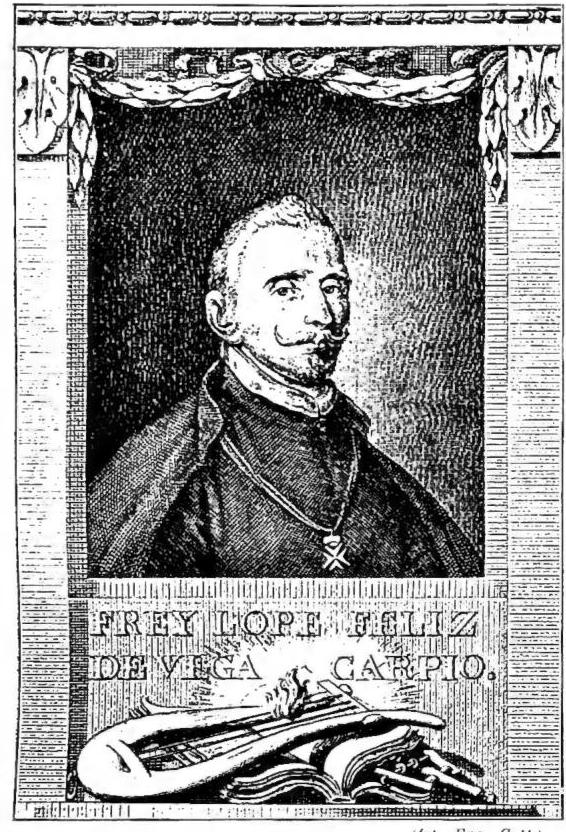
VEGA CARPIO, LOPE FÉLIX DE — Portrait. Engraving by Moreno Tejada, preface to Obras sueltas, Madrid 1776 — Copy in the Vatican Library.

in preparing the decree on justification; in fact, nearly half of the canons on this decree (Session VI of the Council) were taken almost verbatim from his draft, and his influence is evident in the others. At Trent he also took part in debates (25 January 1547) on the Sacraments in general and specifically on Baptism, Confirmation, and (16 February) the Eucharist. From 1547 to 1549 he was in Venice to supervise the publication of his works; in 1549 he returned to Salamanca.

Among his principal works are the Opusculum de iustificatione, Gratia et meritis (Venice 1546) and the masterpiece Tridentini decreti de iustificatione expositio et defensio libris XV distincta totam doctrinam de iustificationibus complectentibus (ibid. 1548). The last two books are directed against Calvin, who had written (13 October 1547) his Antidotum in acta Synodi Tridentinae. Considering this double treatise on justification the best of its kind, Peter Canisius in 1572 brought out a new edition in Cologne, though altering the title somewhat. Even today this work is regarded (M. Grabmann, Storia della teologia cattolica, Milan 1937, p. 209) as the best source for understanding Tridentine doctrine on justification. Other works remain unpublished.

BIBL.: Wadding, Scriptores, p. 17; N. Antonio, Bibliotheca hispana, I, Madrid 1783, p. 88; B. Oromi, Los Franciscanos españoles en el Concilio de Trento, ibid. 1927, pp. 87-121 (with bibliography); G. M. Pou y Marti, I Frati Minori nel primo periodo del Concilio 1545-47, in Il Concilio di Trento, 2 (1943), p. 206 (with bibliography); R. Varesco, I Frati Minori al Concilio di Trento, in Arch. Franc. hist., 41 (1948), pp. 99-104 (with bibliography); various authors, A. de V. en el IV centenario de su muerte, in Liceo Franciscano (Santiago de Compostela), 2 (1949), pp. 75-172.