Machine translation of the 1948–1954 Italian original. The original text is authoritative.
CENERI, MERCOLEDÌ delle. — In the last years of s. Gregorio Magno, the Lenten fast began on the Wednesday preceding the First Sunday of Lent, which was therefore called caput seunii (v.) or also caput Quadragesimae. At the beginning of Lent, penance was impressed upon the faithful by the bishop’s expulsion of public penitents. The rite is preserved in the Roman Pontifical.
According to the seventh-century rituals in Rome, on the morning of this day the penitents presented themselves to the priests appointed for this purpose in the various titular churches; they confessed their sins to them, if these were grave and public, and received from the penitentiary a shining garment of sackcloth sprinkled with ashes, together with the order to withdraw to some monastery in order to complete the penance imposed. Throughout Lent, until Holy Thursday, the day of reconciliation, they remained subject to various penitential exercises. With the disappearance of public penance, the clergy and the faithful, on the Wednesday of the ashes, had ashes imposed on their heads as a sign of penance, a practice already observed in the Old Testament (Iob. 42:6; Jud. 4:16; Ion. 3:6, etc.) and also known among the pagans. It was subsequently prescribed by the Council of Benevento of 1091, can. 4. The ashes are taken from olive or palm branches blessed the previous year, and their blessing, already in use in the tenth century, makes them a sacramental, so that the faithful, receiving them devoutly, may obtain the spirit of true penance. The prayers for their blessing date back to the tenth century (Ordo Romanus V). The chants are those of the penitential processions of this and other days of Lent. The imposition of ashes may also be performed on the following Sunday, provided that they were blessed on their proper day, that is, the preceding Wednesday (cf. AAS, 20 [1924], p. 102). In the imposition of the ashes, the priest says, recalling God’s sentence pronounced upon Adam and all his descendants: “Remember, O man, that you are dust and unto dust you shall return.” Nothing could signify more forcefully our nothingness and the folly of human pride. The Office of that day takes precedence over every other festal Office, even one of the first class. It was around the eleventh century that in Rome the pope, the members of the clergy, and the people on that
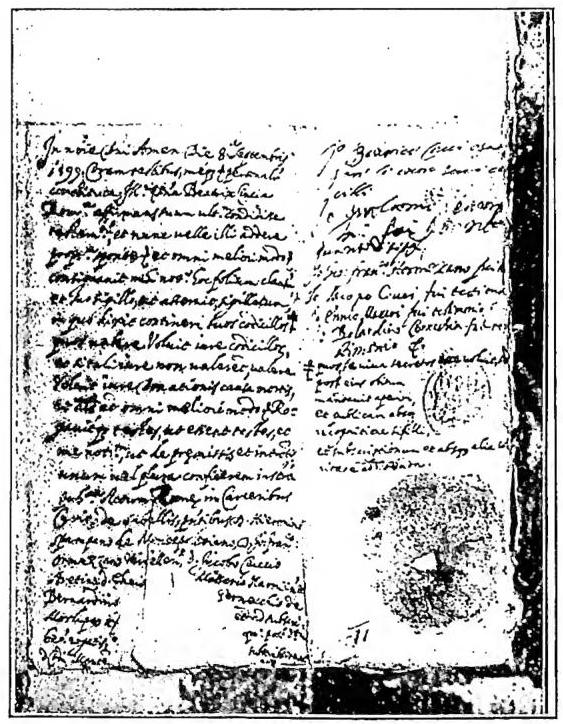
(from C. Ricci, B. C., Milan 1923)
CENCI, BEATRICE - Verbale di chiusura del codicillo (8 sett. 1599) di B. C. con la sua firma - Roma, archivio di Stato.
giorno si raccoglievano dapprima nel titolo di S. Anastasia, e, fatta ivi l'imposizione della c., al canto delle litanie, in abiti di penitenza e a piedi nudi, si recavano processionalmente alla basilica di S. Sabina sull'Aventino, dove, nel piccolo cimitero dell'atrio, il papa recitava un'orazione d'assoluzione, mentre il coro cantava il responsorio Immuntemur (ancor oggi in uso); poi incominciava la Messa. Di questo rito è rimasta ora la statio (v.) in quella basilica.
BIBL.: F. X. Funk, Kirchengeschichtliche Abhandl., I, Paderborn 1897, pp. 241-78; A. Franz, Die kirchlichen Benediktiner des Mittelalters, I, Friburgo in Br. 1909, pp. 461-68; K. A. H. Kellner, L'anno ecclesiastico, 2ª ed., Roma 1914, pp. 93-98; F. Cabrol, Cendres, in DACL, II, coll. 3040-44; L. Eisenhofer, Handbuch der kath. Liturgik, I, Friburgo in Br. 1932, pp. 496-99; I. Schuster, Liber Sacramentorum, III, 4ª ed., Torino 1933, pp. 38-46; M. Righetti, Manuale di storia liturgica, II, Milano 1946, p. 110 sgg. Filippo Oppenheim
Cite this article
“CENERI, MERCOLEDÌ DELLE.” Enciclopedia Cattolica, vol. III (1949), p. 753. Azione Romana digital edition, https://azioneromana.com/article/ceneri-mercoledi-delle.