
PENANCE
Sacrament instituted by Jesus Christ, by which personal penance (paenitentia virtus) is linked to an ecclesiastical judgment to which Christ has granted the power to remit sins.
I. DOGMATIC THEOLOGY.
SUMMARY:
I. Terminology
II. The virtue of penance
III. The Sacrament of Penance:1. The power of the keys conferred by Christ upon the Church
2. The Sacrament of Penance in the ancient Church
a) The historical-dogmatic development in the first three centuries. – b) Public or canonical penance. –3. The progress of penitential doctrine in scholastic theology
4. The innovators and the Council of Trent.I. TERMINOLOGY
The New Testament employs μετάνοια, which in classical literature expresses a change of judgment (νοῦς) regarding a past event, whereas the other term μεταμέλεια designates rather a change of the soul, of the heart. According to the Stoic conception, the philosopher is superior to μετάνοια: «Non mutat sapiens consilium... ideo numquam illum paenitentia subit» (Seneca, De beneficiis, IV 34, 4; cf. Ep. 115, 18: «hoc tibi philosophia praestabit, quo equidem nihil maius existimo: numquam te paenitebit tui»).
In addition to metanoia, the word ἐξομολόγησις, originally meaning confession, was soon used to denote the entire process of public penance (cf. 2 Clem. 8, 3: ἐξομολογήσασθαι ἡ μετανοεῖν). The Latin Church also adopted the Greek term: thus Tertullian speaks of ecclesiastical penance as «Is actus, qui magis graeco vocabulo exprimitur..., ἐξομολόγησις est» (De paen. 9, 2). The Latin Fathers also used the terms Pax, reconciliatio, receptio, communionis restitutio, baptismus laboriosus, secunda post naufragium miseris tabula (cf. St. Jerome, Ep. 130, 9: PL 22, 1115 and St. Thomas, Sum. Theol., 3ª, q. 84, a. 6), which express the effect of the Sacrament—restoring the sinner to the peace of the Church and thus reinstating the state of Grace once received in Baptism (the "first penance"). After the decline of public penance, not only the accusation before the priest but the entire Sacrament of penance came to be called confessio (from the 8th century onward).
II. THE VIRTUE OF PENANCE
The Old Testament does not know a special technical term for "penance" and "to do penance," but the concept is well known. It presents itself in two forms: in cultic-ritual penance, and in the prophetic postulate of "conversion" or "return to Yahweh."In legislative texts, cultic expiations prevail (ablutions, fasts, confession of sins, mourning garments, in sackcloth and ashes; recall the great day of expiation "per sanguinem hircorum et vitulorum" Hebr. 9, 12). In such rites, the soul, the penance of the heart, could be lacking; hence the criticism of the Prophets, who (like the Psalms) exalt the importance of internal penance, of the living consciousness that sin is an offense against God. Even the Prophets do not have a particular term but favor the verb fābh, widely used in profane language ("to turn back toward...," "to return," "to convert"). The object of the return (either explicitly or by sense) is always Yahweh (only in Neh. 9, 29 the Tōrah). The Prophets had a vivid personalistic conception of penance, which is a return to Yahweh and must be determined solely by Yahweh and His will. This fundamental structure is revealed in the following characteristic elements: a) the conversion of the entire existence to Yahweh is required, of which obedience to His will will be proof (cf. Os. 6, 1-6); b) this conversion requires unlimited trust in Yahweh. The people must lay aside all false trust in human aid (strength of arms, political alliances) and in "foreign gods" (idols; cf. Os. 14, 3 ff.; Ier. 3, 22 ff.); c) conversion to Yahweh includes aversion to every evil, to every action contrary to God. This negative aspect, implicitly enunciated by the earlier Prophets, is strongly emphasized in Jeremiah (26, 3; 35, 15; 36, 3) and Ezekiel.
In the New Testament, "metanoia" is a fundamental concept of Christ's preaching: "paenitentia agite, appropinquavit regnum caelorum" (Mt. 4, 17; cf. Mc. 1, 15).
Such "metanoia" is not only a preparation for the Kingdom but admits entry into the Kingdom itself (Lagrange, in the commentary on Mc. 1, 15). The idea of the Kingdom and of "metanoia" form a unity and illustrate each other. Thus, the postulates of the Sermon on the Mount are developments of the demand for "total conversion."
In the metanoia of the Greek text, "satisfactio" for the sins of past life is also included (against Luther), but it is primarily the complete transformation of the "mind," of the entire way of thinking, acting, living—it is the total conversion of man.
This conversion preached by Jesus demands that man recognize God as God and Lord, which amounts to a true upheaval of human life. Hence the note of utmost rigor in the conversion required by Jesus. The sometimes very strict words (cf. Lk. 9, 59 ff.) inculcate that in conversion to God the principle holds: all or nothing (cf. ibid. 9, 62), because Christ not only preaches "metanoia" but represents it in Himself (in the "forma servi" accepted for us) and in His entire life of unconditional obedience to the Father, in which He bore and expiated the sins of the world. The Lord's final command ("... praedicari in nomine eius paenitentiam in remissionem peccatorum": ibid. 24, 47) was faithfully carried out in apostolic preaching (cf. Act. 2, 38; 3, 19; 8, 22; 17, 30). If in the Pauline epistles faith is proposed as the way of life, the death of St. Paul includes "metanoia," of which St. Paul himself is a shining example.
The doctrine of the Fathers particularly illustrates the necessity of penance (both for the pagan who wishes to convert to Christ and for the Christian who has sinned after Baptism), its nature (they insist on the transformation of the will, as well as on penitential works), and its motives (especially the fear of God). Characteristic in patristic doctrine is the frequent recourse to the Old Testament. If the Fathers energetically inculcate penitential works, one cannot speak of a "fatal relapse" into Jewish legalism (Behm, in G. Kittel [V. BIBLICA.], p. 1003), because even in the Gospel preaching the "fructus paenitentiae" are required, and, on the other hand, the Fathers always preach the necessity of internal penance (cf. St. Augustine, Serm., 351, 5, 12: PL 39, 1549).
Scholastic theology dealt with penance primarily insofar as it is a Sacrament, but it also gave the virtus of penance its place in the theological system, applying to it the Aristotelian concept of virtue (cf. St. Thomas, Sum. Theol., 3°, q. 85). Penance is defined as "virtus supernaturalis eaque moralis, inclinans hominem ad detestandum peccatum a se commissum, quatenus est offensa Dei et ad firmum emendationis et satisfactionis propositum." The material object of penance is therefore every personal sin; its formal object is the divine right.
The traditional concept of penitence was rejected by Luther. He eliminated satisfaction as unfounded in Scripture, as injurious to the mediation of Christ and to justification ex sola fide, and above all due to his doctrine on original sin, which would have created in man a radical impotence rendering him incapable, even with the aid of Grace, of reacting to sin. According to Luther, only two elements of penitence remain: passive contrition, that is, an immense fear in the recognition of sin, and faith-trust in the merits of Christ (Confessio Augustana, art. 12, de poenitentia; cf. Die Bekenntnisschriften der evangelisch-lutherischen Kirche, Göttingen 1930, p. 65).
This doctrine, rejected by Leo X (Denz-U, 746 sg.), was condemned at the Council of Trent (sess. XIV, cann. 5 and 6: Denz-U, 914 sg.), which instead reaffirmed the traditional concept of penitence: « Contritio, quae primum locum inter dictos poenitentis actus habet, animi dolor ac detestatio est de peccato commisso, cum proposito non peccandi de cetero » (ibid., cap. 4: Denz-U, 897; cf. also the texts in sess. VI, capp. 6 and 14: Denz-U, 798, 807). Similarly, the Council defines the necessity of penitence for all men of every age who, after committing a sin, wish to acquire Grace and justification (sess. VI, capp. 6 and 7 and can. 9: Denz-U, 798 sg., 819; sess. XIV, capp. 1 and 4 and can. 4: Denz-U, 894, 897, 914). Penitence is certainly necessary necessitate et praecepti et medii; the first is necessitas praecepti affirmativi, the other necessitas medii absoluta, so that even inculpable omission makes the remission of sin impossible (v. ATTRIZIONE; CONTRIZIONE).
#### 1. The Power of the Keys Conferred by Christ upon the Church
a) Covenant. – On the very evening of the day of the Resurrection, the customary Jewish greeting Pax vobis, repeated twice by Christ (Jn. 20:20-23), acquires a particular resonance as He bestows upon the Apostles the power by which sinners are reconciled with God, instituting the Sacrament that was later often called Pax, Pax Ecclesiae.
The words of Christ: α) extend His own mission to the Apostles: Sicut misit me Pater, et ego mitto vos. Christ’s mission was the liberation from sin and the communication of life (cf. Mt. 9:6; Jn. 3:17; 10:10); the mission of the Apostles therefore includes the task of liberating from sin; β) thus assure the Apostles of a particular spiritual power: Haec cum dixisset, insufflavit et dixit eis: Accipite Spiritum Sanctum. The insufflation upon the disciples (ἐνεφύσασεν) in the New Testament is found only here and clearly alludes to the spiraculum vitae (Gen. 2:7; cf. Ez. 37:9). Πνεύμα ἅγιον seems here to be interpreted as a particular gift of the Holy Spirit, that is, not so much a disposition of the mind or heart, but rather a spiritual power, as is further clarified immediately afterward; γ) grant this power so that the Apostles may remit sins as Christ Himself did: «quorum remiseritis peccata remissa sunt eis» (according to the Greek text: ἀφέωνται is the Doric form of ἀφείνται); «et quorum retinueritis, retenta sunt». Since the Apostles must continue the same mission as Christ, the «remission of sins» must be interpreted in the sense in which He remits sin (Jn. 1:29; Mt. 1:21; 9:3; Lk. 7:47-49). This power, called by Westcott the «magna charta» of the Church of Christ, is conferred not upon all the faithful indiscriminately, but upon the Apostles alone; this is demanded by the entire tenor of John’s narrative, where the passages in which the Lord compares the mission of the disciples to His own refer solely to the Apostles. This, moreover, was already the interpretation of the ancient Church: «In solos apostolos insufflavit Christus dicens: Accipite Spiritum Sanctum... Potestas ergo peccatorum remittendorum Apostolis data est, et Ecclesia, quae illi a Christo missi constituerunt, et episcopis, qui eis ordinatione vicaria successerunt» (Firmilianus, Ep. 75, 16 in the Cyprianic collection: ed. G. Hartel, CSEL, 3, 2, p. 821, 1-6). This interpretation is confirmed by the passages in Matthew where the conferral of the power to «remit and retain» is foretold: Mt. 16:19; 18:18. The two metaphors of the «keys» and of «loosing» are distinct but closely related and complement each other: he who holds the keys administers the house (οἰκόνισμος), which is here the Kingdom of Heaven, in the place of the master with the master’s own authority. This power (relatively supreme) includes, beyond the doctrinal sphere, also the power to remit sins, which is more explicitly expressed in the other metaphor. Ligare and solvere render the Aramaic terms «asar» and «sérà», which in rabbinic usage do not merely express doctrinal declarations on the legitimacy or illegitimacy of an action, but also true decisions made by virtue of a properly judicial and coercive power, manifesting particularly in the imposition or revocation of excommunication (cf. H. L. Strack-P. Billerbeck, Kommentar zum N. T. aus Talmud u. Midrasch, I, Munich 1922, p. 738 ff.). That this is the sense in Mt. 16:19 is evident from the parallel passage (Mt. 18:18), where excommunication against the impenitent sinner («sit tibi sicut ethnicus et publicanus»: 18:17) is confirmed by the power of «binding» (18:18); as well as from the practice of the primitive Church (I Cor. 5:3-5; 16:22; I Tim. 1:20) and from the interpretation of the ancient Syriac Fathers, who were particularly familiar with Jewish culture and understood solvere and ligare in the sense of a judicial power over specific persons and sins. From the entire context,
solvere et ligare receives the meaning of «remitting and retaining sins»; and it is true that this sense in Matthew is not as manifest as in Jn. 20:23, but it is contained implicitly in the principal idea of the Kingdom of Heaven. The two formulas are therefore akin, not strictly identical. Solvere et ligare in Matthew has a broader meaning, encompassing not only the power to remit or retain sins, but the entire complex of things or persons that in any way belong to the Kingdom. On the other hand, the ultramundane effect of this solvere et ligare of the Church is expressed more explicitly in Matthew than in Jn. 20; that is, the remission granted by the Church is ratified before God (super terram - et in caelo). The decision of the Church has value also in the heavenly forum; reconciliation with the Church entails reconciliation with God (cf. B. Poschmann, [V. BIBLICA.], p. 11 ff. and B. Xiberta [V. BIBLICA.]). The decisive word on the value of this exegesis was spoken by the Council of Trent, appealing to the «universorum Patrum consensus» (sess. XIV, cap. 1: Denz-U, 894).
b) Judicial Character of the Power of the Keys. – The Council (ibid., cann. 2 and 3: Denz-U, 912 ff.) also rejected certain subterfuges of Protestant exegesis, which had sought to interpret the mandate of Jesus Christ as either the power to baptize or the preaching of the Gospel of remission (cf. Lk. 24:47 and II Cor. 5:18-20); attempts that lack substance also because they do not account for the «bifaria» nature proper to the power granted by Jesus: that is, it is given as a true judicial power, to be exercised in a twofold act, either of condemnation or of absolution (in which the institution of Confession [v.] is implicitly contained). The Council of Trent solemnly proclaimed this judicial character of the power of the keys, which therefore cannot be conceived as a «nudum ministerium pronuntiandi et declarandi remissa esse peccata confienti» (sess. XIV, cap. 5 and can. 9: Denz-U, 899, 919). This does not deny the profound differences between secular judgment and the sacramental judgment of Penance. In the former, the aim is to establish whether the accused is guilty or innocent; the praesumptio and favor legis stand on the side of innocence (nemo malus nisi probetur); the sentence therefore condemns the accused in the case of proven guilt, while declaring him innocent if he is found to be so or if, at least, guilt has not been proven. In the sacramental judgment of Penance, guilt is presupposed; the inquiry concerns its extent and, something entirely new, whether there is currently a truly contrite spirit (repentance); the sentence then absolves or retains, never declares someone innocent. Human judgment serves primarily the vindicative reparation of the violated order; the sacramental judgment of Penance aims above all at the salvation of the one subject to judgment, that is, that his guilt (and punishment) be remitted.
The particular sense of penitential judgment is further clarified by its connection with the other judgments of God: it can indeed be considered as an efficacious application of the judgment that was carried out upon sin on the Cross, thus as a judgment of Grace in opposition to a first judgment issued by God at the very moment of sin («Huiusmodi quippe est peccatum: protinus ut perpetratum est, sententiam fert iudex», St. John Chrysostom, In II Cor. hom. 22, 3: PG 61, 522). It is finally revealed as a (merciful) anticipation of the Final Judgment: «Claves regni caelorum habentes quodammodo ante diem Iudicii iudicant» (St. Jerome, Ep., 14, 8). The characteristic note of the sacramental sign thus appears in penitential judgment, which is a commemorative sign of Christ’s Passion, a demonstrative sign of present Grace, and a prefigurative sign of future glory.
c) Extent of the Power of the Keys. - The power conferred by Christ extends to all sins (committed after Baptism), so that none is unforgivable due to a defect in that power itself. This follows from the very words by which the power of the keys is conferred: no limitation regarding the subjects who will benefit from forgiveness (ἄν τινων ἀφῆτε, Jn. 20:23), none regarding sins, τὰς ἁμαρτίας, without exception (cf. ὄσα ἐὰν δῶσῃς, Mt. 18:18). Moreover, Christ sends the Apostles «sicut ipse missus est», that is, to remit every sin, as is evident from Christ’s teaching (cf. the parables of the lost sheep, the lost coin, the prodigal son) and from His practice (toward the paralytic, the sinful woman in Simon’s house, the woman caught in adultery, the thief on the cross). The Apostles, in fact, forgave even those guilty of the gravest sins. The Church’s conviction of being the heir to an unlimited power is manifested in the earliest synods known, held in Asia Minor in the 2nd century against the Montanists, as well as in the Roman Synod of Pope Cornelius in 251 against the Novatians, and in the various synods against the Donatists. The universality of ecclesiastical forgiveness was solemnly asserted by Pope Gelasius I (a. 495; Denz-U, 167; cf. Lateran Council IV: Denz-U, 430; Council of Trent, sess. XIV, can. 1: Denz-U, 911).
Nevertheless, certain scriptural difficulties must be noted: α) the sin «against the Holy Spirit» (Mt. 12:28-32; Mk. 3:28-30; Lk. 12:10) is proclaimed by Christ as unforgivable, not due to a defect in the power of the keys, but because, as a conscious resistance to the work of the Spirit intended to facilitate faith and conversion, it (morally) excludes such remission; β) the sin «ad mortem» (1 Jn. 5:16-17), according to the context of the entire epistle, is the deliberate and total defection from faith in Christ, committed by those who not only de facto transgress the commandments but reject them ex principio, claiming to attain union with God without the mediation of the historical Christ and without observance of the commandment of charity; for such a sin, the words of 1 Jn. 3:9 apply («omnis qui natus est ex Deo, peccatum non facit... et non potest peccare», cf. ibid. 5:18). It presupposes a disposition with which impenitence is connatural, hence a sin not merely mortal (in our sense) but one that leads (πρὸς indicates the final term) to eternal damnation (θάνατος = the second death). The sin practically coincides with the sin against the Holy Spirit; thus, the moral impossibility of receiving life is also affirmed here. Moreover, St. John, in the passage in question, does not speak of the Church’s power but of the certainty of the fulfillment of prayers; γ) apostasy from the Faith (Heb. 6:4-8); the impossibility of «renewing to penance» those «qui semel... illuminati... prolapsi sunt» should not be explained, with the Greek Fathers, as the non-iterability of their Baptism, but either in the sense of the impossibility of procuring their conversion through the same elementary doctrines already preached to them, or in the sense that, by rejecting the only valid sacrifice, Christ, «iam non relinquatur pro peccatis hostia» (ibid. 10:26).
d) The Sacramentality in the Power of the Keys. — The exercise of the power to remit sins constitutes a true and proper Sacrament of the New Testament, distinct from Baptism. The words of institution (Jn. 20:20-23) can be interpreted sacramentally, since the exercise of the power of the keys involves a «sensible sign» (the judicial character of the power requires, on the part of the sinner, the sensible confession, and on the part of the Church, the external proclamation of the sentence); a sign undoubtedly instituted by Christ for all time, effective of Grace (ecclesiastical remission coincides with divine remission, given through sanctifying Grace). That this is indeed the genuine meaning of the biblical passage was solemnly defined by the Council of Trent against the Protestant denial (sess. XIV, cap. 1 and can. 3: Denz-U, 894, 913; definition repeated against the Modernists: Denz-U, 2047).

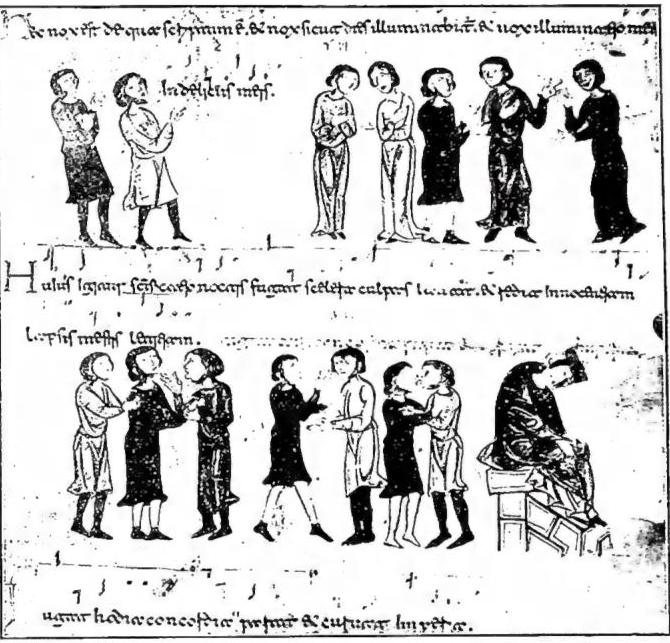
(da V. JALABERT, LOUIS, Les pontificaux mss. des bibl. publ. de France, Parigi 1857, par. 73)
PENANCE - The reconciliation of penitents. Pontifical of Sens (second half or end of the 14th century) - Paris, Bibliothèque nationale, ms. lat. 962, f. 200°.
the pax cum Ecclesia is considered the res et Sacramentum of penance (cf. also L. Lercher, Institutiones theologiae dogmaticae, 3rd ed., IV, 2, Innsbruck 1949, pp. 67 ff., 123).
4. The Sacrament of Penance in the Ancient Church
The penitential practice and doctrine of the ancient Church have formed one of the most delicate subjects in the history of dogma. The principal problems are whether, as has been asserted, the Church in the first three centuries excluded from its forgiveness the most grievous sins, and then the exact evaluation of the penitential institution as it was in force, especially from the 4th to the 6th century, in public or canonical penance.a) The historical-dogmatic development in the first three centuries. — Almost all non-Catholics see the penitential doctrine and practice of this period as determined by the conception of the "Church of Saints," which consists solely of sinless members (Sündlosigkeitsheorie) and by the corresponding evaluation of Baptism as the only penance (Tauftheorie). The primitive Church would therefore have definitively excluded from its bosom those guilty of the gravest sins (particularly the triad of capital sins: adultery, apostasy, homicide); and this not merely as a matter of fact, but because it was convinced that it had no right or power to grant forgiveness for such sins. The later, more lenient practice, introduced when the painful experience of too frequent sins no longer allowed such rigorism to be maintained, would therefore amount to a disciplinary and doctrinal innovation, while the original ideal would be represented by the positions of Montanus and Novatian (thus Rolffs, Harnack, Windisch; cf. J. F. Laun, Busswesen, II, in Religion in Geschichte u. Gegenwart, I, 2nd ed., Göttingen 1927, col. 1394). The overcoming of primitive rigorism, according to this conception, occurred gradually: first with regard to adulterers (in the so-called edictum peremptorium, which was attributed to Callistus, ca. 220), then reconciling apostates as well (in the time of St. Cyprian), and finally pardoning murderers (Council of Ancyra, 314). Similar opinions were advocated by the Modernists (Denz-U, 2046).
Some Catholics also admitted that the Church, before the 4th century, denied de facto reconciliation to the three capital sins; however, such refusal was dictated by the supposed pastoral expediency of such rigorism, and the later mitigation would be considered a merely disciplinary, not doctrinal, innovation (thus D. Petau, De vetere in Ecclesia poenitentiae ratione diatriba, in Dogmata theologica, ed. J. B. Fournals, VIII, Paris 1867, p. 182, followed by F. X. Funk, P. Batiffol, E. Vacandard, G. Rauschen). Other Catholics have denied not only the fact but also the possibility of such a disciplinary change (cf. J. Stuffer, Die Bussdisziplin der abendländischen Kirche bis Kallistus, in Zeitschrift für kathol. Theol., 31 [1907], pp. 433-73).
a) The nascent Church and the Apostolic Fathers. — In it, an elevated concept of the holiness required of its members was undeniably in force (I Cor. 6:11; St. Ignatius, Eph. 4:2; 8:2; Ps. Barnabas, 4:1; 11:11; II Clem. 6:9; 7:6), and the obligation to preserve the seal of Baptism unstained was considered most grave. Yet it also knew grave falls within its own bosom (I Cor. 5:1 ff.; 6:8; II Cor. 12:20 ff.; I Io. 1:8; Apoc. 2:15; 2:21; 3:2; St. Ignatius, Eph. 10:3; Philad. 7:2; 8:1; Trall. 8:2). For all these sins, the possibility of penance and salvation is affirmed (I Clem. 7:4; 8:1-5; St. Ignatius, Philad. 3:2; 8:1; Smyrn. 9:1). Hence the most urgent warnings to penance in this life, where alone it is fruitful (II Clem. 8:2); from the fact that the Apocalypse calls to penance even the Church reproached for fornication and idolatry, Tertullian, still Catholic, will deduce the existence of the "second penance" for all sins (De poen., 8:1-2). The testimony of the most ancient Symbol, "Credo... remissionem peccatorum" (Denz-U, 2), though it refers primarily to Baptism, at least secondarily also suggests the other, more laborious mode of remission (cf. K. Prüm, Der christliche Glaube u. die altheidnische Welt, II, Leipzig 1935, pp. 260 and 464, note 122, against K. Holl). The ecclesial-sacramental nature of penance appears especially in the excommunication of the guilty of a very grave sin, attested already by St. Paul in the case of the incestuous man of Corinth (I Cor. 5:2 ff.), where the authoritative judicial character of the apostolic decision (ἐξουσία) is strongly expressed; excommunication is there expressed with "tradere Satanae," since the devil can exercise his power more freely toward those excluded from the communion of the Church. It is not, therefore, a matter of abandonment to a true satanic possession, as some Fathers believed, nor of bodily death, nor of merely spiritual punishments, but also of corporal ones "in interitum carnis." This excommunication has a vindictive but also medicinal character: "ut spiritus salvus sit in die Domini" (cf. I Tim. 1:20, where Hymenaeus and Alexander have been excommunicated "ut discant non blasphemare"). The "penance of excommunication" for the gravest sins is also attested by the Didaché (10:6; 15:3), by St. Ignatius (Smyrn. 4:1; 7:2; Eph. 7:1), by St. Polycarp in the case of the presbyter Valens (Phil. 11:2), by Ps. Barnabas (19:4), and by the second letter of Clement (17:3-5).
The act of ecclesiastical forgiveness coincides with readmission to the common life of the Church. Forgiving, as well as punishing, is the task of the presbyters ("sint ad commiserationem proni," St. Polycarp, Phil. 6:1). That ecclesiastical reconciliation, as reunion with the community of salvation, is also considered a pledge of forgiveness by God can be legitimately supposed in the Pauline conception of the Church, even if it is not always so clearly expressed as in St. Ignatius: "Quotquot enim Dei et Jesu Christi sunt, hi sunt cum episcopo; et quotquot paenitentia ducti redierint ad unitatem Ecclesiae, et hi Dei erunt" (Philad. 3:2; F.X. Funk, Patres apost., 2nd ed., Tübingen 1901, p. 267).
Particular mention deserves the only writing of the period that ex professo treats of penance, Hermas (v.). The value to be given to its announcement of a post-baptismal penance has been much debated. Many (Harnack, Loofs, Seeberg, Windisch, M. Dibelius, H. Koch, and among Catholics F. X. Funk, P. Batiffol, K. Bihlmeyer) maintained that Hermas was the first to break the severe "theory of Baptism" and, appealing to a supposed celestial revelation, introduced an unheard-of novelty by announcing to sinful Christians a single and extraordinary opportunity for penance in the form of a jubilee. D'Ales and Poschmann have demonstrated that this interpretation is due to a great misunderstanding. What Hermas preaches (Vis. II) as a new revelation is not the possibility of a post-baptismal penance, which is already presupposed as evident in Vis. I (1, 9; 3, 2), but the setting of a limit to penance, namely that it should only be valid for sins committed up to that point. Hermas thus announces not the first, but the last possibility of penance. Convinced of the imminent end of the world, he hopes to shake the sinful Christendom into a mass conversion (Vis., II, 2, 4-9). The object of controversy is then Mand., IV, 3, 1-7, where an opposition is sought between the original ideal of holiness and the new penitential practice. Indeed, the Shepherd seems to approve both the existence of a second penance for the baptized and the doctrine of "some teachers" that there is no penance other than that of Baptism. The apparent difficulty is resolved by considering the specific situation of catechumens and neophytes (newly baptized). The teaching on the possibility of another penance is silenced for them, as it could become an incentive to sin (Mand., IV, 3, 3). They do not have penance (μετάνοια) because they have something greater: the total and gratuitous remission of all their sins (ἀφασις)—this opposition between μετάνοια (post-baptismal penance, laborious) and ἀφασις (total pardon in Baptism) became classical in the ancient Church (cf. Clement of Alexandria, Strom., II, § 55, 6) and must be kept in mind when in some texts the possibility of remission (ἀφασις) is denied for grave sins committed after Baptism. The efficacy of penance is unlimited, excluding not even the gravest crimes such as apostasy and adultery (Vis., II, 2, 2-4; Mand., IV, 1, 8). No trace is found of capital sins considered irremissible due to their objective gravity; only insofar as certain sins demonstrate in themselves a disposition of soul directly contrary to penance may they be irremissible (Sim., VIII, 6, 4; IX, 19, 1; VIII 8, 2).
Of great importance, however, became another restriction found for the first time in Hermas: penance after Baptism is unique: «οὐς γὰρ δούλους τοῦ Θεοῦ μετάνοια ἔστι μία (Mand., IV, 1, 8, cf. ibid., 3, 6); if someone sins after Baptism μίαν μετάνοιαν ἔχει. But from the context it also appears clear that this principle of μία μετάνοια in Hermas is not an expression of a dogmatic impossibility, as if God denied His mercy to the recidivist, but is inspired by pastoral reasons: the recidivist, as demonstrated by his repeated sinning, does not have the true penitential disposition, for which penance is useless. Given the great authority that the Shepherd of Hermas enjoyed at the time, the principle of the single penance was commonly adopted, at least in the Western Church; it should be noted that already in Tertullian this limitation, originally disciplinary, acquires a more dogmatic and categorical flavor (« sed iam semel, quia iam secundo; sed amplius numquam, quia proxime frustra »: De paen., 7, 10; cf. 9, 1).
The practice inaugurated by Hermas of a single post-baptismal penance cannot be considered outright as the most ancient custom. The Syrian Church of the first half of the 3rd century (cf. Didascalia and Constitutiones Apostolicae) seems not to know the limitation expressed by Hermas and adopted by Tertullian as by the Alexandrians (cf. K. Rahner, Busslehre u. Busspraxis der Didascalia Apostolorum, in Zeitschr. f. kath. Theologie, 72 [1950], pp. 257-81).
The ecclesial character of penance appears in Hermas in the excommunication of those guilty of grave crimes such as adultery or idolatry (Mand., IV, 1, 8-9); thus the Church is also the end of penance: insertion into the tower, which is the symbol of the (holy) Church, guarantees the remission of sins and salvation. If for Hermas penance were not concluded with reconciliation, it would be difficult to understand the anger of the Montanist Tertullian against the «Pastor moechorum» who would have precisely opened the Church to adulterers (De pud., 10, 12; 20, 2).
β) The penitential controversies of the 3rd century. - The end of the 2nd century and the first part of the 3rd century are marked by the Montanist crisis (v. MONTANISMO). The necessity of defending the traditional penitential practice against the rigorism of the new prophecy contributed not a little to ensuring that the exercise of the power of the keys, traced in its outlines in the preceding epoch, appeared clearly affirmed at the beginning of the 3rd century. It seems, however, that the Montanist movement induced some bishops here and there to greater severity; note for Africa the affirmation of Cyprian that some among his predecessors, in the province of Africa, had not admitted adulterers to reconciliation (« in totum paenitentiae locum contra adulteria cluserunt »: Ep., 55, 21: ed. G. Hartel, CSEL, 3, 2, p. 638, 23-25). Cyprian, however, also makes it understood that they saw this as a purely disciplinary question: « Non tamen a coepiscoporum collegio recesserunt aut catholicae Ecclesiae unitatem ruperunt »: ibid., p. 639, nn. 1-3). This partly explains the categorical assertion of the Montanist Tertullian: « Hinc est, quod neque idolatriae neque sanguini pax ab Ecclesiis redditur » (De pud., 12, 11): this, stated in general, is false. It is sufficient to recall the letter that Dionysius of Corinth, a contemporary of Pope Soter (165-74), addressed to the Church of Amastris in Bithynia, asking for the reconciliation (δεξιώδης) of all those who from error and « heresy return to the Church » (cf. Eusebius, Hist. eccl., IV, 23, 6) and the case of the confessor Natalis, who after passing to the heresy of Theodotus, the argentine miraculously induced to penance, was reconciled by Pope Zephyrinus (198-217; cf. Eusebius, ibid., V, 28, 8-12).
It is debated whether the affirmations of St. Irenaeus (Adv. haer., I, 13, 5; 7) concerning some Christian women seduced by the Gnostics contain, beyond the fact of their penance, also the attestation of their reconciliation (this is affirmed by P. Galtier, Aux origines du Sacrement de la Pénitence, Rome 1951, pp. 149-52, against B. Poschmann, Paenitentia secunda, Bonn 1940, p. 222 ff.; a similar divergence is manifested regarding the value to be given to the exomologesis repetita of the Gnostic Cerdo: cf. Irenaeus, op. cit., III, 4, 3 and B. Poschmann, op. cit., p. 220 ff.). Undoubted, on the contrary, is the testimony of Tertullian himself who, still
Catholic, in the treatise De paenitentia (ca. 203) defends the second penance, unique as in Hermas (7, 10), open to all sinners (8, 2-6), consisting in an active probatio that requires not only internal repentance but also an external act, the ἐξομολόγησις (9, 1-2); this includes various acts of humiliation and mortification such as publicatio sui, the imploration of the intercession of priests and confessors (9, 4; 10, 6), usco et cinere incubare, ieiunii preces alere (9, 4). The penance, initially performed outside the church (in vestibulo 7, 10), later in the very house of God (De pud., 13, 7), concludes with reconciliation, which, like excommunication, pertains to the bishop.
Very different is the doctrine of Tertullian in the De pudicitia, written after the
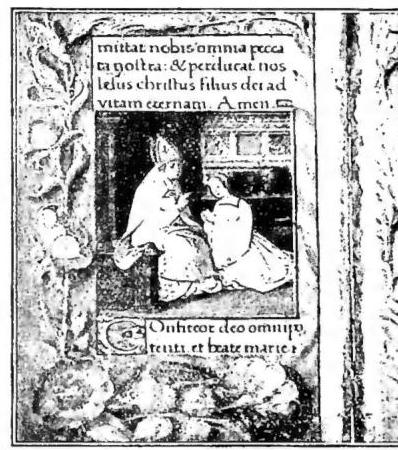
PENANCE - A bishop administers the Sacrament of P. Miniature from the Book of Hours of Renée of France (16th century) - Modena, Biblioteca Estense.
transition to Phrygian heresy (v. MONTANISM, III). Here he distinguishes sins (2, 12-15) into peccata remissibilia (modica, 1, 19; mediocria, 7, 20; leviora, 18, 18) and irremissibilia (capitalia, 9, 20; 21, 14; mortalia, 3, 3; 19, 28; maiora, 18, 18; exitiosa, quae veniam non capiunt, 19, 25). The latter exclude forgiveness by the Church, not by God (de venia Deo reservamus, 19, 6). This distinction is entirely new, unknown even to Tertullian in his Catholic period; as new is the triad of capital sins, which he
Recent criticism has not taken into account Tertullian’s polemical art, nor the numerous contradictions into which he falls due to some arbitrary assertions; it is therefore mistaken to conclude from the particular argument of De pud. the existence of three capital sins to which, according to Tertullian, the ancient Church would have denied forgiveness: idolatry, murder, and adultery occupy the first place among capital sins, but they are not the only ones (De pud., 19, 25; Adv. Marc., 4, 9). Given, however, Tertullian’s great authority, even in the 4th and 5th centuries that triad was considered in some Churches as the sole object of ecclesiastical penance (« Nonnulli putant tria tantum crimina esse mortifera », St. Augustine, Specul. de script. sacr.: De libro Actum Apost.: PL 34, 994). Equally untenable is the opinion that the bishop (« pontifex maximus, quod est episcopus episcoporum ») who safeguards with a « peremptory edict » the reconciliation of adulterers (the proximate occasion of the treatise De pud.) was Pope Callistus (217-22); the accusations of Hippolytus (Philosophumena, 9, 2) against the « lax » practice of Callistus refer to a different matter. That edict, moreover, does not at all constitute the beginning of the controversy, nor did it inaugurate a new penitential practice, nor a new concept of the Church, destroying, as has been claimed, the « baptismal rigorism » hitherto in force. The edict rather authoritatively confirms the practice hitherto in force (which Tertullian implicitly admits, since his polemic presupposes that forgiveness for adulterers was already a constant practice of the « psychics », indeed he admits to having once shared their view (1, 10). The term « edict » is probably the fruit of the same irony that coined the titles pontifex maximus and episcopus episcoporum. The so-called Penitential Edict of Callistus thus reduces to an energetic affirmation, with which an African bishop (probably Agrippinus, primate of the African Church, 218-22; cf. St. Cyprian, Ep., 71, 4) safeguards the traditional doctrine of ecclesiastical forgiveness against the irruption of Montanist rigorism.
Tertullian, who denies the power to forgive grave sins to the hierarchical Church, attributing it either to Peter personally or to the spiritual Church through the spiritalis homo (De pud., 21), indirectly attests how much the struggle against Montanism contributed to promoting in bishops an ever clearer awareness of the power granted by Christ, and its defense through recourse to the Petrine power of « binding and loosing » transmitted to the heads of the hierarchical Church through apostolic succession.
The second penitential controversy, fought in Carthage and Rome, arises during the persecution of Decius (249-51) over the question of the « lapsi » (v.). With Pope Cornelius, it was especially St. Cyprian who defended the traditional penitential practice: against the presumption of some confessors, he reaffirms the power of reconciliation to the bishop and the presbyters authorized by him (Ep., 61, 3); against rigorist tendencies, he admits all lapsi to penance; against the laxists, he insists that reconciliation will not be granted « ante expiata delicta, ante exomologesim factam criminis » (De lapsis, 16). The theory is groundless according to which the alleged rigorism of the primitive Church would have been broken a second time (after Callistus) by Cyprian. The innovator was Novatian (v.), who excluded apostates from any ecclesiastical forgiveness. In penitential practice, St. Cyprian attests, for the first time in the Latin Church, the imposition of hands by the bishop and clergy in the rite of reconciliation (Ep., 16, 2: ed. G. Hartel, CSEL, 3, 2, p. 518 = Ep., 9: PL 4, 258). From a dogmatic perspective, the great bishop shows the characteristic difficulties and imperfections of ancient penitential theology. Strong in him is the principle that God alone forgives sin (De lapsis, 17); God must therefore be placated through the personal satisfaction of the guilty: « Dominus nostra satisfacione placandus est » (ibid.); penance, in contrast to Baptism, must laboriously merit divine remission (Ep., 55, 22). But with equal force, Cyprian exalts the necessity of the Church’s intervention, of ecclesiastical communion; characteristic is how he justifies the peace given to the dying (Ep., 57, 1: ed. G. Hartel, CSEL, 3, 2, p. 651). The perfect synthesis of these two cardinal assertions, lacking in Cyprian, had to wait until the time of the great Scholastics.
γ) Penance in the Eastern Church. - Clement of Alexandria and Origen are the direct witnesses of the tradition of the Eastern Church independently of the Tertullian controversy. Clement agrees with the Shepherd of Hermas in affirming the second, unique penance (Strom., II, 13, 56 ff.), for all sins (Quis dives salvetur, 38, 4; 39, 3; 42, 15; Strom., II, 23, 147, 2 ff.; VII, 16, 102, 2) and in distinguishing between the efficacy of Baptism (ἄφεσις, by pure Grace) and of penance, which instead requires a painful purifying process (Strom., II, 12, 55, 6; 15, 70, 3; IV, 24, 154, 3; Quis dives salvetur, 40, 1). The remission of sin is conceived as a slow process of healing (ibid., 40, 3-6), in which it is necessary to entrust oneself to an expert « spiritual director », who supports penance with correction and prayer: such are the members of the ecclesiastical hierarchy, but also all perfect Christians, the « friends of God » who represent the ideal of the « gnostic ». Clement’s psychological-medicinal conception of penance strongly influenced penitential doctrine in the Eastern Church. Origen should never have been classified among the radical rigorists (as Harnack did). The incriminated text (De orat., 28, 10) in fact contains nothing about a supposed irremissibility of capital sins, but denies them ἄφεσις because there can no longer be any question of their extinction through the baptismal rite; they cannot even be remitted by the immediate action of the Church’s prayer and sacrifice (as « minor » sins can); rather, they must be expiated through the « punishment » (κάλασις) due to them. This third point is the logical consequence of the second, and derives from the essence of mortal sin, insofar as it is a death and separates the sinner from the interior communion of Grace.
BIBL.:
For Tertullian: P. de Labriolle, Histoire de la littérature latine chrétienne, Paris 1924, II, p. 136-158; G. Bardy, La théologie de l'Église de s. Clément de Rome à s. Irénée, Paris 1945, p. 257-268; J. Lortz, Tertullian als Apologet, Münster 1927-28, II, p. 165-180; H. von Campenhausen, Kirchliches Amt und geistliche Vollmacht in den ersten drei Jahrhunderten, Tübingen 1953, p. 250-260. - For the controversy of the lapsi: H. Koch, Cyprian und der römische Primat, Leipzig 1910; P. Batiffol, L'Église naissante et le catholicisme, Paris 1927, p. 231-256; J. Lebreton, Histoire du dogme de la Trinité, Paris 1927-28, II, p. 507-520; H. von Campenhausen, Die Idee des Martyriums in der alten Kirche, Göttingen 1936, p. 150-160. - For the Eastern Church: G. Bardy, La pénitence dans l'Église primitive, in Revue d'histoire ecclésiastique, 1927, p. 489-515; H. Leclercq, Histoire des conciles, Paris 1907-1952, I, p. 157-168; J. Tixeront, Histoire des dogmes, Paris 1930, I, p. 401-410.
A. D'ALES
The first salutary act of the Church toward the sinner is excommunication: Origen lacks a fixed technical term (he speaks of expellere de Ecclesia, foras mittere, a corpore Christi separare, ligare); there is, however, no doubt about the theological meaning of such excommunication: it makes visible what had already occurred in the eyes of God, and it holds a value of perdition before God: separated from the homeland, from the heavenly Jerusalem, from the body of Christ, from unity, the sinner is abandoned to darkness. The authority to inflict excommunication belongs to the bishop ("per episcopi sententiam", In Leo. 14, 2); from this, the penitential practice in Origen’s time is clearly evident: bishops not only exercised such authority but had also formulated the theory of their right to do so: "Per eos qui Ecclesiae praesident et potestatem habent non solum solvendi, sed et ligandi" (In Iud. 2, 5). Thus, Origen placed on the same level the remission of sin to be granted by God and readmission into the Church: "Quo modo audere possum accedere ad Dominum? Quomodo ad Ecclesiam redire?" (In Ps. 36 hom. 4, 2: PG 12, 1353).
The image provided by Origen is confirmed by the Didascalia Apostolorum, which presents a perfect picture of the penitential institution in the Eastern Church during the first half of the 3rd century. It inculcates the remissibility of all sins before God and the Church and frequently polemicizes against those who deny ecclesiastical reconciliation: the notion that God might grant forgiveness to repentant sinners while the Church must deny them ecclesiastical peace is entirely unknown to the Didascalia. The two pardons condition and postulate each other (cf. the study by K. Rahner).
b) Public or canonical penance. - From the 4th century onward, the Church’s power to remit all sins, even the gravest, is attested by increasingly frequent testimonies and sanctioned by solemn magisterium (cf. canon 13 of the Council of Nicaea: "cuilibet in exitu posito et poscenti sibi Eucharistiae participationem episcopus tribuat", Denz-U, 57). What remains is the exact assessment of the concrete form in which the Sacrament of Penance presents itself until the 7th century: public penance, also called canonical penance because it was governed by the canons of the first councils (such as the Synods of Ancyra [314], Neocaesarea [between 314 and 325], Nicaea [325], Antioch [341], Gangra in the East, and the African, Spanish, and Frankish synods in the Western Church), by papal decrees (Siricius, Innocent I, Leo I, Felix II, Hormisdas, Gregory I), as well as by penitential epistles (which over time acquired canonical authority), composed by Gregory Thaumaturgus (d. ca. 270), Peter of Alexandria (d. 311), St. Basil (Epist., 188, 199, 217), and St. Gregory of Nyssa.
a) Description of public penance. - Public penance essentially required a twofold act of the ecclesiastical hierarchy: excommunication from the Church and reconciliation with II. If public penance is defined as that which was done "in ordine paenitentium" (P. Galtier), it must be kept in mind that this aggregation could have different degrees. For public penance to exist, it is not necessary that the sinner de facto (for a determined time and in a determined manner) belonged to the class of penitents; the very exclusion from the Eucharist was already considered an insertion into the order of penitents (St. Cyprian, Origen). The manner of practicing it could vary considerably, but everywhere penitents had a place (ordo) separate from those who could receive the Eucharist, and they received particular impositions of hands. Subject to public penance were not only the so-called three "capital sins," but in general peccata gravia et mortifera (St. Augustine, Serm., 278, 12: PL 38, 1273), while other sins (levia et minuta) were remitted through "daily penance" (prayers, fasts, alms). However, public penance could be voluntarily accepted for such minor faults. The concept of grave sin still lacked precision. It did not matter whether the sins were public or occult. Admission to penance was a favor that had to be requested; originally, it was also open to clerics (cf. St. Cyprian, Ep., 64, 1 = Ep., 59: PL 3, 1014), but from the 4th century onward, universal practice excluded higher clerics from public penance (note the reason given by St. Augustine, Contra ep. Parm., 2, 13: PL 43, 70) and punished them with deposition and degradation (considered equivalent to public penance), later admitting them to lay Communion. Something similar applied to lay "converts," who, instead of penance, chose religious life, withdrawing to monasteries or even remaining in the world. Penitents on their deathbeds were also admitted to penance, but in an earlier period, the practice (not universal, it seems) was to deny peace or Communion to those who had requested penance only in danger of death (St. Cyprian, Ep., 55, 23; ed. G. Hartel, CSEL, 3, 2, p. 641 ff. = Ep., 52: PL 3, 789 ff. and canons 64 and 70 of the Council of Elvira, Mansi, II, 16 ff.); after Nicaea (canon 13, Denz-U, 57), a milder practice was followed, granting penance and Communion (cf. the Epistolae of Innocent I to Exuperius, Denz-U, 95, and of Celestine I to the bishops of Gaul, Denz-U, 111). Public penance consisted of three parts: the imposition of penance, after the confession (in itself secret; cf. St. Leo the Great, Ep., 168, 2, Denz-U, 145) of the guilty party and after the correptio by the bishop; the actio paenitentiae, of which the principal act was exomologesis, which in St. Cyprian sometimes means the entire public penance, but more strictly implied an expressed confession in the very acts of the penitent ("prosternendi et humilificandi hominis disciplina", Tertullian, De poenit., 9, 3), which often had to be repeated. This explains the case of the Gnostic Cerdo, who, admitted to public penance, sometimes performed exomologesis and sometimes neglected II. Furthermore, exomologesis encompassed the entire discipline of penitential life (fasts, works of expiation, etc.); the absolutio paenitentiae given by the bishop and clergy through the imposition of hands (St. Cyprian, Ep., 16, 2), united with the celebration of the Eucharistic Sacrifice, with an efficacious influence on eternal salvation since it restored peace with the Church, the community of salvation.
What greatly differentiates public penance from today’s practice is its non-repeatability (cf. Pastor Hermæ, Mand., IV, 3, 6; Tertullian, De poenit., 7, 10; Origen, In Lev. hom., 15, 2; St. Augustine, Ep., 153, 7). Those who claim to receive penance more often “luxuriantur in Christo,” “quia sicut unum Baptisma, ita una paenitentia” (St. Ambrose, De poenit., II, 10: PL 16, 520). Recidivists are not admitted to ecclesiastical penance but are instead admonished to commend themselves to divine mercy through penitential works (St. Augustine, Ep., 153, 3, 7). Furthermore, those who had once undergone public penance remained, even after reconciliation, subject to a not insignificant post-penitential discipline: from the 4th century onward, they were excluded from clerical status, military service, public offices, and the use of marriage (cf. St. Siricius I, Ep. ad Himerium, in Mansi, III, 657).
β) There has been considerable debate over whether, alongside public penance, a sacramental “private” penance also existed in the ancient Church. The affirmative response, already given by Morinus and Petavius, has recently been defended by A. D'Alès, S. Harent, and P. Galtier. They identify this private penance in the public reconciliation of heretics and those who, for various disciplinary reasons, had been excommunicated without the obligation of undergoing canonical penance; likewise, in the Communion given to the dying and in the remission of “medium” sins (grave but not capital). According to P. Batiffol and J. Tixeront, the transition from public to private penance began to take shape around the year 400; K. Adam initially sought to demonstrate that the introduction of the private form was due precisely to St. Augustine, but later argued that an ecclesiastical penance without excommunication (innerkirchliche Busse) had always existed.
The existence of private penance was instead denied by Fr. X. Funk, E. Vacandard, E. Göller, E. Amann, and—with particularly thorough research—by B. Poschmann, whose argument has gained increasing support. According to the latter, private penance was not introduced before the 7th century. Its first certain trace is found in canon II of the Third Council of Toledo (589), which condemned this form of penance as excerabilis praesumptio (Mansi, IX, 995). The Fathers expressly attest that for the baptized there are only two kinds of penance: the daily private one (prayers, alms, etc.) for minor sins and the canonical one for peccata mortifera (cf. St. Augustine, De symb. ad cat., 7, 15: 8, 16; Serm., 35 1,2-4; 352, 2; Ep., 265, 7). The correptioum medicamenta mentioned by St. Augustine (De fide et operibus, 26, 48) are nothing other than exhortations to penance; there is no evidence that they should be understood as private absolution (cf. B. Poschmann, S. Aurelii Augustini textus selecti de paenitentia, in Florilegium patristicum, fasc. xxxVIII, Bonn 1938, p. 75 and note 2). As recent research by K. Rahner has shown, even according to Origen and the Didascalia Apostolorum, only in public penance with excommunication can a true particular Sacrament be recognized. Outside of it, there are acts of the ecclesiastical hierarchy aimed at the remission of sins, but these cannot be called sacramental in the current sense of the word. To affirm the existence of a sacramental private penance, one would instead have to demonstrate that, in the ancient Church, there existed an ordinary means of remission for grave sins (at least occult ones), in a process exclusively internal (in foro conscientiae) and repeatable, as in fact exists from the 7th century onward. Furthermore, it would be necessary to demonstrate that such a process, if it existed, had sacramental value; it is not possible to see a true absolution (and consequently private penance) in any priestly prayer that implores the remission of sins, nor in any correptio of sins.
The practice of private penance thus appears to have been introduced in the 7th century, beginning in some provinces of Spain and Gaul. It may be said to have been prepared by the penance of the conversi, who had spread the custom of making a secret penance, accepted out of devotion. A change in form was then imposed by the many difficulties of canonical penance (delaying penance until the point of death, for fear of legal consequences; sacrilegious Communions; the distressing situation of recidivists; the tendency to substitute penance with monastic life or conversio, considered a second Baptism). The proximate cause of the change seems to lie in the activity of the Hiberno-Scottish missionaries, who, under the guidance of St. Columbanus, spread the customs of the Celtic Church on the continent as well.
γ) Dogmatic evaluation of public penance. - 1°) The ancient Church knew and practiced penance as a sacramental means of remission of sins for the baptized. Regarding the external manner of administration, while the penitential practice of the ancient Church differs greatly from today’s usage, the same essential elements are nonetheless present. Even in the ancient Church, to obtain the remission of sins in the Sacrament of Penance, the following were required on the part of the sinner: contrition, satisfaction, and confession; on the part of the Church exercising the power of the keys, absolution. Contrition, in the sense of true conversion, was indispensable for being admitted to receive penance. The confession of sins was considered absolutely necessary; this is also confirmed by the declaration of the Council of Trent, which affirms that secret confession before the priest alone was in force in the Church from the beginning: for the confession that initiated every penance was even then, in itself, secret. Satisfaction held such primacy in all penitential practice that penance seemed almost to consist entirely in II. Sacramental absolution was imparted in the form of reconciliation. It is true that in the ancient Church it was not clearly understood what relationship existed between the effect of reconciliation and subjective penance. The testimonies on the penitential practice of the ancient Church further show that ecclesiastical (sacramental) penance was required for all crimina, although in individual Churches and in different periods there was no constant criterion as to which offenses should be considered crimes. In all these respects, the penitential practice in force in the ancient Church thus corresponds to what the Council of Trent requires to constitute the essence of the Sacrament of Penance; it is therefore not necessary to suppose that in the ancient Church there existed some sacramental private penance whose existence, for the first six centuries, is not supported by the testimony of the sources.
BIBL.:
A. D'Alès, La théologie de s. Cyprien, Paris 1922; Id., La doctrine de la pénitence au IIIe siècle, in Revue d'hist. ecclés., 1929, p. 217 ss.; P. Galtier, L'Église et la rémission des péchés aux premiers siècles, Paris 1932; S. Harent, V. Pénitence, in Dictionnaire de théologie catholique, XII, 1, Paris 1933, col. 721-1159; B. Poschmann, Die abendländische Kirchenbusse im Ausgang des christlichen Altertums, München 1928; Id., Paenitentia secunda, Bonn 1940; K. Rahner, Busssakrament, in Lexikon für Theologie und Kirche, II, Freiburg 1931, col. 725-731; J. Tixeront, Histoire des dogmes, III, Paris 1912, p. 177-200; E. Vacandard, La pénitence publique dans l'Église primitive, in Revue du clergé français, 1903, p. 385-404; 1904, p. 129-148; 1905, p. 33-52; E. Göller, Die päpstliche Pönitentiarie von ihrem Ursprung bis zu ihrer Umgestaltung unter Pius V., Roma 1907-1911; E. Amann, V. Pénitence, in Dictionnaire de théologie catholique, XII, 1, Paris 1933, col. 721-1159; K. Adam, Die kirchliche Sündenvergebung nach dem hl. Augustinus, Paderborn 1917; Id., Das sog. Buss-Sakrament, in Theologische Quartalschrift, 1928, p. 161-187; P. Batiffol, Études d'histoire et de théologie positive, Paris 1902, p. 1-116; Fr. X. Funk, Die Bussdisciplin in der vornicänischen Kirche, in Theologische Quartalschrift, 1892, p. 385-420; 1893, p. 1-32; 1894, p. 1-32.
2°) In penitential practice and doctrine, not a few difficulties and imperfections are found; these, however, cannot be justly evaluated except by considering the entire state of theological explanation available at the time. In the history of penitential doctrine, it is clearly seen how the concept of the Sacrament was not yet circumscribed. It is therefore no surprise that there was an excessive valuation of personal works that must "merit forgiveness." This exaltation of the opus operantis is not without connection to the tendencies of asceticism and monasticism (cf. the Pelagian and Semipelagian controversies. St. Augustine, as an anti-Pelagian polemicist, more strongly asserted the moment of ecclesiastical reconciliation). Although the distinction between guilt and punishment was not entirely unknown at the time (cf. St. Cyprian, Ep., 55, 29), it was not applied to penitential theology; thus, it was easily believed that "forgiveness" from God was obtained only when every punishment was also remitted. This also explains how the value of reconciliation given by the Church was considered in some way "hypothetical." Thus, justification was conceived not so much as an instantaneous act (by which guilt is immediately and totally removed) but almost as a successive pardon. The Fathers also held that Grace makes man a friend of God and that it is, as a gift, something permanent. However, they did not pay much attention to the fact that Grace is a positive quality inherent in the soul, by which the state of sin is immediately and necessarily removed. The remission of sins was for them a kind of healing process, not only in the psychological sense of destroying sinful tendencies but also in the sense of the remission of guilt before God.
Finally, since reconciliation, as the name itself implies, was understood in itself as readmission into the community of the Church, its efficacy is recognized all the more clearly the deeper the doctrine of the Church as the Body of Christ, in which charity, the Spirit, and through the Spirit, the remission of sin by God are given (St. Paul, St. Cyprian, St. Augustine). In the administration of the Sacrament of Penance, a certain greater participation of the entire community also appears, which with its intercession aids the penitential work of the sinner; however, it gradually became more explicitly understood who the proper subjects of the power of the keys were.
5. The progress of penitential doctrine in scholastic theology
Its factors are to be sought in the powerful revival of interest in theological speculation as well as in the practical necessity of defending ecclesiastical doctrine on the power of the keys against heresies that shook its very foundations (v. CATARI; VALDESI). The use of dialectics in theology, the application of Aristotelian concepts—highly useful for the great work of clarification and systematization undertaken by the scholastics—however, also created a host of new problems for penitential doctrine and produced a veritable tangle of theories (cf. the application of the doctrine of habitus to penance and V. the extensive research of Anciaux).Two questions occupied scholastic theologians above all:
a) The internal connection between the various factors of penance. - This principal problem, unresolved by the Fathers or by theologians of the Carolingian era, was then placed in a somewhat new light, since, in the personal element, the emphasis was no longer placed on penitential works (satisfactio), but on contrition. This change was caused by the altered penitential practice: from the time when reconciliation was granted immediately after confession, the satisfactio, which still remained to be done, could not be considered the cause of the remission of sins. As the cause of this, only contrition (v.) could be taken into consideration, which from then on stood at the center of penitential doctrine. For the same reason, the concept of remission was further specified: if satisfaction was still to be rendered, contrition and absolution could not produce a "remission" in the sense of a pardon of all punishments (as the ancient Church had conceived remission). By distinguishing between eternal and temporal punishment, the effect of satisfaction was seen in the forgiveness of temporal punishments for sin, while prior contrition and confession bring remission in the sense that they remove the merited eternal punishment or change it into a temporal punishment, as the pseudo-Augustinian treatise De vera et falsa paenitentia (PL 40, 1113-50; composed around the middle of the 11th century) affirms.
Notable is the conception, albeit quite imperfect, of Abelard, condemned at the Synod of Sens (A.D. 1140), since it practically denied the power of the keys, attributing the remission of sin exclusively to the subjective work, to contrition. His theory on the merely declaratory value of absolution strongly influenced the canonists (cf. the Decree of Gratian) and Peter Lombard (IV Sent., d. 18, c. 4 and 5). The priest cannot remit sins but can only show that they are forgiven, analogously to the task of the priests of the Old Testament regarding the healing of lepers. Already St. Anselm of Canterbury had written: «Qui iam coram Deo sunt mundati, sacerdotum iudicio etiam hominibus ostenduntur mundi» (Hom., 13). Hugh of St. Victor, seeking to safeguard the efficacy of the keys, attributed to contrition the liberation from the "inner bond" (impietas vel obduratio cordis), and to absolution the destruction of the "outer bond" (debitium futurae damnationis; cf. De Sacramentis, II, 14, 8). Thus, the fundamental distinction between guilt and punishment had been introduced into the penitential problem, though not felicitously, since Peter Lombard easily demonstrated that the remission of eternal punishment could not be separated from the forgiveness of guilt. Given the universal conviction that the remission of sin was indissolubly connected with contrition, an effective intervention of priestly absolution in the remission of sin seemed possible only if absolution could produce contrition (that is, turn the attritus into a contritus). The problem was sought to be resolved through the POLITEISMO (v.) had distinguished four elements in the process of justification (the infusion of Grace, the motion of free will, contrition, the remission of sins).
b) The systematization of all traditional material within the concept of the Sacrament. - This was the particular work of St. Thomas, already accomplished in his Commentary on the Sentences. The personal factor, paenitentia ut virtus (consisting of the three parts: contrition, confession, satisfaction), is the matter; absolution is the form of the Sacrament of Penance. Matter and form do not operate separately but together, as a single cause, such that the personal acts of the penitent and the exercise of the power of the keys are the (instrumental) cause of the remission of sins (IV Sent., d. 22, q. 2, a. 1, sol. 1; Sum. Theol., IIIª, q. 86, a. 6). They differ in that efficacy comes principally from the form, that is, from absolution; signification, however, is principally ex parte materiae. By positing, with the preceding tradition, the res et sacramentum in interior penance (which coincides with contrition), St. Thomas affirmed that absolution also exerts an influence on the movements of free will (IV Sent., d. 22, q. 2, a. 1, sol. 2; Sum. Theol., IIIª, q. 84, a. 1, ad 3). However, the characteristic difficulty of Thomistic doctrine also appears here in this dual function of contrition, which is an indispensable disposition for Grace and, on the other hand, already presupposes this same Grace; a difficulty that Aquinas sought to resolve by invoking the different forms of reciprocal causality (v. CONTRIZIONE; GIUSTIFICAZIONE).
In opposition to St. Thomas, who had included contrition as an essential element within the Sacrament itself, Duns Scotus taught two distinct paths of justification, independent of one another: the extrasacramental path (in which attritio merits justification de congruo) and the sacramental path, which justifies ex opere operato and is easier because it does not require contrition operating as a «meritum de congruo» (Ox., IV Sent., d. 14, q. 4, n. 6 sqq.). Consequently, Scotus also abandoned the Thomistic conception of personal penance as matter and absolution as form, placing the essence of the Sacrament in absolution alone: «Paenitentia est absolutio, id est, quaedam sententia definitiva absolvens reum» (ibid., 3). Contrition, confession, and satisfaction are necessary as dispositions for the Sacrament but are not its parts. As a result, Scotus and his followers insisted even more strongly than St. Thomas on the efficacy of the opus operatum.
6. The innovators and the Council of Trent
The thesis, fairly widespread in the 11th and 12th centuries, that God alone could forgive sin, leaving to the minister of the Sacrament only the task of declaring the forgiveness of guilt already granted or of remitting the penalty (total or partial), though seemingly in full contrast with the doctrine of the Church as later defined at Trent, admits of a benign interpretation, given also the fluctuating use of the word remissio, sometimes understood not in the sense of the term of the process of justification but of the first active disposition of the penitent toward it (cf. Z. Alszeghy, art. cit., p. 282 sqq.). Wycliffe (v.), however, in his denial of all external ecclesiastical order, rejected absolution as an abuse and confession as useless (Denz-U, 587).Similar opinions were also attributed to Hus (ibid., 670 sqq.), and Sixtus IV condemned in 1478 certain theses of Pedro de Osma (ibid., 724-33). The innovators of the 16th century, by the internal logic of their own system (doctrine on the corruption of human nature and justification by faith alone, rejection of all priestly power), were led to deny penance both as a virtue (personal element) and as a Sacrament (ecclesiastical factor). Since, therefore, it was no longer a matter of school opinions but the very substance of penitential doctrine that was called into question, the Council of Trent thoroughly addressed penance in its fourteenth session (October-November 1551), issuing 9 chapters and 15 canons (Denz-U, 894-906; 911-25). Above all, the dignity of penance as a true Sacrament, distinct from Baptism, was reaffirmed (on contrition, ch. 4; on confession, ch. 5; on the minister, chs. 6 and 7; and on satisfaction, chs. 8 and 9: V. respective entries). It should be noted that the Council, in treating the structure of penance in ch. 3, avoided pronouncing on the disputed question among Catholic theologians whether the acts of the penitent are merely integral parts of the Sacrament (Scotist position) or whether they should be considered the materia ex qua (Thomistic opinion, now very common). The principal effect of the Sacrament is the remission of grave sins quoad reatum culpae, through the infusion of sanctifying Grace; consequently, the total remission of eternal punishment (sess. VI, ch. 14; Denz-U, 807) and the partial remission of temporal punishment (sess. VI, can. 30; Denz-U, 840; sess. XIV, ch. 8 and can. 12; Denz-U, 904, 922). The remission of guilt and punishment in the Sacrament of Penance is irrevocable; one may speak of their return in the case of a subsequent sin only improperly (inasmuch as the privation of Grace returns and insofar as the guilt of the new sin becomes more serious due to the forgiveness previously granted). The "less principal" effects of the Sacrament are the revivification of merits (v. MERITI), the conferral of the "right" to actual Graces, with which the penitent can expiate the remaining temporal punishments and avoid sin in the future; finally, peace and serenity of conscience, an accidental effect and not always attained (sess. XIV, ch. 3; Denz-U, 896). It is defined that even venial sins can be confessed in the Sacrament of Penance (sess. XIV, ch. 5 and can. 7; Denz-U, 899, 917), and it is theologically certain that venial sins can be remitted «vi ipsius Sacramenti» (ibid., 899).
BIBL. GENERALE: L. De San, Tract. de Poenitentia, Bruges 1900; A. D'Alès, Prima lineamenta tract. dogmatici de Sacram. paenitentiae, Parigi 1926; G. Huarte, Tract. de Sacram. poenitentiae, 3ª ed., Roma 1930; E. Amann, A. Michel, M. Jugie, s. V. in DThC, XII, coll. 722-1138; C. Boyer, Tract. de Sacram. paenitentiae et de Extrema Unctione, Roma 1942; B. Poschmann, Der Ablass im Lichte der Bussgesch., Bonn 1948; id., Die innere Struktur des Bussakraments, in Münchener Theol. Zeitschr. 1 (1950), fasc. 3ª, pp. 12-30; id., Busse und Letzte Ölung, in Handb. der Dogmengeschichte, IV, fasc. III, Friburgo in Br. 1951; P. Galtier, De Paenitentia, Tract. dogmatico-histor., nuova ed., Roma 1950.
Agostino Mayer
II. MORAL THEOLOGY AND CANON LAW
SOMMARIO:
I. Necessità
II. Materia
III. Forma
IV. Assoluzione condizionata
V. Effetti
VI. Obbligo di ricevere il Sacramento
VII. Ministro
VIII. Riti orientali
IX. Rimedio penale.I. NECESSITY
The Sacrament of Penance is "necessary by necessity of means," that is, as a means in itself indispensable for those who, after Baptism, have committed mortal sin (Council of Trent, sess. XIV, De Poenitentia, cap. 2; Sum. Theol., 3, q. 84, a. 5). However, forgiveness of sins may sometimes be obtained through perfect contrition alone, combined with the vow or intention to confess, namely when it is impossible to receive sacramental absolution (Council of Trent, loc. cit., cap. 4).II. MATTER OF PENANCE
7. Remote Matter
Remote matter, or rather that which is to be removed, consists of the sins committed after Baptism. It is distinguished into necessary and non-necessary.a) Necessary matter consists of mortal sins committed after Baptism and not yet directly remitted through sacramental absolution. b) Non-necessary (but sufficient) matter consists of: α) venial sins committed after Baptism, even if already remitted through sacramental absolution; β) mortal sins committed after Baptism and already directly remitted through sacramental absolution (can. 902; Conc. Trid., loc. cit., cap. 5). Voluntary imperfections cannot be matter for Penance unless accompanied by circumstances of contempt, scandal, sloth, etc. (cf. A. Lehmkuhl, Theologia moralis, II, 11ª ed., Innsbruck 1910, n. 360). A completely generic accusation of sins (such as, for example: "I accuse myself of the sins committed") is sufficient in cases of urgent necessity (imminent danger of death) and when there is no time to distinctly manifest the sins (cf. I. D'Annibale, op. cit., III, n. 302).
8. Proximate Matter
It has been seen in the respective entries that all admit the necessity of contrition, confession, and satisfaction in the recipient of the Sacrament of Penance, though in varying degrees. For the qualities required in each act, and especially regarding integrity, V. CONFESSIONE; CONTRIZIONE; SODDISFAZIONE, and also PROPOSITO.III. FORM OF PENANCE
### 1. Rubrical Form
The rubrical form of the Sacrament of Penance is as follows: Misereatur, etc.; Indulgentiam, etc. Dominus noster Iesus Christus te absolvat: et ego auctoritate ipsius te absolvo ab omni vinculo excommunicationis, suspensionis (this word is omitted for the laity) et interdicti, in quantum possum, et tu indiges. Deinde ego te absolvo a peccatis tuis, in nomine Patris, et Filii, et Spiritus Sancti. Amen. Passio Domini nostri Iesu Christi, merita beatae Mariae Virginis et omnium sanctorum, quidquid boni feceris, et mali sustinueris, sint tibi in remissionem peccatorum, augmentum Gratiae, et praemium vitae aeternae. Amen.
In cases of imminent danger of death, this brief formula suffices: Ego te absolvo ab omnibus censuris, et peccatis, in nomine Patris, et Filii, et Spiritus Sancti. Amen. The rubrics prescribing that the right hand be elevated from the Indulgentiam to the absolution of sins and that the sign of the Cross be made when imparting sacramental absolution are purely directive. However, it is not advisable to omit them. The prayers preceding and following absolution cannot be omitted without just cause (cf. can. 885). A just cause for omitting them exists especially when there is a notable influx of penitents.
### 2. Essential Form
The essential form of sacramental absolution is: Ego te absolvo a peccatis tuis, in nomine Patris, et Filii, et Spiritus Sancti. Amen. This formula must be pronounced in its entirety, though strictly essential are only the two words: te absolvo, which convey a complete meaning.
### 3. How Absolution Must Be Pronounced
Absolution must be pronounced:
a) orally: if given in writing, by signs, or in any other manner, it is commonly held to be invalid;
b) upon a person who is present. The following proposition was indeed condemned: « Licet per literas seu internuncium confessario absenti peccata sacramentaliter confiteri, et ab eodem absente absolutionem obtinere » (Denz-U, 1088).
For the validity of absolution, moral presence suffices—that is, the presence of persons who, by natural voice (the validity of absolution by telephone or radio has not yet been established), though loud, can converse with one another. However, it is licit to absolve conditionally someone seen from a distance in imminent danger of death (e.g., in a shipwreck) when there is no time to approach them.
IV. CONDITIONAL ABSOLUTION
Absolution given under a present or past condition is valid if the condition exists; it is invalid if the condition does not exist. Absolution given under a condition of necessary future is, in itself, valid; given under a condition of contingent future, it is invalid.Absolution given under a future condition is illicit; given under a present or past condition, it is licit if there is just cause for imposing such a condition. Just cause exists if the confessor prudently doubts whether he has already absolved or whether the penitent is disposed, and cannot conveniently defer absolution.
EFFECTS OF THE SACRAMENT OF PENANCE
1. Remission of Sins — The first and most important effect of the Sacrament of Penance is the remission of sins through the infusion of sanctifying Grace. Regarding this remission, it should be noted that: a) it is not possible to remit one mortal sin without remitting the others (cf. Sum. Theol., 3, q. 86, a. 3); b) mortal sins can be remitted without the remission of venial sins; c) no venial sin can be remitted without the remission of all mortal sins (cf. ibid., 3, q. 87, a. 4); d) one who is in the state of Grace may be absolved from some venial sins without the remission of others; e) sins forgiven in the Sacrament of Penance do not revive due to subsequent sin (cf. Is. 1:18; 43:25; Ez. 33:12-16; Conc. Trid., sess. VI, De iustificatione, can. 17).
2. Remission of Eternal and Temporal Punishment Due to Sins — Through the Sacrament of Penance, along with mortal sin, all the eternal punishment due to it is remitted. This is a certain doctrine, proximate to faith. However, not all temporal punishment due to sins is remitted through the Sacrament of Penance. This is a matter of faith (Conc. Trid., sess. VI, De iustificatione, can. 30; sess. XIV, De Poenit., can. 12). The remnants or imprints of sin (inclinations of the will and sensitive appetite toward sin) are erased, but not immediately (cf. Sum. Theol., 3, q. 86, a. 5, ad 1st).
3. Revival of Merits and Sacramental Grace — Through the Sacrament of Penance, the merits of those acts that were once salutary but were rendered lifeless by mortal sin revive (cf. Sum. Theol., 3, q. 89, a. 5). In the Sacrament of Penance, along with sanctifying Grace, the right to particular aids is also granted, by which man can make satisfaction for sins and avoid future relapses.
VI. OBLIGATION TO RECEIVE THE SACRAMENT OF PENANCE — 1. By divine precept, confession, at least in desire, is necessary as a means of necessity for all those who, after Baptism, have committed mortal sin. This is a matter of faith (cf. Conc. Trid., sess. XIV, De Poenit., can. 6).
The divine precept directly obliges in danger of death and, according to some, also at certain times during life. Indirectly, it obliges whenever: a) one must consecrate or receive the Eucharist (cann. 807, 856); b) one must perform an act requiring the state of grace and is persuaded that it cannot be recovered by an act of perfect contrition alone; c) a grave temptation arises that cannot be overcome without sacramental confession.
2. By ecclesiastical precept, sacramental confession is obligatory once a year for those who know themselves to be in mortal sin (can. 906). This obligation begins when, having reached the age of reason, one is conscious of having committed mortal sin. The age of reason is presumed to be reached at seven years of age (cf. S. Congr. dei Sacramenti, 8 Aug. 1910). The precept of annual confession does not, in itself, bind those who have committed only venial sins, nor, probably, those who, after confessing—for example, at Easter—only venial sins, fall into mortal sin in the same year. The useful time for annual confession may be calculated from January to January, from one confession to another, or from Easter to Easter.
The utility of confession, which was once disparagingly referred to as a "slaughter of consciences," is today uncontested by anyone with experience of life. The imitations, often exaggerated (psychoanalysis, narcoanalysis), that have been made for therapeutic purposes demonstrate that the Divine Institutor knew our poor human nature thoroughly. Apart from its supernatural effects, it suffices to consider the social value of the Sacrament of Penance, which explores, heals, and prevents a range of real and possible crimes that no legislator or judge could ever reach.
VII. MINISTER OF THE SACRAMENT OF PENANCE
The minister is solely the priest to whom, in addition to the power of Order, the power of jurisdiction has been conferred (cann. 871, 872).9. Power of jurisdiction and its exercise
a) By virtue of ordinary jurisdiction, the following may receive sacramental confession: α) the Pope throughout the Church; β) cardinals, likewise throughout the Church (can. 873 § 1; cf. also can. 239 § 1, n. 1); γ) local Ordinaries within their own territory (can. 873 § 1); δ) the canon penitentiary of the cathedral church and of the collegiate church throughout the territory of the diocese (can. 873 § 2; cf. can. 401 § 2); ε) the parish priest within his parish and those who take the place of the parish priest (can. 873 § 1), that is, the quasi-parish priest (can. 451 § 2, n. 1; cf. can. 216 § 3), the actual vicar (can. 471 § 4), the assistant vicar (can. 475), the substitute vicar (can. 474), the vicar economus or whoever, prior to his appointment, temporarily governs the vacant parish (can. 472); ζ) superiors of exempt clerical religious institutes for their respective subjects, according to their constitutions (can. 873 § 2); η) military bishops and chaplains, to whom such faculty has been granted by rescript of the Holy See over military personnel (can. 451 § 3). – b) By virtue of delegated jurisdiction, those who have received it from those possessing ordinary jurisdiction may hear sacramental confessions. In addition to the Pope, only local Ordinaries and superiors of exempt clerical religious institutes may delegate their ordinary jurisdiction, according to their constitutions (cann. 874, 875). – c) Jurisdiction may be delegated ab homine or a iure. In each case, it may be delegated directly or indirectly. Delegated ab homine is that which is granted to a simple priest by one who possesses ordinary jurisdiction. It is granted directly when the faculty to hear confessions is given to the priest orally, in writing, or by another sign. It is delegated indirectly when, by privilege of the Pope or the Ordinary, someone is granted the faculty to choose any priest as his own confessor. Delegated a iure is the jurisdiction granted by law in determined cases. It is granted directly in the case of danger of death, to any priest (can. 882); likewise to a priest traveling by sea (can. 883); or by air (motu proprio Animarum studio compulsi, 16 Dec. 1947: AAS, 40 [1948], p. 17). It is granted indirectly to the priest whom a cardinal or a bishop, even titular, chooses as his own confessor and that of his household (cann. 239 § 1, n. 2; 349 § 1, n. 1). – d) To validly receive confessions, jurisdiction must be expressly granted in writing or orally (can. 879). Presumed jurisdiction is null. However, tacit jurisdiction is probably valid. – e) Jurisdiction may be exercised only over one’s own subjects (can. 201 § 1). But by subjects are understood not only those who have domicile or quasi-domicile in the territory, but also vagrants and pilgrims who are present in the territory at the time (can. 881 § 1). – f) One who possesses ordinary jurisdiction may absolve his own subjects (such, however, only by reason of domicile or quasi-domicile) even outside the territory. One who possesses only delegated jurisdiction may not absolve outside the territory for which it was granted (cf. can. 881 § 2). – g) The local Ordinary may grant the faculty to confess to any secular or religious priest, even exempt, within his own territory (cann. 874, 877, 878). – h) One who has received delegated jurisdiction from the local Ordinary may hear, within the territory of the delegating authority, the confessions of all the faithful, both secular and religious (can. 874 § 1). Nuns and their novices are excepted, for whose confessions a special jurisdiction is required (can. 876). – i) Religious superiors may not receive the confessions of their subjects unless spontaneously and freely requested. Moreover, even when requested, they may not receive them habitually without grave reason (can. 518 §§ 2, 3). – l) The jurisdiction to hear the confessions of those who reside day and night in an exempt clerical religious house is conferred not only by the local Ordinary but also by religious superiors, according to their constitutions, to any priest, even secular or of another religious institute (can. 875 § 1). – m) In an exempt lay religious institute, the superior proposes the priest for the confessions of his subjects, who, however, must obtain jurisdiction from the local Ordinary in whose territory the religious house is located (can. 875 § 2).10. Jurisdiction granted by the Church: a) In danger of death
In danger of death, any priest, even if not approved for confessions, validly absolves any penitent from any sin or censure, even those most specially reserved to the Pope (can. 882; cf. also cann. 884, 2252). However, the absolution of one’s own accomplice in a shameful sin is illicit if another priest, even if not approved for confessions, can and is willing to hear the confession of the dying person without grave danger of infamy and scandal, and the latter wishes to confess to him (can. 884; cf. also can. 2367). One who, in danger of death, was absolved by a priest lacking special faculty from a censure ab homine or from a censure most specially reserved to the Holy See is obliged, after recovery, to have recourse, under pain of reincidence, to the one who inflicted the censure, if it concerns a censure ab homine, or to the Sacred Penitentiary or the bishop or others provided with faculty, if it concerns a censure a iure, and to abide by their prescriptions (can. 2252; cf. also can. 2254).b) During sea travel. – Priests who are traveling by sea, provided they have received the faculty to hear confessions from their own Ordinary (under which name major superiors of exempt clerical religious institutes are not included; Pontif. Comm., 30 July 1934: AAS, 26 [1934], p. 494) or from the Ordinary of the port in which they embark or of another port touched by the ship, during the entire voyage (and probably also in the place from which the ship departs or in which the voyage ends; as well as during the time in which the ship, having left the sea, begins and continues river travel) may hear the confessions of all travelers with them, even if the ship passes or stops for some time in various places subject to the jurisdiction of other Ordinaries. Whenever the ship stops during the voyage, the same priests may hear the confessions both of the faithful who for any reason come aboard and of those who wish to confess to them, even if they disembark for a short time, and absolve them validly and licitly even from cases reserved to the local Ordinary (can. 883; cf. S. Uffizio, 9 Apr. 1900; 23 Aug. 1905; 13 Dec. 1906). If the ship must stop in a port for several weeks, the priest may use his jurisdiction, but not beyond three days if it is possible to have recourse to the local Ordinary (Pontif. Comm., 13 Dec. 1923: AAS, 16 [1924], p. 114). What can. 883 establishes for sea travel is also applicable to air travel (motu proprio of Pius XII, 16 Dec. 1947: AAS, 40 [1948], p. 17). It is debated whether this may be applied to travel on a long railway, e.g., the Trans-Siberian (cf. F. M. Cappello, De Sacramentis, II, Torino-Roma 1944, n. 300).
11. Jurisdiction supplied by the Church: a) In common error
Common error occurs when, in a community, the faithful generally believe that a certain priest possesses jurisdiction, even if in reality he does not. In such a case, the Church supplies jurisdiction (can. 209). This supply is valid even if the error is culpable on the part of the priest, provided it is truly common and pertains to a fact (e.g., the priest is believed to have received jurisdiction from the Ordinary), not to a law (e.g., the belief that any priest can hear confessions). The supply of jurisdiction in common error is valid for all acts of the power of jurisdiction, including the absolution of reserved sins and censures, but not for the absolution of one’s own accomplice in a shameful sin (cf. can. 2367). The supply does not extend to cases where the priest is certainly known to lack jurisdiction, nor to cases of positive and probable doubt about the existence of jurisdiction (cf. can. 209).BIBL.:
A. Vermeersch, De sacramento Poenitentiae, Roma 1933; F. M. Cappello, De Sacramentis, II, Roma 1944; P. Palazzini, Dizionario di Teologia Morale, Roma 1962, V. Penitenza; G. Michiels, Normae generales Iuris Canonici, II, Roma 1949; A. Van Kol, De sacramento Poenitentiae, Brugis 1952.
A. VERMEERSCH
Jurisdiction is supplemented by the Church in two cases: a) In common error. Common error occurs when, in a community, all or nearly all, or even many, positively judge that the priest possesses jurisdiction. This is common error of fact, distinct from common error of law, which occurs when a priest places himself in circumstances such that he ought to be believed to possess jurisdiction, even if the positive judgment regarding the existence of jurisdiction is made only by one or two, and all others, even those present, take no notice of II. In both common error of law and of fact, the Church supplies jurisdiction so that the faithful do not suffer harm. This applies not only when the error is conjoined with a title, even if only putative, but also when there is no title at all, which the Code does not mention (can. 209). According to the most accredited opinion, one who is aware of the defect in jurisdiction is validly absolved by the priest who, due to common error, is believed to possess II. b) In probable jurisdiction. In negative doubt regarding the existence of jurisdiction, it is not licit to absolve unless there is both common error and the necessity to absolve; for in negative doubt, the Church does not supply jurisdiction (can. 209). In positive doubt, it is probable, whether in law or in fact, that it is licit to absolve from sins even without grave reason; the Church supplies jurisdiction.
4. Jurisdiction over religious. This includes not only religious with solemn or simple vows but also those who, without vows, live in the manner of religious (can. 675). Moreover, with regard to the validity of absolution, what is said of religious applies also to novices and to all those who live day and night in the religious house for reasons of service, education, hospitality, or health (can. 514, § 1).
Ordinary (delegable) jurisdiction is exercised: a) over religious of an exempt clerical institute by both the superiors of each institute, according to their Constitutions, and the local Ordinary; b) over religious of an exempt lay institute and of any other non-exempt institute by the local Ordinary (cann. 873 §§ 1, 2; 874, 875).
Over all religious, ordinary (non-delegable) jurisdiction is also held by cardinals throughout the Church, by the canon penitentiary of the cathedral or collegiate church throughout the diocese; and, if the religious are non-exempt, also by the parish priest in whose territory the religious house not withdrawn from his care is located (can. 873 § 1; cf. also can. 464 § 2).
5. Jurisdiction over religious women. This includes only religious women with solemn or simple vows and their novices.
To validly and licitly hear the confessions of religious women and their novices, special jurisdiction is required, conferred only by the local Ordinary in whose territory the religious house is located (can. 876). However, cardinals may hear the confessions of religious of both sexes anywhere (can. 239, 1, n. § 1; cf. also can. 876, § 1). Furthermore, religious women and novices may confess to the so-called occasional confessor. The confessors of religious women, for whom special jurisdiction is required, are ordinary, extraordinary, designated, or special. To these must be added the so-called occasional confessors.
a) The ordinary confessor is he who is appointed to habitually hear the sacramental confessions of the entire community (can. 520 § 1). He holds office for three years; he may be re-elected for a second and third three-year term; he may not be appointed extraordinary confessor immediately after his term expires (can. 524 § 2). — b) The extraordinary confessor is he to whom, by appointment of the local Ordinary, all religious women must present themselves four times a year to receive at least the blessing (can. 521 § 1). He is not bound by the three-year rule and may be made ordinary confessor immediately after his term expires (can. 524 § 2). — c) Designated confessors are those whom the local Ordinary appoints to hear the confessions of religious women who, in particular cases, request their ministry (can. 521 § 2). — d) The special confessor is he whom the local Ordinary appoints to hear the confessions of a religious woman who has obtained him as her confessor or spiritual director (can. 520 § 2). — e) The occasional confessor is any priest who, approved even only for the confessions of women, validly and licitly absolves religious women who request his ministry. Therefore: a) If a religious woman, for the tranquility of her conscience, goes to a confessor approved by the local Ordinary for the confessions of women, or requests him, the confession made in any church or oratory, even if only semi-public (existing in the territory of the delegating authority), is valid and licit, nor may the superior prohibit this or inquire into it even indirectly, and the religious women are not bound to account for their actions to the superior (can. 522). Indeed, the confession is valid and licit even if made outside the aforementioned sacred places, in a confessional legally designated for the confessions of women (Pontifical Commission, 24 Nov. 1920: AAS, 12 [1920], p. 575) or of religious women (cf. Pontifical Commission, 28 Dec. 1927: AAS, 20 [1928], p. 62); or even only designated modum actus or chosen according to can. 910 (Pontifical Commission, 12 Feb. 1935: AAS, 27 [1935], p. 92). — f) Religious women gravely ill with even a non-dangerous illness may request any priest approved for the confessions of women, even if not appointed for religious women, and during the grave illness confess to him as often as they wish; nor may the superior oppose this, either directly or indirectly (can. 523). Regarding the qualities required and the obligations of the minister, V. CONFESSORE. Regarding the specific obligation of the sacramental seal, V. SIGILLO SACRAMENTALE. Regarding the attire to be worn by the minister in the sacramental act, V. CONFESSORE. Regarding the crime of which he may be guilty and the false accusation that may be made against him in matters of solicitation, V. SOLLECITAZIONE.
6. Limitation of jurisdiction. V. CENSURA; COMPLICE IN PECCATO TURPE; RISERVA.
7. Place and time. For the place, V. CONFESSIONALE. With regard to time, the Sacrament of Penance may be administered on any day and at any hour (Decr. auth. 3383). However, one should avoid hearing the confessions of women at rather late hours and before dawn (Collettanea S. Congr. de Prop. Fide, 12 Jan. 1869, n. 1339), except in cases of necessity. In this matter, one should rather follow local customs or any diocesan prescriptions.
8. Various categories of penitents. V. CONSUETUDINARI; OCCASIONE DI PECCATO; RECIDIVITÀ.
BIBL.:
F. M. Cappello, De Sacramentis, II, Torino-Roma 1944; D. Prümmer, Manuale Theologiae Moralis, II, Friburgi Br. 1940; A. Vermeersch, Theologia Moralis, III, Romae 1945; A. Blat, Commentarium textus Codicis I. C., IV, Romae 1927; J. Creusen, Religiosi et eorum privilegia, Brugis 1940; J. Aertnys, Theologia Moralis, II, Torino 1946; F. X. Wernz, Ius Decretalium, VI, Romae 1913; A. Cicognani, Ius Canonicum, Taurini-Romae 1948.
A. VERMEERSCH
potentatis clavium, ibid., 43 (1947), pp. 200-208; E. Janssens, De directione animarum in via purgativa, in Collect. Mech., 32 (1947), pp. 282-83; Sisinio M. da Romallo, Il ministero della Confessione nei primordi dell'Ordine francescano in relazione ai diritti parrocchiali, Bergamo 1950. Andrea Gennaro
VIII. EASTERN RITES
Among Eastern Catholics, due to the frequency of confessions, the ritual part of the Sacrament is so abbreviated that it is no longer very different from the rite used among the Latins; however, the formula of absolution, not everywhere and not solely indicative, is proper to each rite, though sometimes inspired by the Latin formula.The practices of the dissidents are varied; some Byzantine priests, vested in the epitrachelion, stand at the church door on feast days when the faithful enter to celebrate the Holy Liturgy; those who wish to receive Communion approach him saying, “I have sinned,” and he grants absolution. Other priests, rejecting this abusive practice, observe the prescribed ritual, require a detailed confession of sins, and impose penance before or after granting absolution. The devout faithful, accustomed to confessing once or four times a year, prepare themselves with fasts, prayers, and examinations to receive the Sacrament; these spiritual exercises are called goenie by the Russians.
If one examines the formularies, many vestiges of past times are noted: a) a considerable development of the eucological part, sometimes an entire Office; b) a questionnaire according to which the priest interrogates the penitent or a general formula of accusation containing a list of every kind of sin to be recited by the penitent; c) one, and more often several, formulas of absolution of an eucological nature (whether deprecative, indicative, or optative) or of a declarative nature; d) a generally very severe penance and the obligation to return to the priest after having completed II.
In the oldest Greek euchologies (8th–9th centuries), no true penitential rite is found, but only two prayers preserved to this day: Εὐχή ἐπὶ μετανοῦντων ὁ Θεὸς ὁ Σωτὴρ ἡμῶν, ὁ διὰ τοῦ προφήτου σου Νάθαν... Εὐχή ἐπὶ ἐξομολογουμένων, Κύριε ὁ Θεὸς ἡμῶν ὁ τῷ Πέτρῳ κατὰ τῆς πόρνης... Their use can only be conjectured. But the Office or Acoluthia must be sought in the Nomocanon; it is a book written for the confessor, which provides a list of canons—that is, of epitimia or penances—to be imposed for each kind of sin; it also gives explanations on the nature of the various penances and on how to treat penitents, and provides the ritual to be used. Chronologically, three ritual types can be distinguished among the Greeks: the first, from the 10th century, fairly concise, is found in a Didascalia Patrum and in the Rules of the monk Basil (ed. by N. Suvorov, Vierojatnii sostav drevnijeilago ispoviednago i pokojannago ustava v vostočnoi tserhvi, in Vizantishii Vremenih, 8 (1901), pp. 357-434: the most probable form of the oldest regulation of confession and penance, taken up again in two euchologies of the 15th century (Bibl. Moscow 455 and Athos, monast. Pantel. 153); the second, from the 13th century, while retaining the same structure as the first, expands the exhortations, interrogations, and absolution prayers; it is the famous Nomocanon falsely attributed to the Patriarch of Constantinople, Giovanni il Digiunatore (late 6th century), published in various recensions by G. Morinus and by Migne (PG 85, 1889-1932); the third, with an even more developed eucological part, was first published by J. Goar (Euchologion, Paris 1647, p. 679), from which it passed into the official euchology: first in that of Venice 1629. Even the euchology of Benedict XIV adopted this rite (Rome 1743, pp. 452-454) but added a new formula of absolution, called synoptic, which is in fact indicative. In recent times, the Ecomologetarian of Nicodemo l’agiorita (late 18th century) had great influence; he requires the penitent to return to the confessor after completing the imposed penance to receive absolution given with this formula.
Among the Slavs, the ritual development of the Nomocanon followed different paths from those of the Greeks; notable is the Trebnik of P. Moghila, metropolitan of Kiev (1646), which translates the indicative formula of absolution from the Polish ritual of Piotrów; the Ruthenian Trebnik of Suprasl (1736), which Latinizes everything; then in Great Russia, that of Nikon (1658), which chooses a much briefer rite than those found in earlier Trebniks, and that of Moscow 1671, which introduces into the rite the absolution formula of Moghila, still in use among the Russians today.
Armenian manuscripts from the 10th to the 17th century, and the Constantinople edition of the Masztots (1807), present a “rite for making a penitent” and a “rite of reconciliation” for Holy Thursday; here a comparison may be made with the “rite of reconciliation of penitents,” preserved, though unused, in the Roman Pontifical. According to the current rite of the Armenians, the penitent first recites a long accusation; then the priest imposes penance and pronounces an indicative formula of absolution; he finds in his book a series of prayers to be recited according to the case: blasphemy, perjury, etc. Moreover, among the dissidents, there exists the practice of having the faithful recite the general accusation at the beginning of the Sunday Mass, after which the priest imparts absolution to all.
The Penitential of the Syrians, attributed to Dionisio bar Šalibi (12th century), is the rite of reconciliation of an apostate, extended to all sinners. At the church door, the penitent confesses his sins, and the priest says to him: “I absolve you here, and God in heaven,” then they enter, and a long Office begins with chants, readings, and prayers; when this is finished, the priest imposes penance, and when the penitent has completed it, the priest breathes three times upon his face, pronouncing a triple formula of absolution; this second rite concludes with chants. The Syrians also have a series of prayers to be recited according to the case.
The penitential rite of the Nestorians, attributed to 'Išō'-jahl III (7th century), assumes that the penitent has confessed his sins and completed the imposed penance. They go to church and recite an Office of reconciliation, originally composed for an apostate and later extended to all sinners: at the end, the priest makes a sign of the cross, with or without oil, on the penitent’s forehead while reciting the formula: “Signatur, sanctificatur et innovatur N. in nomine Patris...”
According to the books of the dissident Copts, an eucological part precedes and another follows the confession of sins; then the priest imposes penance; once this is completed, the penitent returns to the priest, who recites over him the long formula of absolution that is also said during Mass. On the obligation of confession, long doubted by the Copts, V. Graf, Ein Reformversuch innerhalb der koptischen Kirche im zwölften Jahrhundert, Paderborn 1923, pp. 38-71.
Among the dissident Ethiopians, alongside the absolution formula of the Copts, this very brief optative formula is used: “Absolvat te Deus.”
IX. PENAL REMEDY
This is a burden or obligation imposed by the competent Superior in the external forum upon the offender, who must accept it voluntarily if he wishes to avoid the penalty he would otherwise have incurred. The imposition in the external forum distinguishes the penal remedy from sacramental penance, which is imposed by the confessor.The execution of the imposed burden or obligation may be public or secret; hence the distinction between public and secret penance. As a rule, a public penance is imposed when there is a scandal to be repaired. The Codex Iuris Canonici (CIC) prescribes that a public penance should not be imposed when the committed crime is secret, with the aim of not unnecessarily damaging the offender’s reputation (can. 2312 § 2). Furthermore, the burden imposed need not necessarily correspond to the gravity of the crime committed but rather to the offender’s demonstrated dispositions of repentance, unless other motives lead the Superior to impose a sufficiently onerous burden (can. 2312 § 3). It is clear that the specific purpose of penance is to induce repentance.
Canon 2313 of the CIC lists the principal penances that may be imposed by the Superior: reciting specific prayers, such as the penitential psalms, the litanies of the saints, etc.; performing a particular act of piety that is rather burdensome, such as a pilgrimage; a particular fast; almsgiving; making a spiritual retreat for several days in a religious house. The CIC leaves it to the Superior’s discretion to add, if he deems it appropriate, other penal remedies such as admonition and correction.