
ANSELM OF AOSTA, saint and doctor of the Church.
I. LIFE
He was born at Aosta, in Piedmont, in 1033 or early in 1034, of a noble family. His father, Gandulfo (or Gandulf), of Lombard origin, a man of somewhat prodigal and somewhat harsh character, though he too was later to end his days as a monk, left no particularly pleasant memory in the mind of Anselm. His first educator, however, was his mother Ermenberga, of Aosta, a very pious woman, who later entrusted him, while still a boy, to the Benedictines, who had a priory at Aosta dependent on the abbey of Fruttuaria. Though he was only fifteen, he asked to be admitted as a monk, but his request was not granted, it seems, because of his father’s opposition. Anselm then gave himself up to a worldly life and, forced to leave home because of family disagreements and poor relations with his father, he wandered for three years through Burgundy and central France. He then went to Normandy and made his way to the monastery of Bec, drawn there by the fame of Lanfranc of Pavia, prior of the monastery, to which many young men eager for learning flocked. His extraordinary intelligence and his passion for study at once made him stand out in this new environment. In that atmosphere, so enthusiastic about spiritual matters and under the beneficial influence of Lanfranc, his desire for the monastic life was rekindled. After some hesitation about which monastery to choose, he finally decided on Bec (1063).Three years later he succeeded Lanfranc as prior and director of the school, which he developed and imbued with a spirit all his own. In 1078 he was elected abbot of the monastery. The keenness of his intellect, the extraordinary affability of his character, and the holiness of his life won him immense influence within the monastery and beyond. His relations with Lanfranc, who had been appointed archbishop of Canterbury, and his organization of monastic life in some English monasteries, obliged him to make several trips to England, where he was known and appreciated at the London court. In 1093, despite his extreme reluctance, he was raised to the archiepiscopal see of Canterbury as Lanfranc’s successor (d. 1089).
The situation of the English Church at that time was tragic: complete moral decay and the domination of lay power over ecclesiastical authority. Anselm’s programme was to remedy these two evils: a programme, moreover, that was in line with that of the Papacy itself. It is therefore not surprising that, soon afterwards (1095), a bitter conflict broke out between the archbishop and King William Rufus over the question of recognizing Pope Urban II. After many difficulties Anselm was able to go to Rome to consult the Pope himself, who received him with great demonstrations of esteem. In 1098 he attended the Council of Bari, convened by Urban II to bring back to the unity of the Church those who had adhered to the schism of Michael Cerularius, which was then widespread in southern Italy. In the discussions with the schismatics, Anselm was the great exponent of the Catholic side. He then went to Lyons, where he had to stay, since the king would not allow him to return to England. But in 1100 Henry, who had succeeded his brother William, insistently begged the archbishop to return to his see. However, the new king had no intention of changing his brother’s ecclesiastical policy, and so, before long, the conflict with Anselm flared up again, so much so that in 1103 he had to go into exile a second time, once more making his way to Rome. But the political situation in England did not allow Henry to remain indefinitely at odds with the archbishop. After many attempts, reconciliation was achieved, and Anselm was able to spend the last years of his life in peaceful and intense pastoral work. He died on 21 April 1109; he was venerated from the 13th century onwards. Alexander VIII, on 21 January 1690, enrolled him in the universal calendar with the rite of a semidouble, assigning him the Mass of the feast of St Hilary; Clement XI then, on 8 February 1720, at the request of James III of England, raised the rite to a double with Mass and Office from the Common of Doctors. From that time St Anselm bore the title of “Doctor” (cf. Decree of the S. R. Congregation for the year 1690, ff. 71–73; for the year 1720, f. 124; Roman Martyrology, p. 148). Feast, 21 April.
II. OPERE
A) Opere principali, secondo l'ordine cronologico, giusta le ricerche di F. S. Schmitt, Zur Chronologie der Werke des hl. Anselm von Canterbury, in Revue bénédictine, 44 (1932), pp. 322-50; S. Anselmi Cantuariensis Archiep. Opera omnia, ed. critica di F. S. Schmitt, I e III vol. Edimburgo 1946, II vol. Roma 1940.1. Il Monologion (1076, ed. Schmitt, I, 1-87; Florilegium patristicum di Bonn, fasc. 20, 1929; PL 158, 141-224).
Usci dapprima anonimo col titolo Exemplum meditandi de ratione fidei. È una vigorosa trattazione di Dio uno nella natura (capp. 1-28) e trino nelle persone (capp. 29-78). Vi si dimostra prima l'esistenza di Dio partendo dalle creature e cioè dai concetti di bene, di grandezza o perfezione, di essere o causa e dei gradi dell'essere, onde si conclude esistere «il sommo buono, il sommo grande, il sommo ente o sussistente, cioè sommo di tutte le cose che sono» (capp. 1-4). Si passa poi agli attributi di Dio: l'ascità, che a Lui solo compete (capp. 5-6), mentre tutto il resto ha origine solo da Lui ed ex nihilo (capp. 7-14). Seguono gli altri attributi: prima in genere (capp. 15-16), in quanto tutti convengono a Dio sostanzialmente, onde Egli è somma essenza, somma vita, ecc.; poi in specie: la semplicità, l'eternità, l'immensità, l'onnipresenza, l'immutabilità (capp. 17-28). Si passa quindi a Dio trino, trattando prima del Figlio, Parola creatrice e Verbo eterno del Padre (capp. 29-48), poi dello Spirito Santo, procedente dal Padre e dal Figlio per via d'amore (capp. 49-58), e finalmente delle tre persone assieme (capp. 59-63). Si tratta poi della Trinità come oggetto della nostra conoscenza (capp. 64-67), del nostro amore, della nostra beatitudine (capp. 68-74), della nostra speranza (capp. 75) e della nostra fede (capp. 76-78). Gli ultimi due capitoli trattano del modo di parlare della trinità delle persone (cap. 79) e dell'unità della natura (cap. 80).
In tutta la storia del pensiero umano difficilmente si trova un'opera così densa di pensiero e così lucida intorno a Dio.
2. Il Proslogion (1077-78; ed. Schmitt, I, 89-122; Florilegium patristicum di Bonn, fasc. 29, 1931; PL 158, 223-42).
Il suo primo titolo era: Fides quaerens intellectum, e fu concepito come complemento al Monologion. Questo, secondo il parere di A., presentava l'inconveniente di essere: «mulierum concatenatione contextum argumentorum». Volle quindi ritrattare la stessa materia, ma basando tutto lo svolgimento sopra: «unum argumentum, quod nullo alio ad se probandum quam se solo indigere, et solum ad adstruendum quia Deus vere est... et quaccurque de divina credimus substantia, sufficeret» (proemio).
Questo «unum argumentum» è il concetto di Dio come colui quo nihil maius cogitari possit e quindi il famoso «argomento di s. A.», per provare l'esistenza di Dio, che l'autore ne trae nel cap. 2. Tutto lo svolgimento, pur conservando il suo carattere di deduzione razionale e filosofica, è inserito nel quadro più vasto di uno sforzo verso l'elevazione mistica alla contemplazione e fruizione di Dio. Questo sforzo, che dà all'opuscolo un carattere di si straordinaria potenza, ha due fasi. La prima, dal cap. 1 al 18 (Adiava me propter homitatem tuum), è il primo tentativo, che non approda alla meta, della fruizione di Dio ed è composto di: preghiera (inizio cap. 1), ricerca logica (capp. 1-14), tentativo di fruizione che non approda (capitoli 14-18). La seconda fase consta anch'essa di una breve preghiera (cap. 18: Adiava me Domine...) e di una nuova ricerca logica (capp. 18: Certe vita et... - 23), la quale, approdando, genera finalmente la gioia contemplativa in Dio (capp. 23-26).
La ricerca logica tratta prima dell'esistenza di Dio, secondo il fatto (cap. 2) e il modo, cioè l'esistenza necessaria (capp. 3-4), e poi degli altri attributi di Dio, in genere (capp. 5-11) e in specie (capp. 13-22). Il cap. 23 tratta brevemente della Trinità. Tutto lo svolgimento è veramente derivato con straordinaria potenza di deduzione dal concetto: quo nihil maius cogitari possit.
Il cap. 2 del Proslogion, che è il perno di tutto il trattato, ha dato adito, fino ai nostri giorni, alle più svariate discussioni. Il primo opponente di A. fu il monaco Gaunione, il quale contestò la legittimità della sua deduzione (Quid ad haec respondeat quidam pro insipiente, ed. Schmitt, I, 125-29; PL 158, 241-48). Ma A. mantenne il suo punto di vista (Quid ad haec respondeat editor ipsius libelli, ed. Schmitt, I, 130-39; PL 158, 247-60).
3. Agli anni 1080-85 appartiene un gruppo di opuscoli, tutti in forma di dialogo e di natura strettamente filosofica, costituito dal De grammatico, De veritate, De libertate arbitrii. Essi vanno considerati assieme, come A. stesso lo vuole (prefazione del De veritate).
a) Il De grammatico (ed. Schmitt, I, 141-68; PL 158, 561-82), tratta la questione discussa tra i dialettici del tempo, se il grammatico sia sostanza o qualità. È un esercizio di dialettica o logica formale, concepito come introduzione alle categorie aristoteliche, con lo scopo precipuo d'insegnare all'alunno a distinguere il significato delle parole e a precisare i concetti. Non a torto, sebbene non tutti condividano questo parere, si può considerare il De grammatico come un piccolo modello d'arte pedagogica che richiama irresistibilmente alla memoria il metodo malettico di Socrate nei dialoghi di Platone, sebbene nulla provi che A. abbia conosciuto questi dialoghi.
b) Il De veritate (ed. Schmitt, I, 169-99; PL 158, 467-86) tratta la questione più sostanziosa: cos'è la verità e di che cosa si dice. Dopo un capitolo introduttivo sul valore assoluto della verità, si spiega in quale senso la verità si dica della parola e del pensiero (verità logica), della volontà e delle azioni (verità morale), dei sensi, dell'essenza delle cose (verità ontologica), di Dio, giungendo così alla definizione della verità: «rectitudo sola mente perceptibilis». Nel cap. 12 si tratta della giustizia perché anch'essa è una «rectitudo», cioè: «rectitudo voluntatis servata propter se». Sebbene la struttura del dialogo presenti dei difetti, il contenuto ha invece somma importanza per il pensiero medievale.
c) Il De libertate arbitrii (ed. Schmitt, I, 201-26; PL 158, 489-506) sottopone ad analisi il concetto di libertà, che A. definisce: «potestas servandi rectitudinem voluntatis propter ipsam rectitudinem» (cap. 13). In questa nozione non è incluso il potere di peccare (cap. 1).
Si dimostra poi come tale libertà convenga all'uomo (e all'angelo) sia prima, sia dopo il peccato, e come persista anche sotto la tentazione e nella stessa servitù, cui ci si riduce quando obbedisce al peccato. Si dà infine la definizione e la partizione della libertà.
Anche qui A. apre larghi spiragli di luce, sebbene gli si rimproveri di non aver distinto con sufficiente nettezza il libero dal semplice volontario.
4. Il De casu diaboli (1065-90, ed. Schmitt, I, 227-276; PL 158, 325-60), studia la questione come gli angeli abbiano potuto cadere ed essere colpevoli di peccato, sebbene senza il dono della perseveranza, che essi non ebbero da Dio, in qualche modo non potevano perseverare. Vi è lungamente e profondamente trattata la que-
(Int. Kuc. Catt.)
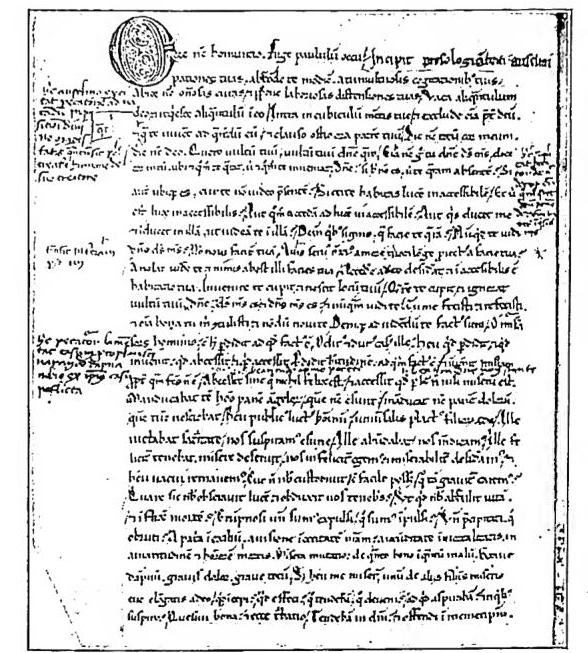
ANSELMO, santo - Incipit del Prologium. Cod. Vat. lat. 532, fol. 219' (sec. XII) - Biblioteca Vaticana.
5. L'Epistola de Incarnatione Verbi. (Ci è pervenuta in doppia recensione: la prima, più breve, scritta prima del sett. 1092, ed. Schmitt, I, 277-90; la seconda, scritta al principio del 1094 ca., ed. Schmitt, II, 1-35; PL 158, 259-84; Florilegium patristicum di Bonn. fasc. 28, I, 1931).
È un trattato polemico contro Roscellino, il quale, nominalista in filosofia, insegnava il tritismo in teologia, sostenendo che, diversamente, si dovrebbe ammettere che il Padre e lo Spirito Santo si sono incarnati assieme al Figlio.
A. premette al suo trattato, dedicato ad Urbano II, un'importante dichiarazione di principi sulla parte della dialettica e della ragione, nonché della S. Scrittura e della tradizione, in teologia. Passa poi alla confutazione di Roscellino, precisando i concetti di natura e di persona, e distinguendo in Dio quel che è assoluto e quel che è relativo, onde dimostra all'avversario le sue asserzioni non avere alcun valore neanche dal punto di vista prettamente dialettico.
È un importante contributo alla teologia della Trinità, mentre l'Incarnazione, malgrado il titolo, vi è toccata solo per lo stato della questione quale era posta da Roscellino.
6. Il Cur Deus Homo (finito nel 1098; ed. Schmitt, II, 37-133; Florilegium patristicum di Bonn. fasc. 18, 1929;
PL 158, 359-432). Lo scopo prefissosi da A. in quest'opera è di provare con « ragioni necessarie », facendo astrazione metodologica da quel che c'insegna la fede, sull'Incarnazione e la Redenzione, che l'uomo, dovendo necessariamente raggiungere la meta ultima assegnatagli da Dio, non lo può se non per l'opera di un Uomo-Dio, e che quindi tutto quel che c'insegna la fede sulla Incarnazione e la Redenzione ha valore « necessario ». Tutto il ragionamento di A. può riassumersi così: dopo il peccato Dio « non poteva » lasciare l'uomo a se stesso, ma « doveva » rialzarlo per sostituire in cielo, come Egli voleva, gli angeli caduti. Né « poteva » Dio perdonare all'uomo senza degna soddisfazione. Ora, il peccato, essendo in qualche modo infinito, non poteva degnamente essere espiato se non per mezzo d'una soddisfazione infinita. Ma questa non poteva essere fatta da un uomo, e neppure da Dio, che non può espiare. Era quindi « necessario » che ad attuarla venisse un Uomo-Dio.
L'opera è divisa in 2 libri. Nel primo, indirizzandosi agli infedeli, A. vuol loro provare che l'uomo non può salvarsi da se stesso. I capp. 1-2 sono preamboli generali. Poi (capp. 3-10) si risponde ad una serie di obiezioni per dilucidare previamente alcuni punti necessari, ad es.: che nessun angelo poteva salvare l'uomo; che il diavolo, anche dopo il peccato, non ebbe nessun diritto sull'uomo (contro una teoria frequente presso i Padri). Segue la prova della necessità di una soddisfazione per la colpa (capp. 11-19), e infine quella dell'incapacità dell'uomo di dare tale soddisfazione a Dio per il peccato (capp. 20-25). Il secondo libro vuol provare che, il fine dell'uomo dovendo essere in tutti i modi raggiunto, la soddisfazione del suo peccato deve essere necessariamente pagata da un Uomo-Dio. I capp. 1-3 trattano del fine che l'uomo deve raggiungere. Si stabilisce poi che questo non può essere raggiunto che per mezzo dell'Uomo-Dio, di cui si descrivono le qualità che doveva necessariamente avere per raggiungere questo scopo (capp. 6-9). Quindi s'illustra l'efficacia e il modo della sua opera redentrice (capp. 10-21). Il cap. 22 è la conclusione.
Il Cur Deus Homo è il primo vero trattato sulla Redenzione e, nonostante i punti deboli, è giustamente ritenuto, assieme al Monologion, il capolavoro di A. e l'opera più originale e profonda, se non proprio definitiva, su questa materia.
7. Il De conceptu virginali et de originali peccato (1099-1100; ed. Schmitt, II, 135-73; PL 158, 431-64), per risolvere la questione come Cristo, nascendo da una vergine, non abbia contratto il peccato originale, tratta della natura (capp. 1-6) e del modo di propagazione (capp. 7, 9, 10) di questo peccato. Poi come questo non poteva passare in Cristo, nato da una vergine (capp. 8, 11-15). I capp. 18-21 deducono alcune conseguenze della precedente dottrina. A. tratta poi della quantità del peccato originale (capp. 22-23); se e come si trasmettono i peccati dei prossimi progenitori (capp. 24-26); gli effetti del peccato originale in questa vita (cap. 27) e nell'altra (cap. 28).
Il trattato rappresenta storicamente un gran passo avanti nella teologia del peccato originale.
8. Il De processione Spiritus Sancti (1102; ed. Schmitt, II, 175-219; PL 158, 285-326), tratta della processione dello Spirito Santo dal Padre e dal Figlio, questione sulla quale A. s'era già intrattenuto al Concilio di Bari. Il cap. 1, dopo un'entrata in materia, stabilisce i punti di fede comuni ai Greci e ai Latini, donde poi A. deriva il principio basilare in questa materia: « quatenua nec unitas amittat aliquando suum consequens ubi non obviat aliqua relationis oppositio, nec elatio perdat quod suum est, nisi ubi obsistat unitas inseparabilis ». Si mostrano poi diverse applicazioni del principio e soprattutto si dimostra come ne derivi la processione dello Spirito Santo anche dal Figlio. Il cap. 2 risponde alle obiezioni dei Greci contro il predetto principio. I capp. 3-7 confermano la dottrina cattolica coi testi della S. Scrittura, mentre nei capp. 8-13 si risponde alle diverse obiezioni dei Greci contro la dottrina cattolica stessa, e nei capp. 14-16 si fa un riepilogo e si esamina il modo d'essere delle tre persone considerate una relativamente alle altre due.
L'opera di A. è il primo grande vero trattato, scritto dai cattolici contro la dottrina foziana. La teologia posteriore vi ebbe ben poco da aggiungere.
9. L'Epistola de sacrificio azymi et fermentati e l'Epistola de Sacramentis ecclesiae sono del 1106-07 (ed. Schmitt, II, 221-32; 239-42; PL 158, 541-48; 551-54).
La prima lettera tocca due altre questioni discusse tra Latini e Greci: quella cioè dell'uso del pane azimo nella Messa - che A. qui difende come legittimo al pari (cap. 1), anzi con maggior ragione (cap. 2), del pane fermentato contro le accuse dei Greci (capp. 3-6) - e quella del matrimonio dopo il sesto grado di consanguinità (cap. 7). La seconda lettera spiega la legittimità di una ragionevole diversità di usi liturgici secondari anche nella celebrazione della Messa.
10. Il De concordia praescientiae et praedestinationis et gratiae Dei cum libero arbitrio (1107-1108; ed. Schmitt, II, 243-88; PL 158, 507-42).
È l'ultima opera di A. e tratta successivamente delle ardue questioni delle relazioni fra il libero arbitrio e la prescienza divina, il libero arbitrio e la predestinazione, il libero arbitrio e la grazia. Prima questione: si precisa il punto della difficoltà (cap. 1); la prescienza di Dio non toglie la libertà in genere (cap. 2), tanto meno la prescienza del peccato (cap. 3). Conferma delle due precedenti asserzioni: teologica (cap. 4), scritturistica (cap. 5). Definizione della libertà (cap. 6). La prescienza di Dio è causa delle cose, salvo il libero arbitrio, ma non è causa del peccato (cap. 7).
Seconda questione: la difficoltà (cap. 1). Dio non predestina al male, se non nel senso che lo permette (cap. 2). La predestinazione lascia intatta la libertà (cap. 3).
Terza questione: difficoltà apparenti della Scrittura contro il libero arbitrio (cap. 1). Principi generali della soluzione (capp. 2-4). Risposta alle difficoltà scritturistiche (cap. 5). Questioni e difficoltà secondarie (capp. 6-13). Conclusione generale (cap. 14).
11. Il De potestate et impotentia, possibilitate et impossibilitate, necessitate et libertate è un'opera abbozzata dopo il De concordia e rimasta incompiuta. (Fu scoperta e pubblicata da F. S. Schmitt, Ein neues unsollendetes Werk des hl. Anselm von Canterbury, in Beiträge zur Geschichte der Philosophie und Theologie des Mittelalters, Münster 32 [1936, III]).
L'opera, che per la materia appartiene al gruppo del De grammatico, De veritate, De libertate arbitrii, doveva essere un'analisi logica, sistematica e completa, dei concetti espressi nel titolo in quel modo che divenne poi tanto in voga fra gli scolastici. Così com'è, riesce poi utile per una migliore conoscenza dei fondamenti filosofici della teologia di A.
B) Orazioni e meditazioni. - Delle Orationes et Meditationes attribuite ad A. e riprodotte in PL 158, 709-1016, solo una parte è autentica: quella pubblicata dallo Schmitt. (III, 1-91). Per le relative questioni critiche V. gli studi del Wilmart specialmente quelli da lui raccolti nell'opera: Auteurs spirituels et textes dévots du Moyen âge latin, Parigi 1932, ed anche: La tradition des prières de s. Anselme. Tables et notes, in Revue bénédictine, 36 (1924), pp. 52-71. Vedi anche gli studi di F. S. Schmitt: Des hl. Anselm V. C. Gebet zum hl. Benedikt. Zur Wesensart der anselmianischen Gebete und Betrachtungen, in Studia Anselmiana, fasc. 18-19 (1947), pp. 297-313, e in Miscellanea Giovanni Mercati, II, Città del Vaticano 1946, pp. 158-78.
C) Le lettere sono riprodotte dal Migne in 4 libri: PL 158, 1059 agg.; ll. 1 e 2; 159, 9-272; ll. 3 e 4. Sono autentiche, con poche eccezioni, quelle dei due primi libri e parte del terzo. Il vol. III dell'edizione dello Schmitt contiene anche il l. I delle lettere. (A. Wilmart, La tradition des lettres de s. Anselme. Lettres inédites de s. Anselme et des correspondants, in Revue bénédictine, 43 [1931], pp. 39-54; F. S. Schmitt, Zur Überlieferung der Korrespondenz des Anselm von Canterbury. Neue Briefe, ibid., pp. 224-38; Zur Entstehungsgeschichte der handschriftlichen Sammlungen der Briefe des hl. A. V. C., ibid., 48 [1936], pp. 300-17). D) Opere dubbie o spurie sono da ritenersi quelle non elencate qui. Non occorre passarle tutte in rassegna. Si
notino solo tra le spurie: De voluntate (PL 158, 487), Hymni et Psalterium Beatae Virginis (Mariale; ibid., 1035-1050), le Omelie (v. Wilmart, Les Homélies attribuées à s. Anselme, in Archives d'histoire doctrinale du Moyen âge, 1927, fasc. 2, pp. 5-29). L'opuscolo: De beatitudine coelestiv patriae (PL 159, 587-606) è la ricostruzione d'una conferenza tenuta da A. a Cluny nel 1104 e redatta dal suo discepolo e biografo Eadmero. Il De similitudinibus ossis Liber similitudinum (ibid., 605-708) è l'opera del monaco Alessandro di Canterbury. Il De Conceptione Beatae Virginis è l'opera di Eadmero (PL 159, 301-18. B. del Marmol, La Conception immoculée de la V. Eadmer, [Pax, 14], Maredsous 1923, con intr. e trad.).
III. SOME POINTS OF DOCTRINE
A.Anselm is essentially a theologian. His importance in the history of thought lies more in the method by which he treated theology than in the deep traces he left on the numerous questions he addressed.
The novelty of Anselm’s method was not in the use of reason, nor even simply of dialectic, to elucidate the data of faith—for this, without which theological science cannot exist, had already been done by the Fathers, both Greek and Latin—but rather in the proportion he assigned to reason and dialectic, particularly of an Aristotelian type, in the theological elaboration of revelation. For Anselm, the subject matter of theological work, namely the data of faith, is supplied by the belief of the Church, Scripture, and the Fathers—especially Augustine, of whom Anselm is thoroughly imbued—and is conceived as an unshakable foundation and infallible norm, antecedent to any justificatory proof of reason, and against which no dialectical conclusion can ever prevail. Indeed, if a dialectical conclusion were contrary to the data of faith, it would be an evident sign that it is erroneous. Here Anselm stands in perfect opposition to Roscelin and the rationalistic tendency of the dialectic he represented. Yet for Anselm, the effort of theological work does not primarily concern the proposition of the revealed datum itself. This, contrary to the earlier patristic tradition, is more presupposed than discussed or elucidated in itself. Instead, theological work concentrates almost exclusively on the subsequent metaphysical and dialectical treatment of this presupposed content of revelation. Thus theology becomes, in the first instance, the metaphysical elucidation of the concepts proposed or included in revelation, the logical deduction of the consequences contained therein, the systematic connection of its various parts, and the dialectical refutation of objections raised against it, especially in the name of dialectic itself. In all this, Anselm does not share the viewpoint of the more or less absolute antidialecticians, of whom Peter Damian was, in the 11th century, the foremost exponent and who showed an excessive aversion to the use of philosophy and dialectic in theological matters. He is, if anything, the brilliant and highly personal pupil of Lanfranc of Pavia, or, better still, the disciple of Augustine, from whom he draws inspiration to achieve a new equilibrium in the question of the relationship between reason and faith. It is the sense of Anselm’s “fides quaerens intellectum,” of his “credo ut intelligam.” It is therefore rightly that Anselm has been called the philosopher-theologian, or even the first metaphysical theologian. One can thus understand to what extent he conceived of theology as a science in a fundamentally Aristotelian sense, how philosophy and theology are intimately united in him, and why he is credited with the title of “father of Scholasticism.” Nor do recent attempts to contest this title have any serious foundation (cf. A. Stolz, Anselm von Cant., Munich 1937, pp. 32 ff.).
In practice, and despite the limits he imposed, did Anselm not sometimes have an exaggerated confidence in the demonstrative force of reason, even when applied to the mysteries of faith? Although some seek to excuse him, the matter seems undeniable. More than the expression of “rationes necessariae,” with which he seeks, for example, to demonstrate the “quia” of the Trinity (Monologion, ch. 64) and the “necessity” of the Incarnation—an expression some would interpret merely as a great convenience or even as convincing reasoning, abstracting from whether it is philosophical or theological in nature (cf. M. A. Jacquin, Les rationes necessariae de s. Anselme, in Mélanges Mandonnet, II, Paris 1930, pp. 67 ff.)—this exaggerated confidence seems to result from the very manner in which Anselm frames and develops these questions. Even the mystical side, so notable in him (Proslogion, Meditations), which cannot be neglected in a fair assessment of his work—since it is in him a genuinely patristic, especially Augustinian, inheritance—does not weaken or alter the nature of his philosophical and dialectical reasoning; rather, it largely supports and nourishes II.
Anselm, in a series of monographs of great completeness and depth—whose beauty remains ever fresh even today—touched upon almost all the major theological problems and, by reflection, many philosophical ones. His “realism” in philosophy has been discussed, but it must be understood with many reservations.
Anselm proves the existence of God in the Monologion essentially by following, though with a personal imprint, the old Platonic way of the degrees of being, so dear to Augustine; but in the Proslogion he attempts a new path. This is the so-called “argument of St. Anselm” (sometimes also called the a priori argument, and, though with much disputable justification, the ontological argument), famous in the history of philosophy. It consists in attempting to prove the real existence of God by deducing it directly from His very definition, from the concept one has of Him. “God is that than which nothing greater can be thought; the concept of such a being is in our mind; but such a being must also exist in reality, outside the mind, because if it existed only in the mind, one could think of another, greater being—one, that is, which existed not only in the mind but also in reality outside it” (Proslogion, chs. 2, 3). The value of this reasoning has engaged many great minds from Anselm onward: some accept it with more or less profound modifications of form and substance (Scotus, Descartes, Leibniz), while others reject it, seeing in it an illicit leap from the ideal to the real order. The argument does indeed show that the being than which nothing greater can be thought must be thought of as existing, i.e., with the note of existence, but it does not follow that this existence is also really extramental, since real existence adds nothing to the constitutive perfection of being but is merely the act of this being (Gaunilo, St. Thomas, Kant). Anselm certainly seems to have been deceived about the value of his discovery. Recent attempts to claim for it a strictly theological or even mystical nature, denying it the status of a true philosophical argument in chapters 2 and 3 of the Proslogion, have no real substance (cf. on this question A. Kolping, Anselms Proslogion-Beweis der Existenz Gottes, Bonn 1939, with related bibliography).
Notable, too, for the depth of thought and rigor of deduction, is his explanation of the divine attributes, both in the Monologion and in the Proslogion. In this way, he laid down the essential outlines of later treatises de Deo uno.
On the Trinity, Anselm systematizes and perfects the psychological theory of St. Augustine, giving the greatest clarity to the doctrine of relations and the deductions that follow from II. Later treatises on the Trinity in the West remained in his wake.
The major anthropological problems were also addressed by him effectively. Thus in his explanation of the state of original justice. Likewise in his conception of original sin as the sin of nature, which was infected in Adam and through Adam, and transmitted by him to all of us in this state—not only infected but also guilty.
Although some of Anselm’s opinions on such matters have had to be supplemented and corrected (e.g., a clearer distinction between natural, preternatural, and supernatural gifts; a better explanation of the effects of Baptism even in children), they nonetheless opened wide avenues of light for subsequent theology.
In his explanation of the Redemption, A. struck a decisive blow against the theory of the “rights of the devil,” and thereby linked his name to that of vicarious satisfaction. This theory, grounded in the concept of sin as an offense in some way infinite against God, in the sinner’s duty to make reparation for the offense, and in the sinner’s inability to do so adequately, provides a profound and highly systematic account of Christ’s redemptive work. This account became classical in the West.
A.’s influence was immense, yet—curiously, and demonstrating that he was a fruit ripened more by his own vigor than by the force of his environment—it was not immediate. It began to be felt only around the thirteenth century, with the full flowering of Scholasticism. Even if this influence was more general than discernible in particular questions, it in no way diminishes his importance, for without him the history of Western thought from the Middle Ages onward would be scarcely conceivable. Even today, his personality exerts a powerful attraction upon those who approach him: so modest without affectation, so full of goodness, so complete and human. His works, in no way inferior in depth of thought or vigor of exposition to those of the greatest thirteenth-century Scholastics, are in many respects far closer to modern taste. In them, far more than the concern for manualistic-didactic exposition, there appears that vital effort in the search for truth which so delights us today.