
PIEMONTE. -
I. GEOGRAPHY
It is the westernmost historical region of Italy (and thus includes its westernmost point, Rocca Chardonnet; 6° 32' 59'' E. Greenw.), roughly encompassed between the Alpine ridge, the Apennine ridge, the Scrivia Valley, and the Ticino Valley.The name (Pedemontium, or "at the foot of the mountains") does not accurately reflect its character: its territory, partly occupied by mountains or hills, is about one-third above 1300 meters, and even the Po Valley plain it contains is its highest portion. It is also, among the Italian regions (including Val d'Aosta), the most extensive and one of the most varied in landscape: the smaller regional units are numerous (Val di Susa, Canavese, Monferrato, Langhe, Ossola, Lomellina, in addition to Val d'Aosta, which is now administratively separate).
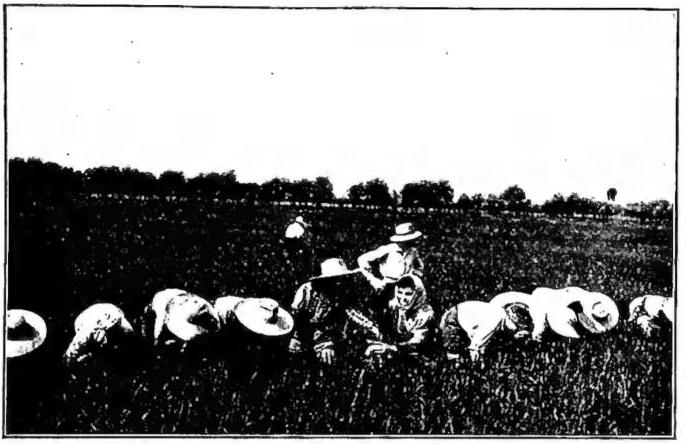
On 9.5% of the Republic's surface, Piemonte gathers 8.1% of its population, concentrated mainly in the fertile plains. Over two-fifths of this population are engaged in agriculture, which enables a rich cereal production (the provinces of Vercelli and Novara alone produce half of Italy's rice;
four-fifths of Piemontese rice is exported; one-third of Italy's rye comes from Piemonte) and an even more notable wine production (Monferrato, Langhe, Po Hills), likewise the object of flourishing exports. The irrigated meadows of the plain and the mountain pastures favor livestock farming (cattle; production of meat, butter, and cheeses), which is also prosperous in the mountains. The scarcity of minerals is compensated by the abundance of water resources, which feed numerous hydroelectric plants. Piemonte, contributing 15% to Italy's industrial production, is surpassed only by Lombardy. All industrial activities are represented, from textiles (cotton mills in Turin; wool mills in Biella) to steelworks (Novi, Mondovì), from paper (Cuneo, Novara) and rubber (Turin) industries to automotive, which boasts the largest Italian complex (Fiat).
The major inhabited centers mostly arise in the heart of the valleys (Susa, Aosta, Varallo, Domodossola) or at their outlets onto the foothills (Cuneo, Mondovì, Saluzzo, Pinerolo, Ivrea, Biella: and especially Turin, which with approximately 800,000 inhabitants is today the fourth-largest city of the Republic).
| Provinces and capital with relative population in 1000 inhabitants | Area in km² | Population | Density per km² | |
|---|---|---|---|---|
| 1936 census in 1000 inhabitants | Estimate 1-1-1930 | |||
| Alessandria 87 | 3564 | 494 | 475 | 133 |
| Asti 53 | 1511 | 246 | 222 | 147 |
| Cuneo 43 | 6002 | 605 | 578 | 84 |
| Novara 73 | 3613 | 396 | 406 | 113 |
| Torino 727 | 6829 | 1312 | 1384 | 203 |
| Vercelli 44 | 2995 | 366 | 358 | 119 |
| Val d'Aosta 26 | 3263 | 83 | 93 | 29 |
| Piemonte — | 28,677 | 3502 | 3516 | 121 |
II. HISTORY
Currently, Piedmont (P.) refers to the western zone of the Po Valley enclosed by the arc of the Alps and the Apennines to the north, west, and south, while to the east the border with Lombardy is formed by the line represented by the course of the Ticino, the Po, and the Tidone rivers, corresponding to the complex of domains of the House of Savoy, as sanctioned by the Treaty of Aachen of 1748.The history of the region begins with the settlement of the first populations in the Neolithic period, likely those same populations that classical tradition called Ligurians, and which between the 5th and 3rd centuries B.C. underwent profound upheaval due to the arrival of certain Celtic tribes that settled in the Po plain and its tributaries. The subalpine region was conquered in the 2nd century B.C. by the Romans, who in the Augustan age also occupied the Alpine valleys. The conquest was consolidated with the establishment of various colonies: Julia Derthona, Hasta Pompeja, Eporedia, Augusta Praetoria, Augusta Taurinorum, Augusta Bagienorum; the old Ligurian and Celtic centers were in turn organized into Roman municipalities. From Mediolanum, Placentia, and Genua, road segments were soon built leading to the Alpine passes, such as the Alpis Poenina (Great St. Bernard), and—
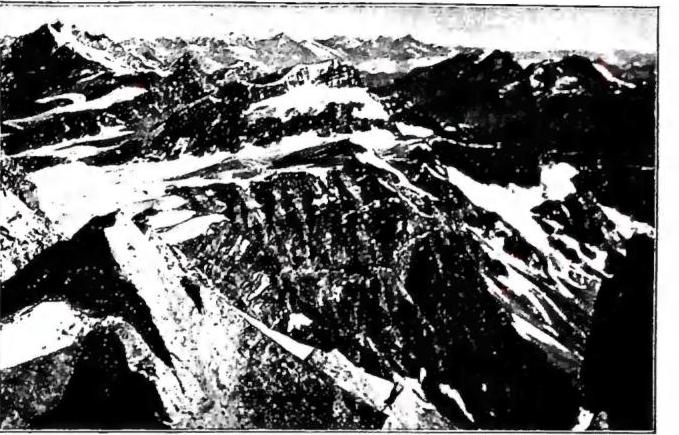
PIEMONTE - Monte Rosa Group. View of the Macugnaga side from Punta Gnifetti (4559 m), with the left foreground.
the Alpis Graia (Petit Saint Bernard), and the Alpis Cottia (Mont Cenis and Mont Genèvre); Julia Derthona, Vercellae, Augusta Taurinorum were the main communication hubs. In the Augustan organization, the foothill region formed the two regions of Transpadana (XI) and Liguria (IX); in Constantine’s fourth-century reorganization, it became part of the larger region of Liguria with its capital at Mediolanum. The rich epigraphic and monumental documentation, along with toponymy—in which Latin suffixes prevail over Ligurian and Celtic ones—attest to how deeply Roman civilization took root in the subalpine region. Regarding Christianization, while it cannot be excluded that sporadic Christian communities already existed in the pre-diocletian era, it is believed that Christianity spread throughout the foothill region only during the Constantinian age: the oldest episcopate in the region was that of Vercelli, whose first bishop, Eusebius, extended his care to the faithful of Novara, Ivrea, Aosta, Tortona, and Turin. In the final decades of the fourth century, bishops also appeared in other major cities, such as Saint Gaudentius in Novara and Saint Maximus in Turin. It is likely that, after Theodosius’s death (399), the new imperial government established in Milan under Honorius proceeded to reorganize civil districts, leading to a restructuring of dioceses, and that the dioceses of Turin, Ivrea, Aosta, Alba, and Acqui were then erected by Saint Ambrose, or at least under his influence. Thus, in Turin, a provincial council of the Archdiocese of Milan was convened in 398. The evangelization of the population was still very rudimentary at the beginning of the fifth century: the sermons of Saint Maximus reveal the mixture of Christian and pagan beliefs among the people. By the end of the imperial era, the foothill region counted four dioceses south of the Po: Tortona, Asti, Alba, and Acqui; and five north of the river: Novara, Vercelli, Ivrea, Aosta, and Turin. The most extensive diocese was that of Turin, which encompassed the entire mountainous zone of the Cottian Alps, where Christian penetration occurred more slowly. The lists of bishops, as preserved in medieval-era catalogues, are unreliable for the earliest period.
The Merovingian conquest of the Aosta and Susa valleys, however, led to the consequence that the Diocese of Aosta felt a strong influence from the Burgundian zone, although its bishops continued to participate in the
Provincial Synods of Milan. Instead, after the Frankish occupation, the Susa Valley along with the Maurienne Valley, which had also been part of the Diocese of Turin, was annexed to the Diocese of Vienne, and later the two valleys formed the Diocese of Maurienne. For the religious life of Piedmont in the Lombard era, the first flourishing of Benedictine monasteries in various cities should be noted: in the Frankish zone, Novalesa (v.) was founded in 726.
As for Lombard political life, it seems that in the subalpine region the dukes, particularly those of Turin, showed signs of real opposition to the kings of Ticino (Pavia). At the beginning of the 7th century, perhaps during the reign of Liutprand, the kings had to replace the dukes, who tended toward autonomy, with gastalds, more reliable interpreters of their will. The collapse of the Lombard Kingdom, both in 754-56 and in 774, became immediately apparent in the Alpine valleys as soon as the Frankish invasion occurred.
With Charlemagne’s conquest, the Lombard dukes and gastalds disappeared, and Frankish counts, who often brought with them loyal groups of warriors, were installed in the Piedmontese cities. All episcopal cities also became seats of counts. The Piedmontese counties, however, were part of a large Duchy of Neustria; as the administrative use of the Roman name Liguria fell into disuse, the region was commonly called Longobardia Neustria. In the 10th century, much of the region was politically included in the March of Ivrea; after its dissolution under Berengar II, so that it was limited by the course of the Po, south of the river, between the Po and the sea, the three marches of Turin (Arduinica), Savona (Aleramica), and Genoa (Obertenga) were formed. In the first half of the 11th century, the margraves of Turin were dominant in the region; the marriage between Adelaide of Turin, heiress of Margrave Olderigo Manfredi, and Oddone, son of Humbert Whitehands, Count of Savoy, marked the first attempt at unifying the countries on both sides of the Alps. Between the end of the 11th and the beginning of the 12th century, hegemony passed to the Aleramici of Savona; but then the marches disappeared due to the division of domains among various family branches. The 12th century saw the formation of margraviates and counties with a predominantly patrimonial character.
Alongside the general term Lombardia (= Longobards), the specific names of territories begin to appear: Lomellina, Canavese, Astese, and above all that of Piedmont (P.), used from the 11th to the 12th century to indicate the high zone at the foot of the Cottian Alps, or the plateau descending from Cuneo toward Saluzzo and Pinerolo. In the region, a notable revival of economic and social life appears as early as the 10th century. The defense against the raids of the Hungarians and Saracens led to the construction of numerous castles, which were not only a defense but also centers of new economic and even commercial activities. Bishops and counts were involved in this; the new life is evidenced by the numerous monasteries that arose; the Cluniac activity corresponds to the Cistercian and later the Carthusian activity; land reclamation and clearing of barren lands, development of pastoralism and wool production, progress in cultivation, form an undisputed merit of the subalpine monasticism. Feudalism also played an important role in this field: the formation of the petty feudalism of the milites secundi, who in the 11th and 12th centuries became true, albeit conditional, landowners, created a new interest in agriculture, the sole support of life, as war was not advantageous in such a poor region.
The formation of the feudal lordships of the bishops in the cities provoked the communal movement. In Asti, Tortona, Alba, Turin, Ivrea, Vercelli, and Novara, local feudal elements organized under the auspices of the bishops. From the struggles between the new communal organizations and the old feudal nuclei arose the attempts to coordinate the political forces of the Piedmontese region in the 13th century. Initially, Frederick I, appealing especially to the feudal lineages, sought to bind the communal cities to an attempt at bureaucratic organization; later, the Angevin counts Charles I and Charles II, centering on Piedmont between the Alps and the Tanaro, endeavored to frame all the cities of the plain; Monferrato (v.), from William VII Aleramico to John II Paleologus, strove to expand their domains to embrace the cities of the river valleys. Lastly, profiting from the experience and failure of others, the Counts of Savoy acted. Masters of the Aosta and Susa valleys, claiming to reconstitute the ancient March of Turin, they strove to recover this important strategic center of the region. In 1248, Frederick II recognized these claims by granting the Savoyards possession of Turin and Ivrea. Over two centuries, from Amadeus IV to Amadeus VIII, the Counts of Savoy, with arms and diplomacy, participated in all the conflicts among the subalpine princes, the Marquises of Saluzzo and Monferrato, the Visconti of Milan, the Angevins of Nice and Cuneo, and succeeded in asserting their hegemony, eliminating the Angevins from the Piedmontese region, restricting the area of the Visconti, making vassals of the Paleologi of Monferrato and the Aleramici of Saluzzo. While the Angevins had styled themselves Counts of Piedmont, Amadeus VIII created for his son the Principality of Piedmont, gathering under this name all the Savoyard Piedmontese domains. The seat of the Prince of Piedmont is his small capital, Turin; here, in the 15th century, the University founded by the Savoyards was organized to meet the needs of their state; here, too, the Savoyard Ducal Council on this side of the mountains was organized. Forced by Duke Filippo Maria of Milan to cede Vercelli and all his territory west of the Sesia, forced by the Marquis of Monferrato to cede Chivasso and the surrounding domains, the Duke of Savoy was master of the entire subalpine strip from Mondovì to Biella. The Visconti domains were reduced to the lower valley of the Tanaro, from Asti to Alessandria; the Marquises of Monferrato and Saluzzo played a balancing act to save their existence. Indeed, Savoyard policy in the 15th century had as its minimum program the annexation of all lands between the Alps and the Ticino: the united resistance of the kings of France and the dukes of Milan opposed this. Under the auspices of the ducal officials, the term Piedmont expanded, initially in the somewhat "vague" form of partes Pedemontis, and by the 15th century reached Vercelli. Within the Savoyard state, the process of amalgamating the various regional elements began, which was also the process of forming the Piedmontese nation. While Saluzzo was tied to French policy and Monferrato to Milanese policy, around the Savoyards a tradition of autonomous Piedmontese life formed, exerting its attractive force on elements still outside. This Piedmontese conception also asserted itself within the state against the Savoyard element. The Piedmontese communal bourgeoisie wanted the Savoyard state to have its base in them rather than in the Savoyard feudal nobility.
During the conflict between France and Spain for dominance, under the French invasion, the Piedmontese state nuclei threaten to perish. The French program of annexing Piedmont to France, however, fails with the Peace Treaty of Cateau-Cambrésis. The Savoyard state re-emerges as independent, but now the territories of Savoy are truly accessory domains, albeit glorious for dynastic traditions. The Savoyard state is essentially Piedmontese: Carlo Emanuele I annexes the marquisate of Saluzzo with the Treaty of Lyon (1601). Vittorio Amedeo I annexes part of the marquisate of Monferrato with the Treaty of Cherasco (1631). Vittorio Amedeo II succeeds in absorbing all of Monferrato in 1708, with the Treaty with the Empire against France in the War of the Spanish Succession; and at the same time, he occupies Valsesia, integrating the territory of Vercelli, which Amedeo VIII had held only up to the foothills of the Alps, just as with the annexation of Alessandria and Valenza he manages to dominate the entire course of the Tanaro. The events of European politics in the following decades, the two great wars of succession of Poland and Austria, enabled Savoyard policy to resume Amedeo VIII's program of expansion east of the Sesia, in what was still called Lombardy at the time.
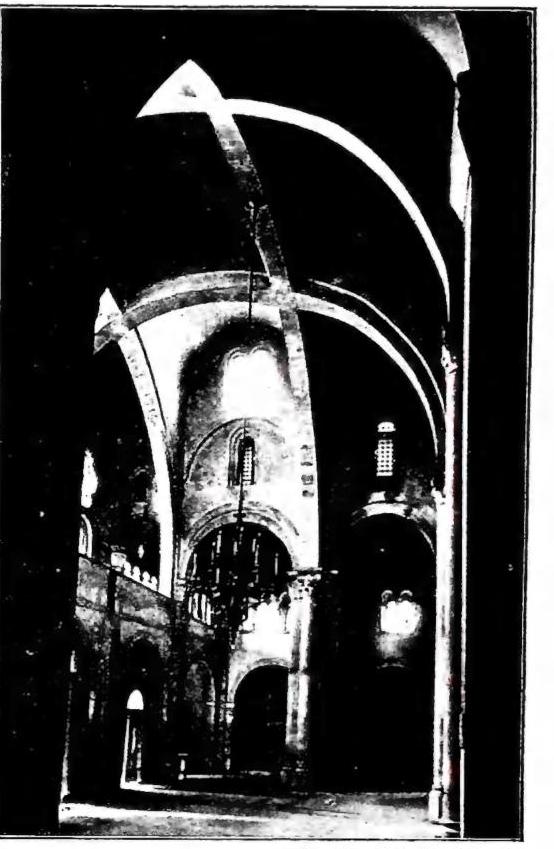
PIEMONTE - Interior of the atrium of the Cathedral, consecrated in 1107. Casale Monferrato.
The government devoted the greatest care to the framework of ecclesiastical organization. The original dioceses had undergone few modifications during the Middle Ages to adapt to changes in the political structure. By the end of the 12th century, following the foundation of Alessandria, with territories taken from neighboring dioceses, the diocese of Alessandria was established; in 1388, the diocese of Mondovì was erected; in 1474, that of Casale; in 1511, that of Saluzzo; in 1529, that of Vigevano; and in 1592, that of Fossano. The 18th century saw the rise of the dioceses of Pinerolo (1748), Biella (1772), and Susa (1772); the last to be established was the diocese of Cuneo in 1817. A particular creation had been the bishopric of Bobbio by Emperor Enrico II in 1014. The princes of the Savoy dynasty, while demonstrating profound piety and deep reverence for religion, always defended the rights of civil authority's superiority over the Church, yet never permitted subjects to polemically intervene in discussions on the relations between the two powers. In Piedmont, the Church collaborated in the formation of the Piedmontese nation and its independence: the blessed Sebastiano Valfrè, during the great wars of the late 18th century, urged the populations to military duty, showing how all should sacrifice themselves for the life of the Fatherland and the prince who represented II.
In the 18th century, a national consciousness emerges in Piedmont. The Piedmontese feel themselves to be a fortunate creation of their princes' military and political efforts, but they also know they have powerfully contributed, with the sufferings
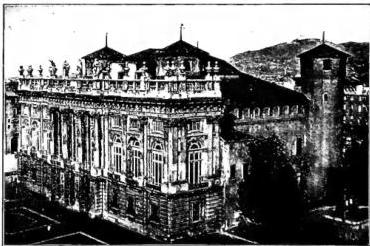
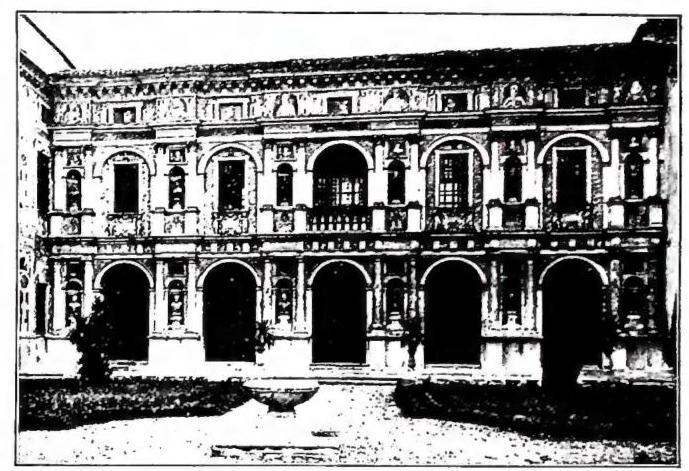
PIEMONTE - Palazzo Madama with the Roman towers, the rear body from the 1400s, and the façade by F. Juvara (1718-21) - Turin.
III. CONCILIAR REGION
It comprises the ecclesiastical provinces of Turin and Vercelli. The Archdiocese of Turin, as metropolitan, has as suffragan sees the dioceses of Acqui, Alba, Aosta, Asti, Cuneo, Fossano, Ivrea, Mondovì, Pinerolo, Saluzzo, and Susa. For ordinary appeals, it has the second-instance tribunal in Mondovì. The ecclesiastical province of Vercelli includes, besides the metropolitan see, the dioceses of Alessandria, Biella, Casale Monferrato, Novara, and Vigevano. Ordinary appeals go to the tribunal of Novara, elevated to second instance.According to the Instruction of the S. Congr. of Bishops and Regulars, 24 Aug. 1889, which for Italy is not modified by can. 292 § 1, the bishops of the two provinces gather annually under the presidency of the prelate of highest rank and seniority and hold the Episcopal Conference. In the decree of the S. Congr. Consistorial, 15 Feb. 1919, P. was expressly exempted from the obligation to hold the regional plenary Council, since in the two ecclesiastical provinces it did not seem difficult to convene the prescribed provincial councils. However, in the subsequent circular of 22 March 1919, bishops were granted the faculty, if they deemed it appropriate, to convene a council for the entire region, with prior apostolic assent. In fact, this faculty was exercised, and the Piedmontese plenary Council was celebrated in Oct. 1927.
With the motu proprio Qua Cura of 8 Dec. 1938, a regional ecclesiastical tribunal was established in Turin with exclusive competence for marriage nullity cases, which has its ordinary court of appeal in the Lombard regional tribunal of Milan and receives appeals from the Ligurian regional tribunal of Genoa. The functioning and procedures of this special tribunal are regulated by the Normae of the S. Congr. of the Sacraments, 10 July 1940, as well as by the particular internal dispositions approved by the bishops of the region. Agostino Pugliese
IV. ART
1. Ancient Age
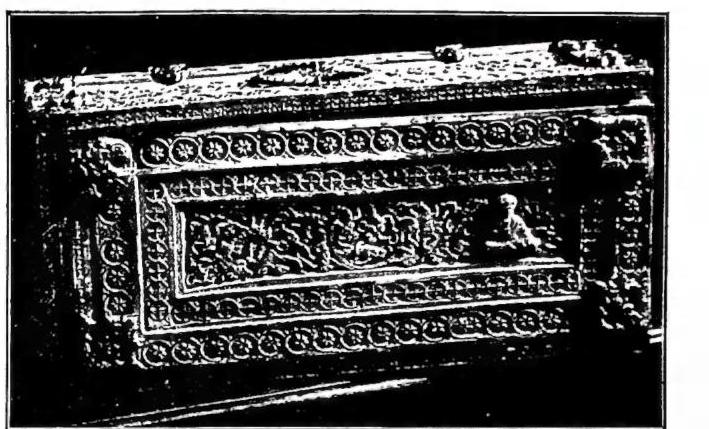
While numerous documents of prehistory survive (rock carvings in the Monte Bego region, Neolithic burial sites in the Aosta Valley (Montiovet) and Susa (Vayes), pile dwellings at Trana, Mercurago, and necropolises in the Novara area: Ameno, Orta, Castelletto Ticino, Varallo Pombia, etc.), and of Roman civilization (Aosta [v.]: urban walls, Porta Pretoria, triumphal arch, cryptoporticus; Susa: gate and circuit; Turin: reticulated layout, Porta Palatina, Porta Pretoria, theater; Acqui: aqueduct; Asti: walls and gate, bronzes; necropolises of Derthona, Pollentia, Libarna; bridges in the Aosta Valley and roads), relatively scarce are the testimonies of Christian art and the early Middle Ages. Despite the region having been evangelized by the bishops Siro, Eusebio, Massimo, and Gaudenzio, and despite the enormous impulse they gave to culture and religion, very little remains from this period.The most notable surviving architectural monuments are the baptistery of Novara from the 5th century (v. Monuments), and the churches of S. Maria di Naula at Piane Sesia and S. Massimo at Collegno, of which the foundations beneath the Romanesque construction are preserved: the baptistery of Settimo Vittone (7th century), the church of S. Giovanni in Asti, erroneously considered a crypt, the crypt of S. Secondo in the same city, S. Michele in Clivolo at Borgo d'Ale, S. Orso in Aosta (early 9th century). Decorative material is found walled into later buildings at Castelvecchio di Testona, Vezzolano, S. Orso in Aosta, in the cloister of the cathedral of Novara, or reused in more recent constructions, or collected and preserved in museums. Lombard funerary slabs are found at S. Pietro in Avigliana. Testimonies of painting prior to the 9th century are lacking, and very rare are those from the 9th to the beginning of the 11th: the fragments of the apse of S. Michele in Clivolo at Borgo d'Ale, deriving from the art of Trier, those of S. Maria di Castelvecchio at Mongrando, now in the Museum of Biella, which have connections with the school of Tours, the Stories of the Apostles in the attic of S. Orso in Aosta, close to the models of S. Giovanni in Münster from 998, the fragments of the Last Judgment at S. Quintino in Spigno linked, like the remnants of S. Costanzo in Dronero, to the style of Corbie, the apse of S. Ferreolo in Grosso, dependent on the miniature art of Regensburg. Two consular ivory diptychs from the 5th century exist in Aosta (v.). Numerous early medieval codices are preserved in the capitular libraries of Vercelli, Novara, Aosta, Ivrea, and many are collected in the National Library of Turin, among which some very precious Irish ones from the monastery of Bobbio. In P. there existed in the early Middle Ages at least two important scriptoria, Vercelli (v.), Ivrea (v.). A very rare Eastern work from the early Middle Ages is the rock crystal foot of the reliquary of S. Margherita in the cathedral of Casale, and precious for its ornaments is the ivory casket with bronze applications from the 9th century in the cathedral of Ivrea.
2. Romanesque Period
From the end of the 10th to the 13th century, in the Romanesque period, architecture asserts itself in P. with original characteristics and resonances that extend beyond the region. The architectural renewal observed in P. proceeds in parallel with that occurring in Lombard art, but the introduction of vaulted ceilings, unlike in the latter, is found only in small constructions or in the side aisles and crypts, while the use of visible trusses almost always continues. The originality of Romanesque churches is given by their narrow and high naves, the very deep apse, and the vertical sense of space, which is particularly emphasized in the interior. This verticality, which existed since the early Christian period, is still prominent in the baptistery of Novara, in the church of S. Lorenzo in Settimo Vittone from the 8th century, and in S. Michele in Clivolo at Borgo d'Ale, and persists in the major Romanesque constructions (e.g., the abbey of Vezzolano, the cathedral of Aosta, and the sanctuary of S. Michele) as a typical expression of the northern character.From the end of the 10th century are the abbey of S. Quintino in Spigno, consecrated in 991, and the cathedral of Ivrea founded around 969. From the same years dates the construction of the church and bell tower of S. Andrea in Turin; from 1006 is the tower of S. Benigno of Fruttuaria, and from 1037 the construction
The exterior is almost always composed of exposed masonry using materials found on-site: squared green and grey stone in the Alpine valleys or pebbles (e.g., the sagra of S. Michele), brick in the plain (e.g., the cathedral of Novara), tuff (e.g., S. Lorenzo di Montiglio), or brick alternated with tuff in Monferrato (e.g., S. Maria di Vezzolano), with very beautiful polychrome effects. However, the most important monuments of this period are the base and the apse of the sagra of S. Michele, the atrium of the cathedral of Casale with its daring vaults, and S. Maria di Vezzolano, built on the ruins of a Carolingian church. Among the bell towers, massive in their solid structure, those of S. Benigno di Fruttuaria and S. Stefano di Biella, and S. Orso di Aosta are noteworthy. Sculpture, an integral element of Romanesque architecture, runs along the architraves or the hundreds of portals, on the ambos (the stunning one on the Isola di S. Giulio in black stone with the symbols of the Evangelists stylized in high relief), in the capitals, sometimes with essentially ornamental motifs (S. Fede di Cavagnolo, S. Lorenzo di Montiglio), sometimes with figurative
(fot. Alinari)
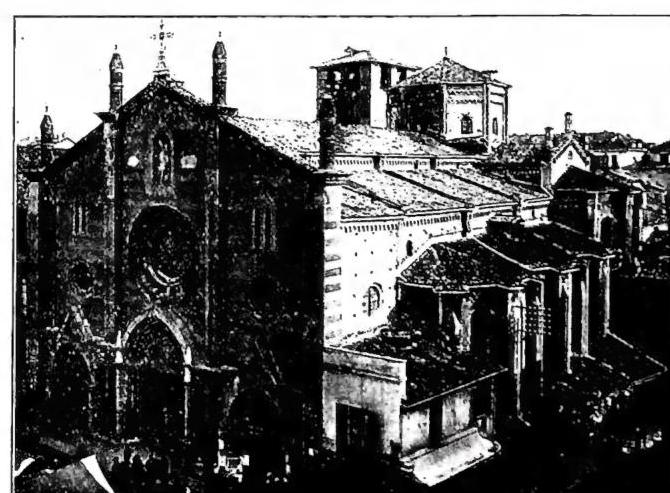
PIEMONTE - Church of S. Secondo (begun at the end of the 12th century). The façade dates to 1462 - Asti.
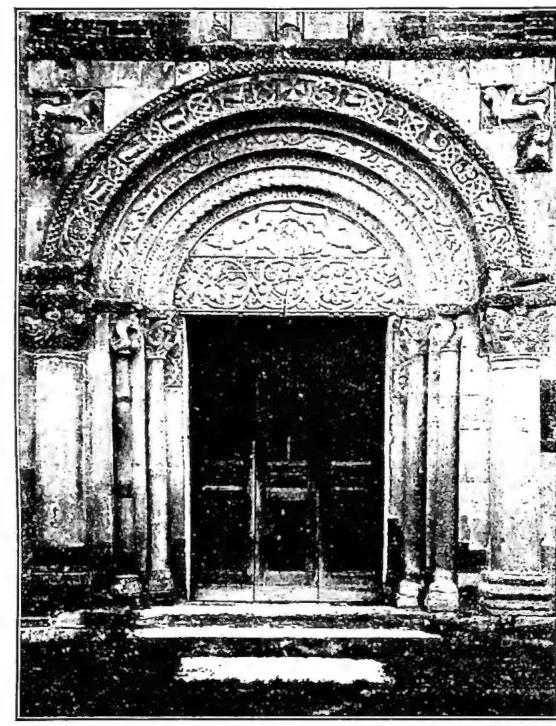
Symbolic motifs (façade of S. Maria di Vezzolano, entrance door to the church of the Sacra di S. Michele), or motifs drawn from the Old Testament or liturgy (cloister of S. Orso in Aosta, 1133; inner narthex of the abbey of Vezzolano, already completed by 1189). The windows of the apses are sometimes framed by magnificent high-relief sculptures. Particularly noteworthy is the decoration of the so-called Zodiac Door at the Sacra di S. Michele, executed by Niccolò, the same artist responsible for the right portal of S. Zeno in Verona. Of high quality are also the reliefs in the lunettes of S. Andrea in Vercelli, attributed to a follower of Benedetto Antelami. The documentation of painting from this period is very rich; the most important cycles are found in S. Michele in Oleggio, S. Siro in Novara, S. Tommaso in Briga Novarese, and S. Giovanni in Piobesi. The rich treasures of Piedmontese churches were dispersed over the centuries, but some documents of their former splendor remain: in S. Gaudenzio in Novara, the 11th-century ivory diptych; in the Cathedral of the same city, the gilded copper binding of Evangeliary no. I; in the Treasury of Vercelli, the beautiful binding of the Evangeliary of S. Eusebio, in gold and silver, precious stones, and enamels from the 11th century; at Novalesa, the reliquary of S. Eldrado in sheet metal.
PIEMONTE - Interior of the dome of the Chapel of the Holy Shroud. Work by G. Guarini (1668-94) - Turin, Cathedral.
Notable diffusion was achieved by floor mosaics, almost always on a white background with black marble tesserae, rarely enlivened with red or green tones. The most considerable examples are in the presbytery of the cathedral of Aosta with representations of the rivers of Paradise (12th century). Also important are the fragments from the church of S. Maria Maggiore, now in the Civic Museum of Vercelli, and those from the cathedral of Casale. Others are found in the presbytery of the cathedral of Novara, at the Civic Museum of Turin, and in the Seminary of Ivrea.
3. The Gothic
Gothic forms penetrate very early into architecture, asserting themselves already at the beginning of the 13th century (interior and sides of S. Andrea in Vercelli) and persisting until the end of the 15th century (cathedral of Saluzzo, 1491-1501).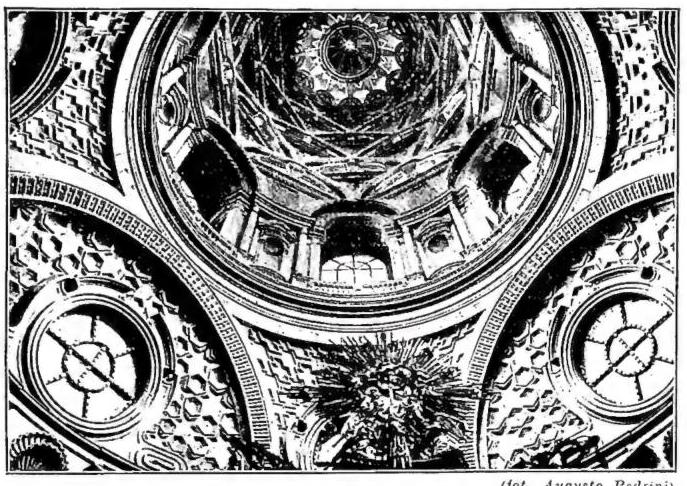
In façades, the use of the slender gable ending beneath the roof predominates. The height is approximately that of Romanesque churches; rarely is it such as to require the use of flying buttresses (S. Andrea in Vercelli, abbey of Staffarda, apse of S. Giovanni di Saluzzo). During this period, many Romanesque churches that had exposed trusses were vaulted (cathedral of Casale, 13th century; S. Orso and cathedral of Aosta, 15th century), lowering the original height of the buildings, which retain in the attic the ancient windows and pictorial decorations.
Decoration is sober and limited to interlaced arches; only around the mid-15th century does the flourishing of ornaments begin in friezes and window embrasures (apse of S. Giovanni di Saluzzo in green stone and façade of the parish church of Chivasso, with intricate tracery featuring saints in niches). The bell towers, always very tall and perforated by bifora and trifora windows, end with slender pyramidal spires, sometimes in glazed brick, flanked by slender pinnacles: typical are those of S. Domenico in Rivoli and S. Giovanni in Saluzzo.
Civil architecture saw great development: numerous houses on the main streets, almost always equipped with porticoes; fortified houses and castles arose in every inhabited center. In the Aosta Valley, Susa Valley, Monferrato, and Langhe, castles and towers are still frequent, some truncated, others still of considerable height (Asti, Alba). Among the houses, the so-called "della ferrata" in Avigliana, that of the princes of Acsia in Pinerolo, and that of the Conte Verde in Rivoli are significant for the superabundance of ornaments, numerous throughout the region. Castles imposing in size in the Aosta Valley (Fénis, Issogne, Verrès, Introd, Graines, Ussel) and in Monferrato (Montiglio, Montemagno, Lerma, Cremolino, Montaldeo, Tagliolo, Silvano d'Orba, Gaglianico in the Biellese). Characteristic are the Piedmontese ricetti, some still in good condition (Busano, Candelo, Salassa, Oglianico).
Gothic sculpture has left few works in marble or stone, excluding baptismal fonts and some reliefs and tomb slabs in Casale, Asti, Vercelli, Turin; of high quality is the group of the Virgin with the Child on the façade of the cathedral of Chieri. A large number of polychrome wooden carvings and statues, many of which are found in the Val d'Ossola, Susa, and especially in Aosta; others are collected in the Civic Museums of Turin, Vercelli, Asti. Among the Crucifixes, those of Fénis, Challant St-Victor, the Holy Trinity of Casale, and the Civic Museum of Turin are noteworthy. Notable are the choir stalls of the cathedral of Chieri with motifs drawn from local flora, others with geometric ornaments and interlacings (cathedral of Susa, S. Giovanni di Saluzzo); others with intricate reliefs and tracery featuring fantastic figures (abbey of Staffarda), others representing saints and prophets (cathedral of Aosta, S. Orso in the same city); finally, those carved by Baldino Surso of Pavia in 1477 for S. Giovanni in Asti.
Interesting fragments of 14th-century Gothic painting of Lombard derivation are found in S. Andrea di Montiglio, in the chapel of the Baptist in S. Francesco di Cassine, in the cloister of Vezzolano; others with French elements in Arnaz, in the Aosta Valley, others of Emilian derivation in S. Pietro di Avigliana and S. Antonio di Ranverso, in addition to various paintings by Barnaba da Modena in Tortona, Alba, Turin. In the first half of the 15th century, the Gothic style with Lombard influence dominates in the Novarese, Vercellese, and Alessandrino (Cassine, Casa Zoppi, art of Bonifacio Bombo), while in other locations the French influence prevails: Turin, Susa, Aosta (e.g., the Deposition by G. Beltrami da Pinerolo in the church of S. Giovanni di Piobesi, 1414).
The most important current is that which connects to the style of Giacomo Jaquerio, which differs from the French in its colder and more silvery colors (presbytery and sacristy of S. Antonio di Ranverso, Crucifixion and saints of the castle of Fénis, apse of S. Pietro di Pianezza, baronial hall of the castle of La Manta).
Very beautiful are the stained-glass windows of the cathedral and S. Orso in Aosta, from the late 15th century, partly the work of local artists. Distinguished masterpieces of Gothic goldsmithing decorate the treasures of the churches. The oldest is the reliquary of S. Andrea from the workshop of Ugo Oignies (cathedral of Chieri); additionally, numerous chalices (Aosta, Alba) and reliquary arms (Aosta, Chieri, Casale, Vercelli), the casket of S. Grato by Giovanni di Malines (Aosta, Cathedral), the silver statues of the Virgin and S. Giuliano (cathedral of Chieri), by Flemish goldsmiths of the second half of the 15th century, the reliquary donated by Anna di Alençon to the cathedral of Casale, by a French artist.
Lombard are the beautiful Cross donated in 1466 by Cardinal Teodoro Paleologo to the same cathedral; the monstrance by the Ostini brothers, Milanese, to the cathedral of Asti in 1466.
Among the illuminated manuscripts, the Statuti of Turin, of Bolognese derivation, and the Malabaila codex are recalled, in addition to those from the Aosta Valley (Aosta, Cathedral and S. Orso) influenced by Jaquerio.
4. The Renaissance. — The Renaissance arrives late in Piedmont; Lombard forms assert themselves at the end of the 15th century, for example, in Alba, Biella, Novara, Vercelli, and at the beginning of the 16th century, for instance, in Revello, Saluzzo (Casa Cavassa), and Aosta, where the portal of the Cathedral is inspired by Bramante’s Lombard forms. Among the most notable constructions, one recalls the interior of S. Sebastiano in Biella, the parish church of Roccaverano, built after a design by Bramante, the Bramantesque sanctuary of the Pietà in Canobbio, and those of the Madonna di Campagna in Pallanza and of S. Croce in Boscomarengo. Of interest are the military constructions, the fortress of Casale, erected in 1469, and the citadel of Turin, built by Francesco Paciotto of Urbino. The cathedral of Turin (v.) retains in its interior a verticality that is still distinctly Gothic. In the second half of the 16th century, Pellegrino Tibaldi works in Turin and Novara in the churches of SS. Martiri and S. Gaudenzio. Sculpture in stone and marble is clearly derived from Lombardy: the portal of S. Domenico in Casale by followers of Amadeo, the lunette on the façade of the collegiate church of Arona by Mantegazza, the altar of the Nativity in the ambulatory of the cathedral of Saluzzo, the monument of Galeazzo Cavassa by Benedetto Briosco, and the statues in the apse of the church of S. Giovanni, the mausoleum of Ludovico II of Saluzzo, in the same city. Antonio Carlone is the author of the altar of S. Teonesto in the cathedral of Alba, and Lombard artists are also responsible for the altar of S. Evasio in the cathedral of Casale and the terracotta sculptures on the façade of the cathedral of Aosta. The Veronese Matteo Sammicheli worked extensively in Piedmont: his altars and funerary monuments can be found in Saluzzo, in the cathedral of Turin, and in S. Domenico in Casale. Particularly fine are the Michelangelesque sculptures of the mausoleum of Pius V in Bosco Marengo.
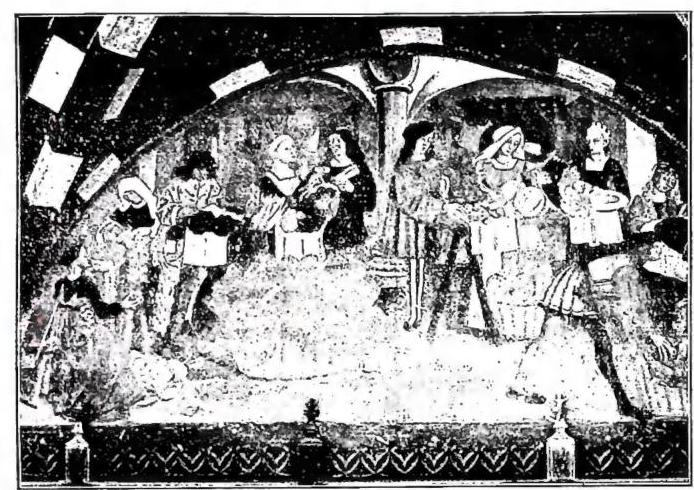
Painting assimilates stylistic elements from neighboring regions and those with which commercial relations were most frequent, adapting them to the local environment. In the last decades of the 15th century, there is a still Gothic-inflected current with German and Flemish influences, of which remain, in addition to works by Defendente Ferrari, the last exponent active as late as 1530, various others by anonymous masters of superior quality (the Master of the Fontana Dispute, the Master of the Magdalene, etc.). Contemporaries of these are Martino Spanzotti, Gaudenzio Ferrari, Macrino d'Alba, Gandolfino d'Asti, and Girolamo Giovenone, all perfectly attuned to the new stylizations of the Renaissance through Lombard masters. The most important cycle of Piedmontese painting at the end of the 15th century is that of the castle of Issogne, where all the varieties of Piedmontese style of that period are present. The most notable figures FERRARIENSIS (v.), who left in the frescoes of S. Bernardino in Ivrea, the former, and in those of Varallo (S. Maria delle Grazie, Sacro Monte) and Vercelli (S. Cristoforo), the latter, the masterpieces of 16th-century Piedmontese painting. In the second half of the century, the sanctuary of S. Croce in Bosco Marengo is enriched with Florentine sculptures and paintings by Giorgio Vasari and other Tuscan masters. Beautiful examples of cut-velvet vestments, gold brocade with soprarizzo embroidery and polychrome reliefs, are preserved in the treasuries of the cathedrals of Aosta, Asti, Biella, Casale, Novara, and Vercelli, with those in relief from the sacred vestments of the Aosta Valley being typical. Notable for their quality are the 16th-century goldsmith works, among which are the silver processional cross of Bishop Ferreri in Vercelli and the silver pastoral staff of the same bishop by the goldsmith Gian Galeazzo Cambi of Cremona from 1520, and the cross of the cathedral of Asti by the goldsmith Feta of Cremona from 1505.
Among the furnishings, one recalls the choir stalls and lectern of S. Sebastiano and S. Girolamo in Biella from 1523, the seats of the chapter house of S. Giovanni in Saluzzo and of the sacristy of the cathedral of Chieri from 1530, the door of the parish church of Revello, and that of the parish house of Villanova Solaro from 1520. From 1590 is the door of the Ospedale Maggiore of Vercelli by Giovanni Sali, now in the Civic Museum of Vercelli.
At the end of the 16th century, the architect Ascanio Vittozzi of Orvieto, summoned by the Savoys for the construction of new fortifications, drew up the first regulatory plan of Turin, designing not only the current layout of Piazza Castello, Via Roma, and the façades of the related buildings, but also foreseeing the first expansion of the city, still enclosed within the now too narrow circuit of the Roman walls.
5. The Modern Age. — The first regulatory plan of Turin’s center would serve as an example for European urban planning. The uniformity of the designs for the houses of the same square and the same street gives harmony to the whole and an absolute originality to the city. But Vittozzi did not limit himself to these urban problems; he provided designs for the churches of Corpus Domini, the Holy Trinity, and the Capuchins, the last two with central plans, as well as the project for the sanctuary of Vicoforte and the church of the cemetery of Cavaglià. Vittozzi’s work was continued by his followers, among whom was Carlo di Castellamonte, author of the project for Piazza S. Carlo, the Certosa of Collegno, the Castello della Venaria, and the Palazzo Taffini in Savigliano. He had as assistants and successors his son Amedeo, author, among other works, of the Royal Palace begun in 1646, the Castello del Valentino, and the hospital of S. Giovanni, and Maurizio Valperga, collaborator in the arrangement of Piazza S. Carlo and S. Teresa. Also to be remembered are Negri di Sanfront, Lanfranchi, Baroncelli, Bertola, Garoe, and Ricca.
On Lake Orta, Richini created for the Milanese who had taken refuge there to escape the plague the beautiful church of S. Rocco in Miasino; in Arona, the sanctuary of S. Carlo and the Seminary. Elegant are the architectures designed by Galeazzo Alessi for the Sacro Monte of Varallo and those of Lombard architects for the Sacro Monte of Orta. In Casale, Sebastiano Guala stands out in the majestic church of S. Filippo with a central plan and the adjoining monastery, in S. Stefano, and in some chapels at the Sacro Monte of Crea.
In the urban planning of the city, Piedmontese architects knew how to align façades with a harmonious sense of horizontality and uniformity (e.g., Via Po), in the layout of the blocks, while the openings continue to be designed with a vertical criterion of space and a rhythm between solids and voids much narrower than in central Italy, corresponding to the temperament and aesthetic needs typical of Piedmont.
When Guarini arrives in Piedmont in 1668, he brings his bold innovations with deeply indented plans, domes featuring intricately interwoven arches, and light-and-shadow effects far more pronounced and dramatic than those used by local architects (the façade and staircases of Palazzo Carignano, the church of S. Lorenzo, and the Chapel of the Holy Shroud). He indulges in the decoration of windows, pilasters, and capitals, favoring brick or dark stone. Guarini concludes the Piedmontese architecture of the seventeenth century. Meanwhile, various Lombard and Luganese sculptors work in Turin. Sculpture remains tied to the Mannerist formulas of the late sixteenth century in Tommaso Carlone; it pursues luministic effects in the stuccoes of Alessandro Casella and Somasso at the Valentino and Palazzo Carignano, and adopts broad, pompous forms in the works of Dionigi Bussola in Casale (Misericordia) and at the Sacro Monte of Orta, as well as in those of the Tabacchetti brothers in Varallo and Crea. Painting does not present works of exceptional prominence and leans toward Caravaggesque luminism in Antonio d'Enrico, known as Tanzio of Varallo, the most notable personality of seventeenth-century Piedmont, in the Casalese Niccolò Musso, in the Saviglianese Giovanni Molineri, and in the more modest Crosio of Trino. Another group follows the footsteps of the Bolognese, particularly Guercino; among these, the most distinguished is
(fot. Giulio Brocheri)
PIEMONTE - Market scene. Detail from the frescoes in the portico of Issogne Castle (late 15th century) - Aosta Valley.
Among the decorators, in addition to Fr. Andrea Pozzo, who worked at the SS. Martiri in Turin (inner façade) and the Mission of Mondovì, the Recchi of Como, Isidoro Bianchi with his sons Pompeo and Francesco, and the Fea brothers of Saluzzo are noteworthy. During this period, interest in furniture and interior decoration intensifies, giving rise to typically local forms and geometric motifs. Artisan workshops begin to flourish, where cabinetmakers, carvers, joiners, gilders, and stucco workers—among whom the Botto of Savigliano stand out—work diligently on interiors: ceilings, floors, baseboards, doors, and furniture for the new Royal Palace.
Intensive work is also carried out in churches to construct new furnishings and decorations. Among the countless examples are the sacristy cabinets of the SS. Martiri, S. Francesco di Paola, and S. Domenico in Turin; those of Ponzano Monferrato (now in the Civic Museum of Turin) and S. Domenico in Rivoli; the confessionals of S. Teresa and S. Francesco di Paola in Turin, and those of S. Filippo and S. Evasio in Casale Monferrato.
In 1714, Juvara (v.) travels to Turin at the invitation of Vittorio Amedeo II and quickly imposes his creative personality, endowed with exceptional qualities in the façade and grand staircase of Palazzo Madama, the church of Carmine, and the imposing, scenographic courtyard of the Oropa sanctuary. He contrasts the heavy luminism of the seventeenth century with the luminosity of an airy architecture, which lends lightness and grandeur to the structural design. Juvara creates in Turin the new eighteenth-century European architecture. A large group of architects, who left works in every locality of Piedmont, flourishes around him, drawing from his art: Francesco Martinez, the Nicolai of Robilant, the Aliaudi of Tavigliano, the Planteri, the Michela, the Borra, the Quarini, the Rana. Some of them display original ideas and well-defined personalities. Among these is Benedetto Alfieri; the Mondovì-born Gallo, who left his masterpiece in the elliptical dome of the Vicoforte sanctuary; the Casale-born Scapitta at S. Caterina in Casale and in the parish church of Murisengo. Bernardo Vittone is the most important figure after Juvara, original in the articulated plan of his churches, especially in the bizarre domes, for example, at S. Maria di Piazza in Turin, S. Michele in Rivarolo, and the parish church of Borgo d'Ale. With the architect
O. Magnocavallo, who favors Palladian forms and dies in 1787, Neoclassicism is already underway, which will triumph fully in the first half of the nineteenth century in Turin, in the noble quarter to the right of Piazza Vittorio Veneto, with buildings designed by Bonsignore, Caronesi, Talucchi, and Antonelli. In Casale, Vercelli, and Novara, Neoclassical forms are imposed for their sober dignity of proportions. Eighteenth-century sculpture is predominantly subordinate to architecture and presents decorative characteristics.
Polychrome wooden sculpture is widely diffused, counting among its many artists some truly notable figures: S. Clemente, C. Plura, the Botto, Perucca, already imbued with the fragile grace of the eighteenth century. Ladatte, a famous goldsmith and bronzist, excels for his refined grace and excellent technique (the clock and bronzes in the Royal Palace, the putti in the church of Carmine, the stag crowning the central pavilion of the Palazzina di Stupinigi). With Bernero and the Collino brothers, the last exponents of eighteenth-century Piedmontese sculpture, forms begin agile and dynamic, concluding in Neoclassicism. Among the Piedmontese goldsmiths and silversmiths, highly appreciated even abroad, Boucheron will be remembered, who executed, among other works, a chased silver lamp donated by the Queen of Spain to the sanctuary of the Madonna dei Fori in Bra. Painting, like sculpture, also has a predominantly decorative function, subordinate to architecture; it indulges in covering vaults and walls and decorating large altarpieces in churches. Numerous fresco painters were called for these decorations, including the Venetians Crosato, Lorenzi, Bortoloni, Bellotto, Ricci, and Nogari; the Romans Valeriani, Trevisani, Maratta, Conca; the Neapolitans Solimena, Giacinto, De Mura; and the Lombards Legnanino in Turin and Carlo Carlone in Asti. The two Piedmontese painters who stand out among the others are C. Beaumont, tied to Neapolitan and French forms and active at the Turin court, and P. F. Guala in Casale and Monferrato, closer to Bolognese and Lombard models. To these are added the landscapes of V. A. Cignaroli, the still lifes of the Rapous and Gili, the bambocciate of Olivero and the Graneri. Among the portraitists, Guala connects to the pittura di tocco. The Grassi of Casale and Clementina derive from French art.
Painting presents particularly elegant and vaporous forms in Valsesia and on Lake Orta, where artists of notable talent, not yet fully appreciated, have left splendid frescoes for their freshness of color and originality of composition: C. Borsetti of Alagna and F. Gianoli of Campertogno, Zanatta, and the great Miasino-born Cantalupi, who evokes Venetian vaporousness and Piazzetta’s models. The decoration of interiors creates masterpieces of elegance in some rooms of the Royal Palace of Turin (the Queen’s apartment), in the Palazzina di Stupinigi, and in the halls of the Accademia Filarmonica of Turin, in the palace of the Fossati counts of Bellino in Asti, and in those of the Gozzani of S. Giorgio and Treville in Casale. One of the Piedmontese characteristics of this period is the mirror-clad walls and ceilings: the most beautiful examples are in Palazzo Carignano, the Royal Palace, and the Gallery of Mirrors at the Accademia Filarmonica. Among the cabinetmakers, Primotti, Piffetti, Bonzanigo, and Tanadei are remembered. During this period, the famous ceramic factories of Vinovo and Turin arise, as well as the tapestry manufactory at the Royal Palace, which lasts about eighty years with cartoons by renowned masters, and the crystal factory of Chiusa Pesio.
Painting, which at the end of the eighteenth century had produced talented scenographers such as Bernardino Galliari and Luigi Vacca, and good miniaturists such as Ramelli and Lavj, is exhausted at the beginning of the nineteenth century; it resists worthily in an ornamental function, achieving stylistic value in the decorations of Palazzo Magnocavallo, the Galliari brothers in Casale, and the Villa of Pollenzo by Palagio Palagi.
Typical eighteenth-century Piedmontese embroideries include the piccolo punto, used in the upholstery of canapés, armchairs, and chairs, along with bandera, a polychrome wool embroidery on a white linen background.
Among the carvings, the choir of S. Secondo in Asti (1714), the furniture of the sacristy of the archbishop’s church in Turin, the stalls of the cathedral of the same city executed by the carver Stroppiana in 1742, the choirs and organ of the cathedral of Asti (1770) by Bartolomeo Varale of Moncalvo, the stalls of the cathedral of S. Antonio in Casale, the pulpit of S. Domenico in the same city, and the splendid furniture of the sacristy of the cathedral of Vercelli are noteworthy. Among eighteenth-century goldsmith works, the monstrance of the cathedral of Asti, by the goldsmith G. A. Groppa (1770), is notable.
The sculptors of the early nineteenth century, G. Spalla, A. San Giorgio, and G. Bogliani, oriented themselves toward Neoclassical models. Among them, Marocchetti stands out as the most interesting figure in Piedmont during this period, leaving his masterpieces in the equestrian monuments of Carlo Alberto and Emanuele Filiberto in Turin. In the second half of the century, the sculptors Vela and Tabacchi distinguished themselves, while painting was renewed by Antonio Fontanesi and his followers Delleani, Calderini, and others, as well as by the Rivara school (Pitarra, Avondo, Reycend). At the beginning of the twentieth century, rationalist architecture asserted itself in the Fiat workshops at Lingotto and, more recently, in the beautiful Olivetti factories in Ivrea. In Turin, in 1919, an avant-garde renewal of painting began under the initiative of Casorati, later continued in 1930 on a broader scale by Chessa, Menzio, Levi, Paolucci, Galante, and Boswell.
V. FOLKLORE
Popular tradition has, naturally, been best preserved in the various Alpine valleys, but some important urban centers have also remained faithful to ancient customs, particularly for major calendar festivals.A very significant folkloric phenomenon is the survival, in many towns of Piedmont, of the abbazie (abbeys), that is, youth associations whose origins date back to the Middle Ages and whose primary function today is to organize traditional festivals, especially for Carnival and Calendimaggio. Among the oldest forms preserved through these associations is the sword dance, still performed in various towns under different names: the ba' cubert of Fenestrelle, the lachero of Rocca Grimalda (Alessandria), and the spadoni of San Giorgio (Turin), San Vincenzo, and Venaus in Val di Susa. In these dances, the ancient propitiatory meaning for the fertility of the fields is still clearly recognizable. The activity of the abbazie or similar youth associations is also responsible for the fact that in various cities of Piedmont, Carnival has retained
PIEMONTE - Eastern reliquary (9th-10th centuries) - Ivrea, Cathedral Treasury.
The folk art of Piemonte reveals its characteristics especially in wooden objects, carved by shepherds or local artisans. These include dining stools, cradles, spinning wheels, distaffs, wedding chests, and even statuettes of saints, which bear the imprint of an innate, somewhat rough but intensely expressive taste. Among the ornamental motifs, the ancient solar wheel is also found. Special attention, among wooden objects, deserves the grolla, the Valdostan wine cup, which takes its name from the mystical Grail and is used for traditional à la ronde drinking among groups of friends.
Rich is also the heritage of folk literature, both in legends with historical or sacred themes, or those concerning magicians, witches, ghosts, "wild men," and the like, and in folk songs, where epic-lyrical songs prevail, as evidenced by the highly important collection published by Costantino Nigra. Finally, in addition to those already mentioned, folk dances such as the corenta and the manfrina or monferrina should be noted, the latter of which has spread far from its place of origin. - Vedi tavv. LXXXVII-LXXXIX.