Machine translation of the 1948–1954 Italian original. The original text is authoritative.
SOLARO DELLA MARGARITA, CLEMENTE. — Piedmontese politician and diplomat, born on 21 November 1792 in Cuneo, died on 12 November 1869 in Turin. From October 1803 to 1806 he attended the Tolomei College in Siena, then run by the Piarists.
The events of those years, culminating in the French occupation of Piedmont and consequently in the deportation of Pius VII, inspired in him a profound and deeply felt attachment to his dynasty and a lively religious sentiment, and contributed to that firm aversion to the new ideas which, with programmatic constancy, he opposed throughout his life with the union of throne and altar. He continued his studies in Turin and there took degrees in both laws in 1812. Attached to the Public Prosecutor’s Office of the imperial court of Turin, he lost no opportunity to express his opposition to the Napoleonic regime, and in that same year he promoted that Società italiana, a meeting place for all those, mostly young people, who wished to react against the Gallicization of culture. According to the statutes of the Association, upon admission the members assumed the names of illustrious Italians in the fields of literature and the arts, with any Roman name excluded, not only because the statutes regarded the period following the fall of the Lombard Kingdom as the classical age of « the freedom of the fatherland », but also probably as a natural reaction to the custom of the Revolution and the Empire of abusing the names associated with Roman identity. Article 4 of the same statutes provided that « the purpose of the Society is Italian culture; every language other than Italian is excluded ». This activity, so to speak national in character, was a clear and decisive opposition to French usurpation and rule, and a profession of legitimism toward the Savoy dynasty. After the Restoration, in 1816, he was secretary at the legation in Naples, headed by the marquis of S. Saturnino, of which
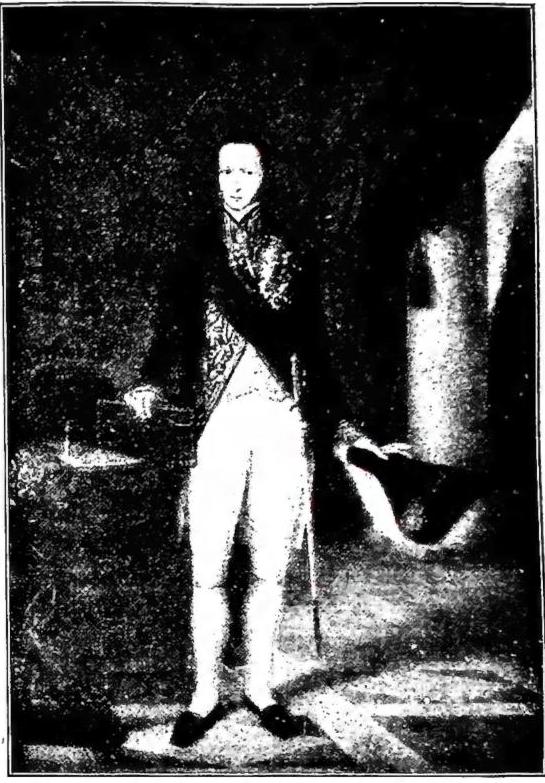
(from C. Lavero - I. Rinieri, Cl. S. della M., I. Turin 1931, vol. between pp. 18 and 19)
SOLARO DELLA MARGARITA, CLEMENTE – Portrait.
In 1825 he married Carolina, a highly religious woman. During the Revolution of 1820–21, he was charged with administering the legation during a temporary leave of absence by the Minister. Returning to Turin in 1825 for his marriage, he was appointed plenipotentiary minister to Madrid in 1826. Convinced that only a thorough struggle against liberalism could curb the danger it posed to absolute governments, during his Madrid mission he drew close to the Carlists and became their fervent advocate both at his own court and before the Holy See, with whose Secretariat of State he corresponded after the pro-nuncio Cardinal Giustiniani, in 1827, entrusted him with the temporary care of pontifical interests. Bound by friendship to the bishop of León, one of the most representative figures of Carlism, S. found himself at odds with the new nuncio Tiberi, whose actions seemed to him prejudicial to the pursuit of an energetic struggle against the liberals, and he was deeply displeased by the failure to restore the Spanish Inquisition. At the same time, he also took issue with Metternich’s policy, which he considered mild and hesitant, and lamented the ambiguous conduct of all monarchist Europe, which did not support absolutism with sufficient energy against constitutionalism. His support for the Carlist cause intensified after the death of Ferdinand VII, and when, in February 1835, S. became Foreign Minister, it conditioned all Sardinian policy toward the foreign powers. In full agreement with the thought and will of King Carlo Alberto, he defended legitimism against liberalism throughout Europe wherever the monarchy of “divine right” was threatened by usurpers. He therefore assisted the Carlists of Spain, the Miguelists of Portugal, and the Bourbons of France, deprived of the throne in 1830. The struggles between the radical and Catholic Cantons of neighboring Switzerland also attracted his attention, particularly with regard to the adjacent Valais, not without the intention of deriving a particular advantage from them.
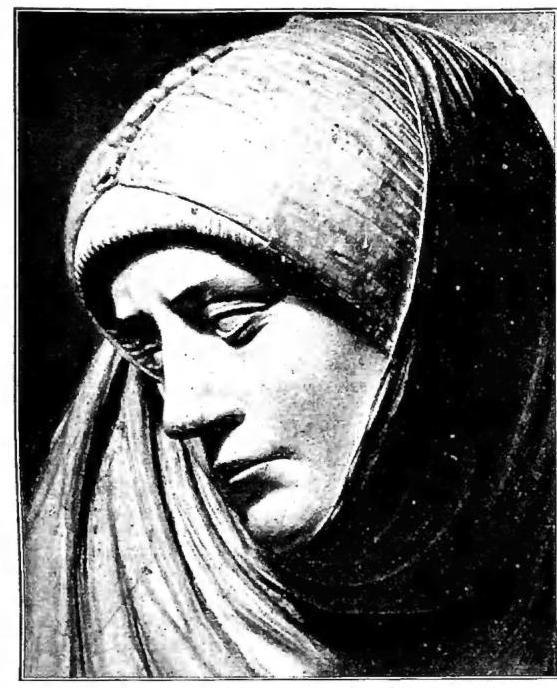
(photo: Solesmes Abbey)
SOLESMES, ABBEY OF SAN PIETRO – Head of one of the pious women, detail from the Sepulchre of Our Lord (sculpture in local stone from the end of the 15th century) – Solesmes, abbey church.
by extending the king’s sovereignty over that region. Relations with Austria were marked, if not by coldness, by distrust, both because he could not forgive Metternich his overly “diplomatic” manner in European legitimist questions, and because he was ill disposed toward the veiled tutelage that Austria at times sought to exercise over Piedmont. S., however, understood very well that Austria was the only ally on whom Piedmont could safely rely in case of danger. In his relations with the Holy See, S. promoted in 1839 the re-establishment of the nunciature in Turin, suspended since 1753. Although he did not succeed in obtaining a formal promise that the nuncios would be awarded the purple at the end of their office, S. nevertheless received assurances to that effect. Having left the Ministry in October 1847, in order to respond to the attacks and criticisms directed against him, S. undertook a work in which he set out the principles followed during his ministry, describing in detail the events from 1835 to 1847; he published it in 1851 under the title of Memorandum storico-politico. In Avvedimenti politici of 1853 he returned more extensively to the premises that had guided his action, intending to demonstrate “how [fortunate destinies] are maintained in any State when the principles of sound politics are followed,” how he had placed “religion as the foundation of politics,” because “everything derives from God... Outside his law there is nothing but falsehood and error; outside his will there is nothing but confusion and disorder”; a thesis he reaffirmed in Questioni di Stato of 1854. He was not elected in the elections for the fifth legislature, held on 8 December 1853, in the constituencies of Borgomanero and Pontestura. He entered the Chamber in February 1854 for the constituency of S. Quirico, which had become vacant, and his mandate was also confirmed for the sixth legislature in November 1857. In the Chamber he spoke several times, opposing Cavour’s ecclesiastical and foreign policy. Defeated in the 1860 elections in the constituency of Dogliani, he did not abandon his publishing activity, and published Risposta del conte C. S. d. M. all'opuscolo «Il Papa e il Congresso» (1860); against the cession of Nice and Savoy: Sulla annessione di alcuni Stati alla Monarchia e sulla cessione della Savoia e di Nizza alla Francia (1860); against the September Convention: Sguardo politico del conte C. S. d. M. sulla Convenzione italo-franca del 15 sett. 1864 (1864). Finally, in the four books of L'Uomo di Stato indirizzato al governo della cosa pubblica (Turin 1863–64), he intended to demonstrate the possibility of Catholic government in modern times.
BIBL.: F. Boffi, Un retrogrado, Il conte C. S. d. M., in Ross. naz., 2nd series, 15 (1918), pp. 270–82; A. C. Jemolo, Il «partito cattolico» piemontese nel 1855 e la legge tarda soppressiva delle comunità religiose, in Il Risorgim. ital., 11–12 (1918–19), pp. 1–52; F. Lemmi, La politica estera di Carlo Alberto nei suoi primi anni di regno, Florence 1928, passim; L. Madaro, S. d. M. e il ristabilimento della nunziatura a Torino nel 1839, in Il Risorgim. ital., 23 (1930), pp. 515–26; C. Lovera-I. Rinieri, Cl. S. d. M., 3 vols., Turin 1931; L. Salvatorelli, Il pensiero politico ital. dal 1700 al 1870, 2nd ed., there 1941, pp. 201–205; A. C. Jemolo, Il mancato ripristino della Inquisit. di Spagna e il conte S. d. M., in Atti dell'Acad. della scienze di Torino, Sc. morali, 76 (1940–41), pp. 443–58; id., Il conte S. d. M. ed il nunzio Tiberi, ibid., 77 (1941–42), pp. 119–43. Silvio Furlani.
Cite this article
“SOLARO DELLA MARGARITA, CLEMENTE.” Enciclopedia Cattolica, vol. XI (1953), p. 561. Azione Romana digital edition, https://azioneromana.com/article/solaro-della-margarita-clemente.