
PIO VII, PAPA. — Barnaba Gregorio Chiaramonti, born on 14 August 1740 (not 1742) at Cesena to Count Scipione and Marchioness Giovanna Ghini. Having completed his early studies at the Jesuit College of Ravenna, he became a Benedictine: in 1775 he was Abbot of S. Callisto in Rome, in 1782 Bishop of Tivoli, in 1785 Bishop of Imola, and shortly thereafter a cardinal. In the administration of the dioceses entrusted to him, Chiaramonti revealed those qualities of gentleness and meekness that were also to characterize his conduct during the most arduous and tragic moments of his life.
After Pius VI died at Valenza on 29 August 1799, the Conclave for the election of the new Pontiff met in Venice, where numerous cardinals had taken refuge under Austrian protection. The deceased Pontiff had established that the future conclave should meet wherever the majority of the cardinals happened to be. The Conclave lasted from 1 December 1799 to 14 March 1800; its secretary and organizer was the young prelate Ercole Consalvi. The candidate preferred by the government of Vienna was Cardinal Mattei. In the voting, Cardinal Bellisomi, Bishop of Cesena, initially prevailed; he was opposed by Austria, and was GARDINALE (v.). In the end, the votes concentrated on Cardinal Chiaramonti, who, in homage to his predecessor, took the name Pius VII.
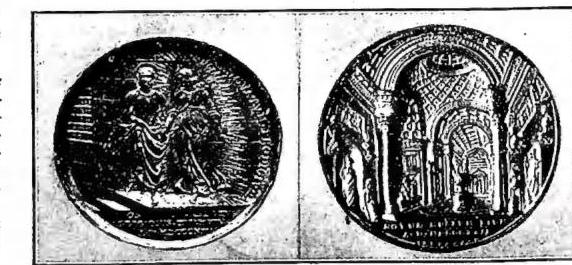
(photograph: Vatican Museums and Galleries)
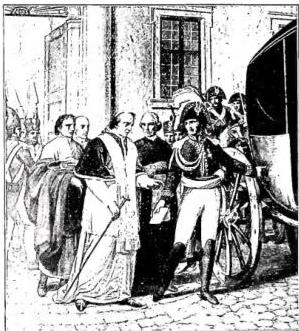
PIO VII, papa — The Pontiff taken from the Quirinal by General Radet on 5 July 1809. Nineteenth-century fresco — Vatican Museums.
Bishop of Vercelli, with communicating to the Pope his intention of establishing agreements between the Church of Rome and the French Republic in a spirit of peace. P. agreed, and entrusted the negotiations in Paris to Monsignor Spina and the theologian Caselli: in Paris they met with Abbé Bernier, the representative of the First Consul. By offering to restore religious peace in France, the First Consul intended to exploit the support of the Church and the clergy. P. soon had to abandon his plans to defend the non-juring bishops, preserve the patrimony of the Church of France, and make Catholicism the official religion of the French State. The long and exhausting negotiations were broken off in June 1801. P. had to send Cardinal Consalvi to Paris, and the Concordat was signed on 15 July 1801. When the Pope examined its text, serious opposition arose among the cardinals, but Consalvi secured the papal ratification of the agreement, and P. signed the Concordat on 15 August and sent Cardinal Caprara to Paris with the authority of a legate for its implementation. The First Consul then, in order to calm the opposition of the old revolutionaries, promulgated the Organic Articles, which subjected certain religious activities to state and police control, in accordance with the spirit of the old jurisdictionalism. P. could do no more than protest against these abuses of the French government in his address to the cardinals of 24 May 1802. On 18 April 1802, the Concordat was promulgated in Notre-Dame and the Te Deum was sung solemnly. In reality, there were many discontented parties, both among the anti-revolutionaries and among the more intolerant revolutionaries. P. was accused of having betrayed the Church. As a consequence of the Concordat, the ecclesiastical principalities in Germany disappeared in 1805, and the property of religious institutions was confiscated. With the proclamation of Napoleon Bonaparte as Emperor of the French, strong pressure was brought to bear on P. to travel to Paris for the ceremony of the imperial coronation. The cardinals were opposed, and were supported by several Catholic governments. P., drawn by the hope that his personal sacrifice might benefit the Church, departed on 2 November, accompanied by seven cardinals and four bishops. The papal journey through France, the first since the Avignon period, gave rise to moving religious demonstrations by the populations along the Florence–Turin–Mont Cenis–Lyons route. On 25 November at Fontainebleau, P. was received in the forest by the Emperor, dressed as a hunter during a hunting party: a very coarse reception, of which the
Pope was not enthusiastic. The coronation ceremony took place in Notre-Dame on 2 December: P. received from the Emperor the oath to preserve peace for the Church and the people; Napoleon himself took the crown from the altar and placed it on his head. The previous day, P. had succeeded in persuading Napoleon to contract a religious marriage with Giuseppina, and this was done secretly. Napoleon sought to persuade the Pope to remain in France, either in Paris or in Avignon. P. resisted every insistence; he warned that if an attempt were made to detain him by force, the Emperor would have in his hands only the monk Barnaba Chiaramonti, because he had left detailed instructions to that effect in Rome. Pope and Emperor parted coldly: from that moment the tension began that was soon to lead to a rupture. P. returned to Rome on 16 May. During the stop in Florence, he succeeded in obtaining the submission of the Jansenist Bishop of Pistoia, Scipione de’ Ricci (v.).
Strengthened by the prestige that came to him from the imperial coronation, Napoleon began to act arbitrarily toward the Church and the Papacy. In France as in Italy, he issued measures even in the religious sphere, going so far as to demand the annulment of the marriage contracted in America by his brother Gerolamo and a rupture with England and the other governments opposed to the Empire. In response to papal resistance, Napoleon occupied Ancona militarily. P. protested, but after the victory at Austerlitz Napoleon replied haughtily, declaring himself the firstborn son of the Church, just as his Carolingian and Capetian predecessors had been; meanwhile, the Papal State was a gift from the emperors, and the popes were required to follow imperial policy.
When Napoleon made his brother Joseph King of Naples, Consalvi protested, invoking the Pope’s rights and his supreme sovereignty over the Kingdom: the Emperor responded by threatening to have the cardinal arrested and granted Benevento and Pontecorvo, papal territories, as fiefs to Talleyrand and Bernadotte. Consalvi renewed his protests, but was forced to resign his office (17 June 1806). The Pope entrusted the Secretariat of State to Cardinal Casoni, who soon had to withdraw and was replaced first by Doria and then by Gabrielli, who continued the policy of resistance. Napoleon then had an ultimatum presented to the Pope: the right to appoint one-third of the cardinals, the coronation of the King of Naples, adoption of the Napoleonic Code, recognition of the Gallican liberties and of the Organic Articles, appointment of an autonomous French patriarch, abolition of ecclesiastical celibacy, and suppression of the religious Orders. The Pope’s refusal precipitated events: on 2 February 1808 General Miollis occupied Rome. P., lodging a new protest, declared to the French general that from then on he considered himself a prisoner. The French regime turned to open violence: the cardinals were either expelled or arrested. After the arrest of the Secretary of State Gabrielli, the Pope replaced him with Pacca. From Palermo the English offered P. hospitality in Sicily and the means of escape, but the Pope refused. An attempt to arrest Cardinal Pacca in the Quirinal Palace itself was thwarted by the Pope’s personal intervention. Meanwhile, on 2 April 1808, Napoleon promulgated from St-Cloud a decree establishing the union of the Marches with the Kingdom of Italy. On 17 May, from Schoenbrunn, he suppressed the temporal power of the popes, declaring Rome an imperial city and assigning the Pope an annual income of two million francs. P. responded by ordering Pacca to publish the bull of excommunication against all those who had ordered or perpetrated the violence against the Holy See (10 June 1809). On 20 June Napoleon wrote to Murat that the Pope was a madman who had to be confined; Pacca and all those who were most loyal were to be arrested. General Radet undertook this odious operation: on the night of 5 July, having scaled the Quirinal, he entered the room where the Pope was and, in the Emperor’s name, ordered him to renounce his temporal rule. The Pope rose to his feet and replied: «I cannot, I must not, I do not wish to. I have promised God to preserve his States for the Church, and I shall never fail in my oath.» Radet then forced P. and Cardinal Pacca to enter a carriage and depart. On 8 July the two prisoners reached Florence, from where they immediately departed for Genoa, Alessandria, and the Cenisio; on 21 July they were in Grenoble. Pacca was confined at Fenestrelle. The Pope was taken to Valence, then to Avignon, and finally, on 15 August, to Savona, where imperial orders soon arrived for the strict surveillance of the illustrious prisoner lodged in the Bishop’s Palace. In appearance there were sovereign honors; in reality, a true prison, with control over his personal relations and correspondence; little by little, the Pope was to be completely isolated. The Emperor hoped to reduce P. to compliance with his wishes, convinced that he was dealing with a weak old man, incapable of resisting when he did not have prudent and faithful advisers at his side.
In the matter of the divorce from Josephine in order to marry Maria Luisa of Austria, the Pope, the sole authority competent in the matter, was ignored. The cardinals who, as a sign of disapproval, abstained from attending the solemn ceremony of the new marriage were stripped of their property and exiled, with a prohibition against wearing the insignia of their dignity. When Napoleon ordered that the bishops appointed by him should take possession of their sees without concern for canonical institution, the Pope condemned the intruded bishops. In retaliation, P.’s imprisonment became harsher: his books and even the materials necessary for writing were taken from him. In November 1800 and March 1811 Napoleon convened two ecclesiastical councils in Paris in order to prepare a national council. This was in fact convened for June 1811; meanwhile, a commission of bishops was sent to Savona to exert pressure on the Pope: under threat of annulment of the Concordat, he was to confirm the bishops already appointed; in the future, once three months had elapsed from the appointment without pontifical canonical institution having taken place, it was to be granted by the metropolitan bishop or by the oldest of the suffragans; the Pope was also to swear an oath of fidelity to the Emperor and reside at Avignon. After prolonged resistance, P. finally yielded, accepting, as a preliminary basis for negotiation, the proposal that a clause be inserted in the Concordat whereby the Pope was to grant canonical investiture within six months, after which the metropolitans would act. As soon as the draft of the document had been drawn up, P. repented, but it had already been sent to Paris. The national council sat from 17 June 1811 to 5 August. The proposed decree, which the Emperor’s representatives wrested from the bishops, was brought to Savona by a new delegation of imperialist cardinals and bishops. P., overwhelmed by the insistence of those who spoke of the needs of the Church, after a long dispute (3–20 September 1811) surrendered, with the reservation that the metropolitan was to proceed by virtue of a formal delegation from the Pope. Napoleon flew into a rage on reading the papal brief and, from Dresden, on the eve of the expedition to Russia, ordered the governor of Turin, Prince Borghese, to transfer P. in complete secrecy to the castle of Fontainebleau. Having departed from Savona on 10 June, although ill, P. reached the hospice at the Cenisio on the 12th; almost at the point of death, he received the Viaticum from those monks. Having recovered and being forced to depart, he reached Fontainebleau on 20 June, and imperialist cardinals and bishops were at his side to induce him to submit to the master’s will. After the disastrous expedition to Russia, at the end of December 1812, Napoleon returned to France and wished to attempt a rapprochement in order to impress the populations, but P. rejected the proposals put to him by the Bishop of Nantes, Du Voisin, and by other bishops. On the evening of 18 January 1813 Napoleon abruptly visited P., once again dressed in hunting clothes. In the days that followed, Pope and Emperor held lengthy discussions: on 25 January an agreement was signed that was to constitute the preliminaries of a new concordat. The Pope accepted the decisions of the Council of Paris and obtained, as concessions, the liberation of Cardinal Pacca and several others, the restoration of the suburbicarian sees, and the right to provide for ten sees. Napoleon hastened to publish such an act, which was intended to remain secret, for the benefit of his policy. Cardinals Consalvi and Pacca, as soon as they arrived at P.’s side, made him aware of the mistake he had committed; on 26 March P. wrote to Napoleon retracting what he had agreed to and declared in a letter to the cardinals that any canonical institution granted by the metropolitans was null. The Pope remained in France
until February 1814, when, overwhelmed by defeat, Napoleon ordered that P. be taken back to Savona and, on 10 March, that he be set free. P. entered Rome on 24 May, but in the spring of 1815, when Gioacchino Murat began his adventurous enterprise, the Pope took refuge in Genoa, returning to Rome as early as 7 June 1815. After 1815 he had once again to confront the problems of reconstructing the State and restoring ecclesiastical institutions. Consalvi deserves the credit for having succeeded, through negotiations conducted in London and Vienna, in obtaining the Congress’s decision to restore all the Papal States, rejecting the Austrian claims to the Legations. Only Avignon remained with France; a small strip of Ferrarese territory on the left bank of the Po was ceded to Austrian Veneto; Benevento and Pontecorvo were also returned by the Kingdom of Naples; the pre-revolutionary papal legislation was partly restored, and the administration was reorganized on new foundations more suited to the times. Card. Consalvi saved the Pope from serious responsibilities, showing him the necessity of putting the past behind him and renewing the state administration. The motu proprio of 6 July 1816 abolished feudal rights, reorganized the courts, and unified the administrations of the provinces and municipalities according to Napoleonic principles. The reform of the ecclesiastical courts and the publication of new codes were also announced. Consalvi, on the other hand, adopted a policy of great tolerance toward followers of liberal ideas in domestic affairs, resisting Austrian pressures, which sought to obtain control over the Papal State. In Rome P. granted the greatest hospitality to Napoleon’s mother and family members, including Card. Fesch himself. With the bull Sollicitudo omnium of 7 August 1814 P. restored the Society of Jesus, suppressed by Clement XIV. In order to regulate ecclesiastical relations according to the new needs, concordats were concluded around 1817–18 with the monarchies of Spain, Sardinia, France, Naples, Bavaria, and Prussia. A notable revival can also be observed in the missionary field. The Congregation of Propaganda Fide began functioning again on new foundations, and, thanks to the Pope’s efforts, the work of religious assistance and penetration in the Middle and Far East was progressively reorganized. Provision was being considered for the difficulties created in Latin America, shaken by rebellion against Spanish rule, while the greatest hopes in North America were beginning to be realized. P. died on 20 August 1823 following a fall in his own study, in which he fractured his femur. He died without knowing of the destruction of the basilica of S. Paolo, caused by a serious fire several days earlier. He was buried in S. Pietro; Card. Consalvi commissioned the Danish sculptor Thornwaldsen to create a grand funerary monument: Wisdom and Strength stand guard over the tomb. - Vedi tav. CIII.