
RICCI, SCIPIONE de’. — Bishop of Pistoia and the most distinguished representative of Italian Jansenism; born in Florence on 9 January 1741, died in exile
(by courtesy of the name, d. P. Pistoia)
RICCI, MATTEO — The Chinese emperor Wanli, protector of R. during his stay in China.
ecclesiastic and political figure in Rignana near Florence on 27 December 1809.
His Jansenist formation derived in part from the milieu in which he spent his youth: first in Rome, where, in the hospitable home of mons. Giovanni Bottari, he established relations and friendships with the principal Italian Jansenists, Enlightenment thinkers, and scholars; then in Pisa, where the philosophical-scientific orientation felt the influence of Cartesianism and naturalism, while the theological orientation, wholly permeated by the doctrine of the celebrated Augustinians Norsi and Berti (teachers at that University), was, together with the teaching of law and ecclesiastical history, open to the novelties of Enlightenment historicism and the Gallicanism of the French appellants; and finally in Florence, where de' R., in 1772 coadjutor canon at S. Maria del Fiore and subsequently vicar general of the archdiocese, completed his education through spiritual and epistolary contact not only with the French abbot Count Dupac de Bellegarde, an adherent of the schismatic Church of Utrecht, but also with the Enlightenment thinker Giovanni Lami, whose Le nouvelle letterarie he read, and with the Tuscan rigorists and anti-curialists of the Florentine grand-ducal Court. When, on 15 August 1780, he made his solemn entry as bishop of the united dioceses of Pistoia and Prato, he had already prepared, following the plan of his French appellant friends and the schismatic bishops of Utrecht, his programme of reform. Some professors of the theological Portico of Pavia helped him in this work, among them Pietro Tamburini, whom he had met in Rome at Bottari’s, and Vincenzo Palmieri. But it may be said that all the Italian Jansenists and sympathizers with Jansenism—or simply all restless spirits desirous of novelty outside Roman obedience—entered into personal and epistolary contact with the bishop of Pistoia, becoming his collaborators. A friend of Leopoldo, ambitious and pressed by persistent appeals from Italy and abroad, he undertook a radical reform of discipline and studies. An extraordinary reform, embracing at once the administration of movable and immovable ecclesiastical property and the liturgical revision of the Breviary and the Missal; the establishment of an ecclesiastical academy dedicated to s. Leopoldo in homage to the sovereign; translations of religious works and pamphlets, written mostly by French appellants, often anonymously; and finally an innovation in catechetical texts, together with the establishment of journals and periodicals and the founding of publishing houses.
(phot. Fides)
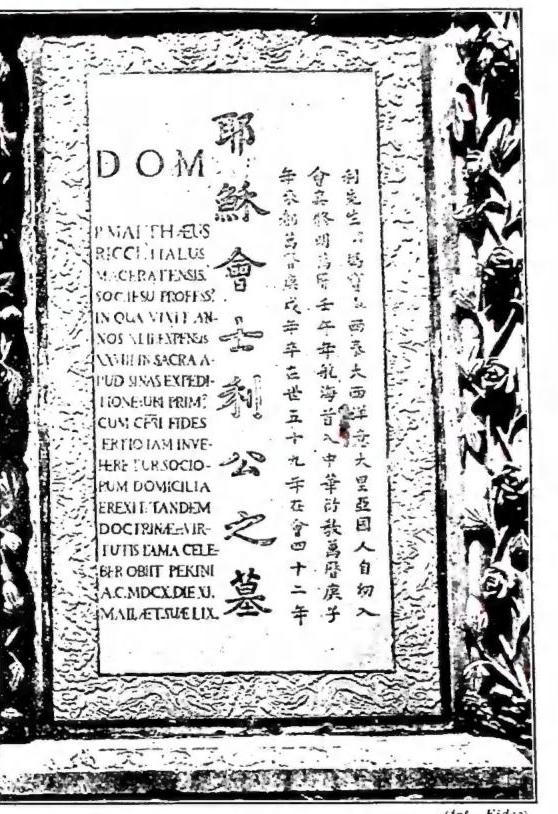
RICCI, MATTEO – Tomb of Fr. M. R. – Beijing.
at Rignana in Chianti. Here he spent the final years of his life studying the Fathers, collecting his extensive correspondence, and composing several devotional booklets and his Memorie. He felt himself to be a survivor of the « ruines du Port-Royal », an exiled confessor, a martyr; and in his thoughts he returned to Quesnel, Saint-Cyran, Arnauld, and the great figures of French Jansenism, almost as though he wished to conform himself to them even in death. One after another, his friends had disappeared in death or been overwhelmed by the violence of political events. Pressed by the affectionate entreaties of the Florentine archbishop, his relatives, his friends, and the grand-ducal court itself, on 9 May 1805 he met with Pius VII in Florence, into whose hands he submitted a declaration of submission. Had he not written the Memorie during those years, one might perhaps have believed in the sincerity of this submission; instead, it must be acknowledged that the ambition, hypocrisy, and duplicity of the Roman student and the Florentine canon accompanied him to the very threshold of the grave. He signed the recantation but « puramente e semplicemente », as he wrote in the Memorie. He would say that he had not wished « dichiararsi reo di una colpa che non aveva commesso », nor « non aver condannato che errori ed eresie quali erano le proposizioni secondo le qualifiche ». It was therefore a hypothetical submission, a « sacrificio grammaticale ». For this reason, after his death, he enjoyed the sympathies of the epigones of the Italian Risorgimento as a « veggente » and thus a martyr to Roman « intrighi », as well as all too mordant antipathy among ecclesiastical historians. His bibliography was consequently varied and disputable. Certainly, his moral character rises no higher than honest mediocrity.
Lacking a sound theological formation, he devoted himself more to liturgical, disciplinary, and ecclesiastical reforms than to theological innovations, imbuing even reforms with a schismatic and heretical spirit—reforms that were premature at the time but that the passage of time was later to justify and the Church to support and implement, such as a return to liturgical piety through translations of the Missal and of prayers concerning particular functions; greater simplicity in worship at a time when there was a threat of reducing churches to theatres; and a sense of enlightened piety that was to direct every action of life toward a more adequate fulfilment of ecclesiastical and religious duties. Thus, the common desire for reform of the Breviary and revision of sacred hagiography, the wish for worship purified of superstitious elements and for a more judicious and critical sense of history, the support given to the culture and intellectual education of the young, an adequate and equitable distribution of ecclesiastical goods and stipends, the keen sense of parochial life, Communion « infra Missam », etc., today constitute the aspiration and fruitful work of the Church. But de' R., placing himself above the Pope, fell into episcopalism. By granting his parish priests rights of divine jurisdiction, he fell into parochialism. He then gave Caesar what he had taken from God and torn away from the Church, and withered all his beneficial activity.