
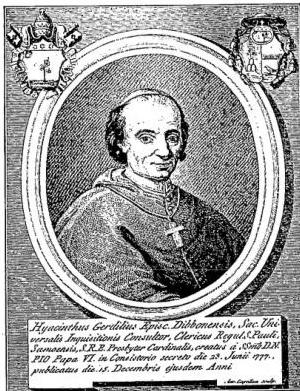
GERDIL, HYACINTHE-SIGISMOND. — Cardinal, philosopher, educator, and theologian, born at Samoens (Savoy) on 23 June 1718, died in Rome on 12 August 1802. At the age of sixteen he entered the Congregation of the Barnabites and completed his higher studies at the University of Bologna. He taught philosophy at the Colleges of Macerata and Casalmonferrato; then natural ethics (1749) and moral theology (1754) at the University of Turin.
In 1764 he left teaching, having been appointed at court as tutor to Prince Carlo Emanuele (the future King Carlo Emanuele IV). In 1776 he was summoned to Rome by Pope Pius VI, and the following year was elected titular bishop of Dibona and then, in the Consistory of 23 June 1777, created cardinal. For twenty years he was extremely busy, both in the offices of the Curia (he also directed the Sacred Congregation de Propaganda Fide) and in composing polemical works against the errors of the age and the attacks on the Church. When Rome was occupied by the French (February 1798), he had to withdraw to Piedmont (where he was treated with some consideration by the occupying French). He was a candidate for the papacy at the Conclave of Venice (1800; he failed because of the veto imposed by Cardinal Hertzan in the name of the Emperor of Austria), from which Pope Pius VII emerged; the latter recalled G. to Rome, where he remained until his death. He was a member of distinguished academies (the Accademia delle scienze of Turin; the Institute of Bologna; the Accademia della Crusca).
G.’s scientific activity was predominantly philosophical. As a theologian, apart from contemporary polemics, he left no original works (but did leave a substantial and sound treatise on Teologia morale); he was also responsible for drafting the bull Auctorem fidei (condemnation of the Synod of Pistoia, 1786). As a philosopher, he followed the development of thought throughout the century with vigilant critical insight; consequently, three periods may be distinguished in his activity: 1) in his early works (L'immaterialité de l'âme démontrée contre Mr. Locke, etc., Turin 1747; Défense du sentiment du p. Malebranche, etc., there 1748), he was frankly Cartesian, sharply criticized Locke (whom he nevertheless appreciated), and enthusiastically embraced Malebranche’s ontologism and occasionalism; 2) more mature in age and study, he professed a more independent Platonism, with an eclectic tendency (Introduzione allo studio della religione, Turin 1755, a work on the history of philosophy, with, in an appendix, two highly notable dissertations: Dell'esistenza di Dio e dell'immaterialità delle nature intelligenti e Dell'origine del senso morale; Recueil de dissertations..., Paris 1760; etc.); 3) finally, on spiritualistic and Christian foundations, he treated the moral and social problems that were developing fully in the final decades of the century, when Rousseau and, in general, the masters of irreligious empiricism seemed to dominate (De l'ordre, Turin 1770–73; Discours philosophiques sur l'homme, there 1769; De l'homme sous l'empire de la loi, there 1774; Précis d'un cours d'instructions sur l'origine, les droits, et les devoirs de l'autorité souveraine, there 1799).
G.’s more strictly religious cultural activity includes ascetical-religious treatments (Vita del b. Sauli, Rome 1805; Breve esposizione dei caratteri della vera religione, Turin 1767, a brief work that for some time enjoyed very wide circulation and was also translated into Polish, etc.), works of positive theology (Saggio d'instruzione teologica, Rome 1776), moral theology (v. SORA), or polemics (in refutation of Raynal, Eybel, G. Febronius, Pfaff, and others).
From an overall point of view, G.’s philosophical thought, which may be defined as a critical and progressive spiritualism, obeys a twofold implicit postulate: confidence in the cognitive powers of the human spirit and, at the same time, in the intrinsic and necessary harmony of reason with faith; and it unfolds along the following lines: 1) defence of Cartesian-Malebranchian spiritualism against Lockean and later sensationalist empiricism; 2) more generally, defence of rationalism against empiricism and, above all, of Christian spiritualism against materialistic naturalism and pantheistic tendencies; 3) study of problems in mathematical and natural philosophy; 4) critical study of moral and political problems, both fundamental and topical.
In his political doctrines G. accepts the concept of equality, but eliminates its deviations: human beings are equal by nature, but relative inequalities necessarily exist among them, and therefore the state of nature is not in itself opposed to the state of society. This does not, however, signify an unconditional approval of society as it is constituted: on the contrary, G. is opposed to the conception of the patrimonial State and to every paternalistic form of government whenever it lacks the positive and conscious contribution of its subjects.
Antonio Lantrua
II. PEDAGOGY
G. must also be regarded as an eminent pedagogist on account of the various works in which he develops a complete program of instruction and education.Leaving aside the two little works composed when he was tutor to the Prince of Piedmont, later King Carlo Emanuele IV: Plan des études pour S.A.R. le Prince de Piémont, avec quelques opuscules relatifs à la même institution (Opere, I, p. 185 ff.) and Pensées sur les devoirs des différents états de la vie (ibid., p. 285 ff.), the works that best reflect G.’s theories and methods are: Considerazioni sopra gli studi della gioventù (ibid., p. 149 ff.), in which the reform introduced into the school is censured because it proclaimed the adoption of easy, hasty, and abbreviated methods, increased the number of subjects, and paid more attention to the quantity of knowledge to be imparted to the pupil than to depth and seriousness. The pupil, on the contrary, must convince himself that study entails effort and toil; easy and hasty methods do not take hold of the mind, nor do they strengthen its faculties or encourage the art of learning on one’s own. Just as physical strength increases all the more the more it is exercised and trained to overcome difficulties, so too does intellectual strength. Naturally, this effort must not weigh entirely upon the pupil’s shoulders, for he would lose heart; but it must be made agreeable through a thousand devices on the part of the teacher. In the Plan des études pour un jeune seigneur appelé aux emplois les plus distingués pour le service du prince et de la patrie (ibid., p. 169 ff.), G. insists that the purpose of the school is not, or is not solely, to adorn the mind with knowledge, but above all to form it; and that the great art of instruction consists in exercising the mind and training it to act independently, so as to discover, almost without realizing it, the truths that the teacher intends to teach. Only in this way are the precious habits of reflection strengthened, upon which the most highly esteemed qualities of the spirit subsequently depend: soundness, penetration, breadth, and balance. The «giovin signore» who wishes to make himself useful to the prince and the fatherland should learn the rules of grammar and the cultivation of style, especially epistolary style, the national and Latin languages, more through appropriate reading and exercises than through precepts, mythology, chronology, geography, the elements of mathematics, philosophy, and above all its logic. Nor should he neglect or undervalue the contribution of religious instruction, which is the sole and solid foundation of morality.
Against these observations G. asserts: 1) Daily experience teaches that inclinations, arising from pleasant or unpleasant sensations, develop with all their force without being capable of being either restrained or moderated by reason, which is still too weak in the child. If they were not repressed and mastered from the outset, bad habits would be formed, which reason would later have to condemn but could overcome only with great difficulty. 2) Nature itself has made man sociable; consequently, every individual must be educated with a view to society, which he can never do without. Everything in the universe is interconnected; and just as, in the physical world, corporeal natures lose some of their activity when they forfeit the relationships that bind them to one another, so intelligent natures, made to occupy a place in the moral world—that is, in society—cannot break the bonds that unite them without becoming denatured and depriving themselves of the exercise of their noblest functions; a perfect man can never be made unless he is made a perfect citizen. 3) The child, moreover, is capable of reasoning well before the age of ten or twelve; he knows perfectly well, in fact, how to discern whether he is punished justly or unjustly; he knows how to distinguish a good action from a bad one. It is therefore harmful to leave this capacity uncultivated, when it should instead be cultivated and refined. In particular, the idea of God is not so sublime that it cannot be acquired, without the danger of false speculations, even before the age of ten or twelve, as Rousseau maintains, because the child knows as well that a house, a statue, or a painting did not make itself; indeed, he immediately asks: who made this? Consequently, it is harmful to delay religious instruction beyond the time when the passions would find in religion a guiding rule and a governing force. And G. concludes: « Contempt for every revealed religion and for Christianity in particular, I would dare say, forgetfulness of the divinity, hatred of every established government, revolt against every legitimate authority, an unrestrained spirit of independence and freedom, obedience erased from the children’s dictionary, a false indulgence in not repressing the excesses of their natural freedom, a false scruple against reasoning with them, against cultivating their minds through any of the studies appropriate to their age: these are the fruits of the new plan of education. » The subtlety of G.’s observations was acknowledged by Rousseau himself, who asserted that G.’s work was the only one he had had the patience to read to the end, regretting only that the author had not understood his own work.