
ROMAN SACRED CONGREGATIONS. — Permanent commissions of cardinals for the handling of Church affairs.
SUMMARY:
I. The Congregations in general
II. The individual Congregations in particular
III. The suppressed Congregations
IV. The Congregations in the civil administration of the Papal States.#### I. THE CONGREGATIONS IN GENERAL.
I. HISTORICAL NOTIONS
The task of the Supreme Pontiff, as bishop of the universal Catholic Church, in governing the Church expanded and intensified over the centuries as the number and importance of the matters to be referred to him increased.With regard to this organization, three periods can be distinguished: from the 1st to the 10th century, the period of the presbyterate and synods; from the 11th to the 16th century, the period of consistories; and from the 16th century to our own time, the period of the Sacred Congregations.
Even during the persecutions, the popes, assisted by their presbyterium, composed of the entire Roman clergy, made decisions concerning not only Rome but also distant Churches, as is clearly evident from a letter of St Cornelius, Pope, in 251, to St Cyprian, Bishop of Carthage. The presbyterate certainly included bishops, priests, and deacons who happened to be in Rome. For matters of greater importance, and especially when it was a question of condemning an error or deposing a guilty bishop, the Supreme Pontiff would summon around him the neighbouring bishops of the Roman province or, depending on the circumstances, bishops from other parts of Italy or abroad who could easily communicate with Rome. This was then the Roman synod or council.
Around the year 1000, when the Church was already engaged in a remarkable activity of internal pacification and organization, followed by vigorous expansion abroad, the Concistorium D.ni Papae (q.V. CONSISTORY) assumed ever greater importance. Composed, at least in the main, of cardinals (q.v.), it began to meet regularly. Alongside the consistory, the Auditorium Papae also became established for handling less important cases reserved to prelates. The increased importance of the affairs flowing to the Holy See, particularly those of a benefice-related nature (which became almost innumerable following the reservation of benefices during and after the Avignon period), rendered the consistory and the Chancery inadequate to deal with the manifold and varied matters. Thus, a division of labour and competence among the various cardinals became necessary, grouped into collegial bodies, mostly permanent, which were called Sacred Congregations.
The first Sacred Congregation, that is, a group of cardinals permanently deputed to deal with a given matter, was the Sacred Congregation of the Inquisition, instituted by Paul III on 21 July 1542 (Constitution Licet ab initio) for the defence of the faith, which was so threatened by the Protestant Reformation. Later, Pius IV entrusted to a group of eight cardinals, later increased to twelve, the task of ensuring the execution of the canons of Trent, thus giving rise to the Congregation of the Council. Two more were created: by St Pius V, the Congregation of the Index, and by Gregory XIII, the Congregation for Bishops’ Affairs. Congregations of a temporary nature with limited authority were also created according to special needs, such as the Congregation for German Affairs established by Pius V in 1568. But it was truly Sixtus V who organically created the Roman Congregations, with his Constitution Immensa aeterni Dei (Bullarium Romanum, VIII, Turin 1863, pp. 985-99) of 22 January 1588, in which he laid down those guiding principles that have substantially endured through the centuries. This did not mean that Sixtus V abolished or in any way diminished the prestige of the consistory, which he himself presided over every Wednesday, but he wished to ensure, through a rational division of labour, greater promptness and efficiency in the handling of business by persons specifically competent in each field. The Congregations created or confirmed by Sixtus V were fifteen in number: five already existed, namely those of the Inquisition, the Index, the Council, Bishops’ Affairs, and that of Regulars, created by Sixtus V himself on 17 May 1586; six concerned not the general administration of the Church but that of the Papal States: the Congregation of the Navy, of the Roman University or Sapienza, of the Annona or Abundance of the Ecclesiastical State, of Waters and Roads, for the regulation of taxes, in addition to the Supreme Tribunal of the Consulta; new ones, concerning the government of the Church, were the Consistorial Congregation, which had charge of inquiries into candidates for the episcopate and the High Supervision of dioceses, the Congregation for Rites and Ceremonies, that entrusted with the Vatican Printing House, and finally the Congregation for the Signature of Grace (on the Constitution Immensa cf. Pastor, X, pp. 181-93).
II. THE MODIFICATIONS INTRODUCED BY THE CODE OF CANON LAW — With the Sapienti consilio of 29 June 1908 issued by Pius X, which was reproduced with a few modifications in the Code of Canon Law, the Roman Congregations assumed substantially the form they still retain today, which can be described in general terms as follows.
It should be noted first of all that the word “congregation” is used in two different senses. The first denotes the assembly of cardinals, which meets at fixed times and is also called a full or plenary congregation, indeed in ordinary language simply a “plenary” (from the Latin plenaria comitia); the second, which is the sense intended here, denotes the individual dicastery or office with its cardinal prefect and the body of officials attached to II.
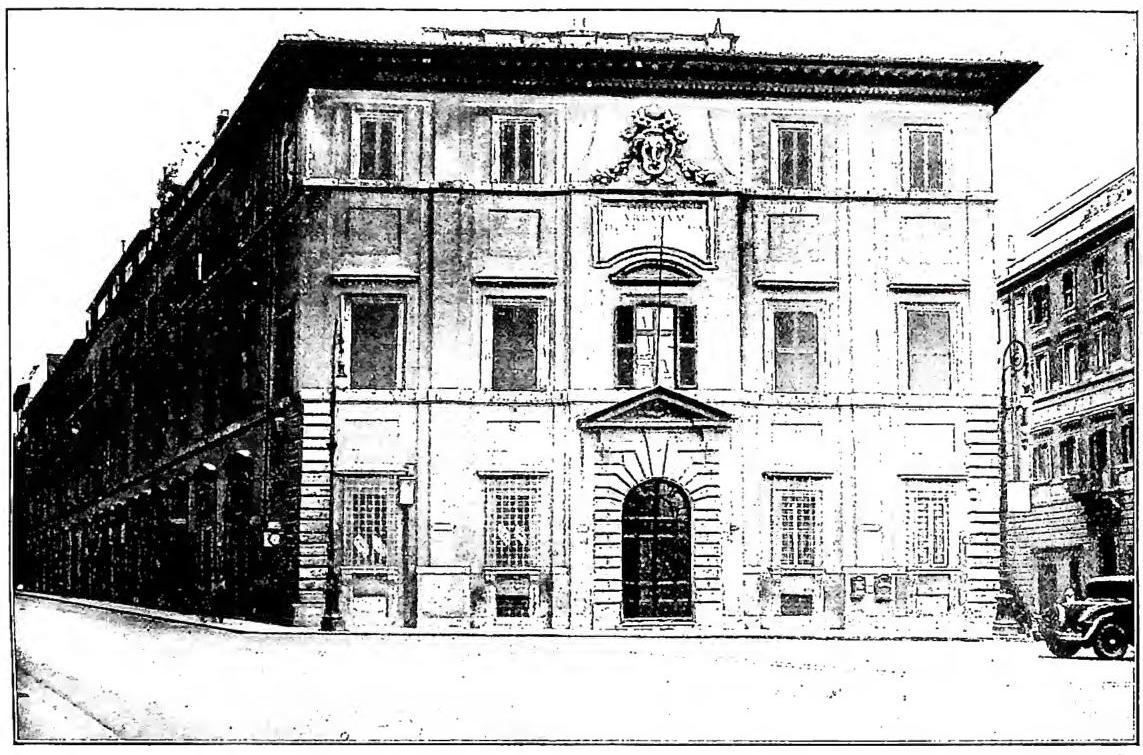
Since 1936, the seat of most of the Congregations has been the palace built for this purpose by Pius XI near S. Maria in Trastevere and S. Callisto, after their transfer from the Cancelleria. The following Congregations are housed there: the Consistorial Congregation, the Congregation for the Sacraments, the Congregation for the Council, the Congregation of Rites, the Congregation for Religious, the Congregation for Seminaries and Universities of Studies. The Congregation of Propaganda Fide, however, continues to reside in the historic palace on Piazza di Spagna; the Congregation for the Eastern Church in the Palazzo dei Convertiti, rebuilt on Via della Conciliazione; the Holy Office in its own palace; and finally the Sacred Congregation for Extraordinary Ecclesiastical Affairs continues to occupy the premises on the top floor of the Logge in the Vatican. The Congregation of Ceremonial is also accommodated in the Vatican Palace.
III. THE PERSONNEL
The personnel of the Sacred Congregations is divided into two categories: major officials and minor officials. The first category includes:a) The cardinals, one of whom is the prefect or secretary (he is called secretary in the three Congregations of the Holy Office, the Consistorial Congregation, and the Congregation for the Eastern Church, because the prefect of these dicasteries is the Pope); the others, generally no more than about twenty for each Congregation, of whom about half reside in the Curia, participate and vote in the plenary sessions;
b) The secretary (assessor in the three aforementioned Congregations);
c) The undersecretary (substitute in the Consistorial and Eastern Congregations; with the exception of the Congregation of Rites, which has its own distinct character; the Congregation of the Sacraments has two undersecretaries; in the Holy Office, the substitute is replaced by the Father Commissioner, a Dominican, who has his own specific duties).
The secretary (or, as the case may be, the assessor) is the true head of the office and director of services. By a decree of the Sacred Congregation of Ceremonial dated 31 December 1930 (AAS, 33 [1931], p. 22), the secretaries or assessors were granted the title of Eccellenza Rev.ma.
Immediately below the secretary comes the undersecretary (substitute in the Consistorial and Eastern Congregations; with the exception of the Congregation of Rites, which has its own distinct character; the Congregation of the Sacraments has two undersecretaries; in the Holy Office, the substitute is replaced by the Father Commissioner, a Dominican, who has his own specific duties). The secretary and undersecretary (or, as the case may be, the assessor and substitute) are appointed directly by the Holy Father, after hearing, as a rule, the cardinal prefect of the Congregation.
The minor officials include: the minutanti or study assistants, a body of trusted personnel, all of whom are priests (with rare exceptions), who hold degrees in theology or canon law. According to Sapienti consilio, they should be admitted only after a regular written competitive examination, but the Pope sometimes dispenses with this examination and appoints this or that minutante or study assistant directly (the Propaganda, the Eastern Congregation, and the Congregation for Extraordinary Ecclesiastical Affairs use the first designation, while all the other Congregations have study assistants, some of whom are qualified as adjuncts with duties practically no different from the others), upon the proposal of the cardinal prefect, accompanied by a letter signed by the cardinal himself.
When necessary, the work of the minutanti is divided by geographical zones (as notably in the Propaganda, the Consistorial Congregation, the Congregation for Extraordinary Ecclesiastical Affairs, and to some extent in the Congregation for the Council and the Eastern Congregation). Where this criterion cannot be applied, as in the Congregation of the Sacraments, competence is distributed by subject matter. Sometimes the geographical division is combined with the subject matter.
There are also the scriptores amanuenses, scribes who prepare the transcription of letters and draft rescripts. Archivists are responsible for the preservation and retrieval of documents.
The department dealing with the treasury and the taxation of various rescripts and petitions is managed by the cashier, accountants, and registrars, mostly laymen, often referred to as distributors or dispatchers. It is, however, the duty of the study assistant to determine the amount of the fee for a rescript and to allocate the sum due to the agent (v. AGENTI PRESSO LE SACRE CONGREGAZIONI. C), when the petition passes through the hands of this solicitor or mandatary, since most bishops use the postal service directly. Today, each Congregation sends the proceeds collected each day to the Administration of the Property of the Holy See, with the exception of the Holy Office and the Propaganda, which have autonomous administrations. It should be noted, however, that the Propaganda conducts all its business “gratis quocunque titulo.”
Among the lay personnel are also the ushers, who maintain office order, cleanliness, and the delivery of petitions within and outside the Congregation.
Before taking up their duties, all officials take an oath of fidelity and secrecy. Many matters are indeed secret (reserved, sub secreto, etc.), and the obligation is greatest in the Sacred Consistorial Congregation and the Holy Office: violation of the secrecy of the Holy Office incurs excommunication, from which only the Supreme Pontiff can absolve.
Although they are not officials of the Congregations, consultors of the Sacred Congregations (v.) perform a very important task. A subspecies of these are the commissioners, members of commissions established, for example, in the Congregations of the Sacraments and the Eastern Church, especially for the decision or defense of the bond in cases of dispensation from marriage or Holy Orders. The commissioners for decisions meet at fixed intervals, in a group of three, under the presidency of the secretary or assessor, to read their votes and render the corresponding decision.
The primary aim of Sapienti consilio was to relieve the Congregations of contentious matters, which were transferred to the renewed Sacred Roman Rota. However, for the handling of certain causes, such as those concerning the validity or nullity of a sacrament like Holy Orders or Matrimony, or the consummation or non-consummation of the latter, the strictly judicial or contentious procedure cannot be applied except with significant restrictions and modifications that safeguard the preeminent interests of the sacrament. Thus, even after 1908, some Congregations—particularly the Congregation of the Sacraments, the Holy Office, and the Congregation for the Eastern Church—must devote much of their activity to the conduct of such proceedings.
The resolution of conflicts of competence between the various dicasteries, which Sapienti consilio had entrusted to the Sacred Consistorial Congregation, now, by virtue of canon 245 of the Code of Canon Law, belongs to a cardinal commission appointed from time to time by the Holy Father—a practice that has occurred only very rarely.
IV. THE HANDLING OF AFFAIRS
As regards the handling of individual matters, it remains difficult to outline the practice of each dicastery in a comprehensive manner, since this varies from dicastery to dicastery according to the subject matter and the will of the prefect or the secretary.It may nevertheless be said that straightforward questions are dealt with immediately by the minutant and by means of a letter or rescript signed by the prefect or even merely by the secretary. Those, however, of a certain importance or exceeding the ordinary faculties of the office are referred to the congress, a meeting of the prefect, secretary, undersecretaries and study assistants, which is supposed to take place every week: and, after the minutant’s report and discussion, a decision is made.
All the more serious matters, to be dealt with subsequently in the plenary sessions of the cardinals, are referred to the congress. The positions for the plenary session are all printed and delivered to the cardinals about ten or twenty days before the meeting. The cardinal ponens, however, also has the complete original in addition to the printed material (which consists of the so-called official sheet in Latin or Italian, containing a summary of the case and a brief outline). In the plenary session the cardinals sit, presided over by the prefect of the Sacred Congregation, according to the order of their precedence, and the ponens reads or delivers his reasoned vote, after which the others do likewise in turn. The secretary records the votes and reports on the discussion in an audience with the Holy Father, to whom the final decision belongs; and the Pope, if he so wishes, confirms the decision taken by the cardinals by a majority vote and orders that it be executed. The decisions of the plenary sessions may be admitted to a new discussion upon the granting of the beneficium novae audientiae, a new presentation of the case in view of new elements that have emerged: if, however, the decision has been approved by the Pope, a new discussion requires an express permission of the Pope himself, which is called « aperitio oris » (q.v.; cf. also TERMINOLOGIA DELLA CURIA ROMANA).
V. THE POWER OF THE SACRED CONGREGATIONS — As regards the power of the Sacred Congregations and the juridical value of their acts, it may be said that they are primarily administrative and governing organs, even though they sometimes perform judicial activities and issue genuine laws. By promulgating the 1917 Code of Canon Law, Benedict XV, with the motu proprio “Cum iuris” of 15 September 1917, established a commission of cardinals for the authentic interpretation of the Code. Before responding on matters of greater importance, however, this commission must consult the Congregation to which the canon to be interpreted belongs. Benedict XV added: “Henceforth the Sacred Congregations shall not issue new general decrees unless grave necessity of the Church so requires. Their ordinary office, therefore, shall be to ensure that the prescriptions of the Code are religiously observed and, where necessary, to issue instructions that render the prescriptions of the Code clearer and more effective and appear almost as a commentary upon them. Finally, if at any time the good of the universal Church should require that a general decree be issued by any Congregation which is at variance with the Code, the Supreme Pontiff shall be informed of the discrepancy, and when the decree is approved, the Code Commission shall provide for the substitution or amendment of the canons of the Code itself.” This modification of the text of the Code since 1917 has occurred expressly only once, and not through a decree of a Sacred Congregation, but by a pontifical decree (motu proprio of 1 August 1948, which abrogated the second sentence of can. 1099 § 2: cf. AAS, 40 [1948], pp. 305–306); yet in fact many parts of the Code itself have been more or less deeply affected in these years. Since, according to can. 244, not only are the resolutions of the Sacred Congregations always approved by the Holy Father, but he must also be notified of any “grave or extraordinary act” which a Congregation intends to undertake, in practice the Pope, in the fullness of his power, authorizes the competent Congregation, when necessary, to legislate, judge, and otherwise act within the sphere assigned to II.
It should be recalled, finally, that according to can. 7 the Sacred Congregations are designated by the name of the Apostolic See immediately after the person of the Supreme Pontiff, of whom they are the first and immediate organ.
II. THE INDIVIDUAL CONGREGATIONS IN PARTICULAR.
I. SACRED CONGREGATION OF THE HOLY OFFICE1. Historical outline
The Sacred Congregation of the Holy Office, until 1908 called the “Sacred Roman and Universal Inquisition,” was established by Paul III with the apostolic constitution Licet ab initio of 21 July 1542.It should not therefore be confused with the medieval Inquisition tribunals (v. INQUISITION), nor with the Spanish Inquisition, which had distinct origins and purposes.
With the rise of the new heresies of Calvin and Luther, which were devastating the most flourishing Christian communities in Europe, Pope Paul III judged it urgent to appoint cardinals as commissioners or general inquisitors, who were authorized to proceed against all apostates, heretics, those suspected of heresy, their accomplices, supporters, and followers, even without the intervention of the Ordinaries.
The general inquisitors could appoint a fiscal promoter, notaries, and delegates in different nations or individual dioceses. However, neither the cardinal inquisitors nor their delegates could receive abjurations or remit penalties, as this authority was reserved to the pope.
The cardinal inquisitors could hear appeals from cases decided in first instance by their delegates and, in such cases, absolve the guilty from censures and other ecclesiastical penalties. No one was exempt from their jurisdiction, though sentences against cardinals and higher prelates were pronounced by the pope in consistory (constitution of Pius IV, 12 April 1563).
The examination and condemnation of books were also entrusted to the general inquisitors, who were authorized by Pius IV, with the motu proprio Cum inter crimina of 27 August 1564, to read, durante munere, any prohibited book and to grant the required license to others, but only with a decision taken in plenary congregation.
Established by Pius V in 1571, the Congregation of the Index (v. below: Suppressed Congregations), the general inquisitors were reserved the examination and condemnation only of books tainted with heresy. The Inquisition was the subject of many constitutions by Pius IV and Pius V, who extended its competence, but it received its definitive structure, together with the Congregation of the Index, from Sixtus V in the constitution Immensa aeterni Dei of 22 January 1588.
Pius X, with the Sapienti consilio of 29 June 1908, suppressed the Congregation of Indulgences and transferred all its competence to the Holy Office; he then reserved to the Congregation of the Council matters concerning the observance of Church precepts, to the Consistorial Congregation the election of bishops, to the Sacred Congregation of Religious the dispensation from vows taken in religious orders or congregations, to the Sacred Congregation of the Sacraments the legislation on the discipline of the sacraments, except for matters relating to the Pauline privilege and the dispensation from impediments of mixed religion and disparity of cult.
Benedict XV, with the motu proprio Alloquentes of 25 March 1917, assigned to the Apostolic Penitentiary the competence regarding the granting and use of indulgences, leaving only doctrinal matters to the Holy Office, to which the Congregation of the Index was annexed as a mere section. The Code of Canon Law did not alter either its composition or its competence.
At present, the Holy Office is the first Roman Congregation in importance due to the nature of the questions it handles and decides; the appellation “Supreme” appears for the first time in the Annuario Pontificio of 1927.
2. Personnel
The Sacred Congregation of the Holy Office consists of several cardinals, general inquisitors, who meet in plenary assembly every Wednesday under the presidency of the cardinal secretary; the prefecture is reserved to the pope (can. 247 § 1).Immediately following is the assessor, a prelate of equal rank to the secretaries of the other dicasteries. Formerly, the assessor was a secular priest, a canonical advisor to the general commissioner.
At the head of the investigative section for criminal cases is the commissary, a member of the Order of Preachers, assisted by two companions (v. COMMISSARIO). The assessor and the commissary are major officials (Ordo Servandus, etc., c. VII, 1), the others minor officials.
However, those who take part in the particular congregation on Saturday, together with the cardinal secretary, the assessor, and the commissary, include the fiscal advocate, called since 1920 the promoter of justice, and the first companion of the commissary, all of whom are appointed by the Holy Father through a note from the Secretariat of State; thus they too may be counted among the major officials.
Of the consultors, some hold the office by virtue of their position, such as the Master General of the Dominicans and the Master of the Sacred Palace, while others are appointed by the Holy Father, chosen from among the most renowned theologians and canonists residing in Rome. They meet every Monday under the presidency of the assessor, and in his absence, of the commissary or the first companion.
The appointment of the qualifiers, consultors for the examination and condemnation of books, is also reserved to the Holy Father. The officials include the substitute of the Index, two summarizers, the notary and substitute notaries. There are also the advocate for the accused, the defender of the bond, the master of the household (economus of the Congregation and the Palace), an archivist, two protocolists, and several scribes.
3. Competence
The Holy Office has exclusive competence regarding doctrine touching on faith and morals and the validity of the sacraments.It judges and punishes heresy and all crimes directly or indirectly related to it, such as adherence to the Masonic sect and other societies condemned by the Church, and remits the corresponding penalties. It is reserved the examination and condemnation of books, the granting of permission to read prohibited ones, and the issuance of norms and instructions in this regard.
It judges, in a single instance or as an appellate tribunal, priests and religious accused of solicitation in confession or of having committed acts of lust against nature or with an impubescent person, or of adherence to a non-Catholic sect; it handles cases concerning the Pauline privilege and mixed marriages, and in general any matrimonial case in which one of the parties is non-Catholic; likewise, only the Holy Office can authorize a non-Catholic to appear before ecclesiastical tribunals. To it are referred questions and cases concerning the nullity of Holy Orders due to a substantial defect in the rite (can. 1993 § 1).
Only the Holy Office can dispense from the impediments of mixed religion and disparity of cult, from the irregularities sanctioned in can. 985 nn. 1, 2, and 3 (marriage attempted by a cleric or religious before a civil official), from the impediment mentioned in can. 987 n. 1; it can absolve from excommunications reserved specialissimo modo to the Holy See, except that sanctioned in can. 2367, and remit penalties imposed in cann. 2335–36 (enrollment in the Masonic sect and other condemned societies), 2363 (calumnious accusation of a priest for solicitation in confession), 2371 (simony), 2372 (ordination received from an apostate, heretical, or schismatic bishop), 2388 § 1 (attempted marriage by a religious or priest before a civil official), and 2399 (simony regarding benefices, offices, or dignities, if the simony is of divine right).
Finally, exclusive competence in matters of eucharistic fasting by priests, whether secular or religious, in relation to the celebration of the Holy Mass, is attributed to the Holy Office.
The competence of the Holy Office has no territorial or personal limits, except for cardinals exempted from its jurisdiction by Sixtus V in the constitution Immensa aeterni Dei; thus even religious are judged by the Holy Office, and in first instance not by their superiors but by the local Ordinary, excluding the vicar general.
The inquisitors and officials of the Holy Office are bound to observe the most rigorous secrecy regarding all matters handled in the sacred tribunal.
II. S. C. CONSISTORIAL. —
4. Origins and development
Among the congregations established ex novo by Sixtus V’s constitution Immensa of 22 January 1588 was the Congregatio pro Erectione Ecclesiarum et Provisionibus Consistorialibus, which, by reason of its importance, was assigned third place, immediately after the Congregations of the Inquisition and of the Signature of Grace, of which the pope was prefect. The name of this new congregation was soon shortened to Congregatio Rebus Consistorialibus Praeposita, pending the adoption of the simpler title Congregatio Consistorialis, which was to remain definitive.Already from the 12th century the Holy See had reserved to itself the examination and decision regarding the erection of dioceses, which until then had been left to the initiative and discretion of the bishops of the provinces concerned. Later, from the 14th century, the popes reserved to themselves the provision of bishops under the threefold form of free appointment, confirmation of chapter election, or canonical institution following presentation.
Both the erection of dioceses and the appointment of bishops naturally fell within the competency of the consistory, together with the other causae consistoriales, namely those matters of greatest importance both from the administrative and judicial points of view.
Sixtus V, in creating the Consistorial Congregation, had intended to provide the consistory with a technical advisory body or specifically qualified organ for the matters to be discussed, and without altering its previous competences he declared: “In consistorio secreto iuxta formam in hanc diem servatam proponantur.” The new congregation, however, was soon to undergo modifications of no small significance.
Innocent XI (1676–89), with a view to providing particular oversight for the dioceses of Italy, established the Congregation for the Election of Bishops, assigning as its secretary his own auditor. This new congregation in turn underwent various modifications and was subsequently reconfirmed by Benedict XIV (constitution Ad Apostolicae servitutis, 17 October 1740) and by Leo XIII (constitution Immortalis memoriae, 21 September 1878), before taking in 1900 the title of Commissio Cardinalitia de eligendis Episcopis Italiae.
While the provision of residential sees in Italy remained in practice entrusted to the auditorate, that of residential sees abroad, outside mission territories, at the beginning of the 19th century was entrusted to the Congregation of Extraordinary Ecclesiastical Affairs (Pius VII, 18 June 1814).
Pius X, by a motu proprio of 17 December 1903, in order to unify the discipline governing the appointment of residential bishops in Italy, suppressed the cardinalatial commission de eligendis Episcopis Italiae, together with the ancient Congregation for the Examination of Bishops, established by Clement VIII in 1592; their respective competences were transferred to the Congregation of the Holy Office.
This was followed by the reform of the Roman Curia, carried out by the same pope through the constitution Sapienti consilio of 29 June 1908. Up to that time, competency over bishops in territories subject to common law had been distributed among the Consistorial Congregation (for the appointment of titular bishops), the Holy Office (for the appointment of residential bishops in Italy), and the Congregations of Bishops and Regulars and of the Council, which had cumulative jurisdiction over the diocesan governance of bishops (the S. C. of Bishops and Regulars had arisen, at least from the beginning of the 17th century, from the merger of the S. C. on the Consultation of Bishops and the S. C. on the Consultation of Regulars, established respectively by Pius V with a brief of 13 February 1572 and by Sixtus V with a brief of 17 May 1586; the former of these two, however, seems already to have existed under Gregory XIII).
The need and utility of reuniting the various branches of the ancient trunk was felt. This was accomplished by the reform of Pius X. The Code of Canon Law merely preserved, apart from a few details, the structure so well defined by Sapienti consilio.
5. Competence
The present competence of the Consistorial Congregation is substantially identical to its original competence in its twofold object: bishops and dioceses (CIC, can. 248). However, whereas formerly the Consistorial Congregation performed only preparatory and executive acts for episcopal appointments, and once the appointment had been made the bishops passed under the jurisdiction of the Congregation of Bishops and Regulars and that of the Council, now instead the Consistorial Congregation exercises personal and complete jurisdiction over bishops. It prepares the acts of provision, selects candidates, and proposes them to the Supreme Pontiff for approval and appointment; it follows the activity of bishops, exercises vigilance and oversight over the governance of their dioceses and the economic status of episcopal mensa, examines the quinquennial reports submitted by them to the Holy See, and grants them quinquennial faculties. This applies, however, only to Latin dioceses of common law.It also appoints, with the approval of the Supreme Pontiff, coadjutors, auxiliary bishops, apostolic administrators, apostolic visitors, and particular ordinaries such as the military ordinary.
As regards dioceses, including nullius prelatures and abbacies, its competence extends to the erection, union, division, suppression of dioceses, the rectification of diocesan boundaries, the establishment of cathedral or collegiate chapters, and other measures pertaining to the constitution, preservation, and status of dioceses. In recent times, however, its competence has been considerably expanded, since a number of territories previously dependent on the Congregation of Propaganda Fide have been placed under common law and thus under the Consistorial Congregation.
When, however, for the appointment of residential bishops, coadjutors with the right of succession, military and palatine ordinaries, and for the erection of dioceses in territories governed by common law, it is necessary to deal with civil governments through diplomatic channels in accordance with concordats or conventions, the competence belongs to the Congregation of Extraordinary Ecclesiastical Affairs, while the Consistorial Congregation retains the drafting of executive acts and jurisdiction over diocesan governance.
In addition to dioceses, directly dependent on the Consistorial Congregation are the apostolic delegations existing in the territories subject to it (Great Britain, the United States, Canada, Mexico, and the Philippines).
Another task incumbent upon it is the preparation of acts for the secret consistory: a task now become secondary, since in it there takes place only the publication or preconization of new episcopal appointments previously approved; and, in partial preservation of ancient tradition, it also includes the simple proclamation of appointments already approved and published after the previous consistory. The Consistorial Congregation therefore prepares, for the other interested congregations as well, the lists of these promotions, together with the note of the postulations for sacred pallia. It also issues invitations to bishops for participation in the semi-public consistory and in the solemn ceremony of canonization of saints.
Finally, it provides for the spiritual assistance of emigrants, insofar as this falls indirectly within diocesan governance, and for the discipline of the emigrant clergy (motu proprio of Pius X, Cum omnes, of 15 August 1912).
It should also be recalled that the section for seminaries, formerly attached to it, was separated and erected into an independent congregation together with that of Studies, by the motu proprio of Benedict XV Seminariorum clericorum of 4 November 1915.
The faculty, moreover, granted to it by Sapienti consilio to settle controversies or doubts of competence among the dicasteries of the Roman Curia is now entrusted by the Code of Canon Law (can. 245) to a cardinalatial commission to be designated by the pope from time to time, as has already been noted.
6. Constitution
The Consistorial Congregation retains the constitution established by Sapienti consilio.The Sacred Roman Congregations are permanent commissions of cardinals for the treatment of ecclesiastical affairs of major importance, which, because of their nature or the persons involved, require the special attention of the Supreme Pontiff.
They are governed by the norms established by the Apostolic Constitution Sapienti consilio of Pius X (29 June 1908), and their purpose is to assist the Roman Pontiff in the government of the universal Church.
1. Number and Names. — The Sacred Roman Congregations are nine in number:
A. The Consistorial Congregation;
B. The Congregation of the Holy Office;
C. The Congregation of the Sacraments;
D. The Congregation of the Council;
E. The Congregation for Religious;
F. The Congregation of Propaganda Fide;
G. The Congregation of the Sacred Rites;
H. The Congregation of Ceremonial;
I. The Congregation of Extraordinary Ecclesiastical Affairs.
2. Competence. — The Sacred Roman Congregations have jurisdiction over all matters pertaining to their respective departments, except those reserved to the Supreme Pontiff or to other dicasteries of the Roman Curia. Disputes or doubts regarding competence between the dicasteries of the Roman Curia are, by the Code of Canon Law (can. 245), referred to a cardinalatial commission to be designated by the Pope from time to time, as has already been mentioned.
3. Constitution. — The Consistorial Congregation retains the constitution established by the Apostolic Constitution Sapienti consilio.
It is presided over by the Supreme Pontiff; its immediate superior is a cardinal with the title of Secretary, and its members include several cardinals, among whom, by right, are the Cardinal Secretary of the Holy Office, the Cardinal Prefect of the Congregation of Seminaries and Universities of Studies, and the Cardinal Secretary of State.
The principal officials, who assist the cardinal Secretary, are the Assessor and the Substitute.
The Assessor pro tempore is, as before, Secretary of the Sacred College of Cardinals, and during a conclave exercises the functions of Secretary of State and Secretary of the Conclave (Apostolic Constitution Vacantis Apostolicae Sedis of Pius XII, 8 Dec. 1945, n. 19; Constitution Sapienti consilio, I, 2, 6). He is also, by right, a consultor of the Congregation of Seminaries and Universities of Studies.
In addition to the principal officials, there are minor officials attached to the sections and offices; finally, there is a college of consultors, among whom are ex officio consultors the Assessor of the Holy Office, the Secretary of the Congregation of Extraordinary Ecclesiastical Affairs, and the Secretary of the Congregation of Seminaries and Universities of Studies.
All those who belong to the Congregation are bound, by oath, in addition to the common secret, to the particular secret known as that of the Holy Office, in all matters concerning the appointment of bishops and other Ordinaries, as well as the erection or union of dioceses. The secret is perpetual and applies even to those persons belonging to the same Congregation who are bound by the same secret but do not reside habitually in Rome.
The same perpetual secret is imposed by the Congregation on ecclesiastics from whom information is sought regarding candidates for the episcopate.
4. Procedure. — The form of procedure at present is solely administrative, never judicial. It varies according to the importance of the matters. For those of greater importance, such as the provision of sees, whether residential or titular, and the erection of dioceses, the relevant processes and acts are first prepared.
The ancient canonical process, in external form, regarding those to be promoted, has not been in use since 3 Nov. 1908 and was expressly abolished, even for foreign matters, by the Consistorial Decree of 29 Feb. 1924; it is replaced by a secret and thorough inquiry conducted by the Congregation directly and, abroad, through the nuncios and apostolic delegates, which better guarantees secrecy, security, and the reliability of the information. The examination of those to be promoted was likewise abolished on the same date, 3 Nov. 1908.
Once the inquiry is completed, the matter is discussed in a general or plenary Congregation, in which the cardinals belonging to the dicastery participate; when the matter concerns another Congregation at the same time, particularly that of Extraordinary Ecclesiastical Affairs, it is handled in consultation and, when necessary, in a joint plenary session.
Matters of ordinary importance are usually dealt with in the Congress of officials, presided over by the cardinal Secretary, and are decided by the same cardinal, by virtue of the habitual faculties that pertain to the Congregation.
All the deliberations of the general Congregations, as well as the matters submitted ex audientia Sanctissimi, are reported for the approval of the Supreme Pontiff by the cardinal Secretary in the customary weekly audience.
The particular needs of the Eastern Churches led Urban VIII to establish, within the same general Congregation of Propaganda Fide, two commissions or, as they were then called, Congregations: one Super dubiis Orientalium (1627), and another Super correctione Euchologii Graecorum (1636), which, in 1717, by order of Clement XI, became a stable and distinct Congregation, Super correctione Librorum Orientalium. Due to the increasing affairs of the East, which required ever more specialized care and specific knowledge, Pius IX, with the constitution Romani Pontifices of 6 January 1862, established within the same Congregation of Propaganda Fide a special Congregation with the title Congregatio de Propaganda Fide pro Negotiis Ritus Orientalis, presided over by the same Prefect of the Congregation of Propaganda Fide, but with its own Secretary, distinct consultors, officials, and archives. With the motu proprio « Dei providentis » of 1 May 1917 (AAS, 9 [1917], pp. 529–31), Benedict XV, acceding to a desire repeatedly expressed by Eastern dignitaries and wishing to give the Easterners a new sign of the Holy See’s benevolence toward them, made this Congregation independent, creating the new Congregatio pro Ecclesia Orientali, whose prefecture he reserved to himself and his successors.
On 20 June 1925, Pius XI established within this Congregation a special Commissio pro Russia (AAS, 18 [1926], p. 62), which, on 6 April 1930, was made independent (AAS, 22 [1930], pp. 153–54), and then, on 21 December 1934 (AAS, 27 [1935], pp. 65–67), was annexed to the Congregation for Extraordinary Ecclesiastical Affairs, with competence limited to Latin-rite faithful residing in Russia.
Within the Congregation for the Eastern Church, a special commission, established by rescripts of the audience of 24 March and 5 May 1928, deals with matrimonial cases, and another (audience of 8 February 1930) with liturgical matters.
2. Competence. — According to can. 257 §§ 1 and 2 of the CIC, “all matters of any kind concerning the persons, discipline, and rites of the Eastern Churches, including mixed affairs—that is, those which, by reason of their object or the persons involved, also concern Latins—are reserved to this Congregation.” Consequently, this Congregation, with regard to the Churches of the Eastern rite, possesses all the faculties that the other Congregations have for the Latin-rite Churches, except, however, the jurisdiction of the Congregation of the Holy Office, in accordance with can. 247ᵃ. The competence of the Congregation for the Eastern Church is personal, in that it extends to all faithful belonging to an Eastern rite, wherever they may be; it is also territorial, in that it is exercised in regions where a hierarchy of the Eastern rite is established. Excluded from its competence, in addition to what falls under the Holy Office, are the duties of the Congregation of Seminaries and Universities of Studies concerning universities, faculties, and institutes (Pius XI, const. Deus scientiarum Dominus, 24 May 1931, art. 4 ff., in AAS, 23 [1931], p. 248), as well as the proper competence of the tribunal of the Apostolic Penitentiary, both for the internal forum (reply of 26 July 1930, in AAS, 22 [1930], p. 394) and for the use of indulgences (notification of 21 July 1935, in AAS, 27 [1935], p. 379).
To this S. C. it seems that—unlike the other Congregations in general after the publication of the new CIC (cf. Benedict XV’s motu proprio Cum iuris canonici, 15 September 1917, no. 2)—legislative power must be attributed. It certainly possesses, moreover, not only administrative power but also judicial power (can. 257 § 3).
With the motu proprio of Pius XI, Sancta Dei Ecclesia, of 25 March 1938 (AAS, 30 [1938], pp. 154–159), in order to unify the governance and apostolic work in all Eastern countries, full and exclusive jurisdiction was granted to the S. C. for the Eastern Church over all faithful, hierarchies, works, institutions, and pious societies, whether of Latin or Eastern rite, in the following regions: Egypt and the Sinai Peninsula, Eritrea and northern Ethiopia, southern Albania, Bulgaria, Cyprus, Greece, the Dodecanese, Iran, Lebanon, Palestine, Syria, Transjordan, Asiatic Turkey, and Turkish Thrace. The S. C. for the Eastern Church, with regard to the Latins dependent on it by virtue of the aforementioned motu proprio «Sancta Dei Ecclesia,» exercises and enjoys those powers that the S. C. of Propaganda Fide had and exercised over them previously.
The CIC (can. 249) confirms almost without modification the competence assigned to the S. C. in 1908.
As its title indicates, it deals with whatever pertains to the administration and safeguarding of the Sacraments, excepting what falls within the competence of the Holy Office regarding questions of faith and matters concerning the Pauline privilege and mixed marriages, as well as the competence of the S. C. of Rites with regard to sacramental ceremonies.
Before 1908, the matters handled by this S. C. belonged for the most part to the S. C. of the Council and also to the Dataria and the Penitentiary.
In reality, the greater part of its activity revolves around Matrimony. One of its offices (precisely Office III) handles dispensations from impediments to marriage, which are very frequent, especially for consanguinity and affinity; before 1908 such dispensations were granted to the wealthy by the Apostolic Dataria and to the poor by the Apostolic Penitentiary.
The same office also deals with the convalidation and radical sanation of marriages initially null due to some impediment or defect of form, the legitimation of offspring, and in general with whatever pertains to the contracting of marriage.
Office II is particularly active, especially in recent years, studying and resolving cases regarding the dispensation of ratified but non-consummated marriages.
The diocesan curias of the entire Catholic world (with the sole exception of those of the Eastern Rites that depend on the homonymous Congregation) must obtain faculties from the S. C. before initiating an investigation into such cases; they then remit the acts of the related process to the S. C. for a decision. In order to study such causes, which proceed in an administrative form and without the intervention of advocates, given their increasing number, the S. C., after issuing the extensive instruction Catholica doctrina of 7 May 1923 (AAS, 15 [1923], pp. 389 ff.), created special commissions of consultors who meet frequently to decide whether it is advisable to propose to the Holy Father the granting of dispensation in individual cases. Some of these causes are decided in the plenary meeting of cardinals that ordinarily takes place every month.
It then falls exclusively and personally to the Supreme Pontiff, upon the report of the Cardinal Prefect of the Congregation or of the Secretary, to grant or deny the dispensation, by which, in virtue of his ministerial power, he dissolves ab extrinseco such marriages that would be intrinsece indissoluble.
Other matters handled by Office II include cases of presumed death of a spouse, separation, etc.
In 1939 a special office of vigilance and statistics on the matrimonial tribunals of the entire Latin Church was created within the S. C. It is the duty of this office, directed by an Under-Secretary, to ensure that the norms of the instruction Provida of 15 August 1936 (AAS, 28 [1936], pp. 313–61) are observed in tribunals that handle causes of nullity of marriage and that the rights of the Sacrament are justly safeguarded. Special vigilance is exercised over the regional tribunals of Italy created by the motu proprio «Qua Cura» of 8 December 1938 (AAS, 30 [1938], pp. 410–13), as well as over observance of the instruction Sacrosanctum of 29 June 1941 (AAS, 33 [1941], pp. 297–318) regarding the procedures to be followed before the celebration of marriages and the keeping of parish records, with the aim of eliminating, as far as possible, the celebration of invalid marriages.
Office I deals with all the remaining Sacraments except Matrimony. Primarily, the work of this office is absorbed by matters concerning sacred ordinations, on which the instruction Quam ingens was issued on 27 December 1930 (AAS, 23 [1931], pp. 120–29) regarding the diligence to be observed before admitting clerics to Orders, with the obligation of specific interrogations or examinations.
Moreover, the office handles dispensations from the prescribed age for the presbyterate, from other moral or physical impediments to Orders, etc. It also decides causes of nullity of ordinations or related obligations, after the processes regarding them, authorized case by case by the S. C., have been conducted in the individual diocesan curias according to the Regulae Servandae imposed by the decree of 9 June 1931 (AAS, 23 [1931], pp. 457–92).
A broad field for Office I is also what pertains to the Holy Mass, including faculties to say two or three Masses, to celebrate at unusual hours or at sea, in a private house, and thus the granting of private oratories for priests and laity. It also deals with Eucharistic worship, on which the instruction Nullo unquam of 26 May 1938 (AAS, 30 [1938], pp. 198–207), De sanctissima Eucharistia sedulo custodienda, was issued with the principal aim of eliminating the danger of profanations of the Most Holy Sacrament; when such profanations occur, bishops are obliged to report to the S. C. for ascertaining any responsibilities and adopting appropriate measures.
Numerous are the dispensations from the Eucharistic fast for the faithful who, due to illness, could not receive Communion (not for priests celebrating Mass, for whom competence lies with the Holy Office, nor for religious, for whom their own Congregation provides).
Regarding the discipline of the other Sacraments, occasions for intervention are rarer, but even for these there are notable documents, such as the most recent decree Spiritus Sancti munera of 14 September 1946 (AAS, 38 [1946], pp. 349–58), by which, with bold innovation, the faculty has been granted to all parish priests to confer the sacrament of Confirmation on infants and adults in danger of death when the diocesan bishop cannot conveniently be present.
As for the personnel of the S. C., it is governed by a Cardinal Prefect; it also has a Secretary and, unlike all the others, two Under-Secretaries, one of whom is chiefly concerned with administration and the other, attached to the office of vigilance over tribunals, with matters regarding marriage. The number of consultors and commissioners of this Congregation is particularly high.
Intimately connected with the C. of the Council were four other C.s, which may rightly be called its appendages, namely: 1) the S. Congregatio super residentia Episcoporum, instituted by Urban VIII (constitution Episcoporum officium, 8 Feb. 1634), revived and endowed with special faculties by Benedict XIV (constitution Ad universae, 3 Sept. 1746); 2) the S. Congregatio iurisdictionis et immunitatis ecclesiasticae, instituted as a true C. by Urban VIII in 1620, vivae vocis oraculo, which, after various vicissitudes, was provisionally united to the S. C. of the Council by Leo XIII; 3) the S. Congregatio super statu Ecclesiarum, erected by Benedict XIV (constitution Decet, 23 Nov. 1740); 4) the S. Congregatio super revisionem synodorum provincialium, created as a particular C. by Pius IX on 1–3 June 1849, vivae vocis oraculo.
With the constitution Sapienti consilio, 29 June 1908, by which Pius X reformed the Roman Curia, the S. C. of the Council was entirely transformed, retaining its name only as a historical memory. To it Pius X united the S. C. Lauretana, erected by Innocent XII (constitution Sacrosancta Redemptionis, 10 Aug. 1698) for the custody and administration of the patrimony belonging to the Holy House and the Basilica, endowing it with very extensive faculties, including contentious and criminal jurisdiction. The CIC reproduces almost verbatim and fully confirms the reform of Pius X; it makes no mention, however, of the S. C. Lauretana, which no longer exists today.
2. Constitution. — From the beginning it was composed of a fixed number of cardinals, appointed directly by the pope. One of them directed the proper functioning of the dicastery, presided over the meetings, and reported to the Supreme Pontiff; only later did he receive the title of prefect.
The C. had a secretary and several officials for the conduct of business. As the scope of its competence expanded and the number of causes increased, it developed a highly organized structure. Even before the reform of Pius X, special mention must be made of the auditor, the defender of the bond, the theologian, and the canonist, who were charged with giving their opinions in matrimonial cases and in those concerning sacred ordination and religious profession.
According to the constitution Sapienti consilio, this C. consists of several cardinals appointed by the pope, one of whom, immediately designated by the Pontiff, serves as prefect. The ordinary functioning of the dicastery is entrusted to the secretary, assisted by the under-secretary, who are the major officials. Below them come the minor officials, namely the study assistants, writers, protocolist, cashier, etc. There also exists a college of consultors, appointed by the pope, who give their vote or opinion. The CIC introduced no changes in this regard.
Its competence pertains only to the Latin Church, excluding places dependent on the C. of Propaganda Fide. In general, it embraces everything relating to the discipline of the secular clergy and the Christian people. Specifically, it must ensure the exact observance of the precepts of the Christian life; regulate matters pertaining to parish priests, canons, and other beneficiaries, confraternities and pious associations of any kind (even if dependent on religious or erected in their churches), pious legacies, pious causes, stipends of Masses, ecclesiastical goods (except those belonging to seminaries and episcopal mensa), minor benefices and offices, diocesan tributes, taxes of episcopal curiae, etc. It can dispense from various canonical laws; exempt from the conditions required for the conferral of benefices when the conferral pertains to the Ordinary; admit to composition those unjustly holding ecclesiastical goods, even those belonging to religious; permit the faithful to acquire ecclesiastical goods usurped by civil authority. It is also competent regarding ecclesiastical immunity and precedence, save the rights of the C. of Religious and the C. of Ceremonial; regarding the celebration and recognition of councils and episcopal conferences; and regarding the handling of causes pertaining to the various matters within its competence, but only in an administrative or disciplinary manner. Two special offices are attached to this C., namely the catechetical and the administrative.
7. Procedure
Before the reform of Pius X, the Congregation of the Council used to handle matters in two ways: by summaria precum and in folio. The expression per summaria precum means that the petition presented to the Congregation was summarized and set forth in a brief compendium. The expression in folio meant that the secretary drew up a detailed written report on the case or question at hand, to be submitted for examination and discussion by the cardinals. The first method was used for matters of lesser importance, the second for more significant and particularly serious business. This distinction dates back to 1649, when the drafting of the official report, the “folio,” began; it was very brief and not printed. From 1679 onward, this report began to be drawn up in a more extensive and detailed manner and printed. Moreover, the same in folio cases were handled and decided either iuris ordine servato or ex officio, i.e., œconomice, depending on the greater or lesser importance of the matter and the will of the parties. The principal documents concerning the special procedure of this Congregation are: 1) the decree Ut debitus, 9 Aug. 1693, of Innocent XII; 2) the edict Non si debba, 17 Sept. 1695, of the same Innocent XII; 3) the regulation of 6 Sept. 1831; 4) the instruction of the Congregation of the Council of 22 Aug. 1840 for matrimonial cases; 5) the instruction of the same Congregation of 17 Sept. 1847, republished with minor modifications in 1884.Under the current discipline, the Congregation handles matters of lesser importance in a congress and those more significant and difficult in plenary session. The congress consists of the prefect, the secretary, and the undersecretary, and to it also attend the study assistants, who report on the various matters entrusted to them. The plenary session consists of the cardinals, who have a deliberative vote, and they decide by an absolute majority of votes.
Important is the official publication, drawn up by the secretary, which bears the title: Thesaurus resolutionum S. Congr. Concilii. It consists of 167 volumes, from 1718 to 1908, that is, up to the publication of the official commentary of the Holy See, namely the Acta Apostolicae Sedis.
Felice Maria Cappello
VI. S. C. DEI RELIGIOSI. — It is the central organ of the Holy See for the direction of religious orders throughout the world.
8. History
On the basis of drafts already prepared by earlier popes, Sixtus V, by the motu proprio Romanus Pontifex of 27 May 1586, established the Sacred Congregation for the Consultations of Regulars (cf. A. Bizzarri, op. cit. in bibl., p. xxiv). With subsequent decrees (among which one of 13 June 1586) he further defined its constitution and competence, until on 22 January 1588, with the bull Immensa, he completed the work by establishing, within the definitive organization of the Roman Curia, the Congregation for the Consultations of Regulars (§ Nec sane minus), and declared it competent to deal with all questions concerning the religious state throughout the world (Bull. Taur., VIII [1944] p. 985).At the outset, this Congregation was distinct from that called “for the Consultations of Bishops,” but after various developments, in 1601 the two Congregations were united under Clement VIII into a single body called the Sacred Congregation of Bishops and Regulars, which acquired vast competence and remained in existence until the reform of Pius X. To promote particular reforms in the increasingly numerous religious orders, the popes following Sixtus V created other bodies within the Curia, which at times came to have the same competence as the Congregation of Bishops and Regulars, leading to evident conflicts of competence and delays in resolving issues. Indeed, Innocent X, by the bull Instaurandae of 15 October 1652 (Bull. Taur., XV [1853] p. 696), established a new Congregation of cardinals under the title “Sacred Congregation concerning the state of Regulars,” with the task of reforming all religious orders in Italy according to the decrees of Urban VIII, especially through the suppression of small convents. This Congregation was confirmed by Clement IX by the bull Iniuncti of 11 April 1668 (Bull. Taur., XVII [1855] p. 657), but Innocent XII, by the decree Debitum Pastoralis of 4 August 1698, suppressed Innocent X’s Congregation and created another, naming it the “Sacred Congregation for the Discipline of Regulars,” to which he entrusted full competence over the discipline of all religious orders, even outside Italy (Bull. Taur., XX [1857] p. 825). Pius IX, ever intent on fostering the flourishing of existing religious orders, by the bull Ubi primum arcanum of 17 June 1846, established the “Sacred Congregation above the state of Regular Orders” (Acta Pii IX, I, Rome 1854, p. 46).
Although often the same prefect and secretary governed the various Congregations charged with religious discipline, the multiplicity and indeterminacy of their competence—even in relation to other Congregations—made a prompt reform necessary in this sector, especially because religious orders with simple vows had become exceedingly numerous in all dioceses, giving rise to new and broader problems regarding the organization of religious life in its internal and external relations. A first reorganization was carried out by Pius X with the motu proprio Sacrae Congregationi of 26 May 1906 (AAS, 39 [1906], pp. 203–204), by which he abolished the Congregation for the Discipline of Regulars and that above the state of Regular Orders, transferring all their competence to the Sacred Congregation of Bishops and Regulars. The definitive arrangement was then completed by the same Pope, together with the reform of the entire Roman Curia, by the constitution Sapienti consilio of 29 June 1908 (AAS, 1 [1901], p. 7), by which, separating the competence of the Congregation of Bishops and Regulars, the part concerning bishops and dioceses was assigned to the Sacred Congregations of the Consistory and of the Council, while the competence relating to religious orders was entrusted to the new Sacred Congregation for Religious Affairs. The Code of Canon Law reproduces the reform of Sapienti consilio.
9. Competence
It is defined by can. 251 § 1, according to which the Congregation “has the exclusive right to deal with the governance, discipline, studies, goods, and privileges of religious of both sexes, whether they have solemn or simple vows, and of those who live in common in the manner of religious without having public vows, as well as of Third Orders secular, save the rights of the Sacred Congregation of Propaganda Fide.” § 3 of the same canon adds: “It is reserved to this Sacred Congregation to grant dispensations from common law for religious faithful, except as provided in can. 247 § 5 regarding the dispensation from the eucharistic fast for celebrating priests, which pertains to the Holy Office.” According to the canon, therefore, the following categories of persons are subject to the Congregation of Religious:a) All religious of both sexes, that is, those faithful who emit public vows, whether simple or solemn, temporary or perpetual, of poverty, chastity, and obedience in a religious order (cf. RELIGIONE). It should be noted at once that religious are subject to the Sacred Congregation both as individuals and as a moral person, so that it also has competence over novices, postulants, and aspirants of a religious order, inasmuch as all these are part of the religious moral person. Persons outside the order to whom the religious provide services, e.g., in hospitals, shelters, boarding schools, etc., not being part of the religious moral person, are not subject to the Sacred Congregation; however, when the places where religious exercise their ministry are private religious properties, it cannot be excluded that for certain matters such persons may indirectly benefit from concessions granted to the religious orders.
b) Also subject to the Sacred Congregation are those faithful who, without having public vows, nevertheless live in common in the manner of religious under the authority of a superior, emitting a vow or promise of obedience, poverty, and chastity; these are the so-called societies living in common without vows, referred to in can. 673. The observations made above apply also to this category of persons.
c) The Third Orders secular, that is, those associations of faithful who, living in the world, strive for a holier life under the direction of a religious order, following a rule approved by the Church (can. 702), are subject to this Congregation, unlike other pious unions and confraternities of the faithful, which depend on the Sacred Congregation of the Council, can. 250 § 2. It should be noted that Third Orders are subject as moral persons, since, as individuals, tertiaries remain simple faithful, subject to the various dicasteries of the Roman Curia.
d) By the constitution Provida Mater Ecclesia of Pius XII of 2 February 1947 (AAS, 29 [1947], p. 114, art. 9), Institutes Secular, that is, those societies of faithful who profess the state of complete Christian perfection without emitting public vows and without the obligation of continuous common life in the manner of societies living in common, also come under the competence of this Congregation.
The scope of the competence of the Sacred Congregation over the categories of persons mentioned is very extensive: it includes every possible question that reflects any situation or interest (as clearly stated in the decree of the Pontifical Commission for the Interpretation of the Code of Canon Law, dated 24 March 1919, in AAS, 11 [1919], p. 251) of the same, whether as individuals or as societies, unless expressly stated otherwise by law. In particular, the Code of Canon Law refers to the regulation of persons, that is, everything concerning the erection, constitution, approval, and suppression of the same; moreover, everything concerning the election, government, change, and removal of superiors. The Sacred Congregation is also responsible for overseeing everything concerning the internal and external discipline of religious orders or societies, including their way of life, questions regarding the observance or interpretation of vows, promises, oaths, etc. Within the scope of the Sacred Congregation’s competence also fall the organization of the studies of religious, the regulation and supervision, in accordance with the Code of Canon Law, of the administration of the goods of religious. On 24 March 1919, the Pontifical Commission for the Interpretation of the Code of Canon Law established the exclusive competence of the Sacred Congregation over the reduction of burdens of pious causes, even if they were not donated to religious but are currently erected or transferred to churches owned or indefinitely used by religious (AAS, 11 [1919], p. 251). The granting of privileges
that religious may enjoy, and dispensations from common canonical norms or from constitutions approved by the Holy See, as well as the sanctioning of invalidities or irregularities committed, form an integral part of the competence of the Sacred Congregation (AAS, 11 [1919], p. 251; 15 [1923], p. 29).
The competence is, however, limited by that of other Roman dicasteries which have exclusive competence in certain matters. The Holy Office has exclusive competence regarding matters of faith or morals even within religious orders, such as the repression of certain specific crimes enumerated by the Code of Canon Law, cann. 2314, 904, 2368; even the dispensation from the eucharistic fast for religious priests celebrating is reserved solely to the Holy Office, can. 247. The Sacred Congregation of Propaganda Fide has ordinary competence over missionary religious orders in matters and questions of a missionary nature; it also, in practice, has competence over some missionary religious orders in both religious and missionary aspects; and by special concession, it also has competence over religious orders of diocesan right in mission territories (can. 252). The Sacred Congregation of the Consistory acquires exclusive authority over religious who become bishops (can. 248). The Sacred Congregation of the Sacraments is the sole competent authority for examining processes concerning priestly ordinations, even of religious (AAS, 15 [1923], p. 39), when these are contested on grounds of coercion suffered or for any other reason except for a defect of form, in which case the Holy Office is competent (can. 249); however, the Sacred Congregation of Religious first grants the dispensation from vows. The Sacred Congregation of the Council is customarily consulted for the incorporation of parishes and religious houses, while all questions concerning the usurpation by civil government of religious property are of the exclusive competence of this Congregation (can. 250). The supervision of associations, unions, etc., of the faithful, even if erected in churches of religious, also falls under the Council. The Sacred Congregation of Seminaries and Universities has exclusive competence over the studies of seminaries, universities, or other institutes of a university type, even if directed by religious, can. 256 (AAS, 24 [1932], p. 149). Finally, the Sacred Congregation for the Oriental Church has exclusive competence regarding all matters of external forum concerning subjects of the Eastern rite, whether religious or not (can. 257). Within these limits, the competence of the Sacred Congregation has the same characteristics as all other congregations, namely, it is universal, ordinary, vicarious, supreme, etc.
10. Procedure
Can. 251 § 3 establishes the manner of proceeding of the Sacred Congregation, which must be exclusively administrative, without the use of judicial formalities. Indeed, the canon clearly states that the Sacred Congregation must remit to the Roman tribunals those cases that require judicial order; furthermore, if the matter involves a dispute between a religious order and a non-religious person, the Sacred Congregation may grant a referral to another Congregation or tribunal, especially at the request of a party, though it is not obliged to do so. It is, in fact, common opinion today that the Sacred Congregations can decide in an administrative manner certain questions ordinarily subject to judicial order. Access to the Sacred Congregation is possible directly by any religious or by the representatives of the individual moral persons subject to it, without the need for intermediaries; however, for male religious orders of pontifical right, the Sacred Congregation ordinarily communicates through the respective procurator general in Rome, according to the provisions of can. 517.Against the decisions of the Sacred Congregation, there is properly speaking no appeal, but rather a recourse to a new audientia or a petition for a plenary session if a decision was made only in congress.
11. Constitution
It is not dissimilar from the other Roman Congregations, though it has its own peculiarities. The physical persons who compose this dicastery are: the cardinal prefect, who represents the supreme authority within the Congregation; next comes the secretary, who directly governs the entire dicastery together with the undersecretary; each section is headed by a study assistant; and finally, there are the officials(Int. Aimari)
CONGREGATIONS – Façade of the Palazzo di Propaganda Fide, architect G. L. Bernini (1627) – Rome.
minor officials, such as the protocol clerk, the archivist, the cashier, and their respective assistants.
In recent times, following the model of those in the Secretariat of State, certain officials known as attachés were introduced; these are non-tenured officers who provide assistance especially within the various sections of the Sacred Congregation. Beside it there exists a body of consultors, appointed by the Supreme Pontiff by means of a special note, whose vote is required for certain important questions. The cardinal prefect, together with the cardinals of the Sacred Congregation and the secretary, form the plenary Congregation, which deliberates on principal matters, such as the issuance of instructions, the resolution of juridical doubts or practical interpretations of laws; or it expresses its own vote on questions that require the authority of the Supreme Pontiff, such as the approval of new religious institutes or of their constitutions, etc. The cardinal prefect, the secretary, the under-secretary, the study assistants, and two or more consultors, together with a secretary of the congresses, constitute the full Congress, to which falls the preparation of questions for the plenary Congregation and the resolution of matters of a certain importance that, however, do not require the plenary Congregation according to the judgment of the secretary. The prefect, the secretary, the under-secretary, and the study assistants form the ordinary Congress, which is empowered to grant faculties, indults, graces, and provisions, etc., that must be issued during the week. The more important questions are brought by the cardinal prefect to the approval of the Pope in the official audience. Decrees or decisions are signed directly by the cardinal and, in his absence, by the secretary, and, if he too is absent, by the under-secretary; generally, the dispositions are countersigned also by one of the study assistants of the respective sections. These, according to the latest internal regulations of the Sacred Congregation, are three in number: the first, called “of Ordinary Affairs,” deals with the direction of religious through the issuance of acts and provisions necessary for the regular conduct of religious life. It comprises three offices: for Male Religious, for Female Religious, and for Societies without Vows and Secular Institutes. The second section, called “of Special Affairs,” comprises a single office that concerns itself with extraordinary cases both from the juridical and practical aspects of religious life. The third section, simply called “General,” has a more directly bureaucratic and documentary function regarding all the matters that come before the Sacred Congregation. It comprises four offices: the Protocol, the Archive and Library, Statistics, and the Juridical Recognition of Religious Institutes. The consultors of the Sacred Congregation of Religious do not properly form a college; nonetheless, with the addition of officials of the Sacred Congregation, the following special commissions were created among them: the juridical commission, for the study of strictly juridical questions; the commission for the constitutions of new religious institutes, for the revision of constitutions to be approved; the commission for the constitutions of secular institutes, for the approval of this new form of religious life; the commission for religious government and discipline, for the examination of the disciplinary state and suggestions for the ever greater flourishing of religious life. This commission is subdivided into subsections: for resignations, disciplinary causes and appeals, and quinquennial reports; for visitations; for the studies of religious.
As in other Congregations, there also exists in this one a group of lay lawyers who serve as legal consultants for matters of a civil character.
VII. SACRED CONGREGATION OF PROPAGATION OF THE FAITH
I. History
As regards its origins, certain facts are noted, while controversial points are omitted. The first embryo of a central dicastery to be established in Rome, to counterbalance the ever-growing influence of the Spanish Council of the Indies and to eliminate the abuses deriving therefrom, dates back to St Pius V. In April 1568, through the nuncio Giambattista Castagna, he informed Philip II of his intention to invite to the East Indies “a person who would depend directly on the Holy See and have the authority of a nuncio”; upon the king’s refusal, Pius V, on 23 July 1568, commissioned certain cardinals of various nationalities resident in the Curia to form a commission to bring heretics of Northern Europe back to the faith. To other cardinals he ordered the formation of a second commission to preside over matters relating to the spread of the Christian religion in the East and West Indies, adopting suitable measures. In the Pope’s mind, the two commissions were to be two branches of a single general, ordinary and stable cardinal congregation.
It appears that the first commission never met; the second, however, under the presidency of Cardinal Amulio, immediately began its sessions, but in the face of Madrid’s hardening stance, it ceased at the beginning of 1569.
The “Pian” commission did not revive under Gregory XIII (1572–85) as some affirm. Gregory XIII, at the urging of Cardinal Antonio Santori, in the Consistory of 10 June 1593, established only the Congregation for the Greeks (pro reformatione Graecorum in Italia existentium et monachorum S. Basilii); it had a precarious existence and was not included in the reform of the Curia ordered by Sixtus V in 1588; it resurfaced in 1593 as a simple commission concerning certain Greek rites and operated from 1593 to 1595. The congregation of Pius V was not revived even under Sixtus V’s immediate successors.
Under Clement VIII (1592–1605), Santori strove in every way to revive the “Pian” congregation, making extensive use of the contribution of the Carmelite Fr Girolamo Graziano. And, in the audience of 6 May 1599, he obtained the august approval to re-establish the congregation, which was styled: Congregatio super negotiis Sanctae Fidei et religionis catholicae. Its members, under the prefecture of Santori, were Cardinals Federico Borromeo, Alessandro de’ Medici, Cesare Baronio, Alfonso Visconti, Silvio Antoniano, Roberto Bellarmino, Pietro Aldobrandini, Cinzio Passeri-Aldobrandini. The first meeting coram S.mo took place on 10 August 1599, the last on 3 July 1600. The final mention of the congregation appears in a document dated 29 March 1601. In its meetings and congregations, all matters concerning missions in Europe and overseas were addressed with a view to freeing apostolic work from the obstacles placed in its way by governments. But once again Spanish intransigence prevailed over Rome’s grand reforming ideas.
In 1604 Clement VIII replaced the congregation, which had been defunct for four years, with a general secretariat for missions, entrusting its direction to the Venerable Pietro della Madre di Dio. This secretariat continued under Leo XI and Paul V.
Finally, through the intervention of eminent men, as the times had now matured, and building on the initiative of St Pius V, under the pressure of events and with regard to the tumultuous situation of Christianity in Europe and in the overseas lands of East and West, Gregory XV (1621–23) definitively established the Sacred Congregation of the Propagation of the Faith with the constitution Inscrutabili of 22 June 1622, clearly defining its aims, which, substantially, have been pursued successfully to this day. The congregation had already been founded on 6 January of the same year and comprised 15 members: 13 cardinals and two prelates, plus a secretary.
In 1626, the long-mooted project of a printing press was realised by establishing a polyglot press at the congregation, which was later incorporated into the Vatican Press. For the history of the Sacred Congregation and its Archive, V. MISSIONS: Central and Peripheral Organisation; FACULTIES; VATICAN, PRINTING HOUSE.
2. Present Competence. — The competence and internal organisation of the Congregation of the Propagation of the Faith were profoundly modified by the apostolic constitution Sapienti consilio of Pius X dated 29 June 1908 and by the internal regulations drawn up on the basis of the Ordo servandus in S. Congregationibus (29 September 1908) on 24 October 1908. Further clarifications regarding the territorial sphere of Propaganda are contained in the motu proprio of Pius XI Sancta Dei Ecclesia of 24 June 1938.
The competence of the Sacred Congregation of the Propagation of the Faith, in the territories dependent on it, extends to all matters that, in other territories, fall within the competence of the other congregations (CIC, can. 252), excepting what pertains to the Holy Office, the Sacred Congregation of Rites, and that for the Eastern Church, and excluding also matters concerning matrimonial causes.
All Ordinaries of mission territories, and within its territories the clergy and people, are subject to it; it exercises its powers also over seminaries for missions, schools, pious works and the administration of goods destined for missions, even when such institutes are located outside the aforementioned territories; and it also has authority over religious as missionaries, as well as over certain Congregations and Societies exclusively devoted to missionary work.
The missions are distributed among: Europe, Asia, Africa, America, Oceania.
Ugo Bertini
VIII. S. C. OF RITES. — 1. Origins. — It was established by Sixtus V with the bull Immensa aeterni Dei of 22 January 1588.
2. Competence. — In the Sistine bull the competence of the S. C. of Rites extended to two distinct fields: liturgy and the canonization of saints. With regard to liturgy, the Congregation was to: a) ensure the observance and purity of sacred rites and ceremonies concerning the Eucharistic Sacrifice, the Divine Office, the administration of the Sacraments, and every other liturgical action; b) emend the respective liturgical books; c) examine and approve, after reporting to the pope, the offices of saintly patrons (in practice it examined and approved all liturgical texts). In connection with this liturgical competence, the Congregation: d) was in charge of ceremonial for the reception of sovereigns, ambassadors, and other high dignitaries; e) was finally the arbiter in disputes concerning precedence. As for the canonization of saints, it was entrusted with the full handling of these causes. In relation to the double competence outlined above, although the Sistine bull does not mention it, the S. C. also dealt with questions concerning relics.
This competence, while remaining substantially unchanged, underwent the following modifications over time.
With regard to the liturgical field: a) the competence that initially extended to the entire Church was restricted to the Latin Church alone, while for the Eastern Church it became the competence first of the S. C. of Propaganda Fide, later of the S. C. for the Eastern Church, created in 1862 within Propaganda and made autonomous in 1917; b) the care of ceremonial for the reception of sovereigns and dignitaries passed to the S. C. of Ceremonial; c) the matter concerning relics, from 1669 (Clement IX, constitution In Ipsis, 6 July 1669) was assigned to the competence of the S. C. of Indulgences and Sacred Relics; and under Pius X it returned to the Congregation of Rites (motu proprio Quae in Ecclesiae bonum, 28 January 1904: Acta Pii X, I, Rome 1905, pp. 141-44); d) questions concerning precedence, with the reform of Pius X (1908), became the competence of the S. C. of the Council and of the S. C. of Religious respectively; e) finally, with regard to the administration of the Sacraments, after the establishment in 1908 of the S. C. of the Discipline of the Sacraments, the competence of the Congregation was limited in this regard to sacred rites and ceremonies alone, while it remained exclusive and absolute for the entire Church regarding the causes of beatification and canonization and sacred relics (can. 253).
3. Ancient functioning. — Sixtus V appointed five cardinals to the Congregation, whose number was later greatly increased. One of the cardinals acted as president, later called prefect, and was assisted from the beginning by a secretary. Each cause was presented for discussion by a cardinal called the ponens or relator, whose appointment, initially made by the Congregation itself, was later reserved to the pope (1665). In the discussion of causes of beatification and canonization, the Promoter General of the Faith always intervened, with a function analogous to that of the public prosecutor in criminal cases; initially appointed on each occasion, he became a permanent office under Urban VIII (11 January 1631). From this point onward, the promoter was granted the faculty of choosing an assistant, who was initially called his substitute, then sub-promoter of the faith, and from about the middle of the last century also assessor of the Congregation. In addition to the Promoter of the Faith, the Congregation had its own notary from 1625, who for a long time also served as archivist of the dicastery. There was also, from the beginning, a protonotary, a remnant of the procedure prior to the institution of the Congregation, when in the discussion of these causes the secretary was a member of the College of Apostolic Protonotaries. Finally, the secretary also had an assistant who later became the substitute of the Congregation.
4. Current organization. — At present the Congregation consists of about twenty cardinals with a cardinal prefect at its head. The secretariat is composed of the secretary, assisted by the substitute and other minor officials, among whom is the hymnographer, tasked with the metrical and stylistic revision of liturgical texts. There is also a chancery headed by the notary and chancellor. The study of questions within the dicastery’s competence is carried out through three sections: the first for the causes of saints, the second for liturgical matters, and the third for both sectors. The first section, of a theological-legal nature, is governed by the Promoter General of the Faith, assisted by the sub-promoter and a certain number of study assistants and writers. Numerous consultors report to it, of whom ten are ex-officio consultors in their capacity as prelates: the secretary of the Congregation, the dean and the two senior auditors of the Rota (a remnant of the ancient procedure when canonization causes were entrusted to the Rota), the sacristan of His Holiness, the Apostolic Protonotary, the Master of the Apostolic Palace, the Promoter and Sub-Promoter General of the Faith, and the general relator of the Historical Section. The other consultors are ordinarily drawn from the ranks of the regular clergy: there are always a Dominican, a Franciscan, a Jesuit, a Conventual, a Barnabite, an Augustinian, a Minim, and a Servite. The second section is composed solely of consultors, among whom the Masters of Pontifical Ceremonies are ex-officio consultors. From among these consultors a liturgical commission is formed, to which matters of a certain importance are submitted for an advisory vote. The third section, called the Historical Section, was created by Pius XI with a motu proprio of 6 February 1930, for the study of the historical causes of the servants of God and for the emendation of liturgical books. It is governed by a general relator assisted by a vice-relator and a number of study assistants. A group of consultors chosen from among the most distinguished representatives of historical sciences, ecclesiastical or lay, report to II.
For their resolution, after the preparatory study conducted by the various sections, minor matters are concluded in the congress, which is attended by the secretary, the protonotary, the Promoter General of the Faith, the sub-promoter, the general relator of the Historical Section, and the substitute, under the presidency of the cardinal prefect. For more important questions, a printed report (positio) is prepared, which, entrusted to a cardinal ponens or relator, is submitted for discussion by the cardinals in the so-called ordinary or particular congregation. Of particular importance are the discussions on the heroicity of virtues, or on martyrdom beatification (v.) canonization (v.), discussions that begin in a preparatory congregation before the cardinal ponens, proceed in preparatory congregations before all the cardinals, and conclude in a general congregation before the Supreme Pontiff, with the participation of all the cardinals and consultors.
Attached to the Congregation is a roster of advocates and procurators. Since 1949 there has also been a college of physicians for the scientific study of proposed miracles, a study that was previously conducted by physicians appointed on each occasion as experts. Finally, it should be noted that every cause of beatification and canonization has a postulator, appointed by the petitioners with the nihil obstat of the Congregation.
5. Archives. — The archives of the Congregation are partly housed in the Vatican Archives and partly in the Congregation’s own premises. At the Vatican, there is the collection of beatification and canonization processes for causes that have been concluded or otherwise archived. In the Congregation’s premises, the archives are divided into three sections: a) the main archive, containing the complete series of registers of Servants of God and liturgical records from 1588 to the present; a collection of calendars from dioceses and religious orders; a collection of ordinary proceedings known as positiones from 1851 onward; printed positiones for the causes of Servants of God from 1814 onward; b) the historical archive, maintained by the Historical Section, containing ordinary proceedings from 1588 to 1850, currently being catalogued, and a miscellaneous hagiographical collection concerning concluded or suspended canonization causes; c) the chancery archive, containing transcripts, i.e., official copies of ordinary and apostolic processes of ongoing beatification and canonization causes, as well as other chancery documents, both ancient and modern. The archives are not open to the public. Access to both the Vatican collection and the various fonds within the Congregation requires special permission from the Secretary. It should also be noted that, like the archives of the other dicasteries, the archive of the Rites was removed to Paris in 1810 by order of Napoleon; when it was later returned to Rome, a collection of printed materials relating to canonization causes remained in Paris and is now preserved in the Bibliothèque Nationale, for which a summary list is provided in Analecta Bollandiana, 5 (1886), pp. 148–58.
Thus, Sixtus V was the first to entrust to the Sacred Congregation for Rites and Ceremonies the task of regulating the rites in the papal chapel, of ordering everything deemed necessary for the honorable reception not only of sovereigns, princes, and their diplomatic representatives, but also of other civil and ecclesiastical dignitaries arriving in Rome, and of examining, summarily defining, and settling disputes and difficulties regarding precedence in the Curia (see Bull. Rom., VIII [Turin 1863], pp. 989–90).
Soon, however, Sixtus V himself deemed it expedient to separate the regulation of sacred rites, which was the proper domain of the Sacred Congregation of Rites, from matters pertaining to papal ceremonial to be observed upon the arrival and stay in Rome of sovereigns, their ambassadors, and civil and ecclesiastical dignitaries. Consequently, shortly thereafter, he established a particular Congregation which, as has been said, was called Ceremonial due to the subject matter it was to handle. Although extensive research has been conducted, the pontifical document formally establishing this Congregation as a separate entity has not been found; nonetheless, the oldest documents preserved in the Congregation’s archives confirm its Sistine institution.
2. Competence. — The competence of the Congregation is threefold: liturgical and religious in character, since it orders all strictly papal ceremonies and extends its authority to regulate functions celebrated by cardinals; secular in character, pertaining to so-called court ceremonial, which is exercised in determining precedence among cardinals, among the prelatures of the Roman Curia, and among diplomatic agents accredited to the Holy See, as well as in ensuring their honorable reception by the Roman Pontiff; and contentious in character, since it resolves any disputes that may arise among the aforementioned persons regarding precedence.
In matters falling within its competence, the Congregation proceeds as follows: minor or previously settled issues are resolved by its secretariat, while more significant or unresolved questions are submitted for examination by the full Congregation (comprising cardinals, secretariat officials, and consultors) and then presented to the Supreme Pontiff for decision.
3. Constitution. — The Congregation is governed by the Cardinal Dean of the Sacred College, who serves as its prefect, it being assumed that, by virtue of his seniority, he is one of the cardinals most experienced in ceremonial matters, particularly those concerning the Apostolic See and the papal court.
Other cardinals also belong to the Congregation.
The secretariat consists of a secretary—who is often, though not always, one of the Masters of Papal Ceremonies—a sub-secretary, and a writer. The Congregation also has a small number of consultors, in addition to the Masters of Papal Ceremonies, who are consultors ex officio.
The Congregation possesses an archive containing interesting ancient and modern documents relating to papal and cardinalitial ceremonial.
On the occasion of sending a pontifical legate and a Noble Guard of the Papal Court to present the zucchetto and biretta to a newly elected cardinal who, at the time of his promotion, is outside Rome, the Sacred Congregation for Ceremonial delivers instructions on the ceremonial for the imposition of the zucchetto and biretta, both to the pontifical envoys and to the newly created cardinal through them.
In his Dizionario, Moroni writes that it is the duty of the secretary of the Congregation to draft the circular letter to the cardinals informing them whether the newly elected Pope recognizes his relatives and, if so, what treatment is due to them.
The constitution and competence of the Congregation have undergone very few changes. The constitution Sapienti consilio of Pius X, dated 29 June 1908 (Acta Pii X, IV, Rome 1914, p. 155), dealing with this Sacred Congregation, immediately states that it “preserves intact the rights hitherto attributed to it,” and the Ordo servandus in Curia Romana, annexed to the cited constitution, declares: “By its nature and constitution, this Congregation remains unchanged in its organization and procedure.” Thus, can. 254 of the Codex Iuris Canonici confirms the competence that this Sacred Congregation has possessed since its inception, stipulating: “To the Sacred Congregation for Ceremonial belongs the regulation of ceremonies celebrated in the papal chapel and hall, as well as of sacred functions celebrated by cardinals outside the papal chapel; furthermore, the same Congregation adjudicates questions concerning the precedence of cardinals and of legates sent to the Holy See by various nations.”
12. Historical notes
In 1793, Pius VI (1775–99), following the example of his predecessors, established a special Congregation “super negotiis ecclesiasticis Regni Galliarum” to address the most serious religious problems arising in France after the Revolution of 1791. This body, confirmed by Pius VII (1800–23) and expanded in competence under the name Congregatio a negotiis ecclesiasticis extraordinariis, continued until 1809, when the Pope was taken prisoner to France.After his return from France, Pius VII, faced with the persistent exceptional difficulties confronting the Church, issued a brief through Cardinal Bartolomeo Pacca, pro-Secretary of State, to Father Francesco Fontana, prepositus general of the Barnabites, on 19 July 1814, establishing a true “Congregatio extraordinaria praeposita negotiis ecclesiasticis orbis catholici.” In 1827 it assumed its present designation and the general character of the other Sacred Congregations.
Pius XI, in a letter addressed to Cardinal Pietro Gasparri on 5 July 1925, decreed that the Sacred Congregation for Extraordinary Ecclesiastical Affairs should have as its prefect the Cardinal Secretary of State. Previously, it had no prefect in the strict sense; the office was held in meetings by the senior cardinal present, while the Secretary of State naturally executed the decisions taken. Moreover, this Congregation, originally composed of eight cardinals, a secretary with a vote, and five consultors, now includes, alongside the secretary, an undersecretary, while the number of cardinals is no longer fixed, nor is that of the consultors. Among the cardinals, however, there are included ex officio, by virtue of the aforementioned letter of Pius XI, the Secretaries of the Holy Office and of the Sacred Congregation of the Consistory, the Chancellor of the Holy Roman Church, and the Datary. There are also minor officials—copyists, attendants, and an archivist—who belong juridically to the Secretariat of State, of which the Extraordinary Ecclesiastical Affairs form the First Section.
13. Competence
Before the reform of Pius X on 29 June 1908, this Sacred Congregation, besides individual matters entrusted to it by express will of the Supreme Pontiff, also handled questions of ordinary administration in certain ecclesiastical provinces. In all such matters, as in particular cases, however, this Congregation—unlike the other dicasteries—limited itself to offering a merely consultative vote, the definitive resolution being reserved to the sovereign pontiff.In the reform of the Roman Curia, the Sacred Congregation for Extraordinary Ecclesiastical Affairs was charged with completing the procedures to be submitted to the Congregation of the Consistory concerning the erection and division of dioceses and the appointment of their respective ordinaries in all territories not subject to the Sacred Congregation of Propaganda Fide, excepting Italy; it was also to deal with all matters referred to its examination by the Supreme Pontiff through the Cardinal Secretary of State, especially those relating to civil powers and to concordats or conventions concluded with various states.
The Code of Canon Law, in can. 255, confirmed these provisions but reserved exclusively to the Sacred Congregation for Extraordinary Ecclesiastical Affairs the handling of procedures for the erection and division of dioceses and the appointment of their ordinaries, without territorial exception, whenever such matters required negotiation with civil governments. Indeed, with regard to the appointment of bishops, this also applies, according to the aforementioned letter of Pius XI, even in cases where governments are consulted about possible political objections to the persons chosen. It should be noted, however, that for Italy, regarding the appointment of bishops, special norms have been introduced after the promulgation of the Code of Canon Law.
In this Sacred Dicastery the procedure for handling matters is analogous to that of the other Congregations. The cardinals who form part of it are summoned by the Secretary of State for plenary sessions whenever occasion arises. The secretary also attends the session and draws up the minutes, which are then submitted to the Supreme Pontiff for the definitive resolution of the matters.
14. Origins
Its earliest origins can be traced to Leo X, who, wishing to restore new splendor to the Roman University established by Boniface VIII (Studium Urbis Generale), instituted, by the apostolic constitution Dum suavissimo of 5 Nov. 1513, a special permanent commission of three cardinals to oversee it (Bull. Rom., V [Turin 1860], pp. 568-70).Julius III, with the bulls Dum attentae (23 Jan. 1552) and Pastoralis officii (27 Mar. 1552), expanded it (F. M. Renazzi, Storia dell'Univ. degli studi di Roma, II, Rome 1804, pp. 253-57). Sixtus V then, with the notable bull Immensa aeterni Dei of 22 Jan. 1588, gave the aforementioned commission a higher and more universal task, numbering it among the true Congregations (Congregatio pro Universitate studii Romani) and entrusting it with the care of all universities throughout the Catholic world, including the most famous ones such as Paris, Bologna, Salamanca, and even Oxford, which had fallen into Protestant hands (cf. Bull. Rom., VIII [Turin 1863], p. 992 sg.).
The new dicastery, which would later be called the S. C. of Studies, saw its activity gradually diminish due to the progressive decline of universities, undermined by political contingencies and error, and because of the ascendancy of the "College of Consistorial Advocates," to which Sixtus V himself entrusted the rectorship of the Roman University (bull Sacri apostolatus, 23 Aug. 1587: Bull. Rom., VIII [Turin 1863], pp. 897-900), until it disappeared during the pontificate of Clement X (1670-76), when Cardinal De Luca, in his Relatio Romanae Curiae Forensis (Disc. 27, n. 1), refers to the Congregatio Studiorum vel Sapientiae as already extinct.
With Pius VII a second period began for the Congregation. After the restoration of the Papal States in 1814, the Pope appointed a cardinal commission for the reorganization of studies in his territory. This intention was carried out by his successor Leo XII with the constitution Quod divina sapientia (28 Aug. 1824), by which the Congregatio Studiorum was also established, though it was limited to "all public and private schools of the Papal States," of whatever type and level (Bull. Rom. Cont., XVI [Rome 1854], p. 86 sg.).
On 20 Sept. 1870 this Congregation ceased to exist civilly, being replaced by the Ministry of Public Education of the Italian government, to which its important archive passed; ecclesiastically, however, it continued to exist, with the broader and original task entrusted to it by Sixtus V, and it concerned itself with the emergence of new Catholic universities worldwide and with all matters concerning the conferral of academic degrees. This task was confirmed by the constitution Sapienti consilio (29 June 1908) of Pius X (AAS, 1 [1909], pp. 7-19).
The competence of the S. C. of Studies had always excluded seminaries, which, initially entirely subject to the jurisdiction of bishops, later became the object of special care by the Holy See through the S. C. of the Council or even the S. C. of Bishops and Regulars, and, from 1906, solely through the latter. The Sapienti consilio reserved such jurisdiction to the S. C. Consistorial, where a special office was established.
Mindful of the ever-increasing number of matters and the importance of the office, Benedict XV, with the motu proprio Seminaria clericorum of 4 Nov. 1915, merged the Office for Seminaries established within the S. C. Consistorial and the S. C. of Studies, creating a new dicastery that assumed the name of the S. Congregation of Seminaries and Universities of Studies (AAS, 7 [1915], pp. 493-95), which was incorporated into the CIC (can. 256).
15. Competence
The provisions of the motu proprio of Benedict XV, by which the new dicastery was to "shape the minds and hearts of clerics" and assume in full the "duties of the Congregation of Studies," were confirmed and clarified by the CIC (can. 256, to which cann. 1376 and 1377 are related). However, its competence does not extend to seminaries dependent on the S. C. of Propaganda Fide (can. 252) and the S. C. for the Eastern Church (can. 257), nor to institutes for the formation of religious (can. 251).The constitution Deus scientiarum Dominus (24 May 1931), with which Pius XI reorganized higher ecclesiastical studies, reserved to the S. C. of Seminaries and Universities of Studies the canonical erection and supreme governance of all universities and faculties of ecclesiastical studies without exception, "even in places and institutes subject to the S. Congregations for the Eastern Church and for Propaganda Fide, as well as faculties belonging to any religious families" (art. 4: AAS 23 [1931], p. 248).
That the same S. C. also has competence over schools and institutes of Catholic education dependent on ecclesiastical authority was declared by the Secretariat of State, for Italy in letters of 14 Apr. 1932 and 23 Aug. 1934, addressed to Cardinal Prefect G. Bialetti, and for Latin America in a letter of 12 June 1949, addressed to Cardinal Prefect G. Pizzardo. It can therefore be said today, in fact, to be the dicastery of "Catholic instruction and education" of the Church.
With the motu proprio Cum nobis of 4 Nov. 1941, Pius XII established within the S. C. of Seminaries the Pontifical Work for Priestly Vocations to safeguard, encourage, and assist vocations to the priesthood, "uniting the faithful of the entire world in a communion of prayer and practical works," "with the faculty to aggregate works and enroll persons," granting them indulgences and spiritual favors (AAS, 33 [1941], p. 279). The statutes and norms for its application are dated 8 Sept. 1943 (AAS, 35 [1943], pp. 369-73).
3. Constitution. — At the head of the dicastery is a cardinal prefect, assisted by a secretary, an undersecretary, and study assistants. For the seminaries of Italy there is an "ordinary" apostolic visitor (cf. AAS, 23 [1931], p. 151), while for seminaries in other nations the apostolic visitor is generally appointed for each individual case or for a fixed period (ad triennium or ad quinquennium).
All seminaries are required to submit a triennial report (cf. AAS, 17 [1924], pp. 547-51), while the colleges of Rome, the universities and faculties of ecclesiastical studies, and the Catholic schools in Italy must submit an annual report. The pontifical regional seminaries of Italy depend directly on the S. C. even in administrative matters (cf. AAS, 6 [1914], pp. 213-18).
For its own and others' benefit, the Congregation has published various works. Among the principal ones are: Eschiridion clericorum, a collection of official documents for the education of the clergy from the origins of the Church to 1938 (a second volume on universities is in preparation); Pii PP. XI constitutio apostolica de universitatibus et facultatibus studiorum ecclesiasticorum with annexed Ordinationes of the S. C. and an alphabetical index (1931); Elencius seminarorum, arranged by nation and hierarchy, with historical introductions, phototypic illustrations, statistical tables, and indices of all seminaries dependent on the S. C. (1934); Regolamento per gli alunni dei pontifici seminari regionali d'Italia (1940); Elenco degli istituti dell'ordine medio e superiore dipendenti dall'autorità ecclesiastica in Italia, with indices and diagrams (1942); Norme per i pontifici seminari regionali d'Italia (1943). The "Work for Priestly Vocations" provides for the printing of promotional booklets in various languages and, since 1945, a Foglio di comunicazione to facilitate relations between the pontifical center and diocesan works. The S. C. promotes study conferences for educators of seminaries and institutes dependent on ecclesiastical authority and publishes the proceedings.
XII. S. C. OF THE REVEREND FABRIC OF ST PETER — 1. Origins. — The earliest traces of this dicastery are found during the pontificate of Julius II, when he, beginning the reconstruction of St Peter’s Basilica, entrusted, by the constitution Liquet Omnibus of 11 January 1510 (Bull. Rom., V [Turin 1860], pp. 481-88), to a certain number of persons the task of overseeing these works.
Subsequently, Clement VII, by the constitution Admonet Nos suscepti of 12 December 1523 (Bull. Rom., VI [Turin 1861], pp. 48-54), appointed a permanent commission of sixty experts, chosen from all parts of the world, with the task of administering the newly established Fabric. This commission, which ‘was chiefly to ensure — as Pastor says — that the money flowing in was not used for other purposes’, was withdrawn from the jurisdiction of any magistracy and placed directly under the Holy See, with the faculty of having its own judge for the handling of all causes relating to II.
In due course, however, Sixtus V deprived it, by the constitution Cum ex debito of 4 March 1589 (Bull. Rom., IX [Turin 1864], pp. 184-87), of so much independence, in order to subject it to the jurisdiction of the Cardinal Archpriest of the Basilica. Since it did not, however, prove itself very effective, the commission was soon dissolved by Clement VIII and replaced by a special dicastery, which was called the S. C. of the Reverend Fabric of St Peter.
To it were transferred all the functions previously belonging to the suppressed commission, and at the same time specific duties were assigned to it, namely: the collection of offerings for the Fabric, the handling of civil, criminal and mixed cases concerning the Fabric itself or directly or indirectly relating to the personnel employed there, and the execution of acts concerning the granting of favours, privileges and indults.
Among its other faculties, this S. C. could grant both personal and real privileges, could claim for itself uncertain pious legacies and those destined for persons under legal incapacity, and could, finally, apply to the benefit of the Fabric the revenues of certain properties during vacancy or in case of dispute. With regard to contentious power, it handled in first instance every civil and criminal cause concerning the Fabric and the persons attached to it; in appellate jurisdiction, on the other hand, it heard causes referred to it by any other tribunal, provided they were not burdened by a special exemption by virtue of a strictly papal act.
The S. C. was composed of a certain number of cardinals (in addition to the Prefect, in the person of the Cardinal Archpriest pro tempore of the Basilica, according to the custom that began with Sixtus V), the Auditor of the Apostolic Chamber, the General Treasurer, the Dean of the Roman Rota, a cleric of the Chamber, the Economus of the Fabric who also served as Secretary of the S. C., a canon of St Peter’s functioning as judge, the Advocate and the Procurator Fiscal, and the General Chancellor.
In order to be better able to fulfil its mandate regarding pious legacies, this dicastery could appoint, in the provinces of the Papal State, its own delegates as commissioners of the Reverend Fabric, who held office for one year; they exercised original jurisdiction and were competent to judge in first instance causes of any value, against whose sentences, however, appeal could be made to the S. C.
Benedict XIV, by the constitution Quanta curarum of 15 November 1751 (Bened. XIV Bull., III, 1 [Opera omnia, XVII, 1, Prato 1804], pp. 326-29), divided this S. C. into two sections, assigning to each well-defined functions, so that there came to be a General S. C., competent to handle contentious causes, and a Particular S. C., composed of the Prefect, three other cardinals, the Economus-Secretary and the ordinary judge, to whom was entrusted the administration of the Fabric. The latter, however, soon disappeared; indeed in 1760, under Clement XIII, a single body was restored.
2. Competence. — The functions of this dicastery, which remained unchanged even after the reforms of Pius VII in 1816, of Leo XII in 1824 and of Gregory XVI in 1834, underwent under the pontificate of Pius IX a considerable limitation, the Pope having withdrawn from it, by an edict of 28 November 1863, all powers in contentious matters, which were transferred to the S. C. of the Council.
Further and more serious limitations were imposed on the S. C. by the reform of Pius X in 1908, it being reduced to dealing only with the administration of the Fabric. In the constitution Sapienti consilio, in fact, it is stated: ‘The Congregation which is called the Reverend Fabric of St Peter shall in future have as its sole concern the administration of the property of the Basilica of the Prince of the Apostles, observing in this matter to the letter the norms laid down by Benedict XIV in the constitution Quanta curarum issued on 15 November 1751.’
3. Constitution. — At the present time the S. C. of the Reverend Fabric, although not mentioned in the CIC, is nevertheless always included among the S. C.s that form part of the Roman Curia; it is composed solely of cardinals, to whom are joined a Secretary-Economus and some minor officials, and comprises an administrative section for the management of property, a legal section for the resolution of disputes relating to it, a technical section charged with the maintenance of the Basilica, and finally the special section called the Studio del Mosaico.
Niccolò Del Re
III. THE SUPRESSED S. C.s
I. S. C. DE AUXILIIS DIVINAE GRATIAE. — Established by Clement VIII to settle the controversies that had arisen between the Jesuits and the Dominicans regarding the efficacy of grace. In the theological controversies of the 16th century the Jesuits, influenced by their own spirituality, tended to emphasise human freedom, the non-intrinsic efficacy of grace and predestination post praeviam merita. In this sense, Lessius (q.v.) put forward certain theses which, condemned at Louvain in 1587, were not, however, condemned at Rome despite the efforts of the Dominicans, who judged them contrary to the traditional doctrine of St Augustine and St Thomas.
In 1588 the Jesuit Molina published at Lisbon his book: Concordia liberi arbitrii cum Gratiae donis, upon which he had been working for years. Through the concept of scientia media, already developed by his master B. de Fonseca, he attempted to reconcile opposing theses; but with an outcome quite different from what he had hoped. The entire Dominican school, led by Bañez, rose in opposition to him, so that Clement VIII in 1596 took the matter into his own hands. The controversy passed through five successive stages: 1) from November 1597 a secret commission examined Molina’s work. After eleven sessions, on 22 November 1598 it concluded with a censure of sixty-one propositions. 2) Powerful influences led the Pope to establish a cardinalitial Congregation de auxiliis Divinae Gratiae in order to reach a direct understanding between the parties. Various sessions in 1599–1600 proved these attempts fruitless. 3) The Pope then appointed a new cardinalitial commission, which, after twenty sessions, on 12 October 1600 concluded with the condemnation of twenty-one of the incriminated propositions. On that very day Molina died at Madrid. 4) Influences operating from both sides impeded a calm assessment of the controversy; the condemnation was deferred and the Pope decided to act personally. This was the most dramatic period. D. Alvarez (q.v.) and T. de Lemos (q.v.) for the Dominicans, G. de Valentia (q.v.) and F. de la Bastida (q.v.) for the Jesuits defended their respective viewpoints. After each disputation session the Pope and the cardinals judged the doctrines expounded. Altogether sixty-nine meetings were held. Clement VIII was increasingly inclined toward a condemnation of Molina when he died on 3 March 1605. D. Bañez (q.v.), the strongest supporter of the Dominicans, had preceded him on 21 October 1604.
After the brief pontificate of Leo XI the controversy resumed under Paul V. From 14 September 1605 to 22 February 1606 nine sessions were held, which concluded with the condemnation of forty-two Molinist propositions. On 28 August 1607 the Pope convened the cardinals for a final hearing of their vote, which proved to be deeply divided. Paul V then judged that, given the circumstances, he did not deem a doctrinal decision opportune. The theologians of both sides were forbidden to accuse one another of heresy pending further measures; on 5 September following this decision was entrusted to the generals of the two Orders (Denz-U, 1090 and added note; cf. 1097 and note).
III. CONGREGATION FOR INDULGENCES AND RELICS
It was established by Clement IX with the motu proprio In ipsis of 6 July 1669, with the task of examining indulgences granted by the Holy See and relics, in order to distinguish authentic ones from dubious and false ones, since in the Middle Ages the abuse of spreading and distributing false relics had become widespread. It later also acquired the competence to grant indulgences and distribute relics. It ceased to exist with the reform of Pius X (1908); the matters within its competence were first transferred to the Congregation of the Holy Office and then to the Sacred Penitentiary, while the part concerning relics was entrusted to the Congregation of Rites. IV. C. OF ECCLESIASTICAL IMMUNITY. — It was established by Urban VIII in 1626 for the handling of controversies relating to the violation of ecclesiastical jurisdiction and privileges by lay tribunals. Sixtus V had already provided for this by entrusting the protection of rights concerning ecclesiastical immunity to the Congregation of Bishops and Regulars. The creation by Urban VIII was confirmed in 1725 by Benedict XIII, who enlarged its juridical sphere, and Gregory XVI finally dealt with it by means of a motu proprio of 10 Nov. 1834. To its other duties this Congregation also added the faculty of deciding on appeal those cases which the episcopal curiae had judged in first instance.V. C. “DE PROPAGANDA FIDE PRO NEGOTIIS RITUS ORIENTALIS.” — It was established within the Congregation of Propaganda Fide by Pius IX in 1862 with the constitution Romani Pontifices of 6 Jan., as an organ chiefly charged with providing for the spiritual needs of Catholics of the Eastern rite. But since this dicastery had absorbed within its sphere that special commission to which in the early years of the 1700s Clement XI had entrusted the correction of Eastern books, it consequently reserved to itself this task, in accordance with the disposition contained in the aforementioned constitution of Pius IX: “Orientalium libris corrigendis, omnibusque et singulis cuiusque generis orientalium negotiis tractandis unice operam navet.”
The powers of this Congregation were notably broader than those of Propaganda itself; it enjoyed, in fact, all the faculties proper to the Congregation to which it was united, and could moreover grant dispensations for mixed religion, disparity of cult, and every other matrimonial dispensation. The reform carried out by Pius X in 1908 left the position of this dicastery unchanged, and it continued to be linked to the Congregation of Propaganda. Later, however, by virtue of the motu proprio of Benedict XV Dei providenti of 1 May 1917, it was released from that connection to assume absolute independence, at the same time changing its ancient name to that of Congregation for the Eastern Church (v. CHIESE ORIENTALI, CHIESE). Until then the same cardinal prefect of Propaganda had governed its prefecture, and the cardinals serving on both dicasteries had been common to both; it had, however, its own secretary, consultors, and minor officials.
VI. C. ABOVE THE CORRECTION OF THE BOOKS OF THE EASTERN CHURCH. — The decision to establish a body charged with correcting the errors contained in the liturgical texts of the Catholic Eastern Churches was taken by Urban VIII following a petition from Philip IV of Spain, in which the king requested that a corrected edition of the Euchologion be provided, to definitively replace those printed at different times through entirely unauthorised private initiatives.
The undertaking required much time, and it was not until 1754, during the pontificate of Benedict XIV, that the Euchologion appeared completely corrected, published by the printing house of Propaganda Fide, according to the model of the Paris edition of 1647. Benedict XIV also concerned himself with the reorganisation of this dicastery, established by the constitution Ex quo primum of 1 March 1756. The C. consisted of the cardinal prefect, five other cardinals, and five consultors.
VII. Sacred Congregation of Bishops and Regulars
This Congregation resulted from the merger into a single body of the two dicasteries “on the consultation of Bishops” (q.V. infra) and “on the consultation of Regulars” (q.V. infra). The exact date of this merger cannot be determined with precision, but it must be placed in the very early years of the 16th century, since under Clement VIII it is already indicated by the single denomination Sacra Congregatio negotii et consultationibus Episcoporum et Regulorum praepositis, composed of a varying number of cardinals, besides the prefect, a secretary, twenty consultors, and an adequate body of subordinate officials.Its competence was very extensive, covering everything relating to Bishops and Religious of every order, with cumulative jurisdiction alongside that of the Sacred Congregation of the Council, the only difference being that it could not resolve doubts authentice. It also exercised a contentious power, originally limited to the handling of causes only in an economic-administrative manner; later it obtained permission to treat them also in a judicial way, but with a procedure distinct from that of the Sacred Roman Rota. In 1800 Pius VII transferred to the competence of the latter the criminal appeal causes coming from diocesan curias.
The Congregation was suppressed by the reform of Pius X in 1908, and its attributions were divided: the part concerning Bishops was assigned to the Consistorial Congregation, that concerning Religious to the Congregation of Religious, while the criminal jurisdiction passed to the tribunals.
VIII. THE CONGREGATION FOR THE EXAMINATION OF BISHOPS
Established by Clement VIII in 1592 in response to a request from the Council of Trent, this Congregation was charged with examining and declaring suitable candidates for episcopal sees. Urban VIII strengthened its authority and effectiveness with a decree of 15 May 1625, binding examiners by oath not to disclose the subject matter of the examinations to anyone. The prohibition lapsed in the time of Clement XIII, and later the obligation to undergo examinations—required of all bishops in Italy, though dispensable for those outside Italy—was also abolished. The Congregation was composed of cardinals, theologians, and canonists. The obligation to undergo examinations was restored by Pius X in 1903 and transferred to the competence of the Holy Office.IX. C. ON THE ELECTION OF BISHOPS. — Established by Innocent XI with the task of proposing candidates for episcopal sees after having conducted a careful examination of the merits and qualities of each. Benedict XIV, with the constitution Ad apostolicae of 17 Oct. 1740, revived it, urging the secrecy of the Holy Office so that everything might proceed with greater care and circumspection. This, however, proved ineffective, and the Congregation soon fell into disuse.
X. C. OF THE RESIDENCE OF BISHOPS. — Established by Urban VIII with the constitution Sancta Synodus of 12 Dec. 1634, with the task of dealing with questions relating to the obligation of residence incumbent upon bishops in their sees and the discipline governing the duration of their absences outside the normal periods of leave, which was fixed at four months for bishops from lands this side of the Alps and seven for those from beyond the Alps. A more organic functioning was later provided by Benedict XIV with the constitution Ad universae of 3 Sept. 1746, by virtue of which the prefecture of the C. was reserved to the Cardinal Vicar of Rome, while its secretary was the secretary of the C. of the Council. Other measures were subsequently taken in 1759 by Clement XIII and in 1824 by Leo XII. XI. C. OF THE APOSTOLIC VISITATION. — Established by Clement VIII with the constitution Speculatores of 8 June 1592, with the duty to visit dioceses and ensure individual prelates regarding the observance of ecclesiastical discipline in its broadest sense. Its functions were first expanded in 1656 by Alexander VII, who also enlarged its personnel by adding more members; but more significant innovations were introduced in 1693 by Innocent XII, who, besides further extending the powers of the C., entrusting it with civil, criminal, and mixed causes, ordered that none of the entities subject to visitation could evade it by claiming exemptions or privileges; to this end, he made the decisions of the C. unappealable. The pope himself was prefect, assisted by eleven cardinals, a secretary who, by a rescript of 29 March 1801, was invested with the power to deal privately with contentious matters, a vice-secretary, a chancellor, and a fiscal commissioner chosen from among the members of the Sacred Roman Rota.
XII. C. FOR THE REVIEW OF PROVINCIAL COUNCILS. — The fervent revival of provincial councils induced Pius IX to establish this Congregation in 1849 with the task of reviewing the acts of those councils, a duty entrusted since 1588 to the Congregation of the Council. The new body, however, being considered as subsidiary to the latter, had the same prefect and the same secretary, to whom a particular secretary was later added, called the extensore, entrusted with transmitting to metropolitans the decisions regarding the acts of individual councils; it also comprised twenty-six consultors, seven of whom were prelates and the others chosen from among the members of the various religious orders. The Congregation was suppressed in 1908 by Pius X, who, by entrusting once again to the Congregation of the Council “all those matters which pertain to the celebration and review of councils, as well as to the gatherings or conferences of bishops,” restored the latter to a previous faculty.
XIII. C. “SUPER STATU ECCLESIARUM.” — It was established by Benedict XIV on 23 Nov. 1740, for the examination of the reports that all Ordinaries are obliged to send periodically to Rome on the state of their dioceses. This duty originally fell within the specific competence of the Congregation of the Council, to which it had been entrusted by Sixtus V in 1588. Therefore, since this dicastery was considered auxiliary to the Congregation of the Council, it shared with it the prefect and the secretary, assisted by a suitable number of prelates and officials; at the same time, it was also assigned a particular secretary, known as the secretary for Latin letters to bishops, whose duties consisted mainly in drafting and dispatching the Congregation’s replies to the bishops. This dicastery, which was also commonly called the Congregation of the Little Council (Concilietto), was suppressed in 1908 by Pius X, who transferred its attributions to the Consistorial Congregation.
XIV. THE CONGREGATION FOR CONSULTING THE BISHOPS
The origins of this dicastery can be traced back to a special commission of cardinals appointed by Pius V with the task of examining the report on the patriarchate of Aquileia, where serious ecclesiastical disorders had occurred, submitted by the apostolic visitor sent there in 1570. The first beginnings, however, of this Congregation date to the pontificate of Gregory XIII, who, recognizing the usefulness of those visits, promoted others, so that the aforementioned commission remained charged with examining the reports of the visitors. In 1601 it merged with the Congregation of Bishops and Regulars.XV. C. ON THE STATE OF RELIGIOUS. — The relaxation of regular discipline in many convents of Italy, where the very small number of members—sometimes fewer than six—practically nullified the purpose of their foundation, induced Innocent X to undertake at first a broad inquiry and then to decree the suppression of a large part of those communities. For this purpose he established, by the constitution Inter coetera of 17 December 1649, the present Congregation, which was charged with examining the administration of each convent, the number of its members, and with taking whatever measures were necessary to remove the abuses that had come to light.
The erection of this dicastery was subsequently confirmed by Clement IX in the constitution Innucchi of 11 April 1668; it was composed of several cardinals besides the prefect, the secretary (who was the same as that of the Congregation of Bishops and Regulars), and a varying number of prelates.
In 1698 Innocent XII, by the constitution Debitum pastorale of 4 August, decreed its suppression and replaced it with a new body of his own foundation, the Congregation for Regular Discipline.
XVI. SACRED CONGREGATION FOR THE CONSULTATION OF RELIGIOUS
The earliest traces of this Congregation are to be found in the work undertaken by Gregory XIII to settle the disputes that frequently arose between Bishops and Religious concerning privileges and to resolve conflicts among the various monastic Orders. Initially established simply under the name of Commissio, in 1582 it received the title Sacra Congregatio super consultationibus Regularium, functioning alongside the Sacred Congregation for the Consultation of Bishops, which had been erected a few years earlier by the same pontiff. The reform of Sixtus V in 1587–88 did not affect the two creations of Gregory XIII, which were both inserted separately into the new order established by the constitution Immensu aeterni Dei of 22 January. However, their close relationship soon drew attention to the desirability of merging the two dicasteries, and although the exact date cannot be determined with certainty, it is certain that during the pontificate of Clement VIII the union must already have been in effect, since after 1600 they are already referred to under the common appellation Sacra Congregatio super consultationibus Episcoporum et Regularium, or more simply the Congregation of Bishops and Religious (cf. above), which remained so until the reform of Pius X in 1908, when it was abolished.XVII. C. OF REGULAR DISCIPLINE. — It was established by Innocent XII in 1698 in place of the dissolved C. on the state of Regulars (see above) with the purpose of examining applications for the founding of new convents and the reconstitution of those that had been suppressed.
The C. concerned itself both with the internal discipline of the convents and with the functioning of model convents—few in number for each religious Order—where the Rule was applied in all its rigor, so that they might serve as models for all members in conforming their monastic life. Its activity suffered a serious stagnation due to the political upheavals of the late 18th century; but it was revived by Pius VII. Later, Gregory XVI took steps to eliminate the inconveniences arising from jurisdictional interference between it and the C. of Bishops and Regulars, ordering that cases rejected by the former could in no way be resubmitted to the jurisdiction of the latter. This C. was composed of a cardinal prefect and a certain number of other cardinals (up to sixteen), the secretary, the substitute, the fiscal advocate, and seven consultors. It was suppressed by Pius X in 1906.
XVIII. C. DELLA STAMPERIA VATICANA. — Established by Sixtus V in 1588 with the constitution Immensu aeterni Dei, with the task of overseeing the proper functioning of the Vatican Printing House, particularly ensuring the correct publication of religious works such as the Bible, the Church Fathers, and the Decretals, which aimed to counter the false theories of the new heretics with the enduring truth of Catholic doctrine.
The Vatican Printing House had been founded in 1560 by Pius IV, who appointed the Venetian Paolo Manuzio to direct it, and was installed in the Vatican in 1587 by Sixtus V, who made great use of it and also wished to equip it with a rich foundry of Latin, Greek, Hebrew, and Syriac typefaces.
XIX. C. FOR THE REBUILDING OF THE BASILICA OF ST PAUL. — One of the first concerns of Leo XII was the reconstruction of the basilica of St Paul outside the walls, which had been seriously damaged by the fire on the night of 15–16 July 1823. Since, however, the papal treasury could not meet all the necessary expenses, with the encyclical Ad plurimas atque gravissimas of 25 January 1825 addressed to the Catholic world, he invited all the faithful to contribute to the undertaking. The appeal met with universal acceptance, so that the Pope was able to order the start of the works at once and, in order that they might proceed in a unified direction and in the best possible way, he established, by the ordinance of 26 March 1825, a special C. to which he entrusted its supervision. The new C. consisted of five cardinals, three prelates, the general treasurer, a secretary and a certain number of architects. The prefecture was reserved to the Cardinal Secretary of State.
XX. C. LAURETANA. — Erected by Innocent XII with the constitution Sacrosancta Redemptoris of 10 Aug. 1698, it was intended to provide for the spiritual and temporal administration of the Holy House of Loreto, the first part being delegated to the diocesan ordinary and the second to a governing prelate. It was endowed with a threefold administrative, gracious and contentious power for the handling of all causes, both civil and criminal; this last power was later withdrawn by Pius VII in 1816 and shortly afterwards restored by Leo XII by virtue of the brief Laureti civitas of 21 Dec. 1827. The dicastery was composed of a cardinal prefect, six voting prelates, an assessor, a secretary, an under-secretary, a criminal auditor and several minor officials.
After the occupation of the Piceno in 1860, when the Italian Government reserved to itself the administration of the Sanctuary of Loreto (Royal Decree 30 Oct. 1860, no. 233, art. 5), the Congregation was left with no authority save that concerning legacies. Finally annexed by Pius X in 1908 to the Congregation of the Council qua Congregatio specialis, today, in the absence of any provision in the Code of Canon Law, it must be considered suppressed.
XXI. C. OF CHINA AND OF THE EAST INDIES. — Established by Alexander VII for the handling of all affairs concerning the Indies and China, this Congregation held its first meeting on 13 January 1665, though it only assumed the rank of a true dicastery in 1677, during the pontificate of Innocent XI. It had to deal with the thorny question of the Chinese Rites, which later became a major issue during the time of Clement XI (cf. Pastor, XV, pp. 301-70). It was composed of several cardinal members of the Congregation for the Propagation of the Faith and had as its secretary the secretary of Propaganda itself.
XXII. C. "DE REBUS GERMANICIS". — It was established by Pius V in 1568 for the study of the grave religious and disciplinary questions of Germany (cf. Pastor, VIII, p. 467; IX, pp. 45, 867-79).
XXIII. C. FOR THE REFORM OF THE CURIA: V. CURIA.
Niccolò Del Re
#### IV. THE C. IN THE CIVIL ADMINISTRATION OF THE PONTIFICAL STATE.
Various magistracies presided over the civil administration of the Pontifical State in Rome, some of which, at different times, were called Congregations. It is well known that in the proper terminology of the Roman Curia, this term has been used not only to designate certain of the great central permanent bodies, with a character similar to today’s ministries, charged with specific branches of the temporal administration, but also minor bodies of a temporary nature, created from time to time by the pope for the study and resolution of particular questions—what today would be called “commissions”—as well as other bodies that, though intended to be permanent, had consultative and limited functions within a larger magistracy, more akin to the “superior councils” existing today within certain ministries. In this category may be included the so-called Congregations of the Chamber, which in the 17th century are found constituted within the Apostolic Chamber (v.).
The matters handled by the Congregations were not only administrative but also judicial, so that certain tribunals in certain periods were called by the name of Congregations, e.g., the Civil Congregation of the Tribunal of the Auditor Camerae (1831-48), which became (1848-70) the Civil Tribunal of Rome.
Congregations in the manifold sense of the word are encountered in great numbers in the administrative history of the Pontifical State, beginning especially from the early 16th century, when, the temporal dominion having been politically consolidated, the popes were able to give it a central and peripheral administrative organization on the model of those being implemented in the other states of the peninsula. Magistracies bearing this denomination are found up until the mid-19th century, when the reforms of Pius IX completely renewed the bureaucratic organization of the State and created the ministries. Only exceptionally did some Congregations survive, such as, for example, the Congregation of Studies, which after 1849 absorbed the abolished Ministry of Public Instruction and which ceased, as regards the part relating to public instruction in the Pontifical State, on 20 September 1870, along with every other pontifical magistracy.
While for many of these Congregations it is often possible to indicate the date and papal document of their establishment, it is not always possible to determine the moment of their dissolution, which for some occurred through merger with other bodies, while others were maintained as honorary bodies or even with different competencies. Frequently, moreover, certain Congregations ceased with the disappearance of the matter within their competence; thus the Congregation of the Vatican Printing House (established by Sixtus V with the bull Immensis), which had moments of particular importance for the great publishing initiatives of that pope and which ceased when Paul V merged this printing house with the Cameral one, already subject to its own supervisory organs.
Normally, the Congregations were composed of cardinals, who, together with technical experts, formed the directing body of the Congregation, also called the “Presidency,” so that in certain periods the Congregations themselves are referred to as Presidencies. Usually, a cardinal presided over the Congregation; its central organization consisted of a certain number of officials assisted by notaries for the drafting of acts (normally the notaries came from those attached to the office of the Auditor Camerae); in the periphery, the Congregation was represented by delegates who often had their own office and position within the hierarchy of provincial officials.
Rarely did the Congregations for administrative affairs of the territory meet in plenary session in the presence of the pope, this being reserved only for cases of extraordinary importance; ordinarily they met in the Vatican Palace or in their own seat when they had one, but very often the meeting took place at the residence or normal office of whoever was its president; only the most important acts were submitted to the pope for signature; during a Sede vacante, they were signed by the cardinals heads of the Orders.
Moreover, there were a great many Congregations that, by their nature, would better be called commissions, and indeed, especially in the first half of the 19th century, similar bodies were established and indifferently called either Commission or Congregation; e.g., the Commission charged with the rebuilding of the basilica of St Paul (Leo XII, 1825) was also called a Congregation (v. above). One may also recall the Congregation for the Revision of Emphyteusis and of Properties Alienated during the Napoleonic Period and the Commission for the Revision of Claims against France, established by edict of 9 September 1819; the Congregation for the Revision of Final Accounts prior to 1848 and the Commission for the Liquidation of Claims prior to July 1849.
Earlier (17th-18th centuries), however, the Congregations established for the study of particular questions were generally called particular deputations, some of which became in fact permanent, such as the Congregation of Spoliations, which dealt with the matter of the property of deceased ecclesiastics and of cardinals elected pope (a very extensive list of these Congregations, mostly concerning the administration of the Pontifical State, whether for the resolution of general problems or regarding individual cities or family matters, may be seen in A. Lodolini, op. cit. in bibl., pp. 69-72).
Below are listed the most notable of the magistracies destined for the government of the Papal State, or in any case connected with its administration, which have been called Sacred Congregations, arranged in alphabetical order.
I. C. OF ABUNDANCE. — Established by Sixtus V (by the constitution Immensia aeterni Dei of 22 Jan. 1588) to remedy the periodic famines afflicting the Papal States. The Pope endowed it with a capital of 200,000 scudi, which he declared the patrimony of the poor, to be used for the purchase of grain to be distributed to the people. The C., which already during the pontificate of Sixtus V had not lived up to the lofty purposes for which it had been created, had a brief existence.
II. SACRED CONGREGATION OF WATERS AND ROADS
Established by Sixtus V with the constitution Immensia aeterni Dei of 22 Jan. 1588, and reorganized in 1590 by the Supremia cura regiminis, it was charged with the maintenance of roads, bridges, and aqueducts of the Papal States; later also with the preservation of riverbanks and the draining of marshes. This Congregation brought together the competencies of several ancient magistracies, which, after Sixtus V, were revived and refounded according to the judgment of the popes as most expedient for regulating this important matter. Alongside the Congregation, and owing to its judicial competence in matters of roadways, arose the Tribunal of Roads. By edict of 8 June 1833, Gregory XVI established the Prefecture of Waters and Roads, which, enriched with similar attributions previously belonging to the treasury and the camerlengo, merged in 1848—and would remain part of it until 1870—into the Ministry of Public Works, Agriculture, Industry, Commerce, and Fine Arts.III. C. ANCONETANA. — Established by Clement XII in 1734 to oversee the operation of the port of Ancona, which he had rebuilt and to which he had granted special customs exemptions.
IV. C. OF AVIGNONE. — Also called the Congregation of Avignone and Carpentras, from the names of the most important cities within the territory that the Holy See possessed in France. It was established by Innocent XII by a rescript of 7 Feb. 1673, mentioned in the constitution Romanum decet Pontificem of 22 June 1692, and was entrusted with the governance of that province; it also judged on appeal the appeals against the sentences of the vice-legate residing in Avignone. The Congregation, composed of prelates and civil officials, was normally presided over by the Cardinal Secretary of State and had the competence and powers previously attributed to the cardinal legates who, in the name of the Holy See, had governed those territories. Given the considerable revenues that came from this administration to the Holy See, the Congregation had moments of particular importance. Clement XIV, with the brief Dudum iam Romani pontificis of 1774, reduced its powers and transformed it into a Presidency, which was suppressed a few years later after the Holy See, by the Treaty of Tolentino (19 Feb. 1797, art. 6), had renounced in favour of France all its rights over Avignone and its territory (cf. F. Benoit, Les archives de la S. Congr. d'Av. au Vatican, 1673-1770, Avignone 1924).
V. STATE. — Established by Clement VIII with the bull Iustitiae of 25 June 1596, its purpose was to defend communities and vassals from the abuses of the barons, particularly regarding the non-payment of debts or the initiation, for dilatory purposes, of legal disputes. The C. also had judicial power in such matters, and appeals against its sentences were allowed to the Apostolic Signature. It survived until 1796.
VI. C. OF GOOD GOVERNMENT. — Established by Clement VIII with the bull Pro commissa nobis of 15 Aug. 1592, for the protection of the interests of the communities of the State, whose economic and financial activity it regulated and whose revenues and expenditures it supervised. Its authority and influence over the governance of the people were considerable, having succeeded in imposing on the communes the establishment and proper maintenance of budgets, the creation of cadastral surveys for the apportionment of taxes (for this purpose a Cadastral Commission was established within it). The C. also oversaw the census of the State’s population and monitored the conduct of elections to municipal offices; it likewise had jurisdiction over civil, criminal, and mixed cases in which the communities were plaintiffs or defendants. To ensure the exact execution of its directives, the C. carried out periodic inspections by sending visitors to every commune; these visitors then drew up extensive reports that still constitute an important source for local history and bear witness to the care with which such inspections were often conducted. Clement VIII’s bull was incorporated into the statutes of the individual communes, and all officials were required to swear scrupulous observance of II. The subject of particular care by the popes, its competence was gradually expanded and more precisely defined through various reforms, especially under Paul V, Clement XII, Benedict XIV, Clement XIII, and Pius VII.
VII. GENERAL CENSUS BOARD
Pius VII, by a motu proprio of 6 July 1816, appointed a board, known as the Cadastral Board, to oversee the operations for the formation of the new rural and urban cadastre which he had ordered “to achieve the greatest possible uniformity in regard to taxation” and to correct any errors of measurement and valuation existing in previous cadastral surveys. The board, composed of prelates and technical experts, was presided over by a cardinal; in 1822 it changed its name to the General Census Board, and on that occasion its competence and powers were more precisely defined. The technical survey work was completed with the compilation of more than 4,000 maps, containing the description of about 4 million plots, accompanied by the respective “catastini,” on which the census enumeration was begun. In 1835, following complaints and requests for correction, a general revision was ordered, for the execution of which Gregory XVI created the Presidency of the Census, under the direction of a cardinal, which absorbed the following Board of Boundaries.VIII. C. DEI CONFINI. — Established by Urban VIII (constitution Debitum of 1 Oct. 1627) to oversee the territorial integrity of the Papal States and to prevent the unlawful alienation of castles and lands, as well as to monitor the spread of contagious diseases from neighboring states. This Congregation had a brief existence, as its competences were absorbed by other offices, such as the Secretariat of State, insofar as the supervision of border integrity was concerned, and by the S. Consulta for the sanitary aspect.
IX. C. DELLA S. CONSULTA (Congregatio pro Consultationibus negociorum Status ecclesiastici). — Sixtus V, with the constitution Immensu, gave form and name to a body already created by Paul IV, composed of four cardinals who were to preside over the affairs of the Papal States. Following the Sistine reform, the Congregation consisted of five cardinals and the Secretary of State, who served as its prefect; to these were entrusted the handling of the most important matters, along with a variable number, from six to eight, of prelates known as “ponents,” who presided over the affairs of the individual “ponenze” (territorial subdivisions of the State). The Congregation also had extensive civil, criminal, and mixed jurisdiction over appeals against feudal lords, governors, the election of magistrates, and all matters pertaining to public health. State representatives in the provinces and local officials were required to report to the Congregation any serious incident occurring within their jurisdiction. The Congregation’s judicial competence eventually became its principal activity, whence its more commonly known designation as the Tribunal of the S. Consulta. The Congregation judged all crimes committed by laypersons or of mixed forum but imputable to laypersons; it could also be entrusted with cases of particular delicacy. The sentences of the S. Consulta served as a norm for other tribunals.
X. C. ECONOMICA. — Established by Benedict XIV with the constitution Igitur of 18 April 1746 for the proper management and administration of the papal treasury, the study and preparation of measures intended to improve the functioning of the economic offices of Rome and other cities of the State, with particular regard to those of the Apostolic Chamber. Having ceased to function at the end of the 18th century, it was restored by Pius VII with the edict of 9 July 1800; by a decree of the Secretariat of State dated 26 July 1815 its competence was notably expanded to include control over the Treasury and the Buon Governo, while the requirement of its prior opinion on all measures concerning commerce, industry, duties, and customs was established.
XI. C. FERMANA. — Established by Innocent XII with the bull Constantis fidei of 3 Jan. 1692 for the political and economic governance of the city and territory of Fermo, with the competence and powers of the C. of the Holy Consultation. Benedict XIV in 1746 reformed its composition and subsequently ordered that the territory of Fermo should not be subject to the jurisdiction of the C. of the Good Government. Clement XIII (1761) abolished the C. and subjected the territory of Fermo to ordinary jurisdiction like any other locality in the Papal State.
XII. MILITARY CONGREGATION
Established by Pius VII to bring together in a single body the offices responsible for military administration, which until then had been divided between the Commissariat of Arms for land forces and the Commissariat of the Sea (which also included coastal defense in general), both of which were administratively dependent on two clerics of the Camera. By a decree of 1 June 1832, Gregory XVI, while reorganizing the armed forces of the State, abolished this Congregation and instituted the Presidency of Arms, which, following the motu proprio of Pius IX of 29 December 1847, became the Ministry of Arms. The Military Congregation should not be confused with the homonymous or Castrense Congregation, established by Gregory XVI in 1838 for the spiritual welfare of the military.XIII. C. NAVALE. — Established by Sixtus V (constitution Immensu) for the formation and armament of the fleet for the defense of the Papal States; after a nucleus of ships had been reconstituted, its competence was transferred to the cleric of the Camera as commissioner for the sea.
XIV. C. GOVERNATIVA DELLE PROVINCE DELLO STATO PONTIFICIO. — Established by Pius VII’s motu proprio of 1816, it had advisory functions regarding matters of some importance affecting the administration of the delegations and was invested with these by the delegate; subsequently (1831) it acquired deliberative functions in budgetary and related matters; Pius IX (1850) ruled that, for matters not expressly within its competence, the C. should have only advisory functions. The C. consisted of two or four members, according to the importance (class) of the delegation, renewable every five years by lot among citizens of certain categories. In 1831 the number of its members was fixed at four and the renewal system was modified; finally (1850) it was established that two members should be chosen from among the provincial councillors, who thereby ceased to be members of their respective councils.
XV. C. FOR THE REVIEW OF ACCOUNTS. — Established by Leo XII by a motu proprio of 21 Dec. 1828, it was charged with reviewing the general budget of the Apostolic Camera and the budgets of the other administrations of the State, as well as with overseeing the public contracts and tenders of the public administrations; it also had the faculty of submitting to the Pope proposals for improving the system of financial and tax administration. It decided, in an administrative capacity, questions relating to contracts of the Camera and, with exclusive contentious jurisdiction, causes concerning exemptions from Camera duties. Composed of four clerics of the Camera who served in annual rotation as presidents, it was entrusted by Gregory XVI to a cardinal (edict of 21 Nov. 1833). The C. ceased to exist on 15 Nov. 1848 with the entry into function of the State Consult, which absorbed its jurisdiction.
XVI. C. SPECIALE SANITARIA. — Established by Gregory XVI by ordinance of 20 July 1834, for the study and reform of sanitary legislation and the regulation of the related field as well as of the health professions; it had the power to issue binding decrees even for persons subject to privileged jurisdiction and could avail itself, for executive acts, of the secretariat of the S. Consulta.
XVII. C. DEGLI SGRAVI. – Established by Sixtus V (constitution Immenza) to decide, by summary procedure, on cases of unjust levies and impositions of taxes by the various magistrates of the State.
XVIII. C. OF RELIEF. — Established by Clement XI by chirograph of 1 February 1701 to revive agriculture and public economy in general; to this end the Congregation solicited suggestions and proposals from all citizens, some of which gave rise to useful initiatives that, however, were not pursued further, as they had to pass first through the competent ordinary offices, which nearly always shelved them; thus, after three years of intense activity, the Congregation ceased to meet and was abolished in 1715.
XIX. C. DEL TERRORE DEGLI UFFIZIALI DI ROMA. — Established by Paul IV on 22 January 1557, with the specific mandate of hearing complaints and receiving petitions from all who resorted to it to seek justice against the violence perpetrated against them by public officials of every rank and condition. It therefore acted to repress the dishonesty of those officials who were not scrupulous enough to exploit their position to commit abuses of power, and to regulate any disputes that might arise between them and citizens. The Congregation was composed of twenty cardinals and forty prelates under the presidency of the pope himself; once a month it admitted complainants to a public audience to hear their grievances and proceed accordingly.
XX. C. ON THE ARTISTIC UNIVERSITIES OF ROME. — Established by Pius IX by motu proprio of 14 May 1852, with the aim of proposing and implementing whatever was deemed expedient to promote both industrial development and the religious aspect of the associations of art and crafts in Rome. The C., presided over by the cardinal vicar, consisted of the senator and the vice-president prelate of « Roma e Comarca ».
XXI. C. OF THE ROMAN UNIVERSITY. — Established by Sixtus V (constitution Immenza), it concerned itself not only with the proper functioning of the Roman University but was also charged with directing the universities founded by authority of the Holy See, those of the Papal States, and colleges in general, with jurisdiction—difficult to define precisely—over public instruction. To find an organism
EUCHARISTIC CONGRESSES — International Eucharistic Congress held in Carthage in 1930 — Procession of bishops descending into the amphitheatre.
To find an organism that would preside over public schools in the Papal States, one must go back to Leo XII, who with the bull Quod divina sapientia of 29 August 1824 definitively established the Congregation of Studies (it should be noted, however, that this important measure derived from preparatory studies conducted by a Congregation likewise called the Congregation of Studies, instituted by Pius VII by decree of 20 July 1816). The Congregation was composed of the Cardinal Secretary of State, the Camerlengo, and the Prefects of the Congregations of the Index and of Good Government. With the accession of Pius IX, the Congregation was renamed the Ministry of Public Instruction, but by letter of 9 August 1849 the Congregation was restored, which, as regards matters concerning public instruction in the Ecclesiastical State, functioned until 1870.