CANONIZZAZIONE

CANONIZATION. — Canonization is a definitive act or sentence by which the Supreme Pontiff decrees that a servant of God, already enrolled among the blessed, be inscribed in the catalogue of saints and be venerated throughout the universal Church with the cult due to all the canonized.

I. CANONIZATION IN THE PRACTICE OF MODERN CANON LAW

From the definition, the difference between beatification (v.) and canonization is immediately apparent. In beatification, the cult is limited to a city, diocese, region, or religious family, and is merely permissive; in canonization, it is extended to the entire Catholic world and is obligatory. But the true difference, as Benedict XIV writes, lies in that ultimate and definitive sentence of holiness which imposes the cult due to the saints in the universal Church: a sentence that the Supreme Pontiff pronounces in canonization, and never in beatification.

One of the characteristic notes of the Church is holiness: she is holy because her Founder is holy, her doctrine is holy, her end is holy, and she is holy because she has the power to generate in every age legions of saints who, through their lives, virtues, apostolate, and miracles wrought through their intercession, confirm the very holiness of the Church. The guardian and judge of this holiness is none other than the Vicar of Christ; and to him alone, who presides over the entire Church and has the right to propose what must be believed and done in matters concerning religion, it belongs to judge who is to be held and honored as a saint. And in this judgment the Pope cannot err. Benedict XIV, an incomparable master in this matter, teaches that he would consider «not only heretical, but certainly temerarious, scandalous to the whole Church, injurious to the saints, suspect of heresy, and an advocate of erroneous propositions, whoever should dare to affirm that the Pope in this or that canonization has erred, and that this or that saint canonized by him ought not to be honored with the cult of dulia», that is, on account of his dignity in the supernatural order.

Moreover, the definitive sentence by which the Pope proclaims the holiness of servants of God finds its first and highest justification in the special assistance of the Holy Spirit that enlightens him, and is solidly supported by a whole complex of investigations, studies, and facts that demonstrate with what discrimination and prudence the Church proceeds in causes of canonization, which are to be numbered among the greatest and most serious within her competence.

Indeed, the normal and ordinary path is not to initiate a cause of canonization unless it is first established that the servant of God has already been recognized as blessed. And if for a moment we recall what was said under the heading beatification, we shall see what long and severe inquiry is employed before a servant of God obtains the title and honors of blessed. Despite this complex of research and verification, two further miracles are required to have occurred after beatification; these are subjected to the scrutiny of several physicians and surgeons appointed ex officio, and are discussed and examined first by a medical commission and then by two prelates, consultors, and cardinals in three or more Congregations, the last of which is presided over by the Pope.

Once the miracles are approved and the decree is promulgated establishing that it is safe to proceed to canonization, there follows another series of acts that unfold in three consistories, for the Holy See desires that in an affair of such gravity, alongside the consultative judgment of the Sacred Congregation of Rites, there be added the equally consultative judgment of the Sacred College of Cardinals. The first is the secret consistory, where, in addition to the cardinals of the Sacred Congregation of Rites, all the cardinals residing in Rome convene. After hearing the report of the Cardinal Prefect of the same Congregation concerning the life, miracles, and acts accomplished up to that point, they are asked by the Supreme Pontiff whether it pleases them that solemn canonization proceed, and they respond with placet or non placet.

Article illustration

Next, a public consistory is held, where one of the conciliar advocates delivers in elegant Latin an oration on the life and miracles of the blessed whose canonization is sought. Upon the conclusion of the advocate’s oration, the Secretary of the Latin Letters, speaking in the name of the Pope, replies that His Holiness exhorts all to invoke divine light through fasting and prayer before the sacred College of Cardinals and the episcopate have declared their intention. To this end, a semi-public consistory is convoked, to which, in addition to all the cardinals, are invited the patriarchs, archbishops, bishops, and abbots nullius residing in Rome, so that, after having taken cognizance of a compendium of the life of the blessed together with the relevant acts, prepared under the care of the Secretary of Rites, they may give their vote.

This final consistory opens and closes with a brief allocution by the Pope, who announces the day on which, in the basilica of St. Peter with solemn apparatus and ceremonies, he will perform the act of canonization. On the appointed day, the Pontiff pronounces before the Catholic world the definitive sentence by which he inscribes the name of the blessed in the catalogue of saints and orders that his memory be honored annually by the universal Church.
What has been set forth thus far concerns formal canonization. There is also an equipollent canonization, reserved for those servants of God who, already in possession of a cult prior to the decrees of Urban VIII, were beatified by equipollent beatification through a papal decree attesting to an immemorial cult and the heroicity of the virtues or martyrdom. For the procedure in these exceptional cases V. BEATIFICATION. But in order to proceed from equipollent beatification to equipollent canonization, three miracles are required to have occurred after the servant of God was beatified. There are also cases, now extremely rare, in which the Pope proceeds to equipollent canonization without the aid of miracles; this occurs when the persons in question are of such

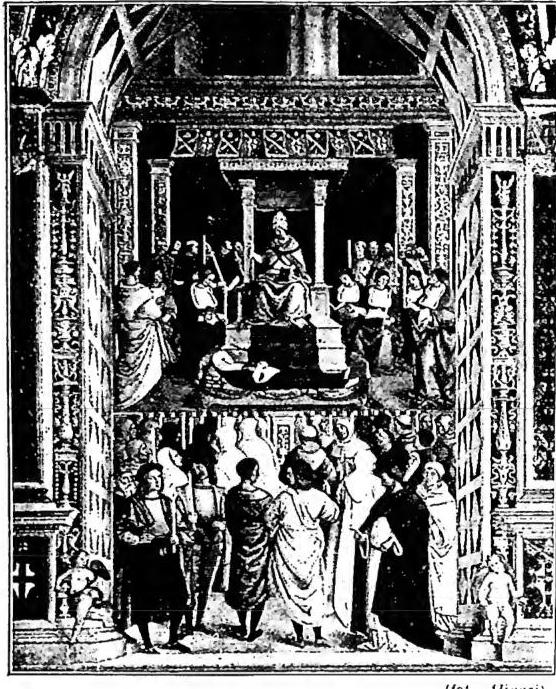
Canonization — Pius II canonizes St. Catherine of Siena (29 June 1461). Fresco by Pinturicchio in the Piccolomini Library (1505–1507) — Siena.

of life or whose glorious martyrdom is demonstrated by the processes with such breadth and certainty of proof as to exclude any doubt.

Bibl.: F. Contelori, Tractatus et praxss de Canonizutione sanctorum, Lyon 1634; Benedetto XIV, De Servorum Dei Beatificatione et de Beatorum Canonizatione, Prato 1839; Codex Postulatorum, Rome 1934; Norme da seguirsi nella compilazione delle Posizioni riguardanti le Cause dei Servi di Dio e Regolamento annesso, ibid. 1943 (collects the various norms issued by the Sacred Congregation of Rites in recent times). Carlo Salotti

II. CANONIZATION IN HISTORY

Summary:

I. Origins of canonization; the cult of martyrs

II. The beginning of the cult of “non-martyrs.” —

III. Episcopal canonization

IV. Papal or universal canonization

V. List of canonizations handled by the Sacred Congregation of Rites from Clement VIII (1594) to Pius XII

VI. Equipollent canonization

VII. Canonization and the Church.

I. Origins of canonization; the cult of martyrs. The early Church regarded martyrdom as the highest expression of faith and charity, and therefore of Christian perfection; for this reason it venerated martyrs as the closest friends of God and the most powerful intercessors for us.

This veneration rested on the public fact of martyrdom and was tied to a twofold element: local and temporal. The cult was bound to the place of martyrdom or the martyr’s burial, and to the date of the martyrdom itself. The memory of a martyr, unlike that of an ordinary deceased person, was not celebrated merely by relatives and friends but by the Christian community as a whole, and the anniversary was entered in the relevant calendars. Moreover, whereas in the piety shown toward the dead the prevailing idea was that of our intercession with God for their salvation, the celebration of a martyr was festive in character, and his intercession was implored on behalf of the living. The first historically documented example of an anniversary feast for a martyr is that of the Church of Smyrna for St. Polycarp, who died in 156 (Martyrium Polycarpi, 18; ed. R. Knopf–G. Krüger, Ausgewählte Märtyrerakten, 2nd ed., Tübingen 1929).

The fact of martyrdom was a matter of public knowledge; the Christian community itself had witnessed II. Ordinarily, therefore, no specific act of recognition by ecclesiastical authority was required. Only in certain particular cases, when sects also claimed to have martyrs—especially in Africa—did a certain vigilance on the part of the ecclesiastical authority seem advisable (see martyrs).

As has been said, the Christian communities kept a kind of list of their own martyrs, recording the name, the date of martyrdom, and the place of burial. This is attested, for example, by St. Cyprian, who reminds his clergy: “Dies eorum quibus excedunt, adnotate, ut commemorationem eorum inter memorias martyrum celebrare possimus” (Epistolae, 12, 2, ed. J. M. J. Hartel: CSEL, III, 303). From this arose the origin of martyrologies and calendars. An example of such lists is found in the Depositio martyrum of the Roman Church, inserted in the Chronography of 354 (see chronography). But the names of martyrs passed even more directly into worship, being inserted in local diptychs and read during the holy sacrifice (see diptychs). The constant contact among the various churches gave occasion for an initial spread of the cult of a martyr beyond his place of origin; their names began to migrate into the calendars and martyrologies of other churches, and certain famous martyrs were also received into the diptychs of those churches.

The golden age of the cult of martyrs was the first centuries after the Peace of Constantine: suffice it to mention the splendid decoration of their tombs, the erection of memorials, churches, and basilicas—often grand—over their graves or in their honor; the pilgrimages, the solemn liturgical celebrations of their feasts, and the panegyrics delivered in their honor. The Oriental custom of the translation and division of their relics then spread to the West, and the centers of cult of the martyrs multiplied. St. Stephen the Protomartyr, after his relics were discovered (415), St. John the Baptist, or St. Lawrence the Roman deacon, and many others, enjoyed a cult that rapidly extended to the whole Church. Popes of Oriental origin introduced many cults of martyrs into Rome; with the migrations of entire populations caused by the barbarian invasions, there sometimes followed the migration of relics and the cult of a martyr (e.g., St. Quirinus from Siscia to Rome, St. Severinus from Noricum to Naples); all this occurred through an organic and natural development, without prior intervention by the bishops. Only from time to time was it necessary to moderate somewhat the excessively ardent and less cautious zeal of the people (see martyrs).

Article illustration

At this stage one cannot yet speak of canonization in the modern canonical sense. The solemn and liturgical cult of martyrs was the fruit of a spontaneous and logical evolution grounded, on the one hand, in the historical notoriety of the fact of martyrdom, which rendered the deceased directly like Christ, and, on the other, in the two fundamental elements for the origin of the cult: the date and place of martyrdom.

II. The beginning of the cult of “non-martyrs.” — The period of persecutions had not yet ended when another group of the deceased began to attract special veneration from the Christian communities, namely the “confessors” (see confessors), that is, Christians who had been brought before the civil authority for their faith but, for various reasons, had either not suffered martyrdom or had survived II. Testimonies to the special veneration accorded to these confessors (in the primitive sense of the word) are very numerous; and upon his death a confessor of the faith could easily become the object of a veneration similar to that paid to a true martyr. Among the best-known examples it suffices to recall: Dionysius of Milan (359); Eusebius of Vercelli (370); Athanasius (373); Meletius of Antioch (381); John

Chrysostom (407). Yet it is easily observed that some of these figures distinguished themselves not only for what they suffered for the faith, but also for their strenuous defence of it in the political and doctrinal arena, as well as by their life and activity, so that, immediately after their death, a reputation akin to that enjoyed by martyrs began to surround them. There are then other figures who, without having been confessors of the faith in the primitive sense, excelled so greatly in doctrine, exemplary life, and manifold activity—whether political-ecclesiastical or social—that after their death they too were soon surrounded by honours analogous to those rendered to martyrs. One need only mention Gregory Thaumaturgus (270), Ephrem the Syrian (373), Basil the Great (379), Ambrose of Milan, Martin of Tours (397), Jerome (420), and Augustine (430), to say nothing of so many others.

But there is more: in the same period, and on a vast scale, the practice of asceticism and monasticism had been developing. The East soon resounded with the fame of hermits and cenobites, and the West too came to know some of its great figures (e.g., Athanasius, the great exile). Anthony the Abbot (356) was known throughout the Christian world through the celebrated biography written by St. Athanasius, where all could read that Anthony was to be equated with the ancient martyrs—not by the shedding of blood, but by a no less authentic and real martyrdom, namely the arduous and continual conquest of perfection (Life, ch. 47: PG 26, 912). Similar veneration was accorded to other great ascetics and monks, such as Hilarion (372), Paul of Thebes (381), and Simeon the Stylite (450). Even the anniversary of their death was celebrated liturgically; at their tombs there often arose shrines of extraordinary renown, destinations of renowned pilgrimages; their relics were venerated and sought after, and churches in their honour multiplied. The first “non-martyrs” to enter the liturgical cult of the Church of Rome appear to have been Pope Sylvester and Martin of Tours. During the 6th–9th centuries, many other “non-martyr” saints were admitted to the Roman calendars; in Rome they had their oratories, monasteries, and churches, and from there this practice spread beyond the Alps, and vice versa. This movement of cult was largely fostered by Popes of non-Roman origin, by the many monks who emigrated to the West, or by the exchange of relics and the diffusion of legends and passions, among other factors.

Another element that must not be underestimated, and which operated deeply and widely, is the literary work of the Fathers and ecclesiastical writers, who systematically developed and spread the theory of “inherent martyrdom,” represented precisely by penitential, ascetic, and monastic life, or in any case by the life of Christian perfection. This theory became the common doctrine throughout the Middle Ages and continues to exert influence even today. A few examples will suffice, while for the rest we refer to the bibliography noted below. Paulinus of Nola urges for St. Felix, a priest of Nola, the glory of martyrdom: “Martyrium sine caede placet, si prompta ferendi mensque fidesque Deo calent; passura voluntas sufficit, et summa est meriti testatio voti” (S. Paulini carmina [ed. J. M. J. Hartel: CSEL, XXIX], carm. 14, vv. 10–12, p. 46). St. Jerome does not hesitate to write to Eustochium: “Mater tua longo martyrio coronata est. Non solum effusio sanguinis in confessione reputatur, sed devotae quoque mentis servitus cotidianum martyrium est” (Epistolae [ed. I. Hilberg], CSEL: LV, ep. 108, n. 31, p. 349). Of Martin of Tours, Sulpicius Severus says: “Implevit tamen sine cruore martyrium”; in his feast, elements of the liturgy proper to martyrs, such as psalmody, are still found.

Bibl.: H. Delehaye, Sanctus, essai sur le culte des saints dans l'antiquité, Bruxelles 1927, pp. 109–21, 162–89; D. Gougaud, Dévotions et pratiques ascétiques du moyen âge, Maredsous 1929, pp. 200–19; H. Delehaye, Les origines du culte des martyrs, 2nd ed., Bruxelles 1933, p. 50 sqq.; M. Viller–K. Rahner, Askese und Mystik in der Väterzeit, Freiburg in Br. 1939, pp. 29–59; H. Leclercq, Saint, in DACL, XV (1949), cols. 373–462.

Article illustration

III. Episcopal sees

Between the 6th and 10th centuries, as the East increasingly distanced itself from the West, the dissolution of the Roman Empire and the migration of barbarian peoples—with the attendant necessity of converting them to the Catholic faith—posed new and arduous tasks before the Church. It was the age of the great bishops, missionary monks, converted kings who ended their days in the cloister, queens and princesses who founded monasteries and churches and then became abbesses or nuns themselves, hermits, and pilgrims—a world in ferment and motion, marked by deep contrasts between violence and holiness, amid young peoples of strong imagination, enthusiastic for the new faith, admirers of the heroes of charity and evangelical liberty. In this period, alongside a flourishing of the cult of martyr-saints, new cults of saints arose everywhere: often the mere reputation of an ascetic life, the founding of a monastery with its beneficial consequences, great almsgiving to the poor, sometimes even a violent death—though not always strictly for the faith—above all the reputation of miracles, sufficed to give rise to a new cult. Popular esteem for a holy life and belief in miracles were the two starting points for these cults of the early Middle Ages. Great churches commonly regarded their founders and first bishops as saints; the same applied to the figures of great abbots. In all cases, their memories were collected, their legends written, with little concern for critical scrutiny; the calendars and martyrologies of those centuries were enriched with ever new names, altars multiplied in churches, and the number of feasts rapidly increased. From time to time, abuses had to be curbed. Charlemagne, for example, had to take measures against improper cults (MGH, *Capitularia*, II, 56: “Ut falsa nomina martyrum et intercentesanctorum memoriae non venerentur”); the Council of Frankfurt [794]: “Ut nulli novi sancti colantur aut invocentur nec memoriae eorum per vias erigantur, sed ii soli in ecclesia venerandi sint, qui ex auctoritate passionem aut vitae merito electi sunt” (MGH, *Capitularia*, II, 170); the Council of Mainz [813]: “Deinceps corporant sanctorum de loco ad locum nullus praesumat transferre sine consilio principis vel episcoporum et sanctae synodis licentia” (Mansi, XIV, 75).

From the various and manifold accounts on this matter, it emerges that in these centuries a more or less uniform practice was taking shape, through which a new cult was authorized. The starting point was always public renown, the *vox populi*, which immediately after the death of the “servant of God” hastened to the tomb, invoked his intercession, and proclaimed his miraculous efficacy. The competent bishop was then informed; indeed, often in his presence, and frequently on the occasion of a diocesan or provincial synod, a life of the deceased was read—above all the account of miracles (the very first nucleus of future processes)—and, following the approval granted, the body was exhumed for a more honourable burial: the *elevatio*. Often, either immediately or later, another step followed: the *translatio*, namely the new deposition of the holy body before or beside an altar, or even beneath or above it; the altar would then take the name of the saint thus venerated. At times, the church itself was enlarged or rebuilt and precisely dedicated to the saint who had been elevated or translated. From the moment of elevation or translation onward, the liturgical feast was regularly celebrated, often with great solemnity, not only in the locality where the altar or church stood, but throughout the diocese, region, province, or entire religious family.

The principal elements of this procedure, which had taken shape in the Merovingian era and acquired a certain consistency in the Carolingian period, are therefore: public renown for holiness and miracles (or martyrdom), presentation to the diocesan bishop or synod (diocesan or provincial) of a life specially composed, with particular emphasis on the miracles attributed to the “saint,” and official approval or consent to the cult, which was inaugurated with the *elevatio* or *translatio*. In other words, a fixed point of cult was created: the altar dedicated to the new saint.

or, rather, in its Church, where the liturgical feast is regularly celebrated. The cult may remain limited or may expand more or less rapidly and widely; this is a secondary element, the essential being the official intervention of the competent ecclesiastical authority, that is, in that age, the ordinary bishop, by virtue of his own authority, often rendered more evident by the concurrence of neighboring bishops or a synod. In this way, we are faced with an ordinary and normal ecclesiastical discipline, universally recognized, therefore legitimate and valid in all respects: namely, the episcopal, or local, or particular cult, as some prefer to call it, the only and exclusive one from the 6th to the 12th century and sometimes continued until the 14th. A very late example, to cite one, we have still in 1215, in the cult of St. Peter of Trevi, celebrated *prout poterat* by the bishop of Anagni, Peter, in the presence of neighboring prelates. St. Peter Damian (d. 1072) was well acquainted with this practice and speaks of it as an ordinary matter (cf. *Opusculum* VI, cap. 19: PL 145, 142).

To conclude: for more than five and six centuries (6th–12th) the episcopal cult was the normal and sole cult in use in the Latin Church. Beside it, as will be seen immediately, the papal cult grew very slowly, and much time and doctrinal and canonical labor were required before it succeeded in supplanting the ordinary medieval cult performed by bishops. It must be noted above all that the episcopal cult gave rise to a true cult of the saint, that is, to the celebration of the liturgical feast, the erection or dedication of altars and churches, the use of the name in Baptism, and so forth, without any limit. The more or less extensive geographical spread of these cults is a secondary and purely accessory element. One must avoid applying modern juridical concepts to those times; moreover, even the formal papal cult, although it obliges the whole Church to venerate a saint, does not in any way imply the imposition of his feast upon the whole Church.

**

BIBL.:** Besides the works of Fr. H. Delehaye, cited above, cf. St. Beissel, *Die Verehrung der Heiligen und ihrer Reliquien in Deutschland*, 2 vols., Freiburg in Br. 1890, 1892; E. Mabillon, *Études sur la civilisation française. II: Le culte des saints sous les Mérovingiens*, Paris 1899.

IV. The Papal or Universal Cult

The transition from the practice of episcopal cult to that of papal cult is almost imperceptible at the beginning. At first, this appears rather casual, and certainly was not intended as a supreme act valid for the universal Church. But it is clear that a cult performed by the pope had greater authority; and therefore, in a second phase, requests for papal authorizations of cult grew ever more frequent. Yet the procedure remains the same as in episcopal cult, and in the majority of cases the pope merely gives his consent, while on the spot the usual solemn elevation and inauguration of the cult proceeds. The travels of the popes in the 11th and 12th centuries gave the popes occasion to perform such elevations in person. Insensibly the papal cult gained greater consistency and canonical value; a stricter procedure formed, and finally it became the exclusive and uniquely legitimate cult.

One may therefore distinguish three periods in the development of the papal cult: a) until the decretal *Audivimus* (1170) of Alexander III was inserted into the Decretals of Gregory IX (1234); b) until Sixtus V, who entrusted the Sacred Congregation of Rites with the task of preparing the papal cult; c) the period of the papal cult according to the practice of said Congregation.

a) First period: until the time of Gregory IX. — Note that the dates in parentheses following the names of individual saints are those of their death.

The first pope to intervene in authorizing a cult outside Rome would have been Innocent I (401–17), to whom the acts of the martyrdom of St. Vigilius of Trent (26 June 403) were said to have been transmitted “ut sacris martyrum memorialibus inserantur”; but the authenticity of the acts, or at least of this notice, is disputed. More certain, however, is the final translation of the body of St. Severinus (d. 482 in Noricum and transported by his disciples to Montefeltro, thence to Castellum Lucullanum [Pizzofalcone] near Naples), which was carried out “tunc sancti Gelasii sedis romanae pontificis auctoritate” (*Eugippius, Vita Severini* [ed. P. Knöll: CSEL, IX] 65). The following notices are more or less uncertain: Boniface IV (608–15), according to a forgery, would have approved “sua auctoritate” the life of St. Maurus the Abbot (15 Jan. 584); Leo III, at the request of Charlemagne, on the occasion of his visit to Verdun, would have elevated the body of St. Suitbert (1 March 713). To Pope Zachary (741–52) is attributed the permission for the elevation of the martyrs Kilian, Coloman, and Totnan (8 June 689) at Würzburg; Adrian I (772–95) would have approved the cult of St. Alban, protomartyr of Britain (under Diocletian), at the request of King Offa. John VIII (872–82) would have personally elevated the bodies of Sts. Agricola, Sylvester, and Desiderius, bishops of Chalon-sur-Saône of the 4th century. More certain is the notice that Bishop Hugh of Würzburg proceeded, on 14 Oct. 983, to the elevation of the body of St. Burchard (2 Feb. 754) “permissu Benedicti papae” (Benedict VII [974–83]). Finally, John XV (985–96) would have authorized the elevation of the body of St. Landoald (687 or 688), celebrated at Ghent on 19 March 982 (though the chronology is erroneous!).

Leaving aside other similar notices, difficult to verify, we come to the first secure papal cult for which a papal document still exists, that of St. Ulrich, bishop of Augsburg (4 July 973), performed by John XV on 31 Jan. 993, during the synod held at the Lateran. Among the prelates present was also the bishop of Augsburg, who asked and obtained permission to read before the assembly the life and miracles of Ulrich, and received general applause. The Pope, on the same date, drew up an act, recounting what had occurred and declaring Ulrich worthy of veneration. All of this fits perfectly into

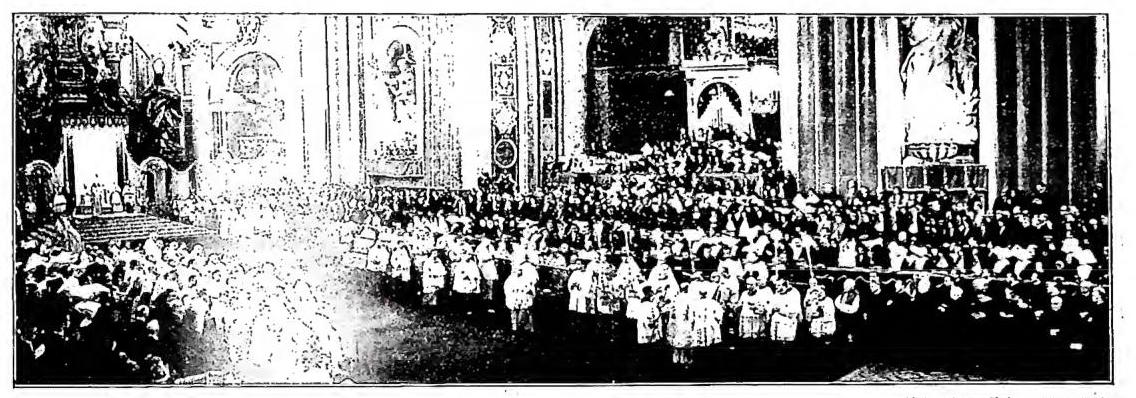
Canonization – Apparatus of St Peter’s Basilica for the canonization of the Blessed Isidore the Farmer, Ignatius of Loyola, Francis Xavier, Teresa of Avila and Philip Neri, performed by Gregory XV (12 March 1622).
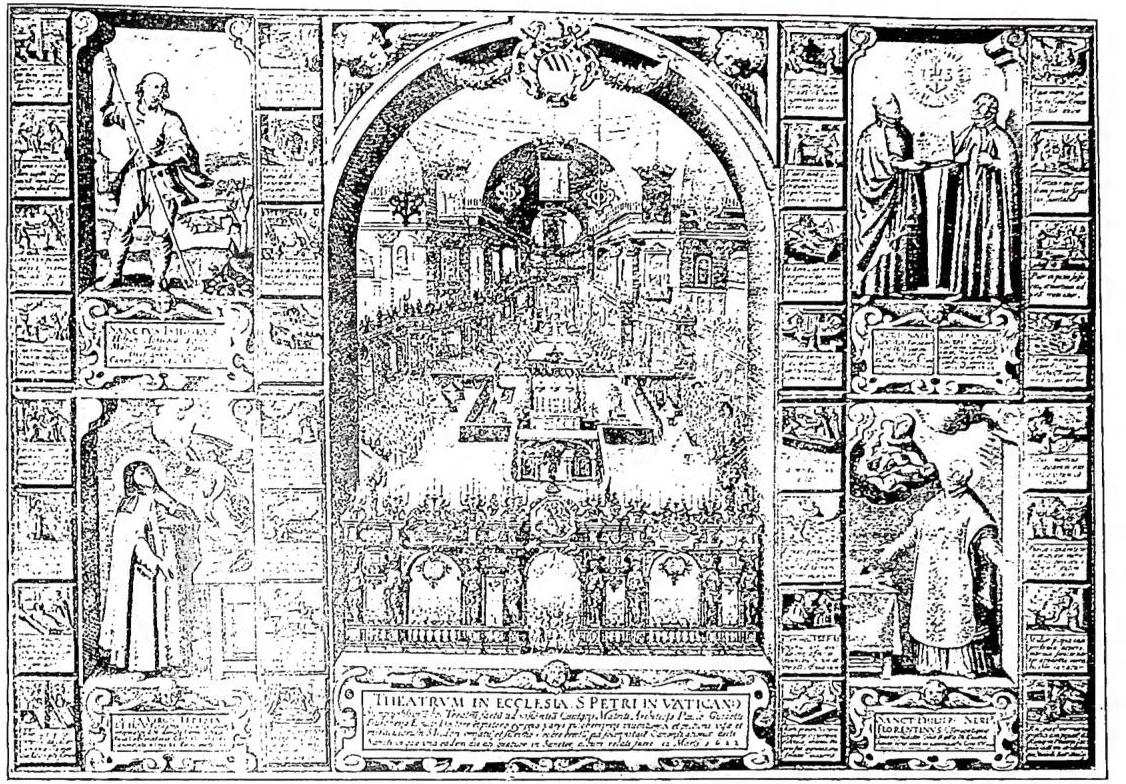
Within the general framework of the procedure then in use, the Pope was the judge. However, this act is usually regarded as the first papal canonization in the present sense of the word.

Article illustration

To Gregory V is attributed the canonization of St Adalbert, bishop of Prague and martyr (23 April 997), performed in the same year; it is certain that he built and dedicated to him, who had been his friend, a church on the Tiber island (later S. Bartolomeo).

Benedict VIII, at the request of Count Boniface, permitted the construction of a church in honour of St Simeon, a monk at Polirone near Mantua (26 October 1016). The Pope replied: “Tractate eum ut sanctum.” This would be the swiftest canonization, occurring one or two months after the death of the servant of God.

John XIX permitted, c. 1024, the elevation of St Adelard, abbot of Corbie (2 January 826), and two years later that of St Bononius, abbot of Lucedio (30 August 1026).

Benedict IX granted, c. 1032, the elevation of St Romuald (16 June 1027). Much more important is his other intervention which, in every respect, constitutes historically the first and perfect act of papal canonization, namely the canonization of St Simeon, recluse at Trier (1 June 1035). In the letter to the German people the Pope explains how he had repeatedly received accounts of the life and miracles of the saint, and how Poppo, bishop of Trier, had directly asked him “ut quod nobis visum fulseret de celebratione eiusdem sanctissimi viri, salubri definitione nostrae apostolicae auctoritatis statueremus atque decerneremus.” At a solemn assembly of “fraternitatis romani nostri cleri,” on the occasion of Christmas (1041), the Pope, by common consent, decreed: “eundem virum Simeonem... ab omnibus populis, tribubus et linguis sanctum procul dubio esse nominandum,” establishing that his feast be celebrated annually and his name inserted in the martyrology. It is evident how much this act differs from the simple papal permissions for elevations that had gone before, above all for the express intention of a definition of universal and obligatory scope for the whole Church. Yet the times were not yet ripe for such decisions, and the canonization of St Simeon, in effect, did not exceed the limits of the usual episcopal canonizations.

Noteworthy also is the case of St Wiborada, recluse at St Gall (2 May 926). Abbot Hitto had solemn vigils celebrated and himself celebrated Mass over her tomb on the day of deposition; later, as Ekkehard recounts, “in sanctam eam levari iam bis nostris temporibus per duos papas decretatum est, et sub Norberto tandem impletum n.” Abbot Norbert, supported by Emperor Henry III, obtained in 1047 (5 January) from Clement II “ut canonizaret et pro sancta haberi praeciperet et anniversarium diem ipsius solemnizandum institueret.” As may be seen, two previous papal concessions were not followed up, and only a third succeeded; from this one may deduce the real value of papal concessions of elevation.

Important, however, for the history of papal canonization is the pontificate of St Leo IX, to whom his frequent journeys gave occasion to perform in person various solemn elevations. At the beginning of 1049, on the occasion of the customary Lateran Synod, after the reading of the life, he permitted in the usual way the elevation of St Deodatus, bishop of Nevers (19 June 679). In the summer of the same year, at the Synod held at Mainz, he likewise permitted the cult of St Gervasius, bishop of Liège. On 3 December following, Archbishop Hugh of Besançon, by special mandate of the Pope, solemnly performed the elevation of the bodies of the abbots St Romaric of Luxeuil (c. 635) and Amatus of Remiremont (c. 625), as well as of Adelfus.

Article illustration

Bishop of Metz, dedicating to them the rebuilt church of Remiremont. The case of St. Gerard, Bishop of Toul, predecessor of the Pope in that see (23 Apr. 994), is particularly interesting. The Pope himself took the initiative; at the Lateran Synod, 2 May 1050, he presented the case to the assembly, spoke of the life and miracles of the Saint, and, to the general applause, decreed: «that henceforth he be held as a saint... throughout all the world, as are the other saints», announcing that he would personally perform the elevation; which he actually did on 21 Oct. of the same year at Toul. Here we are again faced with a formal papal canonization in the sense of the full papal authority; indeed, the Pope addressed a letter «to all the sons of the Catholic Church», signed by all the members of the Roman synod. Thus begins to emerge a distinction between the papal definition and the act of elevation, which until then, especially in episcopal canonizations, had been considered the fundamental act. At Toul the Pope also performed the elevation of a Bishop Romanus of Toul, whose name, however, is not found in the authentic lists of that see.

During his great journey through Germany, in the presence of Emperor Henry III, the Pope personally celebrated at Ratisbon (8 Oct. 1052) the elevation of the Bishops St. Henry (8th century) and St. Wolfgang (31 Oct. 994). Benedict XIV, in his well-known great work on canonization, also accepted as credible the account of the elevation, performed by Leo IX at Padua in 1053, of Sts. Bellinus, Fidelis and Maximus, or, as others claim, Julian, Maximus, Felicity and three innocents; but the matter is very uncertain, as are some other such accounts, easily explained by the notable activity of St. Leo IX in the field of canonization.

Alexander II, while passing through Milan in 1067, is said to have celebrated the elevation of St. Ariald, martyr (27 June 1066), but the account is not entirely certain. In 1070 he permitted the elevation of St. Theobald, hermit at Salanigo (30 June 1066), and granted the Bishop of Burgos the faculty to proceed to the solemn elevation of the Abbot Iñigo of Oña (1 June 1057).

Gregory VII permitted (1073) the solemn elevation of the relics of St. Paschasius Radbertus, Abbot of Corbie (26 Apr. 860), by Bishop Wito; in 1083, at the request of King Ladislaus, he granted the solemn elevation of St. Gerard Sagredo, Bishop of Csanád, apostle of the Hungarians (24 Sept. 1046), Stephen, first King of Hungary (15 Aug. 1038), and his son Emeric (2 Sept. 1031).

Urban II permitted the elevation of St. Godeleva, martyr at Ghistelles (6 June 1070); while passing through Milan in 1095 he is said to have personally performed the elevation of St. Erlembald, martyr (10 Apr. 1076). At the Roman Synod of 1098 the life of the pilgrim St. Nicholas of Trani (2 June 1094) was read, and the Archbishop Bisantius of that city requested the insertion of his name in the catalogue of saints: the Pope entrusted Bisantius himself with the task of proceeding as decided, upon his return to Trani. The Roman Martyrology also includes St. Attilanus, Bishop of Zamora (5 Oct. 1009), as canonized by Urban II himself.

Paschal II canonized St. Angilbert, Abbot of St-Riquier (18 March 1141) in 1100, authorizing his elevation. He also authorized the elevation of the body of St. Canute, King of Denmark (10 July 1086), which took place on 19 Apr. 1101. On 4 June 1109, at Segni, after the usual reading of his life, he permitted the bishops of the region to venerate as a saint Peter, Bishop of Anagni (4 Aug. 1105).

Callistus II, elected at Cluny on 2 Feb. 1119, on the Epiphany of 1120 proceeded to the elevation of St. Hugh, Abbot of Cluny (28 Apr. 1109), whom he had known. In the same year he entrusted the Cardinal of Palestrina, his legate at the Synod of Beauvais, with the task of proceeding to the elevation of St. Arnulf, Bishop of Soissons (14 Aug. 1087). As for the alleged canonization of St. Conrad, Bishop of Constance (26 Nov. 976), the Pope is said to have declined it, referring the matter to a general council. Note the case of St. Gerard, Bishop of Potenza (30 Oct. 1119). His successor Manfred, who reports the fact, went to Rome with a delegation from the people to request his canonization. The case was brought before the consistory, where Callistus read the life of the deceased and pronounced the canonization viva voce, without further document; but to attest its authenticity he ordered the bishops present—Peter of Acerenza, Guido of Gravina, Leo of Marsico, and together with the Cardinal of Palestrina, William—to go to Potenza to proclaim the canonization that had taken place and the granting of a forty-day indulgence. All this must have occurred between the early months of 1123 or 1124. The granting of an indulgence on the occasion of canonizations became customary only about a century later.

Innocent II, present at the Plenary Council of Reims on 29 Oct. 1131, after the usual reading of the life and miracles, permitted the Church of Hildesheim to venerate its own Bishop St. Godehard (4 May 1038). On 22 Apr. 1134, after the preparations for the Council of Pistoia, the Pope, after the reading of the life and miracles, authorized the veneration of St. Hugh, Abbot of Chaise-Dieu, Bishop of Grenoble (1 Apr. 1132). The same procedure was followed at the Lateran Council of 1139, 19 Apr., for St. Sturm, Abbot of Fulda (17 Dec. 779).

Eugenius III, in a solemn gathering of the clergy in Trastevere on 4 March 1146, proceeded to the canonization of St. Henry, Emperor (13 July 1024). In his letter the Pope recalls having given instructions to two cardinal legates in Germany to gather information at Bamberg, where he was buried in the cathedral of that diocese which he had founded.

It is commonly attributed to Alexander III the reservation of the exclusive right of canonization to the Supreme Pontiff alone. The matter, however, is quite different. On 6 July 1170 Alexander addressed to Canute I, King of Sweden, to the bishops, clergy, and people of Sweden the lengthy letter *Aeterna et incommutabilis* (Jaffé-Wattenbach, II, 13546: PL, 200, cols. 1259-61); towards the end of this letter the Pope comes to speak of a particular case: «finally we have heard...», namely of a man who, killed in a state of drunkenness, had been venerated by some as a holy martyr. On this point the Pope teaches that: «even if many signs and miracles were worked through him, it would not be lawful for you to venerate him publicly as a saint without the authority of the Roman Church». Thus it was a particular case for which the Pope gave a directive, as the Supreme Pontiffs were wont to do in many other instances. But barely a decade later, certainly after 1179, an English canonist, diligent collector of papal decisions, inserted in his collection, known as the *Cottoniana prima*, also the *Audivimus* from the letter *Aeterna et incommutabilis*, with some adjustments to the text. Through some other collections of this type, but always of a private nature, the text ended around 1206 in the private collection of Master Alan, an Englishman, professor of law at Bologna. Finally St. Raymond of Peñafort, entrusted by Gregory IX with the official edition of the Decretals, also inserted the *Audivimus* of Alexander III, so that this text, by virtue of that insertion (5 Sept. 1234), became universal law. The final and definitive fortune of the *Audivimus* came in the subsequent interpretations of the great canonists, especially Sinibaldo Fieschi (Innocent IV) and Henry of Susa, known as the «Cardinal Hostiensis», who in his *Summa Aurea* (1253) and in his *Commentaria* (after 1268) interpreted the *Audivimus* as a fundamental law of the papal right of canonization. This most important point in the history of canonization has only recently been properly highlighted through the work of S. Kutner, *La réserve papale du droit de canonisation*, in *Revue historique du droit français et étranger* (new series, 17 [1938], pp. 172-228; offprint, Paris 1938).

The canonizations of Alexander III, moreover, do not differ in any way from those of his predecessors; only half a century later did papal canonizations acquire such splendor and universal resonance that canonistic elaborations could graft onto the text of the *Audivimus*, itself very concise, the idea of a universal law reserving the right of canonization to the Supreme Pontiff alone.

The first canonization of Alexander III was that of St. Edward the Confessor, King of England (4 Jan. 1066), performed at Anagni (7 Feb. 1161), where, in the presence of his court, after examining the *liber miraculorum* and seeing the letters of his predecessor Innocent on the matter, he proceeded to the proclamation.

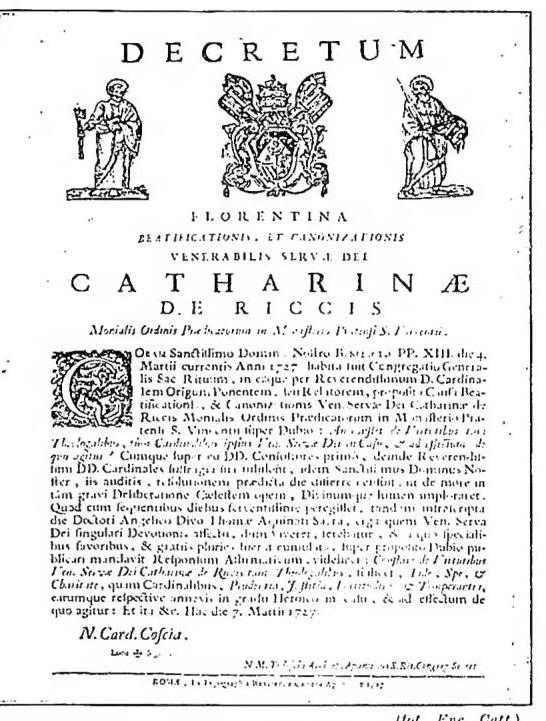
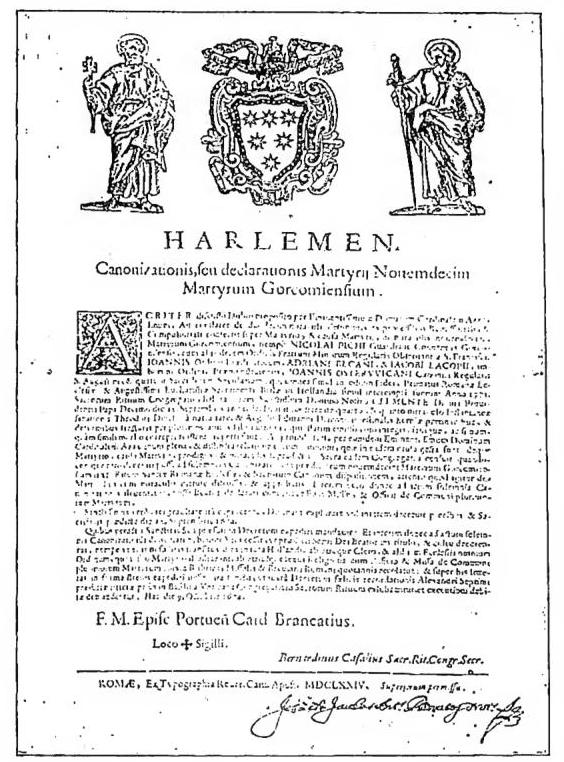
Canonization. – Decree under Pope Alexander III for the canonization of the martyrs of Gorkum (9 Oct. 1674) – Vatican City, Archive of the Sacred Congregation of Rites.

A letter requesting the formation of a commission was sent; it was addressed to all England on 7 Nov. 1161.
Two similar canonizations follow: at Tours on 9 June 1163 the Pope entrusted Thomas, archbishop of Canterbury (the future martyr), after the reading of his life and miracles in a special council, with the canonization of St Anselm of Canterbury (21 Apr. 1109). From Sens, where he was residing, in 1164 the Pope gave a similar mandate for the elevation of St Helena of Skövde, a Swedish martyr (c. 1160). By way of digression, it is worth noting the canonization in Dec. 1165 of Charlemagne (28 Jan. 814), carried out by Paschal III, the antipope whom Emperor Frederick Barbarossa had set up against Alexander III. Paschal entrusted Rinaldo of Dassel, archbishop of Cologne (the noted imperial chancellor), with the solemn elevation of Charles. This is the only case of a canonization performed by an antipope that remained within the scope of “local” canonizations. In 1169, at Benevento (8 Nov.), followed the canonization of St Canute (Knud Lavard), a Danish martyr (7 Jan. 1131). Of far greater importance, however, was the canonization of St Thomas Becket, archbishop of Canterbury (29 Dec. 1170). The fact of his martyrdom produced an enormous impression throughout Europe; the Pope, in 1173, issued from Segni two letters of identical tenor, one of which was directed to all the prelates of the Church. He says that he had known Thomas personally and that he wished to await the report of two of his cardinal legates, especially regarding miracles. Finally, “in capite ieiunii” (21 Feb. 1173), in the presence of very many ecclesiastics and laity, “we solemnly canonized the aforementioned archbishop.” This is the first time that this precise term appears in a papal document. Equally important is the canonization of St Bernard of Clairvaux (20 Aug. 1153). After repeated petitions from the Cistercians, on the feast of the Chair of St Peter (18 Jan. 1174) at Anagni, in the presence of a large gathering of prelates, after the life of Bernard had been read, the Pope decreed: “relying on the merits of the blessed Apostles Peter and Paul, we have decided to enroll him in the catalogue of saints.” This is the first time that we become aware of a formula referring to apostolic authority being used in such an act.

Lucius II in 1181, in the usual form, granted the elevation of St Bruno, bishop of Segni (18 July 1123).
Clement III canonized, on 21 Mar. 1189, St Stephen of Thiers, a hermit and founder of the Congregation of Grammont (8 Nov. 1124). Very interesting is the canonization of Otto, bishop of Bamberg, apostle of the Pomeranians (30 July 1139). In two apostolic letters, dated 29 Apr. and 1 May 1189, addressed to particular German prelates, the Pope declared that he had entrusted two bishops, of Merseburg and of Eichstädt, two abbots and a canon with the task, after a diligent inquiry into his life and miracles, to solemnly and publicly announce, “relying on apostolic authority, that he has been canonized.” This is an authentic canonization by papal delegation. Similar was the canonization of St Malachy O’Morgair, archbishop of Armagh (d. at Clairvaux, 2 Nov. 1148), carried out on 6 May 1190 on the basis of the life written by St Bernard and of many other pieces of information.

Celestine III, on 4 Mar. 1192, at the repeated requests of the bishop of Gubbio and after many reports on the matter “with the common counsel of the brethren” and “by the authority of the blessed Apostles Peter and Paul,” canonized St Ubaldo, bishop of Gubbio (14 May 1136), ordering that his feast be celebrated “among you.” Of similar tenor is the apostolic letter for the canonization of St Bernard (better Bernhard), bishop of Hildesheim (26 Oct. 1025), carried out in Rome at St Peter’s on 8 Jan. 1192. Identical was the canonization of St John Gualbert (13 July 1073) on 24 Oct. 1193. On 27 Apr. 1197 was the canonization of St Gerald, abbot of Sauve-Majeur near Bordeaux (5 Apr. 1105). To the same Celestine is also ascribed the canonization of St Bernard degli Uberti, cardinal bishop of Parma, a Vallumbrosan (4 Dec. 1133), but Clement XI in 1714 refused to extend his feast to the whole Church because it was not possible to prove historically that a formal canonization had taken place. More certain appears the canonization of St Rudesind, bishop of Dumnium in Galicia (10 Mar. 977), probably carried out in 1196.

Innocent III, on 12 Jan. 1199, canonized St Homobonus of Cremona (13 Nov. 1197), and in his letter the Pope for the first time in an official document gave a brief summary of the life of the saint and of his miracles, attesting that it had been composed on the basis of sworn testimonies. On 3 Apr. 1200 he canonized St Cunegonde, empress and wife of St Henry (3 Mar. 1040).

Of 1202 is the canonization of St Gilbert, abbot of Sempringham (4 Feb. 1189). Very interesting is the case of St William, hermit of Malavalle near Grosseto (10 Feb. 1157). Already Alexander II had ordered, at the request of the bishop of Grosseto, that in his diocese the solemn office for the said saint be celebrated *ad interim*, without proceeding to the act of explicit canonization. Innocent (1202, 8 May) after repeated petitions renewed the permission to continue to celebrate the feast. Benedict XIV denied that this act had the character of a canonization; nonetheless we believe that it still concerns a local canonization. On 14 May 1203, at Ferentino, he canonized St Wulfstan, bishop of Worcester (19 Jan. 1095). The Pope had entrusted a commission of two bishops and two abbots to go to Worcester, to proclaim a three-day fast and then to proceed to examine the miracles. Account was taken of a life written a hundred years earlier in Old English, authenticated and sealed. All this was brought to Rome for examination. On this basis the Pope celebrated the canonization and also published the oration of the new saint. On 2 July 1204 the body of St Procopius, abbot of Sázava, was elevated by Cardinal Guido of S. Maria in Trastevere, in accordance with the Pope’s order “that the body of the blessed man be solemnly canonized.”

Honorius III, on 17 May 1218, at St Peter’s in the Vatican, canonized St William, archbishop of Bourges, later a Cistercian monk and abbot (10 Jan. 1209). On 18 Feb. 1220 from Viterbo he announced to all Christendom the canonization of St Hugh, a Carthusian and bishop of Lincoln (17 Nov. 1200), after the now customary “commissio inquisitionis.”

On 8 January 1222, the Cistercian monks of Molesme were granted permission to venerate their abbot, St ROBERT (14 Apr. 1111), “as though he were a saint.” On 21 January 1224, at the Lateran, the canonization of St WILLIAM, Cistercian abbot of Roskilde in Denmark (6 Apr. 1203), took place. A case of special interest is the canonization of St LAURENCE O’TOOLE, archbishop of Dublin (14 Nov. 1181), celebrated at Rieti on 11 December 1225. At his tomb in Rouen many miracles had occurred; therefore the Pope ordered the archbishop of that city to conduct the usual inquiry together with other ecclesiastics, who collected the necessary testimonies. Regarding the life of the Saint, the commissioners forwarded their report to the archbishop of Du-

blin, who, detained at the English court, delegated other dignitaries. These held the prescribed inquiry in Dublin, sealed the proceedings, and sent them to Rouen, whence all the material was forwarded to Rome for verification and decision. This is the first recorded instance of what is now termed a “rogatorial process.”

On 18 March 1226, at the Lateran Council, the canonization of St WILLIAM FITZHERBERT, archbishop of York (8 June 1154), took place after the usual petitions and inquiries. To Honorius III is also attributed the canonization of HUGH, Cistercian abbot of Bonnevaux (1 Apr. 1191), and of JOHN the Hermit, prior of S. Maria di Gualdo. The necessary inquiries were conducted for the former on 2 December 1221 and for the latter on 3 June of the previous year, but no document survives attesting that the canonization was actually carried out. Another similar case is that of JOHN CACCIAFRONTE, Benedictine abbot of Vicenza, murdered on 16 March 1183. Honorius III ordered the “commissio inquisitionis” and a process was even held at Cremona, his birthplace, but no further action was taken.

Gregory IX. The canonization of St FRANCIS OF ASSISI (4 Oct. 1226) aroused universal acclaim; the Pope proclaimed it at Perugia and announced it in two letters, one to the clergy and the other to the universal people (16 July 1228 and 21 Feb. 1229). The actual ceremony was performed by the Pope at Assisi in early July 1228. In the square before the church he delivered a sermon, and after the body was brought into the church, at the singing of the Te Deum, he celebrated the Mass of the new Saint. The formula of this canonization is preserved and is certainly the oldest known. The feast of the Saint was imposed upon the whole Church and immediately accepted universally. Although the Pope had been a friend of Francis, he nevertheless insisted that the usual inquiry into his life and miracles be conducted (the first completely preserved and published canonization process) and that everything proceed according to the customs of the time.

Another notable canonization, famous throughout the world, is that of St ELIZABETH OF THURINGIA (19 Nov. 1231), performed in the church of the Dominicans at Perugia on 27 May 1235. The papal letter is dated 1 June following, and on this occasion too the feast was extended to the universal Church “destructione principiis,” though without real effect. Under Gregory IX, a process was also instituted for ODDO OF NOVARA, Carthusian abbot (14 Jan. 1230). The “commissio inquisitionis” is known to date from 10 December 1240, along with the related process; but everything came to a halt, perhaps due to the Pope’s death.

Finally, and most instructively, the case of St HILDEGARD, Benedictine abbess (17 Sept. 1233), must not be overlooked. Her fame during her lifetime was already universal, and after her death a great number of miracles were attributed to her intercession. Gregory IX appointed a commission and, on 16 December 1233, ordered the process, which was sent sealed to Rome. Finding the depositions insufficient, a further examination of witnesses was ordered, though no record of it has survived. Innocent IV then renewed the commission in 1243, but without practical result. After renewed petitions, John XXII, in 1317, issued fresh letters of commission, but the matter had become increasingly difficult due to the lack of oral testimony and the ever-growing demands of the process. Thus this celebrated Saint was never formally canonized.

A similar case is that of St BRUNO, bishop of Würzburg (27 May 1045). Gregory IX issued the usual commission for him on 1 May 1238, but the process sent to Rome was judged unsatisfactory. Innocent IV therefore ordered a new inquiry (Lyon, 5 Nov. 1245), yet no formal canonization ever took place.

Undoubtedly Gregory IX, an eminent canonist, gave new importance to papal canonization.

After the very brief pontificate of Celestine IV, the great figure of Sinibaldo Fieschi, Innocent IV (1243–54), ascended to the papal throne. Already a professor of law in Bologna, as Pope he wrote the *Apparatus super V libros decretalium*, a commentary that immediately enjoyed wide diffusion and fame, although he expressly declared that he had written it as a private individual. Fieschi’s observations and definitions regarding canonization thus became the foundation for all subsequent canonists. He definitively established Alexander III’s *Audivimus* as the fundamental law of papal canonization, providing its first precise definition, which became classic among canonists. This definition consists in the power “canonice et regulariter statuere quod aliquis sanctus honoretur pro sancto,” that is, with all the prerogatives of public and universal cult. It was precisely in this universality that Innocent IV recognized the root of the papal reservation of canonization: “Solus Papa potest canonizare sanctos,” since only the Pope exercises universal jurisdiction over the entire Church. Yet to arrive at canonization, juridical proofs “de fide et excellentia vitae et miraculis” are required. Innocent IV himself canonized, on 16 December 1246 in Lyon, the archbishop of Canterbury, St. Edmund Rich, originally from Abington (16 November 1240), and at Easter 1247, again in Lyon, St. William Pinchon, bishop of St-Brieuc (29 July in an uncertain year between 1234 and 1241). More grandiose was the canonization of St. Peter Martyr (6 April 1252), whose ceremony was celebrated in Perugia in the piazza before the church of the Dominicans at Easter 1253. The Pope issued two letters of general tenor, one from Perugia on 24 March 1253, the other from Anagni on 8 August 1254. Important is the Pope’s assertion that he had proceeded to canonization “post inquietissimum sollecitudinem, studiosum examinationem, discussionem sollemnem... auctoritate beatorum Petri et Pauli Apostolorum ac nostra.” This was followed at Assisi on 8 September 1253 by the canonization of St. Stanislaus, bishop of Cracow, martyr (8 May 1279). The entire solemn celebration took place completely within the great basilica of St. Francis. From this point onward, canonization would unfold entirely as a liturgical rite. Subsequently, following a commission given by Innocent IV, processes were constructed between 1251 and 1254 for Giovanni Buono (23 October 1249), a hermit, but, for reasons unknown to us, the canonization never took place.
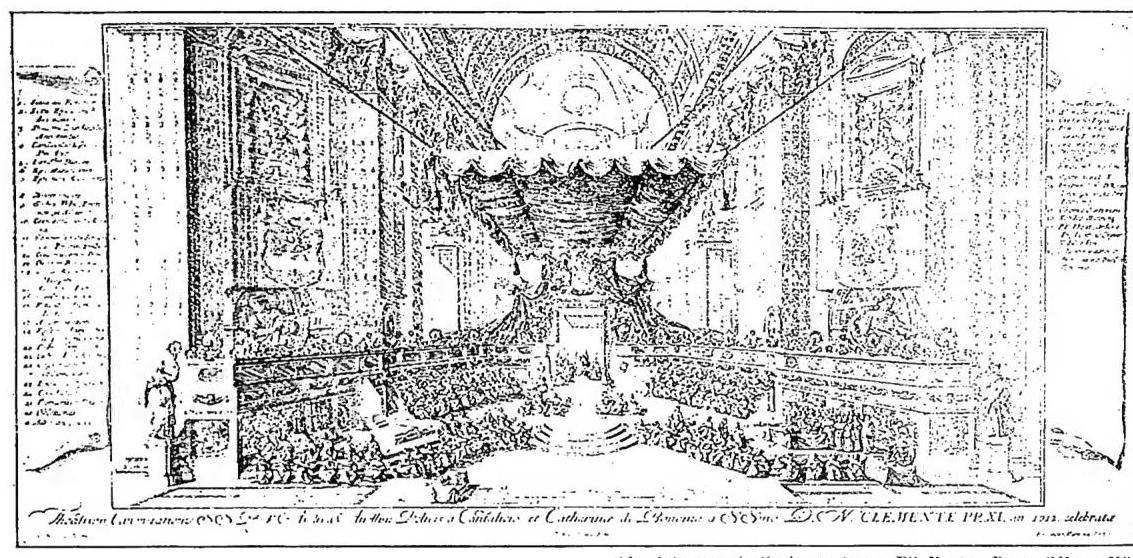
Article illustration

Alexander IV celebrated another famous canonization, that of St. Clare of Assisi, whom he had assisted at her death (12 August 1253). The solemnity took place at Anagni on the second anniversary of her death, 12 August 1255.

Urban IV canonized at Viterbo on 22 January 1262 St. Richard de Wych, bishop of Chichester (3 April 1253). As the Pope states in the letter concerning the cause, the *inquisitio* had been ordered by Innocent IV and “diligenti examine discussa” first by the cardinal bishop of Frascati, Otto of Châteauroux, and finally “per nos et per fratres,” that is, by the cardinals. One sees how the procedure was becoming ever more rigorous.

Clement IV proceeded to the canonization of St. Hedwig, grand duchess of Silesia (15 October 1243), which took place at Viterbo on 26 March 1267.

This period closes with the great figure of the cardinal of Ostia, of whom we have already spoken. His *Summa aurea* and especially his *Commentarium* constitute the culmination of a centuries-long development. From the mid-13th century, one may date the second period in the history of canonization, *de facto* and *de iure* now reserved to the Holy See. Yet with this reservation, the emergence of new local liturgical cults did not cease, though they never reached canonization.

As we have seen, from the first sporadic interventions of some popes—more casual than anything else—one insensibly arrived at attributing a higher and more exclusive value to papal canonization. While at the outset it was primarily a matter of papal permissions or commissions to proceed with the elevation of a saint, this element, hitherto of capital importance, receded into the background; what came to prevail was the simple and formal papal declaration of canonization. Thus the procedure, at first quite rudimentary, acquired true juridical consistency, incorporating the various elements of canonical procedure developed for the various curial processes.

At the beginning, it sufficed to read a life and miracles before the Pope and a synod or some other solemn assembly of the clergy to obtain, by common consent of those present, papal permission for the elevation. But in the respective papal letters, one soon detects the tendency to emphasize the papal act, conferring upon it universal value. The examination of miracles, in some way pertaining to a definition of divine intervention, led to the idea that canonizations were a “negotium maius Ecclesiae,” belonging to the Pope and his Curia. The mere reading of a simple life was no longer sufficient; the Holy See took the initiative and itself requested more ample information. In 1146, in the case of Eugenius III and St. Henry, we know for the first time that the Pope made use of his legates for this purpose. In 1189, with Clement III, the term “commission” appears for the first time, that is, the express mandate given by the Pope to determine persons for the *inquisitio* into the life and miracles.

Under Innocent III (in the case of St. Homobonus), we are informed for the first time that the inquisition was based on sworn testimony. Rapidly, all the juridical precautions then in use for other processes—exemplified, for instance, masterfully by the well-known William Durandus, bishop of Mende, in his *Speculum iuris*, published in 1272 and 1287—were introduced into the preparatory procedure for canonization. In the canonization process, too, there appear the oath *de calumnia*, the *interrogatoria*, the *articuli* prepared ex officio by the papal Curia and transmitted, together with the commission, to the commissioners. The sealing of the acts after each session dates from this same period. In the same way, as with other processes, those for canonization were entrusted to the clerics of the Curia, generally to papal chaplains, for review and rubrication; this was followed by a preliminary examination by a cardinal and, finally, the proposal in consistory.

The liturgical celebration of canonization also underwent substantial evolution in this period. At the outset, it was a simple juridical act, a papal sentence pronounced in synod, without further liturgical celebration. These, namely the solemn elevation with Mass, etc., took place at the place where the saint’s relics rested. Only in 1131, with Innocent II (canonization of St. Godehard), do we learn that the proclamation of canonization concluded with the singing of the *Te Deum laudamus*. In 1192 (with the canonization of St. Ubald), we have the first record that Celestine III, following the canonization, also celebrated Mass in honor of the new saint. From various hints contained in the papal letters for canonizations, one may deduce that a certain ritual formula had developed for the proclamation of a saint; the names of the Apostles Peter and Paul were inserted (first hint in 1174, under Alexander III, for St. Bernard); in 1228 (for St. Francis), the complete formula is preserved: “Ad laudem et gloriam omnipotentis Dei, Patris et Filii et Spiritus Sancti, et gloriosae Virginis Mariae, et beatorum Apostolorum Petri et Pauli, et ad honorem Ecclesiae Romanae.” Under Honorius III (1218), the first concessions of indulgences on the occasion of canonization appear, 40 days (for St. William of Bourges). Gregory IX grants, in 1228, for St. Anthony, for the first time a year of indulgence. For St. Elizabeth (123

The period of indulgence was extended to one year and forty days. From 1288 (St. Francis) it became customary for the Pope to deliver a sermon to the people, then read or have read the miracles, and finally pronounce the formula of canonization, concluding the celebration with Mass. It is also known that at that time the singing of the *Veni, Sancte Spiritus* was already in general use to implore divine aid, so that “God may not permit the Pope himself to err in this matter,” as the Hostiensis notes.

b) Second Period: up to Sixtus V. — Gregory X ordered an inquiry for the process of St. Margaret of Hungary (18 January 1270) to be conducted by three Hungarian prelates. In 1271 the process was closed, but judged insufficient in Rome (the record has been lost); Innocent V therefore commissioned two Italian experts of the Curia to conduct a second process (1276) with the *interrogatoria* sent from Rome. The process survives, but was never followed up. Only recently (1943) Margaret was canonized *aequipollenter* by Pius XII (see below under *canonization, aequipollent*).

Before his death (3 April 1287) in the convent of Santa Sabina in Rome, having received news of the death of Ambrose Sansedoni, a Sienese Dominican (20 March 1287), who was surrounded by a reputation for holiness and extraordinary miracles, Honorius IV immediately ordered four Dominicans to go to Siena to begin the necessary investigations. The commissioners, after the Pope’s death, continued—without formal process—to gather material on the case. But nothing further came of II. When, in 1442 (1443), Eugenius IV was urged to proceed with the canonization, he promised to do so in Rome. Meanwhile, on 16 April 1443, he granted the Roman province of the Dominicans permission to celebrate the feast of Ambrose “as if he had been canonized.” Yet no formal canonization ever took place.

Boniface VIII, on 11 July 1297 at Orvieto, canonized St. Louis IX, King of France (25 August 1270). This canonization had a certain political flavor, as it was carried out by the Pope following his reconciliation with Philip IV, King of France.

Clement V, on 5 May 1313 in Avignon, canonized St. Peter of Morrone, Pope Celestine V (19 May 1296).

John XXII, on 7 April 1317, canonized St. Louis, Bishop of Toulouse (19 August 1297); on 17 April 1320, St. Thomas Cantelupe, Bishop of Hereford (3 October 1282); and on 18 July 1323, St. Thomas Aquinas (7 March 1274), all in Avignon.

Clement VI, also in Avignon, on 26 June 1347 canonized St. Ivo Hélory (19 May 1303) and on 19 September 1351, St. Robert de Turlande, Abbot of Chaise-Dieu (17 April 1057).

Urban V, on 15 April 1369 in Avignon, canonized St. Elzéar of Sabran, Count of Ariano (27 September 1323). The bull of canonization was published by Gregory XI on 15 January 1371. It was the last canonization outside Rome.

Under Gregory XI, the case of Charles of Blois, Count of Brittany, who fell at the Battle of Auray on 29 September 1364, is noteworthy. A regular process of canonization was constructed at Angers in 1374 and sent to Avignon. According to the report of the Venetian ambassador, the Pope, already on the point of departing for Rome, decided to perform the solemn canonization at Marseille on the day before his departure, which actually took place on 2 October 1376; but no source attests that the canonization was actually carried out.

The canonization of St. Catherine, daughter of St. Bridget, placed by some authors in 1378 under Urban VI, lacks any historical foundation; her feast, permitted by Sixtus IV, was fixed by Leo X on 21 March 1512 to 25 June “until her canonization is achieved.” At the same time, in France the reputation of the thaumaturge Peter, Count of Luxembourg (2 August 1387), was flourishing. The antipope Clement VII (Robert of Geneva), who had created him a cardinal-bishop of Metz, commissioned three cardinals to conduct a preliminary inquiry, and in the Consistory of 16 June 1389 Peter d’Ailly, acting on behalf of Charles VI, promoted the cause. A new commission of cardinals was appointed, and in 1390 a process was constructed based on no fewer than 280 articles, but given the turbulent times, everything came to a halt. In 1433 Eugenius IV resumed the cause, and the Council of Basel in 1435 established a new commission, again without result. Finally, Pope Clement VII on 7 April 1527, after repeated petitions, issued a bull permitting the aforesaid Peter and Louis Aleman to be venerated as “Blessed… until canonization is achieved.” But the canonization was never carried out.

Boniface IX, on 7 October 1391, canonized St. Bridget (23 July 1373) in the chapel of the Vatican Palace, and the following Sunday celebrated a solemn Mass in her honor.

Martin V canonized, on 26 March 1425, St. Sebaldus, hermit (19 August, 7th or 8th century). He also ordered an inquiry into Hedwig, Queen of Poland (17 July 1399); in 1426 Albert Jastrzębiec, Archbishop of Gniezno, in his capacity as Apostolic Visitor to the Kingdom of Poland, appointed a sub-commission to collect testimony about the queen; in 1450 the royal chancellor Jan Długosz noted resignedly that there was no longer any hope for the cause.

Eugenius IV celebrated, on 1 February 1477, the canonization of St. Nicholas of Tolentino (10 September 1306), and since the new saint belonged to the Order of Hermits of St. Augustine, after the function in St. Peter’s the Pope proceeded in grand procession to the church of St. Augustine to celebrate Mass there.

Nicholas V, on 24 May 1450, canonized St. Bernardine of Siena (20 May 1444).

Callistus III, on 1 January 1456, canonized St. Osmund, Bishop of Salisbury (4 December 1099); on 29 June 1456, St. Vincent Ferrer (5 April 1419). The bull was published under Pius II on 1 October 1458. On 15 October 1457 he canonized St. Albert of Trapani, Carmelite (7 August 1307); the bull was published by Sixtus IV on 31 May 1476.

Pius II, on 29 June 1461, canonized St. Catherine of Siena (29 April 1380).

Paul II in 1466 ordered the process for St. Emma of Gurk (29 July 1045). In a letter to Emperor Frederick III (1467) he stated his intention to proceed with the canonization, but only in 1938 was the cult approved with the title of “saint.” Paul II also intervened in the cause of St. Andrew Corsini (6 January 1373), a case of great interest for the history of canonization. Andrew was immediately venerated in Florence, and in the war of Florence against Milan in 1440 he was credited with saving the city. On the anniversary of the liberation his body was solemnly exposed. The Pope visited his tomb and readily consented to all the regular manifestations of veneration. Finally, at the urging of Florence, Paul II formed the necessary commission of three cardinals to begin the process of canonization. The cause was resumed under Clement VIII and Paul V, but only under Urban VIII in 1629 was formal canonization possible. It will be seen how Urban VIII definitively put an end to certain claims of cult that appeared not entirely free from impropriety.

Sixtus IV. The special case of the protomartyrs of the Franciscan Order in Morocco—Bernard, Peter, Otto, Accursius, and Adjutus (16 January 1220)—is noteworthy. The Pope had granted *vivae vocis oraculo* permission to celebrate their feast in the churches of the Franciscan Order; but as various objections arose, the Pope issued a brief on 7 August 1481 in which he expressly declared that the Friars Minor “everywhere and solemnly and publicly” could celebrate this feast. This concession therefore perfectly fits within the papal grants of limited cult, but with all the prerogatives of a canonized saint’s cult: a “minor” canonization, if one wishes, but still a canonization. On 14 May 1482 he canonized St. Bonaventure (14 July 1274).

Innocent VIII solemnly canonized, on 6 January 1485, St. Leopold III, Duke of Austria, of the House of Babenberg (15 November 1136).

A case similar to the foregoing is attributed to Julius II (1508).

of Sixtus IV, for the Camaldolese martyrs Benedict, John, Matthew, Isaac and Christian (9 Nov. 1003, near Poznań). However, the notice is an invention of the 17th century. On 12 Dec. 1512 he approved the centuries-old cult paid to Notker of St Gall, called Balbus (6 Apr. 912) for the monastery of St Gall and for the diocese of Constance, with the clause however “quod… propterea canonizatus aut alias approbatus non censeatur,” thus positively excluding the effect of a formal canonization, unlike similar previous concessions already recalled. The formal canonization had already become so rooted as the supreme act of the Pope that it was necessary to prevent possible misunderstandings arising from concessions of a lesser degree.

Leo X, on 1 May 1519, canonized St Francis of Paola (2 Apr. 1527) and, in 1521, St Casimir, son of Casimir IV the Great, king of Poland (4 Mar. 1484).

Boniface VIII, cardinal in 1295, d. in 1341, left an account of the canonization of St Celestine V and of St Thomas Canteloup, in prose; a second on St Celestine, in verse, and a third on St Louis of Toulouse, inscribed in the Ordo Romanus XIV (chaps. III and 115). In the canonical procedure a novelty appears which however was not maintained subsequently, namely an entire series of consistories for the study of the process, and the choice of 7 or 8 prelates of the Curia charged with expounding, on the day of the canonization, the contents of the process in the form of a sermon to the people. Of interest is the notice that the Pope, in the final consistory, appointed two cardinals, generally religious, with the task of preparing the liturgical texts, one the lessons, the other the antiphons, the responsories and the Oremus.

Article illustration
(From: Arte sacra attuale)
Canonization — Pontifical of Pius XII for the canonization of Catherine Labouré (27 July 1947) — Latin chant of the Gospel.

Adrian VI, on 31 May 1523, canonized, in a unique case of this kind, in a single canonization two saints together: St Antoninus, archbishop of Florence (2 May 1459) and St Bennon, bishop of Meissen (16 June 1105 and 1107); the bull however was promulgated by Clement VII on 26 Nov. 1523.

Paul III in 1537 commissioned the nuncio of Sicily to construct the process of canonization of William Cuffinella, hermit at Scicli (4 Apr. 1411). Having examined it, on 26 Feb. 1538, the Pope permitted for the moment the already existing cult, but with the clause: “quod dictus Guglielmus, propter praemissa, canonizatus non censeatur”; the formal canonization never took place. These and similar cases are the first indications of what was later to become beatification (v.).

Sixtus V canonized, on 2 July 1588, St Diego of Alcalá (13 Nov. 1463) and this is the last canonization according to the ancient style. The Congregation of Rites, instituted only a few months earlier, was in fact unable to intervene in any way.

During the second period of papal canonizations, one immediately notes a decisive and complete affirmation of such canonizations as the only legitimate form for the establishment of universal cult. Yet even if in the papal bulls the feast of the new saint is generally prescribed in categorical terms, in reality few of those feasts entered into general use in the Church; the cults remained, de facto, confined to more or less limited territories. Sometimes, however, even in the same papal bulls such limitation is expressly established, without thereby derogating from the quality of “saints” of the respective canonized. Sometimes, though, the papal intervention occurred with the express exclusion of the full effect of the canonization; these are the first indications of the future formal beatification distinct from canonization.

The procedure and rite of canonization in this period is known to us above all through some precise descriptions. G. Gaetani Stefaneschi, nephew of

S. BRIGID, three small golden caskets, filled with wine and bearing the same coats of arms. They are followed by five procurators and the advocate of the cause, and each offers a green basket containing two white doves and two turtledoves. In the case of S. BRIGID, the Pope, out of respect for the Saint so greatly venerated, granted the indulgence in the form of a jubilee, that is, a plenary indulgence. Important is the notice from Amely that the cause had three cardinal commissioners; from other later sources we know that they were chosen from the three orders: bishops, priests, and deacons. The cardinal commissioners, in their turn, had appointed sub-commissioners (bishops, abbots, or other dignitaries) with the necessary faculties for the construction of the apostolic process. During the 15th century, the examination of the processes of canonization, the rubrication, etc., passed to the auditors of the Rota, appointed since the time of Innocent III for the study and handling of certain causes. After Boniface VIII, the auditors, who already formed a well-defined college, were entrusted with examining the processes of canonization. In the canonization of S. BONAVENTURE, the singing of the litanies of the saints appears for the first time. For the canonization of S. FRANCIS OF PAOLA, the noted papal master of ceremonies Paris de Grassia revised the entire ceremonial, in the forms now traditional, which has remained in use, in its broad outlines, down to the present day.

c) Third Period. — Evolution of the procedure and handling of causes by the Sacred Congregation of Rites.

In the general reorganization of the Curia desired by Sixtus V in 1588, by which 15 cardinalatial Congregations were established, the Sacred Congregation of Rites occupied the fifth place. To this Congregation the Pope entrusted, among other things, the task: "that the cardinals also diligently take care concerning the canonization of saints." With this simple phrase, the entire preparation of the causes of saints, until their full maturity—when they could be presented to the Pope in the usual consistories for the final formal examination—was officially and permanently entrusted to the new Congregation. Up to this point, the immediate study of the processes sent to Rome had been entrusted to the auditors of the Rota; however, the auditors did not function, in the causes of saints, as a college, but individually. A permanent body that would oversee and accompany each cause through its various stages to its conclusion was lacking. It happened not infrequently that a process, brought to the Curia and deposited in the house of one of the three usual cardinal commissioners, would be lost due to the death of one of them. Moreover, the processes were constructed according to very disparate criteria. Now, Sixtus V, by entrusting the entire matter of canonization to the new Congregation of Rites, laid the foundations for the definitive formation of that procedure which justly enjoys a deserved reputation throughout the world.

It was too evident that at the beginning the Congregation needed to find the right path, to gather experiences, to establish a stable practice, to find solutions, norms, and generic applications in such a varied matter. This period of orientation and stabilization lasted from 1588 until the end of the pontificate of Urban VIII (1623–44). He deserves credit for directing the canonical procedure of canonization toward that austerity and security which still prevail. In 1642 he had all the decrees and subsequent clarifications issued during his long reign in matters of canonization published in a small volume of 63 pages; it bears the title: *Urbani VIII Pont. O. M. Decreta servanda in canonizatione et beatificatione sanctorum. Accedunt Instructiones et declarationes quas Eñi et Rñi S. R. E. Cardinales praesulesque romanae Curiae ad id muneria congregati ex eiudem Summi Pontificis mandato condiderunt.*

It opens with two decrees of the Holy Inquisition (13 March and 8 October 1625), fundamental in matters of cult. Until that time, new cults had continually arisen. The great saints of the Catholic Reformation, such as S. IGNATIUS, S. PHILIP NERI, S. FRANCIS XAVIER, and S. TERESA, almost immediately aroused spontaneous popular veneration which soon turned into true, and indeed very widespread, cult before the Church had pronounced on their sanctity. Urban VIII abruptly forbade any new ecclesiastical cult; moreover, from then on the existence of such a recent cult was to constitute an impediment to the canonical procedure. Thus, not a few more or less recent cults were then cut short, while others faded away on their own. Thereby, any undisciplined and dangerous impulse toward canonization ceased. For similar reasons, the same decrees forbade the publication of books or writings on the life, miracles, martyrdom, revelations, etc., of persons who had died with a reputation for holiness, without prior ecclesiastical approval and without the due declarations of the authors that they did not in any way intend to anticipate the judgment of the Church in this matter. For the same reason, it was also forbidden to place any mark of religious cult at the tombs of such persons. In a supplement to the aforementioned decrees, it was permitted only to accept and preserve, but in a separate and secret place, the "ex-votos," so that they might serve, if necessary, as evidence of the fame of holiness and miracles in a future handling of the cause. Considering, however, the fact that an already existing cult might also have its juridical grounds, it was established that cults formed "by the common consent of the Church, or by the knowledge of immemorial time, and the tolerance of the Apostolic See, or of the Ordinary," should not be prejudiced.

This is followed by the celebrated brief *Caelestis Hierusalem cives* (5 July 1634), in which the prescriptions of the

The decree of the year 1625 added further incisive norms regarding the canonical procedure for canonization. First, private information about the life, virtues, miracles, or martyrdom of a Servant of God, gathered by any authority to serve a future canonization, was prohibited. Instead, the process had to begin with a particular canonical inquiry into obedience to Urban VIII’s decrees on non-cultus. For legitimately established cults, as previously mentioned, a period of 100 years before 1634 was introduced as the norm. Every interpretation of Urban’s decrees was reserved to the Holy See.

The following formulas were established for the various protests by the authors mentioned above. In consequence of these decrees, a twofold canonical path for canonization was established: *per viam cultus* and *per viam non cultus*. The latter became the ordinary path, while the former remained an exceptional one: *casus exceptus* [from the Urbanian decrees], a fundamental distinction that remains in force today.

Urban VIII also established the progressive order of the fundamental acts. Three times a year (January, May, September), Congregations were to be held *coram Sanctissimo* (the present-day General Congregation), in the presence of the cardinals of the Rites, the Protonotary of the Congregation, the Papal Sacristan, the Promoter of the Faith, the Secretary, and the Rota auditors on duty for the causes under discussion. Fifteen days before the papal Congregations, particular Congregations (the present-day preparatory Congregations) were to be held in the residence of the senior cardinal to prepare the matter for the papal Congregation; the *cardinalis ponens* was to report on the merits of the cause.

The papal Congregation would address the validity of the processes, the virtues, and the miracles. If a General Congregation proved insufficient to exhaust the established topic, the discussion would continue in subsequent Ordinary Congregations, with a report to the Pope. The Ordinary Congregations, on the other hand, were competent in matters concerning obedience to Urban’s decrees, the opening of processes, the appointment and substitution of judges, and similar matters, provided everything was reported to the Pope. The office of secrecy (*secretum officii*) was also imposed, along with the various formulas of the corresponding oath.

Another point that caused many delays and was not always well understood was Urban VIII’s prescription (p. 27) that no proceedings could be initiated “for the purpose of canonization, beatification, or declaration of martyrdom unless fifty years had elapsed since the death of the Servant of God.” Even after fifty years, express papal permission was required. However, the construction of ordinary processes—both those “in genere” and those “in specie, ne pereant testes”—was permitted even before the fifty-year period, provided these processes were sealed and preserved. This was a very strict but wise measure: the reputation for holiness surrounding a recently deceased figure had to undergo, so to speak, a test of its real substance.

Pages 28–56 briefly describe the canonical procedure for causes: postulatory letters from princes and prominent figures as the basis, the “signatura Commissionis” and the formula of the related decree; the judgment on obedience to Urban’s decrees regarding non-cultus; the granting of *litterae remissionis* for the formation of the ordinary process “in genere” and the formula of the remission; after a summary judgment held *coram Sanctissimo*, new remission letters were granted for the ordinary process “in specie.” If the process was to be conducted in Rome itself, the Cardinal Vicar was to be delegated for this purpose, who in turn would appoint a resident dignitary, assisted by the Protonotary of the Congregation of Rites—a practice still in use.

The Pope instructed the auditors to thoroughly investigate the death of the Servant of God and its circumstances, the origin of the reputation for holiness, and any writings left behind. If such writings existed, they were to be collected and examined to determine whether they contained anything that might obstruct the cause. This gave rise to the particular procedure still in force regarding the writings of Servants of God, another crucial point requiring systematic regulation.

Finally, it was established that, after all examinations of the processes and a review of the entire procedure followed in a cause, a particular Congregation was to be held before the Pope to deliberate, after full consideration, “whether it is expedient to proceed to canonization.” This is the Congregation now called *super tuto*.

The final pages of Urban’s booklet contain the texts of circular letters to nuncios, patriarchs, archbishops, bishops, minor prelates, etc., with a renewed formal prohibition against gathering private, extrajudicial information in causes of saints. It was also ordered that the original processes be preserved sealed in the relevant curias, while authenticated copies (*transumptum*) were to be sent to Rome. Finally, the Pope declared that once the Holy See had taken up a cause, it was withdrawn from the jurisdiction of ordinaries unless they received special authorization from the Congregation.

The book concludes with a series of minute prescriptions for auditors, the Promoter of the Faith, advocates, and others. This collection of 1642 constitutes the *magna charta* in matters of canonization, later refined in various points, but in substance remains the foundation of the canonical procedure for canonization to this day.

After the single canonization celebrated by Urban VIII in 1625, a period of stagnation followed until the pontificate of Alexander VII (1658). It was necessary to adapt practice to the norms and to reorganize the entire procedure into a more efficient system. This was achieved through various further prescriptions, of which we present only the most important.

Until the pontificate of Innocent X (successor of Urban VIII), the processes were entrusted to the auditors of the Rota, who studied them “in casa.” However, the Congregation of Rites now took charge of this examination, particularly through the office of the Promoter of the Faith and the Subpromoter. From the time of Alexander VII, the series of *Congregationes* was completed with a *Congregatio antepraeparatoria*; the first recorded in the protocols of the Congregation of Rites date to 1691, both for virtues and for miracles. From then on, the following structure was established: 1) ten *Congregationes antepraeparatoriae*, held in the residence of the *cardinalis ponens* in the presence of the consultors and prelates of the Congregation of Rites, to provide the cardinal with the necessary knowledge of the cause; 2) twenty *Congregationes praeparatoriae*, held in the Vatican (and at times at the Quirinale), in the presence of all the cardinals of the Congregation of Rites, the consultors, and prelates, to inform the cardinals; and finally, 3) thirty *Congregationes generales*, held in the presence of the Pope, to inform him of the merits of the cause. These three Congregations took place both for the discussion of virtues or martyrdom and of miracles, and this series concluded with a final General Congregation, *super tuto*, which opened the way either to beatification or to canonization, depending on the stage of advancement of the cause itself.

With this, the consultors of the Congregation gained increasing prominence. Together with the Promoter and Subpromoter of the Faith, through mutual examination and discussion of the weak points of the causes—highlighted by the Promoter, acting as a kind of prosecutor or public minister to safeguard the rights and moral and doctrinal interests of the Faith, that is, of the Church—the cause was brought, through continuous and progressive clarification, to a stage of perfect maturity for the definitive sentence of canonization.

Following the practice introduced by Urban VIII and within his century, the full separation between beatification and canonization was established (v. BEATIFICATION).

Pope Alexander VII (2 Oct 1655) prescribed that in the letters remissoriales, issued to Ordinaries, a precise term of validity be expressed, beyond which an explicit renewal of the mandate would be necessary. Pope Innocent XI (15 Oct 1675) issued a series of new decrees, after lengthy preparation (*Decreta novissima... servanda in causis beatificationis et canonizationis sanctorum*), with numerous refinements. Among these, mention should be made of the institution, in the processes, of «testes ex officio», to be chosen by the judges independently of the postulators, to better ensure the truthfulness of matters. Severe measures were introduced to guarantee the absolute secrecy of the interrogations, with closure and sealing after each session, and with renewed oaths at every opening. Notable was the introduction of a ten-year interval between the submission of a process to the Congregation and the signing of the Commission, a further tightening of the fifty-year period established under Urban VIII. Detailed norms followed for the specific duties of the sub-promoter, and prescriptions regarding the advocates of the causes. The same Pope Innocent XI, with a decree of 18 Apr 1682, also gave a new and clearer form to the signing of the Commission. By this time, the original idea had been completely transformed. From then on, this signing would have as its purpose the transfer of a cause from the hands of the Ordinary to the Holy See, following a preliminary judgment on the general reputation for sanctity, on miracles, or on the fact of martyrdom, to determine whether the cause deserved to be considered by the Apostolic See. Thus, this act took on the new term *Introitus causae* and was legally fixed by a specific decree. From this determination, the custom arose of conferring upon those whose cause had been introduced the honorary title of «venerabilis». However, in 1913 (26 Aug), Pope Pius X, for reasons of greater security, decreed that this title in the future would be reserved only for the Servants of God whose heroic virtue or martyrdom had been declared; this determination was later incorporated into the *Codex Iuris Canonici*.

Pope Clement XII (11 May 1733) suppressed various and not insignificant abuses and interferences, determined the incompatibility between the roles of consultants, advocates, postulators, etc., and excluded religious consultants from voting in a cause concerning a member of their own Congregation.

Pope Benedict XIV (23 Apr 1741), following especially the cause of Jeanne-Françoise de Chantal—which was based not so much on eyewitness testimony as on secondhand accounts and historical documents—established that in such cases, not two but three or even four miracles were required before beatification could proceed; this ordinance also passed into the *CIC*.

During this same period, between Urban VIII and Benedict XIV, a fundamental element for judging the sanctity of a person was also more precisely defined: the concept of «heroic virtue». Certainly, even in the Middle Ages, as attested by the bulls of canonization of that era and the works of canonists, an «excellentia virtutum» or «multiplex excellentia vitae» was required. But, so to speak, there was lacking a kind of measure of sanctity, suited to human means of assessing supernatural realities. This measure was found precisely in the concept of the heroicity of virtue, derived from Aristotelian ethics; ascetical-mystical and theological literature had applied it to Christian virtues. The College of the Salmanticenses, in a petition to Pope Clement VIII for the canonization of Teresa of Jesus (2 Feb 1602), first introduced the concept of the heroicity of virtue into the causes of saints. The auditors of the Rota also began (c. 1614–16) to adopt this idea in their reports, summarizing it in the now-classical formula: «itaque ad hunc effectum (i.e., for canonization) virtutes heroicae in canonizandis requiruntur». Urban VIII, in his numerous decrees, does not use this term, though he does speak of it in apostolic letters granting, *ad interim*, the title of Blessed to Gaetano da Thiene (1629) and Giovanni di Dio (1630).

The heroicity of virtue is nothing other than a state of perfection or sanctity that enables the person who possesses it to perform acts of virtue with a certain permanent facility, in a habitual and normal manner. This presupposes a complete transformation of the interior life of the soul, the restoration, as far as possible, of man to the state of innocence, under the influence of the gifts of the Holy Spirit. Now, we cannot directly introspect souls, but we can deduce, from external acts, the internal state. Here lies the practical, concrete foundation for judging the heroicity of virtue: the witnesses examined in the processes provide the material, namely the account of numerous facts and episodes from the life of the Servant of God; the comparison of these allows a valid conclusion about the internal motive from which they spring. For these reasons, the idea of the heroicity of virtue quickly entered into the treatment of canonization causes, and all the inquiry conducted through the three now-ritual phases—antepreparatory, preparatory, and general—converges to ascertain the existence, in the subject, of virtues «in gradu heroico».

Even in the second half of the 17th century, theological discussion and elaboration of this concept reached its peak: the treatise by Brancati da Lauria, *De virtute heroica* (1668), remains a classic (v. bibliography); Lappi (1671) deduced its consequences for the causes of saints, and Benedict XIV, in his monumental work on canonization, gathered all pertinent elements on the subject definitively. From this evolution also derives the fact that the juridical conclusion, after the discussion on the heroicity of virtue, rapidly acquired greater value; it constitutes, in fact, a true formal judgment by the Supreme Pontiff on the reality of heroic virtues in the subject whose cause is proposed, and opens the way to supreme glorification when it is confirmed by miracles worked by God through the intercession of the Servant of God.
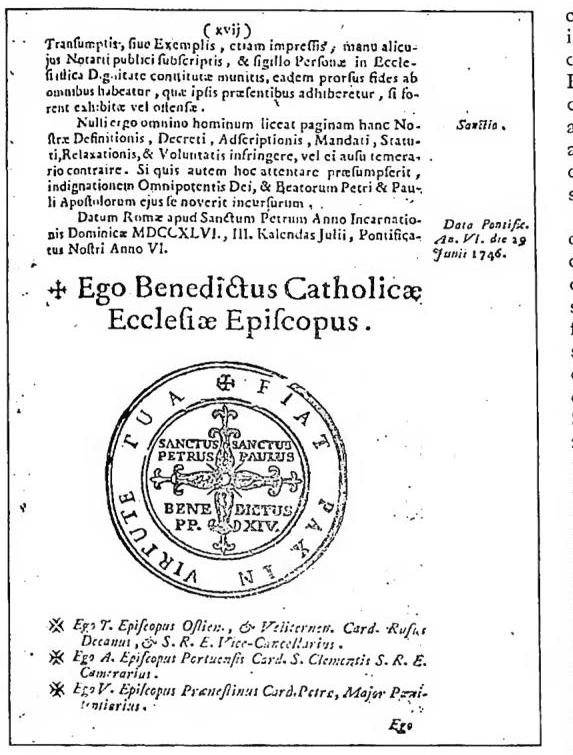
At first, after the discussion of the virtues of a Servant of God, when the judgment was favorable and the Pope had given his consent, the matter was simply noted among the acts of the Congregation of Rites; but soon the papal decision on this point revealed its fundamental importance for a cause. Thus, a certain ceremonial developed around II. By the time of Pope Clement XI (1700–21), it was already customary for the Pope to defer his decision for a time, and only after a period of prayer and reflection, on a proximate festive occasion, to reveal his «mind» in the presence of the Secretary and the Promoter General of the Faith, summoned for this purpose, and to order the publication among the acts. Pope Benedict XIV

Article illustration
Catechumenate: Canonizations - Explicit of the text at the time of the bull of canonization of St. Caterina de' Ricci (29 June 1746) - Vatican City, Archive of the Sacred Congregation of Rites.

Sometimes the Pope dictated the text himself "verbum ad verbum." The Apostolic Printing House then took care of its printing, and the text was affixed to the doors of the churches of Rome. After 1760, the text of these decrees became less formalistic and took on a more solemn tone, often beginning with a biblical quotation. The reading of these decrees was made even more solemn when the Pope had them read in public after a papal chapel or a papal visit to one of the churches of Rome. From 1870 onwards, the reading generally took place in the hall of the Consistory, in the presence of a host of invited guests and representatives of those interested in the cause; on these occasions, the Pope would also deliver a discourse. Notable among these are those of Pius XI. However, after his illness (1938), this custom ceased and was not resumed; now the reading takes place in private form, in the presence of the cardinal relator, the secretary, the Promoter General, and the postulator of the cause. It should be noted that even the decrees on the introduction of the cause, on miracles, and on the "Tuto" were customarily read with similar solemnity (at least after 1800). But at present even these decrees are published in private form.

Among the various more recent decrees concerning causes of beatification and canonization, we may recall only that of Pius X (26 Aug. 1913: AAS, 5 [1913], pp. 436-38), with which he restricted the use of the title "Venerable" to Servants of God whose heroic virtue or martyrdom had been recognized; he prescribed that in recent causes all opposing witnesses be heard, under pain of nullity; and finally established wise norms to better ensure, in ancient causes, the collection and examination of documents. Finally, with the motu proprio "Già da qualche tempo," Pius XI, on 6 Feb. 1930, instituted within the Congregation of Rites the Historical Section, a permanent body charged with all that pertains to the preparation of ancient causes and, in any case, with all matters relating to history and historical criticism in connection with the affairs to be handled by the Congregation (revision of historical readings, revision of liturgical books, and the like).

Throughout this period, the place of celebration for canonizations was the Vatican Basilica; this custom had prevailed since the return of the popes from Avignon. Boniface IX, due to indisposition, celebrated the canonization of St. Bridget in the internal chapel of the Vatican Apostolic Palace, but the following day he descended to the Vatican Basilica for the Solemn Mass.When Alexander VII prescribed the solemn beatification, as the concluding act of the first phase toward canonization, he wished it to take place in St Peter’s: “ut ibi fieret beatificatio, ubi fit canonizatio.” Benedict XIII, when he solemnly consecrated the basilica of the Lateran (1729), to spare expense since the basilica was already magnificently adorned, celebrated there the canonization of St John Nepomucene and the beatification of St Fidelis of Sigmaringa (19 and 24 March). Clement XII, a great patron of the same basilica, likewise celebrated in it the only canonization of his pontificate (1736) and the beatification of St Joseph of Leonessa. Benedict XIV (13 Dec. 1741) issued a constitution in which he laid down that canonizations and beatifications, whenever the Pope was in Rome, should be celebrated exclusively in the Vatican basilica. Yet the canonizations of 1881 and 1888, under Leo XIII, owing to the political events of 1870 and the years following, were carried out as best they could in the Hall of Blessings above the atrium of St Peter’s; only in 1897 did the ceremony return to the basilica.

It is worth noting also the case in which several saints were canonized at a single ceremony. Under Gregory XV, when the first instance of a quintuple canonization occurred, it was decided and settled to preserve the order of antiquity, namely the date of death, except that St Ignatius of Loyola, as founder, was given precedence over his spiritual son, St Francis Xavier, so that the order ran as follows: Isidore the Farmer, Ignatius, Francis, Teresa of Avila and Philip Neri. But under Clement X a consultation was sought from the celebrated canonist G. B. De Luca, who proposed the hierarchical order, a principle accepted by the decree of 6 Dec. 1670: “servandum esse ordinem hierarchiae ecclesiasticae; et si plures sint eodem ordine, praeforatur dies mortis.” Finally, under Clement XII (decree of 17 Apr. 1737), precedence was granted, within the same hierarchical order, to a religious founder. All such founders, however, are preceded by a martyr, since martyrdom is the most exalted witness to Christ.

Some details may now be given about certain aspects of the canonization ceremony. The solemn procession that precedes the Pope when he descends from the papal apartments into St Peter’s is in some respects very ancient, for the Pope was already received with solemn honours on his arrival in the Middle Ages. But once canonizations began to be regularly celebrated in St Peter’s, the Pope was accompanied by the entire papal court and household. We have evidence of this from the fifteenth century onwards. The procession for the canonization of St Hyacinth opened with the singing of the antiphon Ave maris stella, an usage that has remained to this day. The custom of carrying a banner bearing the image of the new saint dates from the canonization of St Stanislaus, bishop and martyr (1253), and is attributed even to a miracle: it is said that the saint’s image suddenly appeared before the cortege, which led in time to the use of a huge banner such as is still employed. The display of another banner

The banner hanging from the façade of St Peter’s Basilica dates back at least to the construction of the new St Peter’s.

The triple petition addressed to the Pope for the canonisation to appear in its full form dates from at least 1482 (cf. St BONAVENTURA). The procurator of the cause, from the end of the Middle Ages until about the 18th century, was always the ambassador of a Catholic power, assisted by a consistorial advocate, who would approach the Pope with urgent requests that he might wish to canonise the servant of God in question. The Secretary of Briefs to Princes would respond, and the Litany of the Saints would be intoned. The same parties would repeat the urgent petition, the Secretary would respond again, and the *Veni Creator Spiritus* would be intoned; finally, after the third most urgent petition, the Pope would pronounce the definition, after which the advocate, on behalf of the ambassador, would request that the act itself be drawn up. The ceremony would conclude with the *Te Deum*. This solemn rite was maintained until recent times, when, to shorten the excessively long ceremony, the Litany of the Saints was moved to the beginning of the procession, while the three petitions were combined into a single one, followed by the *Veni Creator* and the definition. Even in the time of Clement XI the wording of the canonisation varied somewhat.

The same Clement XI, who was very fond of preaching to the people, also delivered the homily after the canonisation, a practice that had not always been observed before him but became standard thereafter.

The offertory, one of the most singular and characteristic ceremonies of canonisation in its present form, dates back, as has already been noted, at least to that of St BRIGID (1391). Benedict XIII, having sought the opinion of the blessed Cardinal Tommasi, suppressed the custom of offering animals; however, Benedict XIV restored it without further ado, and it has remained in force to this day. As for its origin, those authors who claim that the papal master of ceremonies Pietro Amely, whose description survives, was its inventor have been misled by a hasty reading; Amely merely states that the elaborate adornment of the papal chapel for such a celebration was of his own design; the rite itself of the offertory, including that of the animals, appears to be more ancient, but we lack information. The offerings of candles, bread and wine are taken from the ritual for the dedication of churches or the consecration of bishops. The more or less learned deductions of ancient and modern authors regarding the significance of the offering of animals are without real foundation.

A final note on the lavish decorations used in canonisations. The various accounts and descriptions contained in the *Ordo Romanus* of the 14th and 15th centuries, in the diaries of Paris de Grassis, and in the Roman ceremonial of Marcello, all unanimously recall the richness of the adornments and illuminations used in canonisations. In the new Vatican Basilica, with its vast space so admirably suited to papal ceremonies, the design of the decorations was soon entrusted to the most renowned artists. It is enough to consult the engravings inserted in the printed acts of canonisations to admire the variety and grandeur of these arrangements, which at times quite transformed the appearance of the basilica. Among the most notable artists whose designs survive, we may mention Bernini, Borromini, Carlo Fontana, Vanvitelli, Valadier, Poletti and Vespignani. For half a century now, no change has been made to these designs. The introduction of electric lighting has led to the number and arrangement of the chandeliers being fixed (it is said that there are about one hundred thousand lights).

V. LIST OF CANONISATIONS PREPARED BY THE SACRED CONGREGATION OF RITES FROM CLEMENT VIII (1594) TO PIUS XII (followed at the end by those canonisations already definitively fixed for the Holy Year 1950 up to the end of June 1949. It should be noted that sometimes the bulls of canonisation were not published at the same time as the solemn canonisation; the list gives only the dates of the solemn canonisations).

Clement VIII, 14 April 1594: St Hyacinth of Odrowąż (15 August 1257); 29 April 1600: St Raymond of Peñafort (6 January 1275).

Paul V, 29 May 1608: St Frances of Rome (9 March 1440); 1 November 1610: St Charles Borromeo (3 November 1584).

Gregory XV, 12 March 1622: for the first time in history, the canonisation of a group of five saints: St Teresa of Jesus (15 October 1582), St Philip Neri (26 May 1595), St Ignatius of Loyola (31 July 1556), St Francis Xavier (2 December 1552), St Isidore the Farmer (15 May 1130).

Urban VIII, 25 May 1625: St Elizabeth, Queen of Portugal (4 July 1336); 24 April 1629: St Andrew Corsini (6 January 1373).

After an interruption of nearly thirty years:

Alexander VII, 1 November 1658: St Thomas of Villanueva (8 September 1555); 19 April 1665: St Francis de Sales (28 December 1622).

Clement IX, 28 April 1669: St Peter of Alcántara (18 October 1562) and St Mary Magdalene de’ Pazzi (25 May 1607).

Clement X, a second group canonisation of five saints, 12 April 1671: St Rose of Lima (24 August 1617), St Louis Bertrand (9 October 1581), St Cajetan of Thiene (7 August 1547), St Francis Borgia (30 September 1572), St Philip Benizi (22 August 1585).

Alexander VIII, another group canonisation of five saints, 16 October 1690: St Lawrence Giustiniani (8 January 1455), St John of Saint Facundus (11 June 1479), St Paschal Baylon (17 May 1592), St John of God (8 March 1550), St John Capistran (23 October 1456).

Clement XI, 22 May 1712: St Pius V (10 May 1572), St Andrew Avellino (10 November 1608), St Felix of Cantalice (18 May 1587), St Catherine Vigri of Bologna (9 March 1463).

Benedict XIII, 10 December 1726: St Turibius Alfonso de Mogrovejo (23 March 1606), St James of the Marches (28 November 1476), St Agnes Segni of Montepulciano (20 April 1317); 27 December 1726: St Pellegrino Laziosi (10 May 1345), St John of the Cross (de Yepes; 14 December 1591), St Francis Solano (14 July 1610); 31 December 1726: St Aloysius Gonzaga (21 June 1591) and St Stanislaus Kostka (15 August 1568); 16 May 1728: St Margaret of Cortona (22 February 1297); 19 March 1729: St John (Nepomucene) Wolf of Pomuk (16 May 1393).

Clement XII, 16 June 1736: St Vincent de Paul (Depaul; 27 September 1660), St John Francis Regis (31 December 1640), St Catherine Fieschi-Adorno of Genoa (15 September 1510), St Giuliana Falconieri (19 June 1340).

Benedict XIV, a third group canonisation of five, 29 June 1746: St Fidelis of Sigmaringen (Mark Roy; 24 April 1622), St Camillus de Lellis (14 July 1614), St Peter Regalado (13 May 1456), St Joseph of Leonessa (4 February 1612), St Catherine de’ Ricci (2 February 1590).

Clement XIII, the first canonisation of six saints together, 16 July 1767: St John Cantius (24/25 December 1473), St Joseph of Cupertino (18/19 September 1603), St Joseph Calasanz (25 August 1648), St Jerome Emiliani (8 February 1537), St Seraphin of Montegranaro (12 October 1604), St Jane Frances de Chantal (13 December 1641). There follows a gap of forty years.

Pius VII, another canonisation of five saints, 24 May 1807: St Francis Caracciolo (4 June 1608), St Benedict the Moor, the ‘Moor’ (4 April 1589), St Angela Merici (27 January 1540), St Colette Boilet (6 March 1447), St Giacinta Marescotti (30 January 1640). There follows another gap of thirty-five years.

Gregory XVI, 26 May 1839, another group canonisation of five: St Alphonsus Maria de’ Liguori (1 August 1787), St Francis Jerome (11 May 1716), St John Joseph of the Cross (Charles Gaetano; 5 March 1734), St Pacificus of San Severino (24 September 1721), St Veronica Orsola Giuliani (9 July 1727).

Pius IX, 8 June 1862: the 26 Japanese martyrs (6 Franciscans, 3 Jesuits, 17 laypeople: 5 February 1597) and St Michael de Santi (10 April 1725); 29 June 1867, a solemn canonisation for the centenary of the death of St Peter: St Josaphat Kuncewicz (12 November 1623) and St Peter Arbues (17 September 1485), martyrs; the 19 Martyrs of Gorkum (11 Franciscans, one Dominican, three Premonstratensians, one

Article illustration
Canonization — Decree for the approval of the writings of the Venerable Servant of God Tommaso della Vergine, Trinitarian (1 Apr. 1775) — Vatican City, Archive of the Sacred Congregation of Rites.

Among the saints canonized by the Roman Pontiffs are: s. Agostino (354-430), four secular priests, one layman: 9 July 1572), s. Paolo della Croce (Paolo Francesco Danei; 18 Oct. 1775), s. Leonardo da Porto Maurizio (26 Nov. 1731), s. Maria Francesca delle Cinque Piaghe (Anna Maria Gallo; 6 Oct. 1791), s. Germana Cousin (1601; no other indication; the feast was fixed on 15 June).

LEO XIII, on 8 Dec. 1881, s. Giovanni Battista de Rossi (23 May 1764), s. Lorenzo da Brindisi (Cesare de Rossi; 22 July 1619), s. Benedetto Giuseppe Labre (16 Apr. 1783), s. Chiara da Montefalco (18 Aug. 1308); on 15 Jan. 1888, the Seven Founders of the Order of Servites, s. Pietro Claver (8 Sept. 1634), s. Giovanni Berchmans (13 Aug. 1621), s. Alfonso Rodriguez (31 Oct. 1617); on 27 May 1897, s. Antonio M. Zaccaria (5 July 1539), s. Pietro Fourier (9 Dec. 1640); on 24 May 1900, s. Giovanni Battista de la Salle (7 Apr. 1719), s. Rita da Cascia (22 May 1457).

PIUS X, on 11 Dec. 1904, s. Alessandro Sauli (11 Oct. 1592), s. Gerardo Maiella (15 Oct. 1755); on 20 May 1909, s. Giuseppe Oriol (22 March 1702), s. Clemente M. Hofbauer (15 March 1820).

BENEDICT XV, on 13 May 1920, s. Gabriele dell'Addolorata (Francesco Possenti; 27 Feb. 1862) and s. Margherita Maria Alacoque (17 Oct. 1690), on the following 16th s. Giovanna d'Arco (30 May 1431).

PIUS XI celebrated 15 canonizations in the Holy Year 1925: on 17 May 1925, s. Teresa del Bambino Gesù (Teresa Martin; 21 Dec. 1897); on the 21st, s. Pietro Canisio (Kanis, Kanijs; 21 Dec. 1597); on the 24th, s. Maria Maddalena Postel (16 July 1846), s. Maddalena Sofia Barat (24 May 1865); on the 31st, s. Giovanni Eudes (19 Aug. 1680), s. Giovanni Batt. M. Vianney (4 Aug. 1859). On 22 June 1930, s. Lucia Filippini (23 March 1732), s. Caterina Thomás (5 Apr. 1574); on the 29th, the eight Canadian Jesuit martyrs, s. Giovanni di Brébeuf and companions (1642-49), s. Roberto Bellarmino (17 Sept. 1621), s. Teofilo da Corte (19 May 1740). During the Holy Year of Redemption 1933-34 there were six canonizations. On 4 June 1933, s. Andrea Uberto Fournet (13 May 1834); on 8 Dec., s. Maria Bernarda Soubirous (16 Apr. 1879); on 14 Jan. 1934, s. Giovanna Antida Thouret (24 Aug. 1826); on 4 March, s. Maria Michela del S.mo Sacramento (Desmaisières; 24 Aug. 1865); on the 11th, s. Luisa de Marillac, widow La Gras (15 March 1660); on the 19th, s. Giuseppe Benedetto Cottolengo (30 Apr. 1842), s. Pompilio M. Pirrotti (15 July 1766), s. Teresa Margherita del S. Cuore di Gesù (Anna M. Redi; 7 March 1770); on 1 Apr. 1934, s. Giovanni Bosco (31 Jan. 1888); on 20 May, s. Corrado da Parzham (Giov. Ev. Birndorfer; 21 Apr. 1894). On 19 May 1935, s. Giovanni Fisher (22 June 1535) and s. Tommaso Moro (9 July 1535); on 17 Apr. 1938, s. Andrea Bobola (16 May 1657), s. Giovanni Leonardi (9 Oct. 1609), s. Salvatore da Orta (18 March 1567).

PIUS XII, on 3 May 1940, s. Gemma Galgani (11 Apr. 1903), s. Maria di s. Eufrasia Pelletier (24 Apr. 1868); on 7 July 1946, s. Francesca Sav. Cabrini (22 Dec. 1917); on 15 May 1947, s. Nicola di Flüe (21 March 1487); on 22 June, s. Giovanni de Britto (4 Feb. 1695), s. Bernardino Realino (2 July 1616), s. Giuseppe Cafasso (23 June 1860); on 6 July, s. Michele Garicoits (14 May 1863) and s. Elisabetta Bichier des Ages (26 Aug. 1838); on 20 July, s. Luigi Maria Grignion di Montfort (28 Apr. 1716); on 27 July, s. Caterina Labouré (31 Dec. 1876); on 15 May 1949, s. Giovanna di Lestonnac (2 Feb.

Written. Here too the canonical procedure and the formal canonization are lacking, but the effect is the same; it is enough to recall that even for saints formally canonized, besides the act of canonization, a second act is required, by which the Pope imposes the feast on the universal Church. Thus we remain within the sphere of equivalent canonization. 2) Benedict XIV, however, constitutes a second group of saints, for whom he notes the papal act of imposing the feast on the whole Church, without any previous canonical procedure or formal act of canonization. These are the saints inserted by papal act into the universal calendar. Since, moreover, a calendar of the universal Church, in the strict sense, exists only from the time of St Pius V (v. UNIVERSALISTI), equivalent canonization in this latter sense is found in all cases in which a Pope inserts the feast of a saint, never formally canonized, into the said calendar. Benedict XIV, among other things, adduces as examples the saints Romuald, Norbert, Bruno, Peter Nolasco, Raymond Nonnatus, John of Matha and Felix of Valois, Stephen of Hungary, Venantius, Gregory VII, etc. After the time of Benedict XIV the list of such cases could be greatly extended (St Peter Damian, Bede the Venerable, Cyril of Jerusalem and Cyril of Alexandria, Scholastica, Irene, Boniface apostle of Germany, Augustine apostle of England, etc.).

In fact, liturgists and canonists have accepted this view of Benedict XIV, and down to our own times the insertion of saints not formally canonized into the calendar of the universal Church has been regarded especially as an example of equivalent canonization. Yet the same Benedict XIV, in the same work, Bk. IV, part 2, ch. 6, discusses at length the concession of Mass and Office in honour of saints not canonized; here he presents as examples, among others, Norbert, Bruno, Peter Nolasco, John of Matha and Felix of Valois, Stephen of Hungary—all already cited as examples of equivalent canonization; but here he no longer speaks of equivalent canonization, but of something entirely different. Are the cases cited, then, equivalent canonization or not? At least the matter does not appear altogether clear, and the author has somewhat complicated the issue.

Recent times, however, have at last brought us two papal acts expressly declared to be equivalent canonizations: the equivalent canonization of St Albert the Great under Pius XI (16 Dec. 1931: AAS, 24 [1932], pp. 1-17) and of St Margaret of Hungary under Pius XII (19 Nov. 1943: AAS, 36 [1943], pp. 33-40). In both cases there preceded a historical-critical study by the historical section of the Sacred Congregation of Rites and the subsequent discussions of the historical consultors and above all of the ordinary Congregation. The normal procedure was therefore lacking; no miracles were required; but the Supreme Pontiff proceeded, by his own full authority, to proclaim the two persons as saints to be venerated as such throughout the Church. For St Albert the Great the feast was imposed on the universal Church at the same time, given that he was also declared, in the same papal act, a Doctor of the Universal Church; the feast of St Margaret, however, was not imposed on the universal Church. In both papal acts it is clearly stated that the act itself is to be a true and full equivalent canonization.

From this point a twofold meaning of equivalent canonization emerges: in the sense of Benedict XIV, namely as the extension or imposition of the feast of a saint not formally canonized, which today must be called equivalent canonization in an improper or broad sense; and in the sense of the two papal acts just cited, namely true and proper equivalent canonization in the strict sense.

When the schemas for the Code of Canon Law were being prepared, a schema for equivalent canonization had also been drawn up, but it was later withdrawn in order to leave the Supreme Pontiffs full freedom to proceed in this field. Hence no precise juridical definition or norm for procedure in individual cases exists. It is certain, however, that a person proposed to the Pope for equivalent canonization must present certain indispensable elements, such as, for example, the authenticity of the person, historical proof of the virtues or certainty of martyrdom, the existence of true miracles wrought by the person after death, the existence of an ancient and genuine liturgical cult, its origin, its continuation, and a certain prominence of the person—elements historically verified in the two cases now existing of true and proper equivalent canonization.

VII. CANONIZATION AND THE CHURCH

Canonization constitutes, in the life of the Catholic Church, an essential element, inasmuch as it attests the holiness of the Church itself throughout history, a property or distinguishing mark of the true Church of Christ confessed in the Nicene-Constantinopolitan Symbol. This holiness must certainly be verifiable, and the Church must be able to show the world the holiness of its members in a tangible way. Here we are not dealing merely with the holiness common to all Christians to which they are called, but above all with outstanding holiness, to which many Christians can and do in fact attain. The mark of outstanding holiness has never been lacking in the Catholic Church, but since it is an external element, the Church must have the means and faculty to declare, in doctrinal form, that this or that person is truly holy, that is to say, that he or she expresses, in his or her life, the evangelical ideal prefigured and demanded by Christ. This official declaration is precisely canonization.

For the life of the Church, therefore, it is necessary that the mark of holiness should never be lacking, but it is not necessary for the Church that this or that person be canonized. Of the number of saints who have lived and will live in the Church, only a few will and are destined, by positive disposition of Providence, to receive explicit recognition of their holiness in canonization. This is also the reason why the Church, as such, does not take the initiative in introducing a cause, but leaves this to Providence, which makes use for its purposes of ordinary means and ways. Sometimes, however, the history of a cause reveals very clearly particular dispositions of God; see, for example, the extraordinary speed with which the cause of the Capuchin friar Conrad of Parham was conducted (the most rapidly concluded cause in recent times: introduction 1914, canonization 1934).

The immediate and direct object of the papal definition in canonization is solely the fact that the soul of the holy person enjoys the glory of heaven; this, however, is not a fact directly included in the treasure of supernatural revelation, closed after the death of the last Apostle; therefore the Pope cannot define it as an object of divine faith, but only as an object of ecclesiastical faith. Vatican Council I, in its exposition of papal infallibility, does not expressly name the canonization of saints as an object of papal infallibility. It is, however, the common doctrine of theologians that the Pope in canonization is truly infallible, since it is a most important act pertaining to the moral life of the universal Church, inasmuch as the saint is proposed not only for veneration because he enjoys heavenly glory, but also as a model of virtue and of the real holiness of the Church. It would be intolerable if the Pope in such a declaration, which involves the whole Church, were not infallible. This doctrine is supported by not a few canonization bulls, even from the Middle Ages, by the deductions of canonists from the Middle Ages onwards, and by theologians from St Thomas Aquinas. Benedict XIV teaches that it is

It is likewise heretical and temerarious to teach the contrary. - See Pls. XLII-XLIV.

Bibl.: The indispensable work, and one which, in a certain sense, has not yet been surpassed, is the monumental *De servorum Dei beatificatione et beatorum canonizatione* by Card. Prospero Lambertini, 5 vols., Bologna 1734-38. The learned Jesuit Fr. De Azevedo prepared a new edition of it in 1747-1751, enlarged and furnished with copious indices. The latest edition is that of Prato 1839-46. N. Baudeau published a summary: *Analyse de l'ouvrage de Benoît XIV sur les béatifications et les canonisations*, Paris 1750. Fr. De Azevedo also produced a much-praised summary: *Doctrina de servorum Dei beatificatione et beatorum canonizatione, ex libris Benedicti XIV redacta in synopsis*, Rome 1760. A similar adaptation was made by the Capuchin Fr. Joseph d'Audierne: *Lettres curieuses, utiles et théologiques sur la béatification des serviteurs de Dieu, et la canonisation des béatifiés, on abrégé du grand ouvrage du card. Prosper Lambertini, pape sous le nom de Benoît XIV, sur la même matière*, 5 vols., Rennes 1788-64. The work of the learned cardinal now appears somewhat cumbersome, but its undisputed merit lies in having gathered together an immense body of material. He presented it, however, as a canonist rather than as a historian, so that his tendency was to systematize it too often in a formalistic manner. The theological-doctrinal part, on the other hand, is excellent. Because the author was later elevated to the supreme pontificate, his work acquired a very considerable authority, almost unchallenged even today. In the Sacred Congregation of Rites he is known as the “Magister v.”

Historical treatments: P. Dürfler, *Die Ausbreitung der Heiligenverehrung nach den römischen Inschriften und Bildwerken*, Munich 1913; L. Hertling, *Materiali per la storia del processo di c.*, in *Gregorium*, 16 (1935), pp. 170-95 (very important); F. Gagna, *De processu canonizationis a primis Ecclesiae saeculis usque ad CIC*, Rome 1937-38 (doctoral thesis); G. Giaquinta, *Ricerche sull'istituto giuridico della c. dalle origini alle Decretali di Gregorio IX*, ibid. 1947.

Legal treatments, canonical procedure: all the best canonists treat of the process of canonization more or less extensively and profoundly. Only the principal ones are listed here: T. Malvezzi, *Tractatus de sanctorum canonizatione*, Bologna 1487; it is the first printed canonistic treatise; it is also found in vol. 14, tom. XX of *Tractatus universi Iuris*, Venice 1534, ff. 97-103; G. Castellani, *Tractatus de sanctorum canonizatione*, Rome 1520, Venice 1605; F. Contelori, *Praxis de canonizatione sanctorum*, Lyons 1609 and 1634, describes the procedure before the reform of Urban VIII; A. Rocca, *De sanctorum canonizatione commentariis*, Rome 1610; id., *Opera omnia*, II, ibid. 1719 (a work of great learning); L. Castellini, *Elucidarium theologicum de certitudine gloriae sanctorum canonizationum*, ibid. 1618 and 1628 (very important because it treats the state of development of causes in relation to the reforms of Urban VIII); C. F. De Matta, *Novissimus de canonizatione sanctorum tractatus*, ibid. 1628 and 1668 (a classic, since it bridges the ante- and post-Urbanian eras); F. Scacchi, *De cultu et veneratione sanctorum in ordine ad beatificationem et canonizationem*, I. *De notis et signis sanctitatis beatificandorum et canonizandorum*, ibid. 1639 and 1679. The other three volumes: II. *De martyrio*, III. *De beatificatione*, IV. *De ordine iudiciario harum causarum*, remained unpublished; A. Matteucci, *Practica theologico-canonica ad causas beatificationum et canonizationum pertractandas*, Venice 1722 and 1751 (a good work, but soon overshadowed by that of P. Lambertini); S. Trama, *Manuale pro conficiendis processibus in causis beatificationis*, Naples 1904; G. Noval, *Commentarium CIC*, IV, part 2°, *De causis beatificationis sanctorum Dei et canonizationis beatorum*, Turin-London 1932 (a very extensive treatment inspired by the work of Benedict XIV, excellent in its information); J. Brosch, *Der Heiligsprechungsprozess per vitam cultus*, Rome 1938 (illustrates the procedure for the confirmation of cult with ample exemplification drawn from the cause of Bl. Joseph Hermann); S. Indelicato, *Le basi giuridiche del processo di beatificazione. Dottrina e giurisprudenza intorno alla introduzione delle cause dei servi di Dio*, ibid. 1944; id., *Il processo apostolico di beatificazione*, ibid. 1945 (continuation of the preceding); special mention should be made of the work which has become a classic: *Codex pro postulatoribus causarum beatificationis et canonizationis*, sponsored by the General Postulation of the Friars Minor; the 1st ed. was prepared by the advocate of the Rites, L. Lauri (Rome 1879), the 2nd by the notary etc. G. Fornari (ibid. 1909), the 3rd (ibid. 1923) and the 4th (ibid. 1929) by the General Postulator of the Franciscans, Fr. A. M. Santarelli.

On heroic virtue: L. Brancati de Lauria, *De virtute heroica*, in *Commentaria in III et IV librum Sententiarum Ioannis Duns Scoti*, Rome 1653-82, II, Disputatio XXXII, pp. 709-815 (a fundamental theological study); M. Lappi, *De heroicitate virtutum in beatificandis et canonizandis requisita*, ibid. 1671, is the application of theory to the treatment of causes; P. Lambertini (Benedict XIV), *De Servorum Dei beatificatione et de beatorum canonizatione*, III, chaps. 21-25 (pp. 207-85 of the Prato ed. 1840, definitive formulation of the matter); R. Hofmann, *Die heroische Tugend. Geschichte und Inhalt eines theologischen Begriffs*, Munich 1933 (a broad theoretical-practical study of the concept of heroicity and its application in the causes of saints); L. Hertling, *Theologiae ascetica cursus brevior*, 2nd ed., Rome 1944, pp. 3-23; R. Garrigou-Lagrange, *Le virtù eroiche nei bambini*, Turin n.d.

On the papal infallibility in canonization: besides the theologians well known to all such as St. Thomas, Bellarmine, Suárez, Báñez etc. and the ordinary dogmatic treatises on the subject, cf.: L. Castellini, *Elucidarium theologicum de certitudine gloriae sanctorum canonizationum*, Rome 1618 and 1628, with particular reference to the question; G. B. Riccioli, *Immunitas ab errore tam speculativa quam practico definitivam S. Sedis apostolicae in canonizatione sanctorum*, Bologna 1668; F. Spedalieri, *De infallibilitate Ecclesiae in sanctorum canonizatione causa seu titulo*, in *Antoniarum*, 22 (1947), pp. 3-22; id., *De Ecclesiae infallibilitate in canonizatione sanctorum quaestiones selectae*, Rome 1949.

Rite of canonization and beatification: Card. G. Gaetani Stefano, who preserved the account of three canonizations in which he participated: 1) of St. Celestine V, in 1313; *De canonizatione Caelestini V*, in *Acta SS. Maii*, IV, Paris 1866, pp. 479-80; 2) of St. Louis of Toulouse, in 1317; text in *Ordo Romanus XIV*, chaps. 11 and 15; *PL* 78, 1249-50, 1254-59; 3) of St. Thomas de Canteloup, in 1320; notice in L. H. Labande, *Le cérémonial romain de Jacques Cajetan* (*Bibl. de l'Ecole des chartes*, 54), Paris 1893, p. 69; S. S. P. Amely, *De canonizatione s. Brigidae* (in 1391), in *Ordo Romanus XV*, chap. 153; *PL* 78, 1359-62; P. Galesini, *Vita s. Bonaventurae* (canonized in 1482), in *Acta SS. Iulii*, III, Paris 1867, p. 820; S. Cristoforo Marcello, *Ritum ecclesiarum sive sacrorum canonarium, S. R. F. libri tres*, I, 6; *De canonizatione*, Rome 1516 and subsequent editions. Cf. the ample and erudite exposition of this work, dedicated to Benedict XIV by Giuseppe Catalani (I, Rome, pp. 220-48); G. B. Mari, *Distribua de mystica rerum significatione quae in sancto-rum canonizatione ad Missarum solemnia S. M. Pontifici offerti solvi*, ibid. 1638; D. Cappello, *Contextus actorum omnium in beatificatione et canonizatione s. Francisci de Sales, ep. Genevernis, a S. M. D. N. Alexandro VII P. M. Sanctorum fastis adscripti*, ibid. 1665 (rite of beatification and canonization); U. De Rubies, *Relazione dell'apparato fatto in S. Pietro per la c. de cinque santi... canonizzati a' 16 ott. 1690 da Alessandro VII*, ibid. 1690; G. Chiapponi, *Acta canonizationis sanctorum Pi. V... habitae a S. M. D. N. Clemente XI... quibus accedit districato eiusdem super mysteriis oblationum in Missa canonizationis...*, ibid. 1720; G. B. Memmi, *Il rito di canonizzare i santi spiegato*, ibid. 1726; O. Agnello, *Dissertatio: sul rito della c. de' santi*, Lucca 1737; G. Amici, *Il sacro rito della c. brevemente descritto*, Rome 1807, 2nd ed. enlarged by his son, ibid. 1839 (also French version); G. Moroni, *Le Cappelle pontificie, cardinalizie e prelatizie*, historical-liturgical work, Venice 1841, passim pp. 98-132 and 366-68; St. Ciccolini, *Delle oblazioni presentate al Sommo Pontefice nella c. de' Beati...*, Rome 1867 (also French version); J. Brinkhine, *Die feierliche Papstweihe*, ibid. 1925; Th. Klauser, *Die Liturgie der Heiligsprechung*, in *Heilige Überlieferung*, Münster in W. 1938, pp. 212-23 (a very serious scholar); Anon., *Rito e cerimonie per le beatificazioni e c.*, Milan 1947.

Encyclopedic treatments: G. Moroni, s.V. in *Dizionario di erudizione storico-ecclesiastica...*, VII, Venice 1841 (much material, but not always critically evaluated); T. Ortolan, *Canonisation dans l'Église romaine*, in *DThC* II, cols. 1626-59, a rather canonistic and doctrinal treatment with much bibliography; R. Naus, *Causes de beatification et de canonisation*, in *DDC* III, cols. 10-37, predominantly canonistic, with bibliography; L. Hertling, *Canonisation*, in *DSP*, 11 (1937), cols. 775-85, contains a brief history; very important is a list of medieval processes published; broad doctrinal exposition from the ascetical point of view.

LISTS OF CANONIZATIONS: the first printed list of canonizations is that of Peter de Natalibus, *Catalogus sanctorum et gestorum eorum*, Venice 1493, pp. 272-75 (chap. *De sanctis nuper canonizatis*); L. Castellini, *Elucidarium theologicum de certitudine gloriae sanctorum canonizationum*, Rome 1628, pp. 430-52 (chap. *Numerosus catalogus illorum iustorum tantum, qui publico ac solenni ritu ad Ecclesiae Romanae album adscripti fuere... nondum editis*, in alphabetical order, without chronological indication); A. Rocco, *De canonizatione sanctorum*, in *Opera omnia*, I, ibid. 1719; ibid., pp. 146-50; *Catalogus sanctorum quorum canonizationes interimi potuerunt* dall'803 al 1601, the year in which this treatise was published, with a fairly critical system; I. Fontanini, *Codex constitutionum quas Summi Pontifices ediderunt in solemni canonizatione sanctorum a Ioanne XV ad Benedictum XIII sive ab an. 993 ad a. D. 1729*, ibid. 1729 (a fundamental but incomplete work); Anon., *Breve notizia delle solenni c. dei santi, celebrate in diversi tempi nella patriarcale basilica Vaticana*, ibid. 1807, 2nd ed., ibid. 1839 (a rare little work; the author was able to make use of manuscript notes of the papal ceremoniers); G. Moroni, *Catalogo dei santi dal Romani Pontefici solennemente canonizzati*, in *Dizionario di erudizione storico-ecclesiastica...*, VII, Venice 1841, pp. 307-11; not critical regarding the Middle Ages; Anon., in *Analecta iuris pontificii*, 5 (1861), cols. 1057-59 (from 993 to 1861).

very restrained); X. Barbier de Montault, Oeuvres complètes, IX. Poitiers 1894, pp. 134-44 (Catalogue des Canonisations, from 993 to 1888, a compilation not always critical); A. Battander, Annuaire pontifical catholique, 4 (1901), pp. 528-55 (ch. Liste des bénédictions et canonisations faites au XIXe siècle: 1800-1900; it should be noted that Battander gives the dates of the relevant apostolic bulls and letters, which, however, are not always those of the solemnity itself); ibid., 6 (1903), pp. 409-19 (ch. Canonisations formelles, a very rich catalogue, but not always historically reliable); Catálogo de los santos que han sido canonizados por los Romanos Pontífices desde León III a principios del siglo IX hasta el papa reinante Pío X (an uncritical list), in Enc. cur.-amer., XI, p. 195; K. Richtsätter, Die Heiligen des letzten Jahrtausends, in Stimmen der Zeit, 112 (1927), pp. 82-84 (a list of canonized saints arranged according to the date of their death, up to 1925, very accurate); M. R. Toynbee, S. Louis of Toulouse and the process of canonisation in the fourteenth century, Manchester 1929 (appendix D lists those of the 13th c., appendix E those of the 14th, but also includes local canonizations); Th. Klauser, Die Liturgie der Heiligsprechung, in Heilige Überlieferung, Münster 1938, pp. 229-33 (a list of canonizations from 993 to 1485, but only those for which secure historical sources are known, which are always cited; very useful and of primary importance); Anon. [A. Carinci], Acta canonizationis Pii XI, I, Roma 1939, pp. 12-16 (a list of canonizations from 1588 to 1939).

STATISTICS OF CAUSES BEFORE THE S. CONGREGATION OF RITES: the S. Congregation of Rites has published, since 1890, from time to time, the Catalogus et status causarum beatificationis Servorum Dei et Beatorum canonizationis. We give a complete list with an indication of the number of causes recorded: 1890, status as of 1 Oct.; causes no. 152; 1895, status as of 1 Jan.; causes no. 215; 1901, status as of 1 Mar.; causes no. 287; 1909, status as of 1 Apr.; causes no. 321; 1921, status as of 1 Nov.; causes no. 328; 1931, status as of 1 Sept.; causes no. 551. Up to this year only causes proceeding by the non-cultus route, i.e., by the ordinary method, are recorded. Also: 1941, status as of 13 Apr.; causes no. 764. The increase in number is partly due to the criterion adopted of recording also causes proceeding by the cultus route (confirmation of cult). Giuseppe Löw

CANONIZATION OF CIVIL LAWS. — In certain matters the Church, instead of formulating its own legal norms directly, establishes that the laws enacted by the various States on those matters shall be valid as norms of canon law: the norms enacted by the State, inasmuch as they thereby become part of the Church’s legal system, are called, in an expression now traditional, “canonized civil laws” (leges civiles canonizatae).

Naturally, for the Church to be able to do this, the matters in question must be those regulated by the laws of the State; and indeed we see that in the CIC the canonization of civil laws occurs almost exclusively with regard to contracts (cf. cann. 33 § 2, 1529, 1926 and 1930) and prescription (cf. cann. 1508), for which matters, therefore, the Church’s legislation is not uniform but varies from State to State.

The reason why the Church resorts to this indirect method in establishing certain norms is above all the desirability that in certain matters the canon norms should be identical or nearly identical to the civil ones, and moreover should conform to the requirements arising from the character of the various peoples and from differing circumstances of place and time.

It is obvious, however, that just as the Church cannot enact laws contrary to divine law, so civil norms can have the force of canon law only insofar as they do not conflict with divine law: this reservation is sometimes explicitly stated by the Church when it canonizes civil laws, but it must be understood even when it is not expressed. Furthermore, just as the Church, by canonizing civil laws, does not thereby lose the power to enact laws on the same matter, should it wish to regulate it fully with norms of its own, so, in canonizing civil laws, it may derogate from them at certain points with its own norms, which will therefore prevail in the Church’s legal system over the corresponding civil norms: we see, for example, that although, as has been said, civil laws on contracts and prescription are canonized, the Church has nevertheless established various norms regarding contracts entered into by ecclesiastical entities, and regarding prescription in ecclesiastical matters; these norms derogate from the civil laws, which will therefore be applicable in such matters only insofar as, besides not being contrary to divine law, they are also compatible with the norms enacted by the Church.

It should be noted that there are also cases in which the ecclesiastical legislator refers to the laws of the State without thereby having canonized them; this occurs, for example, when a canon norm mentions legal institutions in such a way as to presuppose the norms of the respective State legal system (cf. cann. 600 n. 3, 1613 § 1, etc.); or makes certain legal situations depend on the state of the State’s legal norms (cf. cann. 547 § 2, 581 § 1, 1513 § 2, etc.); or finally refers to civil law to declare that it, and not canon law, is to govern certain relationships (cf. cann. 1016, 1813 § 2, 2108).

BIBL.: V. GIUDICE, Il diritto dello Stato nell’ordinamento canonico, in Arch. giuridico, 91 (1924), pp. 3-27; P. Cipriotti, Contributo alla teoria della c. delle leggi civili, Roma 1941; O. Cassola, La recessione del diritto civile nel diritto canonico, Tortona 1941. Pio Cipriotti

CANORI-MORA, ELISABETTA, Venerable. — B. Rome 21 Nov. 1774, d. there 5 Feb. 1825.

Of a distinguished Roman family, she was sent to the monastery of the Augustinian nuns of St Rita at Cassia for her education, but left after three years because of poor health. In 1796 she married Cristoforo Mora, a doctor of medicine. In her marriage Elisabetta suffered greatly from her husband’s jealousy and infidelities, and his dissipation brought the family almost to poverty. She bore all this with admirable patience, devoting herself to the education of her daughters and to a life of piety, joining the Third Order of the Trinitarians. She received supernatural gifts, ecstasies, visions, prophecies; she also endured the pains of the mystical night and suffered assaults and vexations from the devil. The first fruit of her continual sufferings was the conversion of her husband, who, after becoming a widower, entered the Conventual Franciscans, where he lived and died as a good priest.

Pius IX introduced her cause of beatification in 1864, and Pius XI declared her heroic virtues on 26 Feb. 1928.

BIBL.: A. Pagani, Biografia della ven. E. C. M., Roma 1911; [C. Testore], Inviti all’eroismo, II, ibid. 1942, pp. 159-1942. Gennaro Moretti

CANOSA. — A city in Apulia, in the province of Bari, of ancient origin, known for its necropolises with rich grave goods and for notable remains of Roman buildings. Situated in a favourable position on a major thoroughfare, the Via Traiana, Christianity took root there early, assuming a predominant place in comparison with other centres in the region. It was thus one of the first episcopal sees in Apulia; as early as 357, among the participants in the Council of Sardica, a certain Stercorius ab Apulia de Canusio is mentioned (St Hilary, Fragm., II, 632; PL 10, 643; cf. Gregory the Great, Ep., I, 51 and Ughelli, X, 35). Even in the 6th century Canosa is listed among the most important cities of Apulia (Procopius, Bell. got., III, 18; Paul the Deacon, Hist. rom., II, 22), but it later suffered serious damage at the hands of the Lombards, so that between 689 and 706 the Duchess Teoderada, regent for her son Gisulfo, restored the bishopric there and built a church dedicated to St Sabinus, the patron saint of the city. Roughly at the same period should be dated the evident works of reconstruction of another large building, with a central plan within a square perimeter, unpublished, discovered and explored in 1937 about 1 km from the town, in a locality called S. Angelo and later S. Leucio, perhaps in memory of two successive different dedications. In a sarcophagus

A relic was found there, with a golden cross on its chest.

On the outskirts of the city, another Christian building had already been identified, dedicated to St. John the Baptist. It also had a central plan inscribed within a polygon, covered by a dome, with apses arranged in opposition, which was perhaps mistakenly thought to be a baptistery.

Noteworthy is the fact that in both buildings the walls appear to be hastily constructed, with extensive use of pre-existing materials—large, uneven blocks, patched and leveled with fragments of bricks or marble. In contrast, the arches are always built with newly manufactured bipedales. This technique is quite different from the Ravenna style and is more comparable to that of contemporary monuments in North Africa.

After Canosa was destroyed once again by the Saracens around the mid-9th century, its bishop, Peter, is said to have taken refuge in Salerno. Later, after the invaders were driven out, Bishop Angelarius is said to have transferred the relics of Sts. Rufinus, Memorus, and Sabinus from the ruins of his city to Bari. However, just as there are no reliable data on these events, neither is there any documentation for the alleged existence of a bull by Pope Sergius II, who, following this event, is said to have united the diocese of Canosa with that of Bari, which was elevated to an archdiocese.

Finally revived by the Normans, Canosa rebuilt its cathedral dedicated to St. Sabinus; Pope Paschal II inaugurated it in 1101. Notable within it are the marble cathedral supported by two elephants, carved for Bishop Orso toward the end of the 11th century, and the pulpit, the work of Acceptus the archdeacon. Beside the cathedral is the tomb of Bohemond (d. in 1111), with a fine bronze door, a hybrid of Byzantine and Arab art, signed by Rogerius of Melfi.

It is certain that after the 11th century the diocese of Canosa was united with that of Bari, recognized by Urban II as the primatial see of Apulia, and no further names of bishops solely of Canosa are recorded. Even today, the archbishop of Bari holds the united title of Canosa.

Bibl.: CIL, IX, 6192-95; J. Gay, L'Italie méridionale et l'Empire byzantin (867-1071), Paris 1904, pp. 193-96 and passim; E. Bertaux, L'art dans l'Italie méridionale, 1894, V. index; H. Nachod, Das Baptisterium von C., in Römische Mittheil, 30 (1915), pp. 116-28; N. Iacobone, Canusium, Lecce 1925; Lanzoni, pp. 288-95.

---

CANOSSA, LUDOVICO DI. — Of the Veronese branch of the counts of Canossa (who are not descended from the family of Countess Matilda), born in Verona in 1476 and died there in 1532. Through family connections, he was educated and trained at the courts of the Gonzagas of Mantua and the Montefeltros of Urbino, where he learned so well the art of court life that Baldassare Castiglione chose him as the model for the ideal courtier (Il Cortegiano, I, ch. 3).

A man of culture (he knew much Greek and collected books and manuscripts), a friend of scholars and artists, he was esteemed as one of the most skilled and capable diplomats of his age and was soon employed with success in embassies by Guidobaldo of Urbino and by Julius II, who on 10 February 1511 appointed him bishop of Tricarico. Leo X chose him as his majordomo and sent him as nuncio to France in May 1513, where he succeeded in reconciling Louis XII with Henry VIII of England. He was one of the most ardent supporters of French policy, and in September 1515 negotiated the league between Leo X and France, which was ratified on 24 October 1516. He then received the bishopric of Bayeux, and from 1523 to 1529 served as French ambassador to Venice. To oppose Spanish predominance, he worked with Gian Matteo Giberti, datary of Clement VII, on the League of Cognac, which brought so much harm to Italy and the famous Sack of Rome (1527). In 1529 he retired to his villa at Grezzana, in the *otium elegans* that was the aspiration of Renaissance humanists, not far from Verona. In April 1531 he resigned his bishoprics as well.

Bibl.: C. Migliorazzi, L. di C. Ricerche storiche con documenti inediti, Città di Castello 1907, a panegyric work; many of his letters are in the Capitular Library of Verona, from which C. Cavattoni extracted and published a selection (in *Opuscoli Veronesi* for the election of Bishop Luigi di Canossa, Verona 1861; cf. *Arch. st. ital.*, 2nd ser., 15 [1862], pp. 82-84, where a more balanced assessment of Canossa is given); other letters are in collections published in the 16th century; G. B. Pighi, *Giammatteo Giberti vescovo di Verona*, Verona 1921, ch. 3, §§ 1-3, especially ch. 19, where more complete works of Canossa are discussed; Pastor, IV, 1-2, pp. 186-89 and passim.

---

CANOSSA, Luigi di. — Cardinal, born in Verona on 30 April 1809, died there on 12 March 1900. In 1873 he entered the Society of Jesus in Rome, remaining there for several years, but finally, on medical advice, he had to leave due to his frail health. He then settled in his native city and was appointed by Pius IX in 1861 bishop of Verona. Deeply devoted to his diocese, he begged the Pope—who had designated him as successor to Cardinal Parocchi in the archiepiscopal see of Bologna—not to proceed with the appointment. The Pope consented and instead, in the Consistory of 12 March 1877, conferred upon him the red hat, with the title of S. Marcello. He devoted himself to the governance of the diocese with great zeal, always keeping in mind the obligations arising from his episcopal dignity.

Bibl.: Anon., Il card. di C., in *La rassegna nazionale*, 114 (1900), pp. 631-37.

---

CANOSSA, Maddalena Gabriella, of the marquises of, Blessed. — Born in Verona on 1 March 1774, died there on 10 April 1835. Orphaned of her father at age five, abandoned by her mother, Marchioness Teresa Szlucha, who remarried, at age eighteen she attempted to enter the Discalced Carmelites at Conciliano. She dedicated herself to the care of street girls (1799), beginning to gather some of them into a boarding school (1800-1801); then she established a “Ritiro Canossa” in a small house purchased near S. Zeno in Oratorio (1802), where she also opened (1803) a school of charity. She tried to live there herself (1805), but was soon forced to return to her family. In 1808, with the approval of the civil authorities, she obtained the former monastery of SS. Giuseppe e Fidenzio in the working-class district of S. Zeno Maggiore (which was later given to her as a gift by Francis I on 30 November 1815), where she transferred her first retreat and established herself there. With her came Leopoldina Naudet (1773-1774), who became superior, along with some companions from a dissolved institute that sought to be reestablished. Maddalena and Leopoldina worked together until November 1816.

To the first draft of her institute of the “Daughters of Charity” in Verona, the Blessed gave definitive form in Venice (1812-16), where she wrote its rules. Following the Venetian model, she then reformed the community in Verona; and gradually she devoted herself to founding houses in Milan (1816), Bergamo (1820), Trento (1828); and prepared those in Brescia and Cremona, which were established after her death. The foundress’s aims were: the instruction and education of the poorest and most abandoned young women; instruction and assistance to women of the lowest class; religious instruction in parishes; visits, care, and instruction for the sick in hospitals; internal instruction of young women from the countryside to train them as rural schoolteachers; sometimes also the education of the deaf-mute; and for the more affluent, the practice of spiritual exercises for ladies at the various houses of the institute. She promoted in various places the union of ladies for hospital visits; she also attempted to found a “Sons of Charity.” A woman of noble spirit, she inspired admiration in Bonaparte and in the Austrian sovereigns; Pius VII gave her guidance and encouragement; Leo XII approved her constitutions and institute (1828); Pius XI declared her heroic in virtue, and Pius XII beatified her on 7 December 1941.

Article illustration
Canova, Antonio – Portrait of Pius VII – Vatican Museums.

Biel.: C. C. Bresciani, Orazione funebre in morte della $r$. madre M. march. di C., Verona 1835; A. Schlor, Die Philanthropie des Glaubens, Vienna 1839, reduced and translated into Italian under the title: La filantropia della Fede o la vita della chiesa di Verona in questi ultimi tempi, Rome 1840; C. C. Bresciani, M. march. di C., Verona 1849; id., Collezione di orazioni funebri, I, ibid. 1866, pp. 391-425; G. Stofella, Il ven. d. G. Bertoni nella vita della ven. march. M. di C., ibid. 1929; C. C. Bresciani, Vita della ven. M., march. di C., Isola del Liri 1941; G. Stofella, Note per servire alla storia del ven. C. Bertoni: Le relazioni del servo di Dio con la b. M. di C., ibid. 1943.

Giuseppe Stofella

CANOSSIANE, DAUGHTERS OF CHARITY. – Religious institute founded by the Blessed Maddalena of Canossa in Verona in 1808. The first cradle was the monastery of St Joseph, where the first young girls were taken in under the guidance of some disciples of the Blessed. A second house was opened in Venice in 1812, where the Blessed had been invited by the Cavanis brothers (v.). The rules she drew up were approved by Leo XII on 23 Dec. 1828. The Institute spread rapidly and new houses arose in Milan, Cremona, Brescia and elsewhere. In 1859 the Daughters of Charity established themselves in China, where they soon made great progress, rendering great assistance to the missionaries. The Institute’s purpose is the education of girls from the common people, the training of elementary school teachers, and the exercise of all works of charity and parochial assistance. It has 308 houses divided into 7 provinces with over 4,500 religious.

Biel.: see above.
Silverio Mattei

CANOSSIANS: V. DAUGHTERS OF CHARITY.

CANOVA, Antonio. – Sculptor, b. at Possagno on 1 Nov. 1757, d. at Venice on 13 Oct. 1822. At the beginning of his artistic career he long admired in Venice, in the halls of the Farsetti palace museum, the plaster casts of ancient statuary, and this may be said to have been his first school, besides that of the sculptor G. Torretti.

His first patron was the Venetian senator G. Falier, who entrusted him with the commission for two statues: Eurydice and Orpheus (1773-76, Asolo, Villa Falier); but his birth as a new sculptor, in opposition to late Baroque style, already visible in the group Daedalus and Icarus (1779, Venice, Museo Correr), matured during his stay in Rome with the Monument to Clement XIV, executed at the age of twenty-five (1784-87), Rome, church of the SS. Apostoli. Here the Herminian scheme of the Monument to Urban VIII is revived, but the three figures of the Deposition: the Pope, Temperance, and Meekness, have an Attic simplicity and fully express a religious composure. Soon after, Prince Rezzonico and the two cardinal brothers commissioned from C. the Monument to Clement XIII. For five years C. worked on the grandiose tomb which was unveiled in St Peter’s Basilica in 1792, on Holy Thursday. Great admiration was aroused by the realism of the two lions guarding the sarcophagus, the classicism of the Genius of Death, the idealism of the allegorical figure bearing the Cross, and the expressive power of the old Pope absorbed in prayer. From then until his death, C.’s style had no rivals in Europe.

To the passion of his time for classical mythology C. gave satisfaction by reviving in his creations: Love and Psyche (1794, Paris, Louvre), Hercules Flaying Lichas in the Sea (1795-1813, Rome, Galleria Nazionale d’Arte Moderna), Perseus (1799-1802, Vatican, Pio-Clementino Museum), the Italic Venus (1805-1812, Florence, Pitti Gallery), Venus Victrix in the guise of Pauline Borghese (1806-1808, Rome, Borghese Gallery), Paris (1812-13, Munich, Alte Pinakothek), The Three Graces (1813-16, Leningrad, Hermitage), of which group Foscolo, in his well-known poem, wished to be the ideal inspirer.

Also worthy of mention are the numerous stelae: that for Admiral Ema (1792-95, Venice, Museo dell’Arsenale), that for Antonio Eustinian (1797, Padua, Museo Civico), for Giovanni Volpato (1806-1807, Rome, portico of the SS. Apostoli), for Domenico Mancini (1817-18, Forlì, church of the SS.ma Trinità). He often employed the scheme of the slightly tapering stele, surmounted by various crowns; in bas-relief the bust of the deceased.

Article illustration
Canova, Antonio – Self-portrait in marble.
Possagno. Canovian Temple.

Article illustration
CANGVA, Antonio - The · Temple - conceived by A. C. - Possagno

in front of it a young woman in an attitude of sorrow. The monuments to Vittorio Alfieri (1804–10, Florence, church of Santa Croce), to Maria Christina of Austria (1798–1803, Vienna, church of the Augustinians), and to the Stuarts (1817–20, Rome, Vatican Basilica), though less successful in their architecture, nevertheless contain details of exquisite beauty; the last, with the busts of the exiled kings James III and his sons Charles III and Henry IX, especially for the two funeral Genii, represents one of the most significant moments in C.’s art. Of great importance is his portraiture, the part, even today, most admired of his vast output. The marble loses its rigidity, for C. sculpted “the most fleshy flesh ever treated by chisels” (L. Cicognara). Singular skill in modeling and a vigorous and poetic investigation are revealed in Napoleon as First Consul (1803, Florence, Pitti Gallery) and in Napoleon Victorious (1811, Milan, Brera Palace), in the portraits of the Napoleonic family: Madame Letizia (1805–1808, Chatsworth, collection of the Duke of Devonshire), Cardinal Fesch (1807, Possagno, Gipsoteca), Pauline Borghese (1807, Rome, Napoleonic Museum), Caroline Bonaparte, Joachim Murat (1812, Naples, Royal Palace of Capodimonte). Great solidity of plastic planes is found in the two portraits of Pius VII (1817, Vatican, Braccio Nuovo Museum; Rome, Palazzo dei Conservatori) and in the figure of Pius VI in prayer, a work left unfinished (1822, Vatican Basilica).

In the span of about thirty years, C. sculpted fifty-three statues, twelve groups, fourteen cenotaphs, eight large monuments, seven colossi, two colossal groups, fifty-four busts, and twenty-six bas-reliefs; this did not prevent the artist from participating in the public life of his time. The motu proprio of 1822 by Pius VII, which prohibited the removal from the Roman State of ancient monuments of painting and sculpture, was suggested by C., who also originated the Vatican Lapidary Museum collection by donating to the Pope eighty cippi with inscriptions acquired from the Giustiniani family. Appointed Inspector of Fine Arts in Rome and in the Papal States on 10 August 1822, C. took up the post and rendered valuable services to the Holy See.

After repeated entreaties by the French ambassador and Cardinal Consalvi, he traveled to Paris a first time for the portrait of Bonaparte (1802), a second time (1810) during the exile of Pius VII for the portrait of the Empress Marie Louise—in the Diary dictated to his half-brother Abbot Sartori, one can see his religious consistency and his love for the things of Italy—a final time in August 1815 for the negotiations regarding the restitution of works of art plundered from the State of the Church. C. overcame difficulties and resistance: the correspondence with Cardinal Consalvi on this matter is of interest. In twenty days, the restitution of the statues, paintings, codices, manuscripts, medals, and prints listed was accomplished. C.’s name was inscribed in the Golden Book of the Capitol, and Pius VII conferred upon him the title of Marquis of Ischia and an annual income, which C. devoted to pensions for young artists and for the benefit of academies.

At the design of Pietro Bossi and following suggestions by Antonio Selva, in his final years C. arranged for the construction of a great temple in Possagno: he himself laid the first stone on 11 July 1819, dressed in the habit of the Supreme Order of the Knights of Christ. For his church he had painted the large altarpiece The Deposition of Christ from the Cross, and he managed to complete some metopes with episodes from the Old and New Testaments and to model in plaster the great Pietà. To religious art he had given one of his masterpieces, the Penitent Magdalene (1796, Genoa, Palazzo Bianco). He died in Venice in 1822; the funeral was celebrated by the Cardinal Patriarch in the Basilica of San Marco, and the funeral oration was delivered by Leopoldo Cicognara in the Academy of Fine Arts.

His art, which some like to say is parallel to the poetry of Foscolo, represents the last great voice of Italian art that moved Europe; in an individuality of forms and spiritual conception, it expresses the monumental value of sculpture. Rigid classicism found its representative in Thorwaldsen; C.’s was in the end a romantic attitude toward classicism, which explains one of the reasons, not the least, for his charm and his genuine greatness. — See Plate XLV.

Bibl.: L. Cicognara, *Biografia di A. C.*, Venice 1823; G. Bossi, *Biblioteca canoviana*, 4 vols., ibid. 1823; M. Misurini, *Della vita di A. C.*, 2 vols., Prato 1824; Quatremère de Quincey, *C. et ses ouvrages ou mémoires historiques sur la vie et les travaux du célèbre artiste*, Paris 1834; P. Zurla, *Disertazioni sulle opere di religioso argomento di A. C.*, Rome 1832; A. D’Este, *Memorie di A. C.*, Florence 1864; G. Merlo, *Diario del C.*, Bassano 1865; A. Agnoletti, *C. e l’Arte sacra*, Rome 1922; L. Coletti, *Inediti*.

CANOVA, ALEXIS. - French Jesuit and missionary, born at Sellières (Jura), 1 Sept. 1805, died at Trichinopoly (India), 2 Dec. 1888.
Received into the Society in 1824, he left for the Madura mission in 1839, where he spent 49 years. Superior of the mission from 1844, he was appointed in 1847, through the intervention of Fr. Giuseppe Bertrand (q.v.), first Vicar Apostolic of Madura; he was the first Jesuit to receive episcopal dignity after the restoration of the Order in 1814, yet retained the office of regular superior until 1875. When Leo XIII introduced the ordinary hierarchy into India, he became the first Bishop of Trichinopoly (1886). From 1859 to 1861, after the resignation of Abp. Anastasius Hartmann, he served as Apostolic Administrator of Bombay.
Bishop Canova’s episcopate was much troubled by the struggles of the Goan schism and the initial difficulties arising from the Concordat of 1857 and the dual jurisdiction. He displayed great fortitude and notable organizational ability, combating Protestant propaganda, promoting schools, colleges and seminaries, and fostering the formation of the indigenous clergy.

Bibl.: P. Suau, Monteggiare A. C. premier évêque de Trichinopoly, Paris 1891; A. Jean, Le Maduré, l'ancienne et la nouvelle mission, Lille 1894, pp. 371-78; J. A. Otto, Gründung der neuen Jesuitenmission durch General P. J. Ph. Roothaan, Freiburg in Br. 1939, pp. 289-1944.

CANTACUZINO, ŞERBAN. - Born c. 1640, died 1688; prince or “domn” of Wallachia from 1678 to 1688. His long reign was important from the religious, cultural and economic points of view. During his time the complete Romanian translation of the Bible was made (Biblia lui Şerban, 1688). Of interest is his policy at the time of the siege of Vienna in 1683, to which he was present in the army of the Turkish vizier: Cantacuzino encouraged the besieged to resist and aided their communications with Christians. After the Turkish defeat he erected a wooden cross in a forest near Vienna as a sign of his sentiments. He entered into alliance negotiations with the Imperials and the Holy League with a view to the possible liberation of the entire Balkans and the restoration, for the benefit of his family, of the Byzantine Empire that had once belonged to them. The possibility of a union between a Romanian Romania and the ancient Greek Romania of the Byzantines never presented itself again.

Bibl.: C. Giurescu, Istoria Românilor, III, Bucharest 1942, pp. 156-1945.

CANZONI. - Narrative poems whose rich production flourished especially in Tuscany from the 14th to the 16th centuries. They were customarily composed by popular poets and street-singers (cantimpanca), who performed them in public squares (in Florence, the little square of S. Martino al Vescovo), accompanying themselves on the viola at fixed days and hours before an audience chiefly of common folk. The custom of the street-singers was so pleasing to the populace that in some cities, such as Florence, Perugia and L’Aquila, they were paid by the commune. Rarely has the name of the authors of the canzoni come down to us, though the famous Antonio Pucci (1310-88), “campanaro” and town crier of the Commune of Florence, is remembered. The metre employed was usually the ottava rima, although under the name of canzoni there were sometimes included narrative poems in the metre of the sirventese or the ballad. A canzona (often also called istoria) comprised about fifty ottave, a length that allowed sufficient development of the narrative without tiring the audience; yet on occasion the subjects treated required more extensive compositions, embracing a considerable number of canzoni. The material drew on everything that constituted the imaginative and spiritual world of the public to which they were addressed.
According to their principal subjects, the canzoni have been divided into several groups, listed below with the most important examples for each: 1) Legendary and fairy-tale canzoni (Bel Gherardino, Lionbruno, Donna del Vergiù, Reina d’Oriente); 2) Chivalric canzoni, developing themes from the Carolingian and Breton cycles (Rotta di Roncisvalle, Rinaldo da Montalbano, Storia di Milone e Berta, Vanto dei Paladini, canzoni of Tristano, Lancillotto and Carduino); 3) Historical canzoni, inspired by events and personages of 14th-16th-century Italian history (Guerra di Pisa, Guerra aquilana di Braccio, Sacco di Volterra, Istoria del Duca Valentino); 4) Classical canzoni, recounting episodes from the ancient Greek and Roman world (Guerra di Troia, Fatti di Cesare, Piramo e Tisbe); 5) Sacred canzoni, on which some particulars will be given below. As to subject-matter, these comprise: a) Hagiographic legends; b) legends inspired by the Bible and the Gospels; c) moralizing legends. For the first group, which is also the most important, there exist canzoni on the following saints: Alberto, Antonio abate, Bernardino da Siena, Caterina martire, Cristina, Cristoforo, Feliciano, Giacomo, Giovanni Crisostomo, Giorgio, Giuliano di Buon Albergo, Lorenzo, Lucia, Orsola, Sebastiano, Stefano, Teodora, and a few others. Among those of the second group we may recall the canzoni of Adamo ed Eva, s. Giovanni Battista, s. Maria Maddalena, Resurrezione, Vendetta del Salvatore, Giudizio Universale, vita, lamento e transito della Madonna. To this group may also be assigned two 14th-century poems which, while composed in a somewhat more elevated literary style, do not fundamentally depart from the manner of the canzoni: the Fanciullezza di Gesù by Fra Felice da Massa and the Passione di Cristo by Niccolò di Mino Cicerchia (1364), both authors being followers of St Catherine of Siena. Among the principal moralizing legends may be noted: Il castellano, Leonzio, La cortigiana, Il giocatore disperato, “a most beautiful story of Senso who sought never to die.”
As to their character and poetic value, the sacred canzoni share a style and a complex of procedures common, more or less, to all canzoni and connected with the character of (relative) improvisation and popular appeal that distinguishes these poems. Their authors, that is, employ similar formulae for the opening and closing of the canzoni and a whole terminology made up of adjectives, adverbs and entire stereotyped verses.

Article illustration
(lat. Andecum)

Sacred cantari, or cantari sacri, are narrative poems in ottava rima, composed between the 13th and 16th centuries, and used as needed to facilitate the rapid composition of the poem. They exhibit a kind of "aedic style," making it impossible to distinguish the individual personalities of the authors or to highlight their differing contributions, even from an aesthetic standpoint. These compositions all share a family resemblance, even when distant in time or originating from different regions. Compared to the fairy-tale or chivalric cantari, the sacred cantari generally reveal mediocre craftsmanship and limited poetic quality. None can rival the flowing ottave of the cantare of Liombruno or the episodic epic style of the cantari of the Aquilan War. However, in their best examples—such as the cantari of St. Alexis, St. Catherine, St. George, and St. John the Evangelist—the qualities typical of these compositions, such as narrative fluidity, vividness, and spontaneity, imbue the poems and make them pleasant to read. The two aforementioned poems, *La Fanciullezza di Gesù* (*The Childhood of Jesus*) and *La Passione di Cristo* (*The Passion of Christ*), stand out for their absolute poetic value. In these, the intense religious sentiment finds some of the deepest and most lofty accents in all of Italian sacred poetry: the stanzas 410–413 of *The Childhood* (on the silence of Jesus in the desert) and the episode of the meeting between Mary and Jesus in *The Passion* by Niccolò di Mino Cicerchia deserve to be included in the essential poetic heritage of every educated person.

The sacred cantari, for the most part, remain unpublished, scattered across manuscripts, incunabula, and popular prints in various libraries (such as the Casanatense and Corsiniana in Rome, the Nazionale in Florence, the Marciana in Venice, and the library of Wolfenbüttel in Bavaria, among others). Some have been gradually published in philological or literary history journals, but a critically edited collection, such as the one Levi produced for the legendary cantari, does not yet exist. The current state of affairs in this regard is outlined in the essay by Cianciolo cited below. An important fact is that several of these sacred cantari were reproduced in popular booklets, in crude prints that circulated for centuries up to our own time, and some even entered the oral tradition of the people—a sure sign of their vitality.

Bibl.: Niccolò di Mino Cicerchia, *La Passione di N. S. Gesù Cristo*, Bologna 1878; E. Levi, *I cantari leggendari del popolo italiano*, in *Giornale storico della letteratura italiana*, suppl. 16 (1914); E. Levi, *Fiore di leggende*, Bari s. a.; D. A. Perini, *La Fanciullezza di Gesù, poemetto inedito del sec. XIV di fra' Felice da Massa*, Firenze 1926; F. Ugolini, *I cantari di argomento classico*, Firenze 1933; R. Valentini, *I cantari della guerra aquilana di Braccio*, Roma 1932; C. Branca, *Il poemetto popolare trecentesco e il Testo di Ineraccio*, Firenze 1936; U. Cianciolo, *Contributo ai cantari di argomento sacro*, excerpt from *Archivum Romanicum*, 22 (1938), pp. 11–111; V. CAINAN, *Il cantare quattrocentesco di s. Giovanni Evangelista*, Città del Vaticano 1947. Paolo Toschi

---

**CANTARINI, Simone.** — Painter and engraver, born in Orciano di Pesaro in 1612, died in Verona on 16 October 1648. A pupil of Claudio Ridolfi, he also studied the works of the Venetians and Federico Barocci. Drawn to the art of Guido Reni, he joined his school and then traveled to Rome, where he was influenced by the works of Raphael. Returning to Bologna, he established a well-known and frequented workshop; he was summoned to Mantua by the duke, for whom he painted a portrait. Dissatisfied with the result, the duke dismissed him, and Cantarini fled to Verona, where he died.

An eclectic and academic painter, Cantarini is to be considered a disciple of Reni, to whose art he remained tied despite a temporary falling-out between the two. Malvasia described him as "the most graceful colorist and the most correct draftsman of his century," but his value is confined within the narrow limits of an easy and prolific disseminator of the Bolognese pictorial tradition of his time.

He was also a notable engraver and drew extensively on models from the works of Veronese, the Carracci, and Reni himself. Numerous works by him are preserved in Bologna, the Marches, and in Italian and foreign galleries. Among these are mentioned: *The Transfiguration*, in San Urbano in Bologna; *St. Anthony*, in Cagli (Pesaro); *The Assumption*, in the Pinacoteca of Bologna; a *Sacred Family*, in the Borghese Gallery in Rome; *Joseph and the Wife of Potiphar*, in the gallery in Dresden; etc.

Bibl.: C. C. Malvasia, *Felsina pittrice*, II, Bologna 1841, pp. 373 ff.; O. Pollak, s.V. in Thieme-Becker, V, pp. 324–25, with extensive bibliography; U. Ojetti–L. Dami–N. Tarchiani, in *La pittura italiana del '600 e del '700 alla mostra di Palazzo Pitti in Firenze*, Milan 1924, p. 34; *Katalog der Staatlichen Gemäldegalerie zu Dresden*, Dresden 1930, p. 35. Pietro Zampetti

---

CÀNTARO. — From the Greek *kantharos*, a type of drinking cup with a wide mouth; it also designates the basin from which water flows in Roman houses or in front of temples. It was placed in the atria of Christian basilicas, protected by a *tegurium* supported by columns, and used for the ablutions of the faithful. St. Paulinus of Nola, in the year 397, describes the *càntaro* arranged in the atrium of the Vatican Basilica (*CSEL*, XXIX, pp. 94–95). In his letter to his friend Severus on the arrangement of basilicas, he repeats: *Cantharus intrantumque manus lavat, amne ministro* (*CSEL*, XXX, p. 290). There was also a *càntaro* in the atrium of the Basilica of St. Paul, and an inscription placed there by St. Leo the Great (440–61) invited the faithful to wash their hands: *ablue fonte manus* (G. B. De Rossi, *Inscriptiones christianae*, II, 1, Rome 1888, pp. 80–81). An inscription on the *càntaro* of Blera admonishes: *Christiane lava manus et ora*.

Pope Symmachus (498–514) adorned the *càntaro* already existing in front of the Vatican Basilica and placed another outside in the field.

There was also one at Tebessa in Africa, in the atrium of

Byzantine excavations uncovered the remains of one *c.* and another was found in Tunisia at Zaghouan. It appears that a *c.* was also located in the atrium of the rebuilt basilica of Hagia Sophia in the time of Justinian. Another is recognized in the mosaic of San Vitale in Ravenna, where the Empress Theodora is depicted.

In the Middle Ages, the *c.* in front of the Vatican Basilica was replaced by the bronze *pinea*, described by Pietro Mallio and Filippo van Winghe. Two *c.* still remain in Rome: one in the atrium of the basilica of Santa Cecilia, the other in the cloister of the Santi Quattro Coronati (q.V. ablution).

In many Christian tombstones, the *c.* is depicted as the vessel of life, from which doves (souls) drink. Later, the term *c.* was also applied to a type of candle stand; hence the *Liber Pontificalis* often uses the terms *canthara*, *cereostata*, *fara canthara*, etc. (e.g., *Liber Pontificalis*, I, 173).

Bibl.: H. Leclercq, *Canthare*, in *DACL*, II, 2, cols. 1933–1969.

---

Enrico Jesi

CANTATA. — The cantata in general has its origins in the 17th century. Monody, which succeeded 16th-century polyphony, gave rise to the cantata, which seems to combine the two previous forms in its mixed use of chorus and recitative. A distinction is made between church cantatas and chamber cantatas. The former developed mainly in Germany, reaching formal perfection in the art of Bach. The latter found fertile ground in Italy, where it manifested in four distinct schools: Florence, Venice, Rome, and Naples.

The church cantata opens with a multi-voiced chorus, followed by a series of arias and duets, concluding with a final chorus. Bach left a rich corpus of cantatas—over two hundred in number. Most were composed for Protestant worship. The chamber cantata, as the name suggests, was performed in the apartments of noble houses, with few singers, few instruments, and no choral parts. Its subject matter was never religious. It can be said that the chamber cantata, by cultivating and developing solo singing in every way, paved the way for theatrical music.

In Rome, as in Venice, Florentine monody took on independent forms, though still somewhat uncertain. Luigi Rossi and Giacomo Carissimi gave it stable form in Rome, the former for the chamber cantata and the latter for the church cantata. In Bologna, too, the cantata had illustrious exponents, such as Cazzati, Bononcini, and Perti. In Naples, under the genius of Alessandro Scarlatti, the chamber cantata reached its highest artistic interest, both for its increasingly dramatic themes, its richer instrumentation, and the rich melodic vein peculiar to that region. The form of the cantata died out in Naples by 1700. From the cantata emerged two currents: pure instrumental music and theatrical music.

Article illustration
Bibl.: *Die Entwicklung deutschen-geistl. Solo-Kantate des 17. Jahrh.*, Freiburg in Br. 1923.
Francesco Coradini

---

CANTERBURY. — The episcopal see of Canterbury (Kent, England), founded in 597 by St. Augustine, apostle of England, sent there by St. Gregory the Great, was the primatial see of that kingdom until the 15th century. After the schism, it became the primatial see of the Anglican hierarchy, a position it retains to this day. Among the most notable Catholic archbishops are St. Lanfranc (1070–1089) and St. Anselm (1093–1109), both Italians, St. Thomas Becket (1162–70, the martyr), and Stephen Langton (1207–28). The first Protestant archbishop was Thomas Cranmer, appointed in 1533, followed in 1556, under the Catholic Queen Mary Tudor, by the last Catholic archbishop, Reginald Pole (1553–58). After Pole, all archbishops have been Protestant. It should be noted that Anglicans, in their lists of Canterbury archbishops, place them all in unbroken succession, without distinction, as if the Protestant ones were the legitimate successors of the Catholic ones.

Among Anglican archbishops, noteworthy are Matthew Parker (1559–75), famous for the question of episcopal ordinations performed with the Edwardine formula; John Whitgift (1583–1604), who attempted to introduce Calvinist doctrine into the Church of England with the *Lambeth Articles*; William Laud (1633–45), beheaded by his enemies; William Sancroft (1678–90), deposed for refusing to take the oath of allegiance to the new king after the expulsion of the Stuarts; and among more modern figures, E. W. Benson (1883–96), Randall T. Davidson (1903–28), and C. Gordon Lang (1928–42), renowned for their pan-Protestant congresses and their efforts toward union with Eastern schismatics.

The Anglican archbishop of Canterbury performs various functions depending on whether he is considered as a dignitary within the Anglican-Episcopal communion spread throughout the world, as head of the Church of England, as metropolitan of the ecclesiastical province of Canterbury, or simply as bishop of his diocese. Within the Anglican-Episcopal communion, he is regarded as the *primus inter pares* among all other bishops; he therefore has absolutely no jurisdiction outside his own province and diocese, whether

Finally, he has jurisdiction over some isolated dioceses that still do not belong to any ecclesiastical province, such as those of Gibraltar, Jerusalem, etc. He presides over the Lambeth Conferences, to which all Anglican and Episcopalian bishops from around the world are invited every ten years; however, these conferences cannot formulate any canons or make any disciplinary or doctrinal decisions that are binding. In the Church of England—that is, in the church formed by the two ecclesiastical provinces of Canterbury and York—the supreme head is the King or Queen of England, according to the 37th Article of Religion, which, in practice, means the English Parliament. Both the Archbishop of Canterbury and the other bishops of the Church of England are subject to the Parliament’s discretion in serious matters, while in less important cases they are subject to special delegations of Parliament (the Privy Council, the Court of Arches). The Archbishop of Canterbury holds the title of "Primate of all England," whereas the Archbishop of York is only "Primate of England." He has the right to crown the King; he is considered the first Lord of the Realm and is preceded only by members of the royal family; he is also the legal chairman of the "National Assembly of the Church of England," which consists of the joint meeting of the two provincial assemblies of Canterbury and York.

Bibl.: S. L. Ollard-G. Cross, *A Dictionary of English Church History*, London 1912; E. A. McKilliam, *A Chronicle of the Archbishops of Canterbury*, ibid. 1913; A. W. Rowden, *The Primates of the Four Gorges*, ibid. 1916; H. Lowter Clarke, *Constitutional Government*, ibid. 1924; *The Official Yearbook of the Church of England*, 1938, ibid. 1948.

---

ART

The remains of the ancient abbey where St Augustine and his successors were buried have been identified in Canterbury, and the church of St Martin is also indicated as preceding the saint’s arrival in England. However, the most important monument in the city is the ancient cathedral, which dominates the urban center with its imposing structure. Founded in 1070 by Bishop Lanfranc immediately after his appointment to the see of Canterbury, it soon underwent transformations and additions in the late 11th century under Bishop Anselm. The beautiful crypt with its interesting cubic capitals, part of the transept, and the choir are all that remain in the cathedral of the original Romanesque church. Indeed, this structure was completely transformed in the late 12th century through a series of works begun in 1175 under the direction of the French architect William of Sens, adopting the characteristics of French Gothic buildings. After 1192, the work of the French architect was continued by an English colleague also named William, who, while making some modifications to the original design, did not substantially alter its spirit.

The works continued into the 14th century and the early 15th, when the construction of the western transept and the great nave was completed in the style of late English Gothic, which also characterized the great central tower erected in 1495. The northwest tower of the façade, however, dates to the first half of the 19th century.

Among the most important works of art still preserved in the cathedral are the tombs of Henry IV and Archbishop Warham, both in the English Gothic style.

In addition to some remains of ancient Franciscan and Dominican convents, Canterbury preserves notable remnants of the city’s ancient walls and fine civil architecture from the Middle Ages and the Renaissance.

Bibl.: C. Enlart, in A. Michel, *Histoire de l'art*, I, II, Paris 1905, pp. 511 sqq.; II, I, ibid. 1906, pp. 70 sqq.; W. Armstrong, *L’arte nelle isole britanniche*, Bergamo 1910, pp. 28 sqq.; A. W. Clapham, *English Romanesque Architecture before the Conquest*, Oxford 1930; I. N. Summerson, s.V. in *Enc. Ital.*, VIII (1930), p. 778 (with previous bibliography). Emilio Lavagnino

---

CANTICLE

I. General Notions

*Canticle* (in Greek, *φῶς*) generally refers to a poetic composition intended for singing, used for the praise and thanksgiving of God. St Paul, speaking of the early Christian eucological songs, expressly mentions canticles alongside psalms and hymns. Writing to the Ephesians (Eph. 5:19), he says: *"Speaking to yourselves in psalms and hymns and spiritual canticles, singing and making melody in your heart to the Lord."* A similar expression is found in his letter to the Colossians (Col. 3:16). Ecclesiastical tradition has not preserved sufficient elements to distinguish precisely between these three categories of songs, especially canticles in comparison to psalms and hymns. However, liturgical discipline, following the cited Pauline texts, classifies poetic songs used in the Church under the same terms: *psalms* are the poetic texts contained in the Psalter of David; *canticles*, those contained in the Bible outside the Psalter—and this is now the specific sense of liturgical vocabulary. They are closely akin to the psalms, sharing the same poetic structure based on parallelism and the same intent: to express elevated religious sentiments of particular nobility and intensity. In particular, they resemble the doxological psalms in content, as they predominantly express praise and thanksgiving, consistent with the generic meaning of the word; though supplications and elegiac themes are not absent.

Liturgical Use. — Canticles were originally composed not for liturgical use but simply to nobly express the sentiments of their authors, and were committed to writing solely to preserve their memory. Yet it was natural that such elevated formulas would be used by pious individuals to express or evoke similar sentiments in analogous circumstances, and in particular would be adopted for public worship. Many psalms (including the well-known *Miserere*) were first composed for entirely specific purposes before being included in the official collections of the Psalter. There is also the case of a canticle that was fully incorporated into the Psalter and used on par with the other psalms: the canticle recorded in 2 Sam. 22:2 ff., composed by David when he was delivered from all his enemies, which later became Psalm 17 with minor variations. Psalm 104, up to verse 15, is part of the canticle recorded in 1 Chron. 16:8 ff. However, of the canticles not included in the Psalter, there is no evidence that the Jews used them in public worship; Christians, on the other hand, made extensive use of them, especially in the morning praises, because their elevated style and doxological content render them highly suitable for extolling the perfections of God, His works, and His benefits. Even those that do not refer to the works of creation or, more generally, to God’s benefits, but to specific historical events of the Old Testament—such as the crossing of the Red Sea—can be used by Christians with full relevance to the new reality, since it is well understood that ancient events are taken as figures of the events of Christ and the Church. The first to be used were the canticle of Moses at the Red Sea (Ex. 15:1 ff.) and that of the Three Young Men in the Furnace (Dan. 3:52 ff.), which may be considered the typical canticles. Others were later added, particularly the evangelical canticles, which, largely through the work of St Benedict, became part of daily use. In the Roman Breviary, the New Testament canticles are used at the end of Lauds, Vespers, and Compline, almost as a complement to the hymn; those from the Old Testament are used in the psalmody of Lauds, specifically in the penultimate position.

Until the reform of Pius X (1911), seven canticles were used for this purpose, one for each day of the week. Pius X greatly encouraged this usage. He established

### Canticles of Praise

The Office of Lauds has a double scheme: one for ordinary times and another for penitential times, and this is done for the sake of precision, since the canticle expresses in general sentiments of praise and not of penance. In this way, seven other most noble formulas of praise have passed from the occasional reading of the Bible to liturgical use.

In the Benedictine Breviary, which reflects a more ancient form of the Divine Office, the canticles of the Old Testament are used not only in Lauds but also in Matins: indeed, on Sundays and the most solemn feasts, after two Nocturns with six psalms each, a third is added, formed of three canticles.

The Ambrosian Breviary, which is also very ancient, uses canticles in Matins.

Besides the Divine Office, canticles are widely used in the Mass, especially in the chants that follow the Epistle. Usually, however, only some verses are used, more rarely entire canticles. Notable above all is the use of the Canticle of the Three Children, already mentioned, after the fifth lesson on the Saturdays of the Tempore, when, instead of responding *Deo gratias*, one proceeds immediately to sing a part of II. After some prophecies of Holy Saturday, specifically after the fourth, eighth, and eleventh, some verses of the canticles of Moses and Isaiah are sung. In processions, canticles are widely used, especially evangelical ones, along with psalms and hymns. Notable is the singing of the *Benedictus* by the adult choir.

### III. THE CANTICLES OF THE OLD TESTAMENT

We have said that the canticles of the Old Testament used in the Roman Breviary are fourteen: more properly, they should be called thirteen, because the two canticles taken from the prophet Daniel are strictly only two portions of the same canticle placed in the mouth of the Three Children in the furnace.

Following the biblical order of the book from which they are taken, a brief review will be given here, indicating their place in the Office, namely the day of the week and the first and second schemes of Lauds to which they are assigned.

1. 2. Moses in his first canticle (Ex. 15:1–19; Thursday II) celebrates the wonders of the Red Sea; in the second (Deut. 32:1–43; Saturday II) he sings of God’s covenant with Israel and His immense love for the chosen people, so often repaid with the blackest ingratitude. — 3. Hannah, mother of Samuel (1 Sam. 2:1–10; Wednesday II) blesses the Lord for the wondrous gift of motherhood and for divine kindness toward the humble. This canticle is closely related to the psalm *Laudate pueri* and to the *Magnificat*. — 4. David (2 Chron. 29:10–13; Monday I) while gathering materials and treasures for the construction of the Temple, celebrates God as the supreme being, master of all things, to whom it is fitting to dedicate what man possesses that is most beautiful and precious. — 5. Tobias (Tob. 13:1–10; Tuesday I) celebrates God’s goodness and His designs of mercy toward the Jews even in Babylonian captivity. — 6. Judith (Judt. 16:15–21; Wednesday I) sings of God’s power in creation and in the defense of His people. — 7. Jesus son of Sirach, author of the *Ecclesiasticus* (Ecclus. 36:1–16; Saturday I), prays to God for the Israelites scattered throughout the world, that He may make Himself known to all peoples, gather Israel, and restore ancient glory to Jerusalem. — 8. Isaiah in the first canticle (Isa. 12:1–6; Monday II) invites praise of God, foretelling deliverance from Babylonian slavery; in the second (Isa. 45:16–26; Friday I) he sings a hymn of joy to the invincible God, Savior of Israel and author of all things, arbiter of all human destinies. Of Isaiah, mention should also be made of the canticle found in chapter 6, verses 1–2, on the benefits God bestowed upon His beloved vineyard, that is, the people of Israel; it is sung on Holy Saturday morning after the fifth prophecy. — 10. Hezekiah, miraculously delivered from a mortal illness (Isa. 38:10–20; Tuesday II), poetically expresses the anguish of extreme peril and the joy of sudden healing. — 11. Jeremiah (Jer. 31:10–24; Thursday I), comforted by God with the vision of Israel’s forgiveness, sings of the joy of return from Babylon. — 12. 13. The Three Children, Hananiah, Azariah, and Mishael (Dan. 3:52–56; 3:57–88; Sunday II and I), moved at being miraculously delivered from a cruel death and feeling themselves incapable of thanking God sufficiently alone, call upon all creatures to join them in divine praise. This is the biblical canticle most used in the Church from earliest times and is also used in the Mass on Saturday of the Tempore after the fifth lesson. It has a simple structure, reviewing one by one all the works of God that fill heaven and earth, inviting them to bless, praise, and exalt their Lord. It inspired St. Francis in the Canticle of the Creatures. — 14. Habakkuk (Hab. 3:1–19; Friday II) extols divine Providence, which with terrible justice and unfailing mercy directs all human events.

### IV. THE EVANGELICAL CANTICLES

The evangelical canticles (*Benedictus*, *Magnificat*, *Nunc dimittis*), the last blossoms of inspired Hebrew poetry, arose around the cradle of Jesus and sing of His divine mission as Savior of the world. For this reason, the Church has deemed it fitting to recite them daily at the end of the most important canonical hours. They receive special honors in the Office, recalling in some way the solemnity of the Gospel in the Mass. They are sung standing, making the great sign of the cross at the beginning and repeating the musical introduction at each verse; if desired, a more ornate and solemn tone may be used. In Solemn Vespers, which is the evening counterpart of the Mass, during the singing of the *Magnificat*, the most important and suggestive ceremony takes place, which is the incensation.

**

Bibl.:** F. Cabrol, *Cantiques*, in DACL, II, cols. 1975–99; S. Bäumer, *Histoire du Bréviaire*, trans. franc., Paris 1905; H. Marbach, *Carmina scripturarum*, Strasbourg 1907; H. Schneider, *Die altalteinischen biblischen Cantica*, Beuron 1938; M. Righetti, *Storia liturgica*, II, Milan 1946, pp. 502 sqq.; Pietro Albri-gi.

---

Song of Songs

A poetic book of the Bible, included in the third class known as the *Kethûbhîm*, or Hagiographa; in the Hebrew Bible, it is part of the group called the “Five Scrolls” or “Megillot” (v. BIBLE).

**Summary:**

I. Name and Content

II. Naturalistic Interpretation

III. Typical Interpretation

IV. Allegorical Interpretation

V. Examination of Various Interpretations

VI. Literary Form

VII. Author and Date.

### I. Name and Content

The Hebrew title *Sîr hassîrîm* literally means “Song of Songs”; it has the force of a superlative, i.e., “the most excellent song” (cf. the German *Das Hohelied*), and so the interpretation of some ancients, according to which this title would mean “a song among (other) songs” composed by Solomon, to whom the book is attributed, is not correct.

The content of the book is entirely singular and, at first glance, seems unexpected in a sacred collection such as the Bible: it speaks, in fact, according to the letter, of mutual love between two characters who may be designated as the Bridegroom and the Bride. Moreover, the composition does not, at first sight, show a well-connected conceptual framework, but rather gives the impression of detached passages that only vaguely recall one another. A summary of the content may be as follows:

Desires of love of the Bride for the Bridegroom; dialogues between the two, with an appeal to the “daughters of Jerusalem” (1:2–2:7). In a soliloquy, the Bride describes a fateful visit from the Bridegroom, repeating the description of spring recited by him under her window and the praises addressed to her (2:8–17). The Bride, having lost the Bridegroom, searches for him at night in the city; then a solemn procession is described ascending from the desert, formed by armed men surrounding the litter of Solomon (3:1–11). The Bridegroom describes the physical beauties of the Bride (4:1–5:1). The Bride recounts that, having heard the Bridegroom knocking at her door at night, she delayed in opening to him, and when she did open

He had withdrawn; she then searched for him through the city and encountered the “daughters of Jerusalem,” to whom she gave a description of the Bridegroom (5:2–6:3). A new description and praise of the Bride, offered by the Bridegroom (6:4–12). Description of the “Shulammite” (7:1–10). The Bride invites the Bridegroom to follow her into the flower-filled countryside (7:11–8:4). The Bride returns from the desert leaning on her Bridegroom: memories of the past and resolutions for the future are expressed (8:5–7). Dialogue between the Bride and her hostile brothers; the Bride affirms that her vineyard is worth more than Solomon’s famous one; invitation from the Bridegroom and his companions to the Bride, and her response (8:8–14).

Even from this schematic outline it is clear how difficult it is to form a judgment both on the literary form of the Canticle and on its meaning; and in fact, over the centuries, both in Judaism and in Christianity, the most diverse answers have been given to both questions. To begin with the question of meaning, which is the more important, the responses have been extremely numerous, ranging from those that regard the Canticle as entirely secular and erotic in character to those that treat it as the subject of lofty mystical speculation. These responses may be grouped into three main classes.

II. NATURALISTIC INTERPRETATION

According to this view, the Canticle is nothing more than a celebration of the love between a man and a woman. It seems that even toward the end of the first century A.D. some Jews interpreted—or at least treated—the Canticle in this sense, though traces of their view soon disappeared. Among Christians, the first representative of this interpretation is Theodore of Mopsuestia (d. 428), who regarded the Canticle as a little poem written by Solomon in praise of his Egyptian wife; indeed, because of its profane character, Theodore apparently wished to exclude the Canticle from the biblical canon. His opinion, perhaps shared by a few others, was condemned in 553 by the Fifth Ecumenical Council and did not reappear among Christians for many centuries. Protestantism revived it, for it was vaguely expressed by Castellio (Châteillon), a friend and follower of Calvin; but precisely because of this opinion, Calvin banished Castellio from Geneva in 1544. After a few other tentative efforts, Herder (1778) fully defended the naturalistic interpretation, treating the Canticle as a collection of detached erotic songs; after him, this interpretation gained ever greater ground among Protestants.

A well-defined ethnological basis in support of the naturalistic interpretation was believed by K. Budde to be found in the marriage customs of the Hauran, the region northeast of Palestine. These customs had been described by Wetzstein in his article “Die syrische Dschtafel,” in Zeitschrift für Ethnologie, 1873, pp. 270–302, in the following summary. In that region the wedding feast is held especially in spring and, lasting seven days, is called the “week of the king.” During this period, the bridegroom plays the role of king and the bride that of queen, and the ceremony assigns them almost regal garments, a retinue of “friends of the bridegroom” and “friends of the bride,” and especially the “throne” on which the two are seated. This “throne” is made from the boards of the threshing floor (Dreschtafel), covered with carpets and cushions, and solemnly carried on the shoulder of a villager the morning after the wedding. The festivities of the “week of the king” consist of feasts, songs, and dances, among which the waf, or the “description” of the physical beauty of the bride and groom, is particularly important, as is the “sword dance.” The latter is performed on the threshing floor the evening of the wedding, before the first nuptial night: the dancer is the bride herself, surrounded by a double chorus of men and women, and during the dance she brandishes a sword with which she keeps at bay a young man who pretends to want to abduct her.

On this ethnological basis, Budde advanced his interpretation (contemporaneous articles in The New World of Boston, March 1894, pp. 56ff., and in Preussische Jahrbücher, 1894, pp. 92ff.) applied to the Canticle (commentary, 1898). The Canticle would be a collection of wedding songs performed during the “week of the king” in some Jewish district, probably in the vicinity of Jerusalem: Solomon and the Shulammite of the Canticle would be the two spouses of the “week of the king”; Solomon’s litter would be the “throne” of the two spouses; the companions of the Bridegroom and the daughters of Jerusalem would be the respective retinues of the two; their descriptions would be the cazf, and the dance of the bride would be preserved in the double-choir dance contained in the Canticle (7:1ff.). Today the naturalistic interpretation still predominates among rationalist or Protestant scholars and has also found representatives among Jewish scholars (cf. U. Cassuto, Il significato originario del C. dei C., in Giornale della Società Asiatica Italiana, 1925, pp. 23–52).

III. TYPOLOGICAL INTERPRETATION

According to this view, the Canticle narrates a well-connected love story, whether real or imaginary, but the ultimate aim of this narrative is not the historical account itself, rather the higher moral sense that is symbolized in it; thus the Canticle would have two meanings, the literal or immediate one, which, however, is a “type” of a second, moral or reflective meaning.

The supporters of this interpretation have fixed the literal meaning in various ways: it would refer to Solomon’s love for the Egyptian woman, or for the Shulammite, or for an obscure shepherdess, while according to others it would be a fictional plot of the love between a shepherd and a shepherdess, or between Jewish nobles, etc. The moral meaning, too, has been fixed in various ways, especially in relation to the religious principles of the respective interpreters; thus, as a rule, Jewish scholars have found it in the love of the God Yahweh for the Jewish nation, while Christians have seen it in the love of Christ for the Church or for individual souls.

The typological interpretation appears, clearly defined, for the first time in the twelfth century, both among the Jews with Ibn Ezra and among Christians with Honorius of Autun; the latter sees in the Canticle a description of the marital love of Solomon, which is, however, the type of the love of Christ for the Church. Another follower of this exegesis is not found until 1569, when the Spaniard Luis de León published his commentary following the “typical” interpretation; since this was such a novelty, the author had to defend himself against this charge (along with other accusations) before the Spanish Inquisition, though he emerged with only a warning. But a few years later this interpretation found wide acceptance both among Catholics and Protestants; in the nineteenth century, however, it went into decline, and today it has almost entirely disappeared among Protestants, while among Catholics it is still occasionally followed by writers who seem to depend exclusively on the “typical” commentary of Calmet.

IV. ALLEGORICAL INTERPRETATION

According to this view, the Canticle is a continuous metaphor: the entire composition contains only one sense, for the expression of which the author made use of metaphorical expressions drawn from the language and customs of love. Thus, according to this interpretation, the Canticle does not have a dual sense, one historical of the plot in itself and then a second moral toward which the plot aims (as the typological interpretation holds); rather, it has only the moral sense, expressed, however, through continuous metaphors, i.e., through allegory.

The allegorical interpretation is the oldest of which we have knowledge regarding the Canticle. If this book entered the biblical canon, it was—as scholars of every tendency unanimously admit—on the essential condition that it be interpreted allegorically, at least at the time of its canonization. Subsequently, in keeping with this Jewish tradition, we find the allegorical interpretation in the Targum, in the various Midrashim, and in other rabbinic writings, which—

The variations of many kinds agree on the exegetical principle that the Song under the allegory of a spouse and a spouse treats directly of the relations between the God Jahweh and His beloved nation of Israel. When the Bible passed to Christianity, this traditional exegetical principle regarding the Song also passed to it, but it was usually updated and harmonized with the further progress of divine revelation, so that the earliest Christian expositors saw in the Spouse an allegory of Christ and in the Spouse an allegory of the Church; such an application was fully justified by the Christian Scriptures themselves, according to which Christ is «the end of the Law» (Rom. 10:4; cf. Mt. 5:17), and therefore this ultimate end of all revelation was applied to what the book narrates of the relations between Jahweh and Israel, as of an intermediate stage. Other Christian expositors, developing this application further with a view prevalently homiletic and parenetic, extended it to the relations between Christ and Mary, Christ and the faithful soul, and the like, without claiming in such applications to make a historical-critical inquiry into the original meaning of the book.

New allegorical interpretations were subsequently proposed over the centuries, but they remained without following. Thus, certain medieval rabbis supposed an allegory of the relations between Solomon and personified Wisdom; others, of Avicennist tendencies, the relations between the active intellect and the human soul; some followers of the Cabbala proposed allegorical interpretations of Cabbalistic nature; a political allegory was supposed already by Luther, and after him by some others until the close of the 19th century; finally, in our own day, a stellar allegory has been proposed, which according to ancient astral cults sees in the Spouse the Sun, in the Spouse the Moon, in the loves of the Spouses the phases of the stars, etc., as well as a liturgical allegory in honor of the god Tammûz (Hadad, Dod) and the goddess Ištar (Astar).

V. EXAMINATION OF THE VARIOUS INTERPRETATIONS

The naturalistic interpretation falls into the grave error of explaining the Song by confining itself to the text of the book alone, rejecting what the most ancient textual tradition testifies about the book itself. Yet the fundamental difficulty arises of explaining how the book, which would originally have had a merely erotic meaning, entered the canon of the Sacred Scriptures for the Israelites; it is true that it is answered: the entry into the canon occurred because at a certain time the book was interpreted mystically, in accordance with the allegory that later became traditional; but from such an answer the difficulty is only slightly shifted, not resolved, because we are led to ask how it could be that a religious allegory, so delicate for the Jews, could have been based on a composition notoriously erotic, which even in Christian times lent itself to indecorous applications by certain Jews, as the Talmud attests (Tôsephîd Sanhedrin, XII, 10). On the contrary, if the allegorical interpretation — as far as we know — has always accompanied the Song, allowing its entry into the canon, this demonstrates that it arose with the Song itself, as indeed the tradition holds. And, neglecting such a tradition, one was from the beginning in the interpretation of the Song, as for centuries Arabists erred and the Arab masses still err in interpreting in an erotic sense the poems of Ibn al-Fârid (1182-1235), which instead are essentially allegorical in accordance with the usage prevalent among Sufi mystics. As for the only positive proof, namely the analogy with the nuptial customs of Ḥawrân, it must be observed that it is not at all evident to us that among the ancient Hebrews there was practiced a nuptial “week of the king” with the precise ceremonies described above, although in the Bible, in Flavius Josephus, and in the Talmud there are preserved either fleeting occasional allusions or entire treatises regarding nuptial customs; the few points of contact refer to generic customs, which can be found more or less among the most diverse and distant peoples.

The “typical” interpretation, especially that which finds its “historical meaning” in the marital events of Solomon, appeals generically to tradition. But such an appeal does not appear justified, since, even admitting that in Jewish tradition Solomon was sometimes a symbol of the Messiah, not all the individual traits of his life lent themselves to this symbolic use, and least of all did his marital affairs, since his marital straying is reproached by the Bible itself (1 Kings 11:1-4; Ecclesiasticus [Vulg.] 42:21-22). And in fact neither his marriage with the Egyptian, nor much less his supposed loves with the Shulamite or other women, had such resonance as to spontaneously rise to the “type” of the love of the God Jahweh for Israel. On the other hand, the Song has no explicit reference that links its supposed “historical meaning” with the “moral” one, so that the entire composition could very well be interpreted as an occasional epithalamium, without any higher moral aim. This is all the more true if one wishes to trace the “historical” plot not to Solomon, but to a simple shepherd or similar unknown figures.

The traditional allegorical interpretation is based on the external testimonies offered by Rabbinic Judaism and by the biblical literature itself (of which absolutely devoid are the other later allegorical interpretations, such as the Avicennist, the Cabbalistic, the political, the stellar, etc., which represent fantastic attempts of individual schools). The explicit testimonies demonstrate that among the Palestinian rabbis at the end of the 1st century A.D. the Song was esteemed a sacred book by immemorial tradition (Ḥâdîhajim, III, 5; cf. 'Abôth dhê-R. Nâthân, I); toward the same time begins to spread the abuse of singing profanely passages of the Song at banquets, especially nuptial ones. Against this usage Rabbi 'Aqîbâ' inveighed with the severest threats (Tôsephîd Sanhedrin, XII, 10; cf. Sanhedrin, 101a).

If then this book, apparently erotic and bearing no explicit declaration of allegory, was interpreted allegorically, this could happen because there already existed an ancient literary custom of veiling the relations between the God Jahweh and His beloved nation of Israel by means of the relations of two spouses. The biblical passages, especially from the prophetic literature, which demonstrate this custom, are very many (Hos. 2; Is. 54; 62 passim; Jer. 2:2; 3:3; 31:3; Ezek. 16:23; etc.); and in fact this custom is recognized by scholars of every tendency. It is therefore legitimate to suppose that the Song is a composition arising in some circle of learned and pious Israelites, among whom the aforementioned traditional allegory regarding Jahweh was cultivated in a special manner and with further developments, to the extent that there was no felt need to add to the composition its allegorical explanation (similarly to what later Sufi mystics did).

VI. LITERARY FORM

From a literary point of view, the Song has been considered a true drama, or a collection of detached songs, or a composition of idyllic type.

Already at a first reading one perceives that the composition has some dramatic movements, as was noted already in antiquity (Origen: PG 13, 61); but only from the 17th century onwards attempts were made to divide the composition regularly into acts and scenes, obtaining however the most discordant results regarding the number of characters and scenes. Today such attempts are abandoned by competent scholars, both because of their disappointing results and because ancient Hebrew literature shows no trace of drama of the Greek type.

Article illustration
That the Song is composed of detached songs might seem demonstrable from that apparent fragmentation

This text already appears at its first reading. However, alongside this fragmentation, one also notes a certain logical thread that reconnects the various parts: the characters remain the same from beginning to end, certain episodes recur (cf. 3, 1 ff. with 5, 6 ff.; 3, 6 ff. with 8, 5 ff.; 4, 1 ff. with 6, 5 ff. and 5, 10 ff.; etc.), as do certain characteristic expressions, while the language and style are uniform. Moreover, the hypothesis of detached songs is, proportionally, no different from the hypothesis of a drama, with individual scholars arbitrarily detaching a number of songs according to their own dispositions.

The hypothesis of a composition of idyllic type best accords with the traditional allegorical interpretation, and this is already a serious argument in its favor. The author, having established his fundamental allegory of love, contemplates the different moments of this symbolic love by having the Bridegroom and the Bride speak and act as ordinary spouses, while often also keeping in mind certain points of Jewish history and geography, that is, events and places where the love of Jahweh for Israel was most clearly manifested. Thus, the entire composition presents itself as a series of different scenes, yet framed by a general idea.

VII. AUTHOR AND DATE

Until the beginning of the 19th century, the indication of the author was found in the very “title” of the book (1, 1): C. of C. which (is) of Solomon. From that time onward, this indication began to be considered a mere literary device, and today this opinion is widely held even among Catholic scholars. The same device is found in the Book of Wisdom, which bears the title Wisdom of Solomon, though it is undoubtedly a work written in Greek many centuries after Solomon; a similar literary device is also found in Ecclesiastes, partially conceived in the persona of Solomon. This title may have been added by the author of the Song of Songs himself, but more likely it was added later. This is also suggested by the fact that in this title the relative pronoun is used in the form *’dēser’*, whereas in the text of the Song of Songs the form *’sē’* consistently appears.

A literary examination of the book makes it clear that the language employed therein is not classical Hebrew from the time of Solomon, but rather the Hebrew used after the return from the Babylonian exile, that is, a Hebrew deeply infected by Aramaic influences. In the brief eight chapters of the book, more than a dozen words and numerous dialectal forms are found that betray Aramaic influence. Moreover, in 4, 13, the word *pardēs*, “park,” “garden” (“paradise”), appears, which derives from the Persian *paridaiza* (cf. Greek *paradeisos*), indicating a period after the Babylonian exile (the other word *pyrion*, which appears in 3, 9, and is sometimes said to derive from the Greek *phoreion* with the meaning of “litter,” is highly uncertain). The very fact that the author of the Song of Songs so confidently established his allegory of love without fear of being misunderstood seems to require a period in which the use of presenting the relationship between Jahweh and Israel under the symbol of two spouses was already widely disseminated. This dissemination was achieved above all through the spread of prophetic writings, especially those of Jeremiah and Ezekiel, which flourished during the Babylonian exile. Therefore, for this reason as well, the Song of Songs must be later than these prophets.

There are no sufficiently secure elements to delimit more precisely, within the post-exilic period, the time in which the Song of Songs arose. The Septuagint version, which misinterprets some Hebrew words (4, 1, 3; 6, 7) and transcribes others because it does not understand them (4, 5; 5, 11, 14), may suggest that a considerable amount of time had passed since the publication of the Hebrew text. One might therefore conjecture that this occurred around the middle of the 4th century B.C. The followers of Budde’s theory suppose that the Song of Songs was written between the 3rd and 2nd centuries; some even think of the 1st century A.D.

BIBL.: The works written over the centuries on the Song of Songs are innumerable; but very many have only an ascetic or mystical aim, and many more recent ones are mere literary exercises in translation or poetic paraphrase, and thus of no importance for literal exegesis. Among Christian expositors who best represent the traditional allegorical interpretation were, in the patristic era, Pseudo-Athanasius, *Synopsis Scripturae Sacrae* (PG 28, 348), and later Nicholas of Lyra, *Postilla perpetua* (Antwerp 1634), and Genebrardus, *Cant. Canticorum versibus et comment. explicatum. Subiuncti sunt trium rabbinorum Salomonis Tarbiy, Abben Esrae, et innominati cuiusdam comentarii* (2nd ed., Paris 1570). Among modern commentaries, among Italians we may recall: D. Castelli, *Il C. dei C.*, Florence 1892 (naturalistic interpretation); S. Minocchi, *Il C. dei C.*, Rome 1898 (typical interpretation; the other translation by the same author, in *Le perle della Bibbia*, Bari 1924, follows the mythical idolatrous interpretation); G. Ricciotti, *Il C. dei C.*, Turin 1928, with extensive bibliography. Among foreign works we may recall: Fr. Delitzsch, *Hohelied*, 2nd ed., Leipzig 1875; F. S. Tiefenthal, *Das Hohelied*, Kempten 1880, with extensive bibliography; K. Budde, *Das Hohelied erklärt*, Freiburg in Br. 1898; K. Siegfried, *Hohes Lied*, Göttingen 1898 (a follower of Budde); P. Joüon, *Le Cantique des Cantiques*, Paris 1909 (allegorical-historical); A. Miller, *Das Hohe Lied*, Bonn 1927; C. Gebhardt, *Das Lied der Lieder*, Berlin 1931; G. Pouget and G. Guitton, *Le Cantique des Cantiques*, Paris 1934; F. Wutz, *Das Hohelied*, Stuttgart 1940. For the interpretation of ascetic writers over the centuries: F. Ruffenach, F. Cavallera, C. Cabassut, M. Olphe-Galliard, in *DBs*, cols. II (1937), 86-109. Cf. also the commentaries by G. Girotti (*La S. Bibbia*, 6), Turin 1938, pp. 188-244; and by D. Buzy (*La S. Bible*, ed. L. Pirot and Clamer, 6), Paris 1946, pp. 281-363. Giuseppe Ricciotti

Article illustration
CANTIMPRÉ, THOMAS OF: V. TOMMASO di CANTIMPRÉ.

CANTINI, THOMAS. — Carthusian, d. Nov. 18, 1649. Doctor of theology, he left the Society of Jesus to enter the Carthusian Order in the monastery of Naples, where he professed on Dec. 21, 1608. He was prior of Trusilli, Capri, and Calabria.

Of him we have: *Expositio in Canticum Canticorum... opus... emendatum ac in meliorem formam redactum... in lucem editum a ven. Patre D. Victore Felicissimo (Nabantino) Calabrae Cartusiae... Priore*, Naples 1859. Among the manuscripts he left behind are: *Sacra Carmina* (ms. in the Barberini Library, Rome, no. CXXIX); *De bonitate et malitia humanorum actuum*, bk. II.

BIBL.: S. Autore, *Scriptores S. Ordinis Cartusiensis*, ms. of the Grande Chartreuse, IV, pp. 368-69; D. Taccone-Gallucci, *Memorie storiche della certosa di Calabria*, Naples 1885, p. 1946. Gabriele Costa

SINGING. —

I. GENERAL CHARACTERISTICS

Singing in the Church originally had the purpose of rendering public prayer more solemn: it is therefore eminently liturgical, since liturgy was born with singing. Just as there are various liturgies, so too are there different forms of singing, each with its own special characteristics. In the group of songs from Western liturgies, there are at least four forms of singing: Ambrosian, Galilean, Visigothic, and Gregorian (for Ambrosian, Gallican, and Visigothic, Byzantine, Armenian singing, etc., see the corresponding entries). Gregorian chant can be called decisively Roman, because it is of Roman origin and because, at least from the time of St. Gregory, it took on its own distinct character, different in text and style from other Western liturgies. It must also be called Roman for its immediate sources, which are clearly Roman. Roman for its Latin text, which presents melodic and rhythmic characteristics, so to speak, local, and these to such a degree as to constitute the melodic and rhythmic basis of chant: that is, the tonic accent, which forms an infinite variety of cadences and even entire melodies; the indivisibility of the first time, or rhythmic unity, which gives it a solemn rhythm well suited to prayer; freedom

rhythmic, that is, a succession not predetermined, as in prose or Latin discourse, and freed from the metrical concerns of the classical age; harmonious cadence in the phrases, especially in the recitatives, which correspond to the oratorical rhythm of rhythmic prose (v. CURSUS). In addition to these genuinely Roman characteristics, Gregorian chant accepts, as the basis of its modulation, diatonicism and modal freedom, which the West—and Rome in particular—had inherited from the ancients. Roman, too, is Gregorian chant because its style or general expression places great emphasis on sobriety and discretion, characteristics that are eminently Roman and which flowed into the personality of St. Gregory the Great, to whom its authorship is attributed.

II. ORIGIN

The work of this Pope (590–604) presupposes an entire formative period, to which contributed the repeated and varied public prayer (and thus modulated) of the Pontiff; his dialogues with sacred ministers and the people; the people’s participation in the chanting of the psalms; the role assigned to soloists in the melodic sections that interspersed the readings and the rest of the prayers; the Supplications or Litany, which gradually became popular and with which prayer was made for all the needs of the Church; the progressive increase in solemnity, which, after the persecutions and through the work of the popes preceding St. Gregory, was given to the liturgy; the Stationes, which contributed in a particular way to defining the feasts and solemnities of the Lord and the saints. For all this, and because the accent is without doubt Latin and Roman, and even the various melodic sources are either indigenous—that is, Western—or assimilated by the Latin genius, this chant is truly Roman. To these various sources are joined traditions imported from the Church of Jerusalem, or which formed the artistic heritage of the new converts and cantors, more or less vulgarized in different churches of the West. Some of these churches, such as that of Milan, present an indelible authority; but among them all notable stylistic divergences reign.

Article illustration

III. THE WORK OF ST. GREGORY. — Today, criticism no longer disputes the paternity of this Pontiff over Roman chant. He, by reason of his scientific and artistic training, his personal gifts, his monastic life, his contact with great Latin and non-Latin minds, and his duties as archdeacon—which included the care and direction of subdeacons, chamberlains, readers, singers, as well as his personal service as head of the choir—was more than sufficiently prepared for the systematization of the Roman rite, which he himself directed. This systematization of solemn liturgy, universally attributed to him, necessarily entailed chant, because at that time, and given the purpose of the former, one could not be realized without the other. His work, which legend would adorn with marvelous episodes, was confirmed, barely forty years after his death, in the epitaph of Pope Honorius (d. 638), which proclaims that in the divine song “Gregorii tanti vestigia iusti dum sequeris ca-piens meritumque geris.” St. Gregory carried out his work principally through the Schola cantorum, a true school of professionals, which, once it had put into effect the “renovavit, compilavit et auxit” (reform, centonization, and new compositions—summarizing the work directed by St. Gregory), executed it, taught it, and propagated it in Rome and throughout Europe. No other explanation accounts for the double fact—both the stylistic and procedural homogeneity discovered throughout the entire ancient Gregorian repertory, and the identical, constant dissemination, by means of notation or graphs, even when different from one another, in so many different countries, before the 8th century. If the musical manuscripts do not go back beyond this age, nor are more abundant than from the 9th and 10th centuries onward, nevertheless the testimony to their existence through tradition and palimpsests is certain even in earlier times, such as the 6th century. From the 8th century, in the Carolingian era, the work of St. Gregory was imposed in absolute form, though it had not been introduced everywhere for prudential and special reasons. Outside the Gregorian reform remained Milan, which has preserved its melodies to this day, and Spain, which only in the 10th century officially abandoned the Visigothic liturgy and adopted the Roman liturgy. Two 12th-century manuscripts preserved in Rome show us, rather than a primitive chant anterior to St. Gregory, the work of someone who wished to compose a new liturgical repertory, with a style far less felicitous than the Ambrosian or the Gregorian.

IV. MUSICAL NOTATION

Gregorian manuscripts present a twofold general aspect: a) the natural evolution of the signs themselves; b) the various graphs adopted in the different countries of Europe. The evolution of musical signs depends on the fact that, in the beginning, the signs of tonic accentuation proper to oratory and grammar were adapted, as such, to express sounds of different pitch: high sounds (the acute accent, musically called the *virga*), and low sounds (the grave accent, called the *punctum*). At this stage, the entire sign, as in grammar, represented the tonic value. Such is the notation called oratorical or in campo aperto, because the individual sounds do not have in writing a fixed or relative height among themselves; so much so that certain pages of the manuscripts offer the case in which, once the page is finished, the neumes extend beyond the margins. To clarify the tonal value were memory, practice, and, in many manuscripts, melodic signs and letters such as *s* (*sursum*), *a* (*altus*), *i* (*iussum*), *d* (*deprimatur*), sometimes accompanied by *v* (*valde*), *m* (*mediocriter*). Toward the 10th and 11th centuries, the neumes began to follow a graduated arrangement, obeying a line, at first imaginary or ideal, then one of those already traced in chalk on the parchment for the text, and finally to different lines, up to four. But the neume

Canto – Geographical Distribution of Latin Neumes.

From its ancient form, placed on the stave, the neume was imprecise in terms of accent length; thus it gradually shortened, thickening its ends (strokes or dots) and fixing them in a precise position on the line or space of the tetragram. Thus, from accentuation one passed to notation. In neumes or figures of two or three accents, the tonic elements separated, and the stroke joining them no longer retained the character of a virga but that of a simple connection. During the period of oratorical notation in the open field or scriptoria, neumes are distinguished by the characteristics of different nations. Today they have been classified into at least fifteen notations. These are: 1) Primitive, Northern Italy; 2) Nonantola; 3) Novalesa; 4) Milan; 5) Central Italy (Arezzo, Lucca, etc.); 6) Southern Italy (Benevento, Montecassino, Bari); 7) England; 8) St. Gall; 9) German or Gothic; 10) Metz; 11) Primitive and Norman France; 12) Chartres; 13) Aquitanian; 14) Visigothic, in Spain; 15) Catalan, which developed when the Roman liturgy was adopted in that region.

Almost all these notations, especially St. Gall, Metz, Chartres, and Nonantola, use signs and letters called rhythmic to clarify the value of the neumes. The signs are of two classes: modification of the neume (rendered broader) or the addition of strokes and letters such as c (celeriter, ordinary tempo), nl (naturaliter), t (tenete), a (augete), increasing the value, or even x (expecta), accompanied, in the case of delay letters, by v (valde) or m (mediocriter). There are also other letters, such as p (pressionem), pl (pulchre), f (fortiter), which suggest how meticulous not only the execution but also the expression was, anticipating by many centuries (in the 10th) the modern expression marks. Delicate pronunciation nuances are not overlooked, such as the so-called liquecent or semivocal notes for diphthongs, liquid letters, doubled letters, etc. Many manuscripts of Beneventan, Aquitanian, and Novalesa notations also contain rhythmic signs and letters; traces of melodic and rhythmic signs and letters are found in English manuscripts. For pedagogical purposes, various alphabetic notations were devised: those of St. Odo, Hermannus Contractus, Hucbald (or dasian), Montpellier, etc. For the convenience of singers, Gregorian chant can be transcribed into modern notation, always preserving the grouping of notes forming the neumes and the appropriate rests; the single note, by convention, takes the form of a quaver, which better corresponds to the recitative and rhythmic character and to the phrasing of Gregorian melody.

V. Decline

The carelessness of singers, the negligence and incompetence of copyists, the new tastes that in the 13th and 14th centuries produced the Ars nova with its discant, organum (combination of different voices), the proportional value given to neumes for greater concordance of simultaneous voices, the Renaissance with its passion for revising ancient texts, polyphonic art itself, the neglect and ignorance of liturgical piety, which led to a preference for private and subjective acts of devotion, the use of musical instruments, etc., all contributed to the progressive ruin of Gregorian chant. Its manuscripts were relegated (if they survived destruction) to libraries, until the revival of liturgical spirit and the study of monuments. It was through the work and influence of Fr. L. P. Guéranger, restorer of the Roman liturgy in France and of monastic life, that many scholars began to concern themselves with reviving those manuscripts and seeking their interpretation. Meanwhile, various practical editions of corrupted chant were produced in different countries, and one of them, that of the publisher Postet, prepared by Haberl, was fortunate enough to pass as a supposed work of the great Palestrina and to gain quasi-official status. By 1901, studies by the monks of Solesmes and other scholars had advanced to the point that, after the thirty-year privilege for the Regensburg edition had expired, the Pope declared absolute freedom of research.

VI. Restoration

From the election of Pius X (1903), it was immediately expected that, following the initiative begun by Leo XIII with *Nos quidem* (17 May 1901), an official reform would be imposed in accordance with the manuscripts. The volumes of *Paléographie musicale*, published by the monastery of Solesmes (seven folio volumes had already appeared between 1889 and 1901), containing reproductions of numerous manuscripts and studies, as well as several practical editions (Liber Gradualis, Antiphonarium) presenting a substantially authentic version of Gregorian chant; the edition of the *Liber Usualis* published by A. Mocquereau with numerous critical refinements and the addition of rhythmic signs that popularized that edition, had prepared the ground for Pius X’s *motu proprio* on sacred music. In this document, restored chant is already mentioned. However, to avoid editorial exclusivism, it was decided, by a *motu proprio* of 25 April 1904, that the Holy See would publish a typical edition, for the preparation of which an international commission was established. Practical difficulties prevented its work from leading to a truly critical form, so the drafting was entrusted solely to J. Pothier, who published the Kyriale and the Graduale in 1908 and the Antiphonarium in 1912. Later, the Vatican Commission was dissolved, and the Sacred Congregation of Rites took direct charge of publishing the other books: *Officium Maioris Hebdomadae*, *In Nativitate Domini*, etc., the editing of which was entrusted to the monks of the monastery of Solesmes.