
F. BONAVENTURE, Saint. - Doctor of the Church.
SUMMARY:
I. Life
II. His writings
III. The doctrine of the Seraphic Doctor
IV. Iconography.I. LIFE
St. B. was born in 1221 at Bagnorea, now a suburb of Bagnoregio in ruins near Viterbo. His father, probably a physician, was named Fidanza Giovanni, and his mother Ritella. Seeing the child gravely ill, she obtained his recovery through a vow made to St. Francis of Assisi. The event, attested by St. B. himself, had no small influence on his religious and intellectual orientation.Sent to the Faculty of Arts in Paris around 1236, he donned the Franciscan habit in the convent of the Friars Minor about 1243 and studied theology under Alexander of Hales (d. 1245), ROCHELLE, LA (v.), Eudes Rigault (d. 1275), and perhaps also William of Melitona (v. , d. 1257). In 1248 he began his teaching by commenting on the Gospel of St. Luke, and from 1250 onward, the Sentences of Peter Lombard. After 1253 he composed his Quaestiones disputatae and the Brevilogium, a small theological summa. Around that time a crisis erupted that was to set the secular clergy against the Dominicans and the Franciscans, first over the issue of the University and later over the more vital question of the legitimacy of the two new mendicant Orders. They were directly attacked by William of St-Amour (v.) in his Tractatus de periculis novissimorum temporum (1256). St. B. replied in the name of the Friars Minor in his Quaestiones disputatae de perfectione evangelica. With the intervention of Alexander IV, the conflict was momentarily calmed, and among other measures, the University was ordered to officially receive among its doctors Friar B. and Friar Thomas Aquinas. The ceremony took place on 23 October 1257, by which time St. B. had already had to renounce teaching, having been elected Minister General of the Order of Friars Minor on 2 February 1257.
This Order had experienced prodigious growth and at that time probably counted more than 20,000 religious. It was in the midst of a developmental crisis, disturbed by dangerous doctrines such as Joachimism and the extremist tendencies of the Spirituals. It was necessary to moderate the zeal of some, to stimulate others toward a more regular life, and to perfect the administrative organization of the new institute. The new Minister General, a prudent and firm spirit, was the providential man. His seventeen years of governance so profoundly, happily, and stably influenced the future of the Order that he is justly considered its second founder. Though his administration encountered misunderstandings, the great majority paid homage to his virtue and talent.
St. B. usually resided in Paris, which at the time was like the brain of Christendom, but he often traveled within France, to Italy, England, Germany, and Flanders. Living so close to the University, he could not remain indifferent to the movement of ideas. For ten years he refrained from intervening openly, but then the spread of Averroist doctrines led him to deliver two series of Lenten conferences against them: De decem praeceptis (1267) and De donis Spiritus Sancti (1268). Almost all the theses he denounced were later condemned in 1270 by the Bishop of Paris, Stephen Tempier.
A new attack against the mendicant Orders was launched in 1269 GERARDO D'ABRÉVILLE (v.), and St. B. was among the first to counter it with his Apologia pauperum (1270), “the most perfect work of Franciscan literature” (E. Longpré).
Seeing how, despite the intervention of Stephen Tempier and the Holy See, Averroist doctrines continued to spread, B. decided to mount the pulpit once more. From 9 April to 28 May 1273 he delivered his conferences on the Hexaemeron before a large audience of masters, bachelors, and students, addressing the gravest problems of philosophy and theology and providing their solutions. In no other work does his thought find a fuller or more vigorous expression. Unfortunately, these discourses were interrupted by his promotion to the cardinalate. When Clement IV named him Archbishop of York, B. managed to have his appointment declined, but Gregory X, who needed him to prepare the upcoming ecumenical council, named him Cardinal Bishop of Albano and ordered him to proceed to the papal court as soon as possible. For a year B. presided over the commission charged with preparing the Council, which opened on 7 May 1274.
Soon after, the four Friars Minor sent by the Pope to the Greek Church to prepare the union of the Churches arrived in Lyons, accompanied by delegates of the Greeks. The union was realized on 28 June and was the last great joy experienced by B., for, owing to his always delicate health, he succumbed to exhaustion caused by so many journeys and labors. He died in the night between 14 and 15 July (1274), assisted by the Pope himself, who ordered priests throughout the world to celebrate a Mass for the repose of his soul.
He was canonized by Sixtus IV in 1482 and proclaimed “Doctor of the Church” by Sixtus V in 1588. His feast is celebrated in the universal Church on 14 July. The title “Devout Doctor,” which he had received after his death, was later replaced, beginning with Gerson, by that of “Seraphic Doctor.” B. left the memory of a naturally amiable and benign man: Ecce vir bonus et benignus, verecundus visu, modestus moribus et eloquio decorus (Breviarium Romano-Seraphicum, ant. I ad I Vesp. 14 July); even his enemies were compelled to acknowledge the holiness of his life. He possessed the gifts of prudence and counsel to such a high degree that the cardinals, gathered to elect a successor to Clement IV and unable to agree, resorted to his guidance and elected the candidate he recommended. What most amazes us is that this perfect superior, who had to live amid so many human contingencies, was also an eminent metaphysician, a profound thinker, and a prolific writer.
II. GLI SCRITTI
Le opere di B. furono sovente trascritte e gli furono attribuiti molti opuscoli mistici. Le edizioni complete o parziali dei testi originali latini e le traduzioni in lingue moderne si contano a centinaia, ma il loro elenco non ha che un valore storico, dopo che apparve l'edizione critica, voluta dal p. Bernardino da Portogruaro nel 1871, preparata dal p. Fedele di Fanna (m. nel 1881). Fu condotta a termine dai Frati Minori del collegio S. Bonaventura di Quaracchi presso Firenze, dal 1882 al 1902, sotto la direzione del p. Ignazio Jeiler. È un'opera insigne, giudicata, fin dal suo primo apparire, come un modello del genere. Malgrado le difficoltà che presentava tale lavoro nel tempo in cui venne eseguito, non ebbe che a subire piccole critiche, ritocchi o addizioni di secondaria importanza. Consta di 10 voll. in-fol. (più 1 vol. di tavole per il Commentario sulle Sentenze [I-IV] non numerato). Qui non si menzionano che le opere più importanti o più caratteristiche ed eventualmente si rettificherà l'edizione critica alla quale si rinvia, accennando alle opere in essa omesse e alle varie edizioni manuali che ne pubblicarono gli editori, come pure gli studi e le traduzioni più importanti.1. Opere teologiche
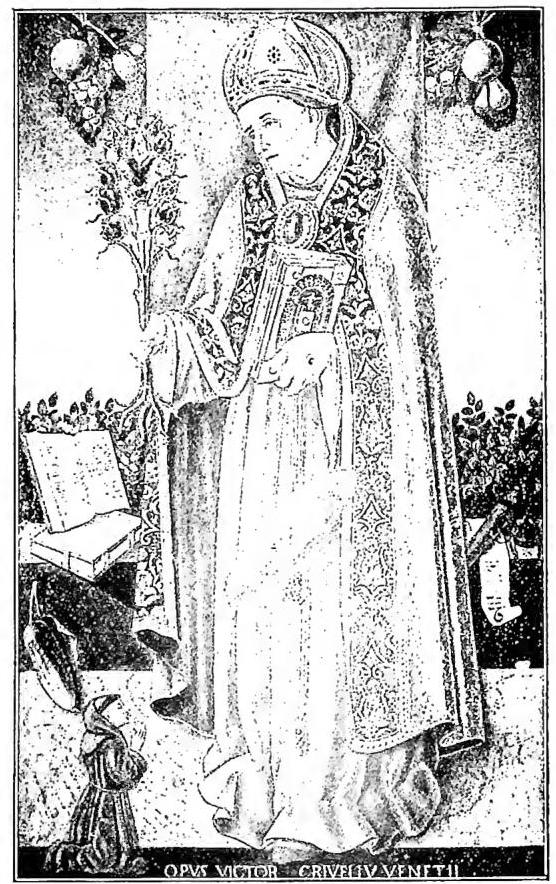
I Commentarii in quattuor libros Sentent. Petri Lombardi (vol. I a IV) furono scritti dal 1250 al 1254 e son generalmente considerati come i migliori; vi rivela infatti e la potenza speculativa del suo spirito e le sue tendenze dottrinali. Però un principiante, anche se provvisto di genio, non è un uomo maturo e giova(da J. Chiarelli, Les Mystiques Italiennes, Parigi 1912, p. 33) BONAVENTURA, santo - S. B. con l'albero della Redenzione, di Vittore Crivelli (sec. XV). Sportello di trittico. Parigi, museo Jacquemart André.
Il Breviloquio, scritto verso il 1257, è una brevissima somma teologica (vol. V, pp. 199-201; ed. man., commentario letterale di volgarizzazione per cura del p. Teodoro Barbaliscia 2 voll., Pompei 1934). Padrone del suo piano e del suo metodo, il Dottore Serafico vi rivela l'alta idea che aveva della teologia speculativa ed alcune sue tesi favorite sono esposte con maggior chiarezza che nel Commentario.
La grande edizione ha pubblicato diverse Questioni disputate: sette De scientia Christi, otto De mysterio Trinitatis, quattro De perfectione evangelica (vol. V, pp. 1-198). Altre sono state scoperte in seguito: due De existentia angelorum e De mendicitate (sono state identificate e pubblicate dal p. Ferd. Delorme in S. Bonaventurae collationes in Hexaemeron et bonaventuriana quaedam selecta, Firenze-Quaracchi 1934, pp. 295-327 e 328-56); dieci De caritate e De novissimis (furono ritrovate dal can. P. Glorieux e sono in corso di pubblicazione nella France Franciscaine, 1936 sgg., documento II). Inoltre il p. Vittorino Doucet (Descriptio codicis 172 bibliothecae communalis Assiviensis, in Archivum Franciscanum Historicum, 25 [1932], pp. 514-15; e Quaestiones centum ad scholam franciscanam saec. XIII ut plurimum spectantes, ibid., 26 [1933], pp. 474-96) ed il p. Francesco M. Henquinet (Un branillon autographe de s. Bonaventure sur le Commentaire des Sentences, in Etudes Franciscaines, 44 [1932], pp. 635-55 e 45 [1933], pp. 59-82) attribuiscono a B., con più o meno certezza, un insieme di questioni teologiche bastevoli a formare un nuovo volume in-fol. della grande edizione. Esse sono però inedite.
Il testo delle conferenze sui Dieci comandamenti (1267), sui Doni dello Spirito Santo (1268) e sull'Hexaemeron (1273) non fu redatto da s. B., ma dai suoi uditori (vol. V, pp. 327-503). Il p. Ferd. Delorme, op. cit., ha pubblicato un testo delle conferenze in Hexaemeron che permette di controllare e talora correggere quello pubblicato dai Padri editori di Quaracchi (vol. V, pp. 327-454).
Il piccolo trattato De reductione artium ad theologiam (vol. V, pp. 317-26: ms.) è stato ritenuto da uno specialista (G. Rabeau, Introduction à l'étude de la théologie, Parigi 1926, p. 365) come « il contributo più importante del medioevo all'introduzione della teologia ».
2. Scritti esegetici. - Il più importante è il Commentario su s. Luca (1248), opera giovanile, probabilmente ritoccata più tardi, utile specialmente ai predicatori (vol. VII intero).
3. Scritti essetici o mistici. - Il più celebre è l'Itinerarium mentis in Deum (vol. V, pp. 293-316) scritto alla Verna nell'ott. 1259, molto letto, tradotto e commentato.
Altrettanto si potrebbe quasi dire del De triplici via (1259: VIII, pp. 3-27) ove, in termini concisi, s. B. ha esposto le grandi linee della sua dottrina mistica (J. Fr. Bonnefoy, Une somme bonaventurienne de théologie mystique, le « De triplici via », Parigi 1934).
Devotissimo alla santa Umanità di Cristo, B. ne scrisse con soavità nel Lignum vitae (VIII, pp. 68-87), nella Vitis mystica (VIII, pp. 159-229), da cui la liturgia attinse le lezioni proprie dell'ufficio del Sacro Cuore, e nel De quinque festivitatibus pucri Iesu.
Se le famosi Meditazioni della vita di Cristo non sono, quali le possediamo noi, l'opera di B., sembra però averne egli fornito il nocciolo primitivo e lo spirito (p. Col. Fischer, Die « Meditations Vitae Christi ». Ihre handschriftliche Überlieferung und die Verfeinerfrage, in Archivum Franciscanum Historicum, 25 [1932], pp. 3-35, 175-209, 305-48). L'influenza considerevole che ebbero sulla spiritualità e sull'arte, specialmente sul testo religioso, si deve quindi attribuire in pari e a lui. I Sermoni di s. B. (V, pp. 532-74 e IX) furono dati davanti ad uditori molto diversi e specialmente in ambienti istruiti: clero, religiosi, università, e ciò spiega la ricchezza del loro contenuto dottrinale (G. Cantini, S. B. da Bagnoregio, in Antonianum, 15 [1940], pp. 29-74, 155-88, 245-74).
III. THE DOCTRINE OF THE SERAPHIC DOCTOR
1. Origin of his doctrine. — The considerable list of authors cited by St Bonaventure was compiled by the editors of his works (X, pp. 265-77) and bears witness to the extraordinary richness of his documentation.Miraculously healed by St Francis of Assisi, St Bonaventure became his humble disciple. More learned than his seraphic father, he would know how to translate into formulae, and where necessary justify and defend the ideal of the Poor Man of Assisi. Like him, he distrusted the “Greek and Latin glories” and sought the imprint of God not only in the visible world but also in the invisible. Like him, he condemned every science that did not teach men to love and go to God with all their soul. He is the “Franciscan doctor” par excellence. The doctrine of St Augustine admirably suited the Franciscan ideal, and St Bonaventure, more than any other contemporary, spoke of him with the greatest reverence. He considered him the doctor “maxime authenticus inter omnes expositores sacrae Scripturae” (Qu. disp. de scientia Christi, q. 4, vol. V, p. 23), and it has been calculated that in the Quaracchi critical edition he is cited no fewer than 2,625 times. St Bonaventure did not content himself with compiling the usual florilegia or “chains” of texts, but drew directly from the works themselves and so assimilated their doctrine that his own appears as the finest synthesis of Augustinian thought in the Middle Ages (E. Longpré, S. Augustin et la pensée franciscaine, in La France Franciscaine, 15 [1932], pp. 5-76).
Among the authors especially favoured by St Bonaventure should also be numbered Dionysius, that is, the Pseudo-Areopagite, Boethius, St Gregory, St John Damascene, St Anselm, Alexander of Hales, whom he respectfully called “my master and my father.” The principal source of his inspiration remained Sacred Scripture; it could largely be reconstructed from the quotations scattered through his works, so much so that their enumeration occupies eighty-four pages (in three columns) of the great edition. When he cites a text, he usually gives its reference by indicating the book and chapter.
2. General characteristics of the doctrine of St Bonaventure. The unity of doctrine. — This is the most striking feature. In the felicitous phrase of Fr Monnot, “philosophy, theology, mysticism are systematically fused, yet not confused.” The Seraphic Doctor knew how to make the proper distinctions, but this vivisection of the real world, necessary in laboratory experiments, did not make him lose sight of the whole. The only world that exists, in which we move and which we must know, is that of a humanity founded on Christ, redeemed by Him, and oriented toward Him. A purely natural order is merely hypothetical; we know little of it and can reconstruct it only by conjecture. As a true Franciscan, St Bonaventure did not believe he should waste time on vain researches, but, keeping the end to which we are destined in view, he resolutely directed all the lower sciences, including philosophy, toward theology, indeed toward mysticism and even ecstasy. This same sense of the real and the concrete explains the importance he attached to experience, “the principle of science” (III Sent., d. 24, a. 2, q. 3, f. 4, p. 522), and the expression ut patet per experientiam recurs frequently. The most subtle reasoning, like the most splendid demonstrations, fails to convince him if the conclusions clash with experience. He takes account of every kind of experience—scientific, historical, or religious—and this explains his respect for tradition and his tendency, in doubt, to incline toward the opinion that is closest to piety. It has often been—and rightly—observed that he showed respect for authority, even purely human authority; yet in this we still discern his fidelity to truth. Whenever he can, he charitably explains an erroneous proposition, and at times his charity appears almost too ingenious; but after all, he wishes the truth to be spoken, “ne amore hominis veritati fiat praeiudicium” (II Sent., d. 44, dub. 3, p. 1016 b). He wishes Aristotle to be followed, but only when he speaks the truth (Coll. in Hex., ed. Fr. Delorme, p. 92).
3. The Christian philosopher. — St Bonaventure is the “Christian philosopher” par excellence. Philosophy, which in a world without grace would be an end in itself, in the present order can attain its goal only by submitting to faith and accepting its control; it is but the handmaid of theology, yet an indispensable handmaid. The philosophy of St Bonaventure fits squarely within the Platonic tradition; yet he knew Plato only indirectly, whereas he read Aristotle directly and without prejudice, judging and correcting him freely. To Aristotelian abstraction he preferred the Augustinian theory of illumination, and it was from St Augustine that he took the theory of seminal reasons, formal germs that God has placed in matter. He did not share with other scholastics the interpretation of Aristotelian hylomorphism, and this explains why he attributed the composition of matter and form, equivalent to potency and act, even to spiritual beings. Such peculiarities, like others noted in discussions of the philosophy of St Bonaventure, do not constitute his philosophy. In the work La philosophie de s. Bonaventure by E. Gilson (Paris 1924; German trans. by Böhner), regarded as the deepest doctrinal study of the Seraphic Doctor, the solidity, richness, and profundity of this genius are brought to light; ever intent on union with God, he judges all things in the light of the sanctuary. To this constant care in seeking God corresponds the exaltation of universal analogy and the doctrine of exemplarism that explains it (J.-M. Bissen, L'exemplarisme divin selon s. Bonaventure, ibid. 1924).
4. The theology of St Bonaventure. — His theology, like his philosophy, draws its inspiration from St Augustine, yet is authentically scholastic. He was the first in the Middle Ages to distinguish clearly between Sacred Scripture, which at that time was what positive theology is for us, and speculative theology, the fruit and glory of human reason, yet a fallible science (Proem. in I Sent., q. 2, ad 4, p. 11 b). With a sure hand, in the Breviloquium, he sketched the ideal he formed of the theologian: to explain by deductive reasoning, starting from a divine attribute, both what God is in Himself and what He has done outside Himself (J. Fr. Bonnefoy, De synthesi operam Dei ad extra ad mentem s. Bonaventurae, in Antonianum, 18 [1943], pp. 17-28). Various authors (notably A. Stohr, Die Trinitätslehre des heiligen B., Münster in W. 1923) have sought to trace the sources of St Bonaventure’s Trinitarian theology and have spoken of St Augustine, the Pseudo-Areopagite, St John Damascene, Richard of St Victor, Alexander of Hales, Eudes Rigault, etc.; yet although he draws on all of these and in particular shows the influence of Greek theology, St Bonaventure is entirely his own. In conformity with his theological conception, though without neglecting St Augustine’s psychological analogies, he prefers a priori demonstrations of the Trinity to explanations by mystical paths (J. Fr. Bonnefoy, Le St-Esprit et ses dons selon s. Bonaventure, Paris 1929, pp. 12-57).
His theology is eminently Christocentric and finds its fullest expression in the Collationes in Hexaemeron; it may be said that he paved the way for the Scotist doctrine of the absolute and universal primacy of Christ.
St Bonaventure, like almost all his contemporaries, denied the Immaculate Conception; yet as happened with others, this error did not obscure his Mariology on other points, and thus it is that, with effective expressions and particular insistence, he affirmed the universal mediation of the Blessed Virgin Mary (P. Di Fonzo, Doctrina s. Bonaventurae de universali mediatione B. Mariae Virginis, Rome 1938; E. Chiettini, Mariologia s. Bonaventurae, ibid. 1941).
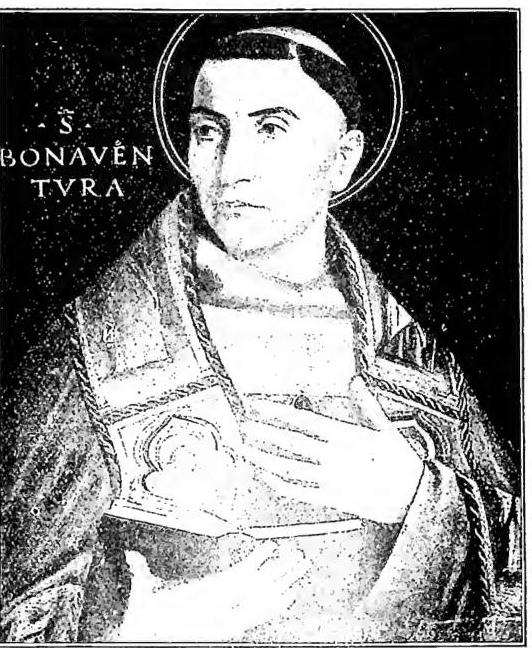
BONAVENTURE, St. – Painting by Il Cavazzola (16th c.). Verona, Civic Museum.
6. The Influence of St. Bonaventure. – His influence has been and remains considerable. His works were widely read during his lifetime, and St. Thomas Aquinas, on several occasions, made use of extensive passages taken from certain disputed questions of his friend (P. Glorieux, De quelques « emprunts » de s. Thomas, in Recherches de Théologie ancienne et médiévale, 8 [1936], p. 166). Many authors have commented upon or summarized Bonaventure’s Commentary, or drawn inspiration from it (ed. of Quaracchi, I, pp. LXIV–LXXIII). Among the three Franciscan families, the Capuchin Friars Minor were the most faithful to St. Bonaventure, since both the Friars Minor and the Conventual Friars, in their great majority, adhered to the Scotist school. The most famous follower Bari (v.), who left behind, among other works, a course in theology and a course in philosophy ad mentem Seraphici Doctoris Bonaventurae.
The voice of St. Bonaventure was not heard only at the Council of Lyons (1274), where he acted as papal legate, but has been invoked in later councils: Vienne (1311), Constance (1414–17), Basel (1431), Florence (1439), the Lateran (1512), Trent (1545–63), and the Vatican (1869–70) (cf. Ludovicus de Castroplanio, Seraphicus doctor s. Bonaventura in oecumenicis catholicae ecclesiae conciliis cum Patribus dogmata definiens, Rome 1874). While restoring Scholasticism under the high patronage of St. Thomas Aquinas, Leo XIII did not fail to recall the name of Bonaventure and praised the Minister General of the Friars Minor for having undertaken the critical edition of his works.
The influence exerted by his mystical doctrine is even more extensive. It operated directly through the incredible diffusion of his “divine little works,” as St. Francis de Sales used to call them; indirectly through the many preachers, orators, and saints who were formed in his school and propagated his spirit. The great number of anonymous writings that circulated under his name are largely due to his disciples. Nor was his influence lacking in Gothic art (R. Boving, Bonaventura und die französische Hochgothik, Werl in V. 1929); in the art of Giotto, through his life of St. Francis; and among painters and stained-glass masters who drew inspiration from his writings on the Passion (E. Gilson, S. Bonaventure et l’iconographie de la Passion, in Revue d’Histoire Franciscaine, 1 [1924], p. 420).
His memory endures in the Greek Church and among dissenters eager for the union of Churches, such as Arseniev and Kobilinski; there are converts, like Denissenkoff, who believe that only the Platonic philosophy of St. Bonaventure and his Christocentric theology can provide a basis for agreement with dissenters on doctrinal questions. It may be that Bonaventure will be called upon in the near future to play the role of conciliator, as he already did at the Council of Lyons.