
DEMONIO. - In ecclesiastical language, it denotes an angel fallen through rebellion against God and punished in hell. Whereas the “devil” or “satan” is the head of the invisible powers of evil, the d. (τὸ δαιμόνιον) is one of the malign spirits (οἱ δαίμονες, usually τὸ δαιμόνια in the New Testament) that infest the world, performing a malevolent function opposed to that of the angels. Thus Jesus said of hell, “which was prepared for the devil and his angels” (Mt. 25, 41).
The devil is one; he is not the same thing as d.: the demòni or démoni (δαίμονες and δαιμόνια are not differentiated) are a multitude.
I. HOLY SCRIPTURE
From the very beginnings of humanity, the spirits of evil intervene as the cause of our fall: “Death entered the world through the envy of the devil” (Wis. 2:24). In the biblical text of Gen. 3 neither a d. nor Satan is named; the being who speaks and acts through the serpent is an evil spirit. Is it the devil or Satan who acts here, or a d. on his own behalf, to accuse or destroy men before God (cf. Job 1:9-11; 2:5; Apoc. 12:10), V. DIAVOLO; SATANA.In the Old Testament the d. often appear as frightening mythical animals: the “hairy one” (id'ir) and the “night specter” (līlīth [v.]) in Is. 34:14 (Vulg.: pilosus, lamia). In Lev. 17:7 it is strictly forbidden to sacrifice to the iē'irīm (Vulg. daemones); in Lev. 16:8-10 'Azā'zēl, associated with the iē'irīm, is an evil spirit opposed to Jahweh. The true God is also contrasted with the iēd (Deut. 32:17; Ps. 10:37), probably analogous to the Babylonian īidu. Sēdīm is also the name given to false gods. Animals such as the serpent were held to be connected with demonic forces (v. DRAGONE). The conceptions and classifications of the d. became more complicated in later Judaism, on the basis of that popular animistic mentality which among the Arabs created the many-formed gīnu.
These isolated actions are manifestations of the more general mission that God entrusted to the Messiah and revealed to our first parents: the Woman’s Son par excellence will be bitten in the heel by the serpent, which will deprive him of human life; but in the course of this struggle, which ends in death, the Savior will crush the serpent’s head (cf. Gen. 3:15). Jesus announced at once both this victory and the sacrifice by which he would achieve it, when on the eve of his Passion he said: “Now is the judgment of this world; now the prince of this world will be cast out. And I, when I am lifted up from the earth, will draw all things to myself” (John 12:31-32).
God revealed to the angels in a prophetic vision the mystery of the Incarnation which he had willed from all eternity (Rom. 16:26). Most of these pure spirits worshiped the future Christ. Satan, however, and other angels, led by his example, refused. “And there arose in heaven a great battle: Michael and his angels fought against the dragon, and the dragon and his angels fought, but they could not prevail... And the great dragon was cast down, the ancient serpent, he who is called the devil and Satan, who seduces the whole earth. He was cast down to the earth, and with him his angels were cast down” (Apoc. 12:7-9).
When God introduces “again” into the world, no longer in figure but in reality, the “Firstborn of all creation,” and commands his angels to adore him (Hebr. 1:6), this will not be a surprise for them, since they were already awaiting this event; nor will they hesitate, since at the time of their trial they had already demonstrated their submission through a joyful act, acclaiming God and the future Christ together: “Now salvation and power and the kingdom of our God and the authority of his Christ have come” (Apoc. 12:10). Cf. F. Risi, Sul motivo primario della Incarnazione del Verbo, IV, Roma 1898, pp. 128-47; P. Arrighini, Gli angeli buoni e cattivi, Torino-Roma 1937, p. 156-70).
II. THE DOGMA
The point of departure and solid foundation of theological speculation in the doctrine under consideration is the certainty that the d. are fallen angels. This is a revealed truth not only in the Apocalypse (v. above), but also in many other highly explicit texts. Jesus said to his disciples: “I saw Satan falling from heaven like a flash of lightning” (Lk. 10:18). The devil fell because he “did not stand fast in the truth” (Jn. 8:44). St Pietro speaks expressly of “angels who sinned and whom God cast into hell” (II Pt. 2:4). And St Jude (v. 6) refers to “the angels who did not preserve their principality, but abandoned their own dwelling.”If, then, the d. are fallen angels, it is necessary to apply to them all the properties that Revelation revea-
(Int. Alinari)
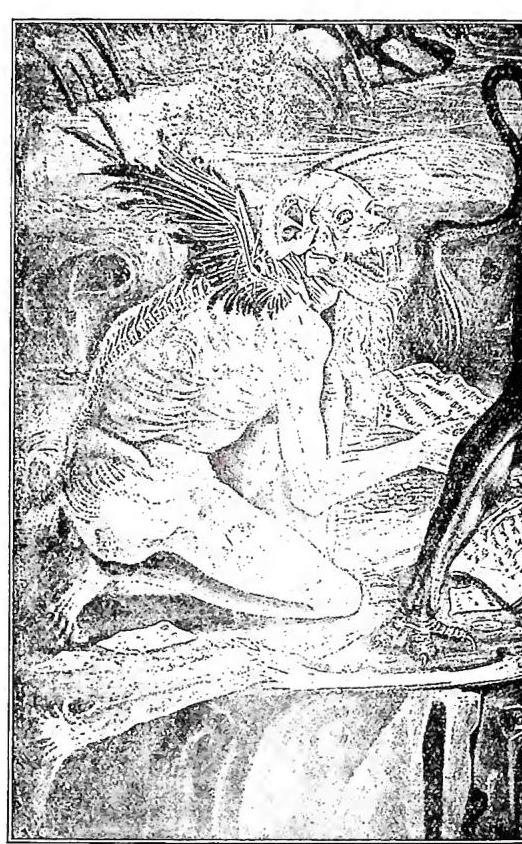
DEMONIO – Detail from The Temptations of St. Anthony, by Bernardo Parentino (15th century) – Rome, Palazzo Doria.
refers to the spiritual nature of angels, since a moral fault cannot modify the nature of the one who is guilty. It is not possible to attribute a body to them, as some ancient authors and scholastics have done.
To say that the d. are fallen, that they have sinned, that God has punished them, is implicitly to affirm that they became evil through their own fault and that they were not created as they now are, contrary to what certain sects of Manichaean inspiration wished to assert; these were later condemned by the Council of Braga in Portugal (a. 563) and by the Fourth Lateran Council of 1215 (cf. F. Cavallera, Thesaurus doctrinae christianae, 2nd ed., Paris 1936, nos. 612–39; Gelasius I [492–496], Dicta adversus Pelagianam haeresim, nos. 23–33, as well as the profession of faith imposed on the Waldensians by Innocent III [cited there, nos. 632–635 and 638]). One must likewise conclude that they were created neither in the state of glory nor confirmed in goodness, but in the state of Grace, from which they fell without ever having enjoyed the beatific vision.
Given the spiritual nature of the d., one must absolutely reject an opinion widely disseminated among certain medieval writers (cf. E. Mangenot, Dénon, in DThC, IV, cols. 339–400), according to which these angels were condemned to hell for sexual relations with women. This opinion, now abandoned, was based on a false version of Gen. 6:2 (cf. id., ibid., cols. 326–327). There is almost universal agreement in placing the angels’ guilt in an act of pride (cf. the letters of Popes Hormisdas and Gregory I, in Cavallera, op. cit., nos. 626 and 640). Tradition, however, is not clear in specifying what this consisted of. Many doctors assert that Satan wished to «be like God», but among them there is no agreement in determining the meaning appropriate to this formula (cf. St. Thomas, Summa Theol., 1°, q. 63, a. 3). This opinion, moreover, has as its sole foundation a reflection which Is. 14:13–14 attributes to the king of Babylon and which has been applied to Satan. Now the accommodated sense, even less than the mystical sense, cannot serve as a foundation for faith. Indeed, it presupposes faith. The only solid basis for determining the guilt of the d., together with its circumstances, is the allegorical literal sense of chapter 12 of the Apocalypse.
Contrary to certain ancient doctors, it must be held that the d. were punished immediately after their sin (cf. Apoc. 12) and that they immediately began to undergo the twofold punishment of loss, that is, deprivation of God, and of fire. And by a special permission, they are able to harm human beings «for a little while» (ibid., 12:12), that is, until the Last Judgment, without meanwhile being exempt from the torments of hell. The number of the d. is generally considered to be very large. According to Apoc. 12:14, in his fall the dragon had dragged with him «a third of the stars of heaven», that is, of the angels. Various scriptural texts (Ez. 28:14–16; Rom. 8:38; Eph. 6:12; I Cor. 15:24) lead to the conclusion that the rebels belonged to different orders in the celestial hierarchy. Satan continues to exercise real dominion among them (Mt. 9:34; Lc. 11:15), more as a leader than as a head, since one cannot speak of hierarchy and properly speaking of subordination in a place which common faith rightly regards as the realm of disorder (cf. Job 10:22).
Hell is common to the angels and to reprobate human beings, since condemned human beings are cast into the fire «prepared for the devil and his angels» (Mt. 25:41). Like that of human beings, the punishment of the d. is eternal and cannot undergo any mitigation, as Apoc. 2:9–10 expressly affirms and as the Second Council of Constantinople (553), confirmed by Pope Vigilius, defined (cf. Denz-U, no. 211).
The principal occupation of the d. until the consummation of the ages consists in tempting human beings in order to lead them into sin. They have succeeded so well that Jesus himself gave Satan the title of «prince of this world» (Io. 12:31; 14:30; 16:11). The Book of Job (chapters 1 and 2) clearly suggests that Satan cannot harm anyone unless God permits it, and only to the extent to which it is permitted him.
It is certainly correct that the d. is temptation (v.). He does not necessarily intervene in all the evils to which we may be subject; it is in no way incompatible with the holiness of God that he be the cause, even the immediate cause, of a moral trial (such as the temptation of Abraham, Gen. 22), or of a physical evil (cf. Job 3:6: «Can evil come upon a land without God being its author?»). But the Scriptures, on the other hand, attest that the d. are sometimes the cause of our misfortunes and illnesses (cf., in addition to Job 1 and 2, Mt. 12:22; 17:14–17). Moreover, roaming about like a lion seeking its prey (I Pt. 5:8), they do not refrain from blowing upon the fire of passions or discord.
Some ancient author wished to assert that every human being, from birth until death, is assigned an evil angel who opposes the guardian angel. This theory is founded neither on tradition nor on Scripture and therefore deserves no credence whatsoever (cf. S. Weber, De singulorum hominum daemone impugnatore, Rome 1938).
Giovanni Francesco Bonnefoy
III. IN ART.
The devil makes his appearance in Christian art in a significant manner no earlier than the 6th century. One of the most an-
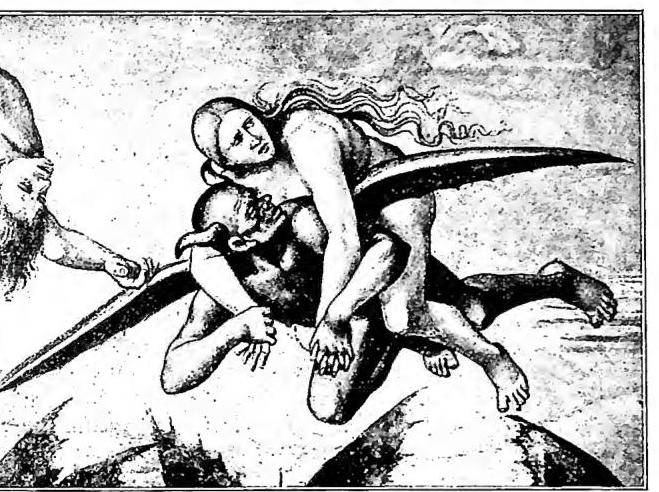
cient representations of the d. is found in a fresco in the Egyptian church of Bawit (6th century). Others from the same period are found in miniatures of the Bible of s. Gregorio Nazianzeno, preserved in the National Library of Paris. Characteristic of these representations is Satan’s almost angelic appearance. From the 12th century onward until the end of the Middle Ages and, one may add, until around the second half of the 16th century, the demonic image undergoes a radical transformation: the horrific predominates. The seduction of beauty gives way to the seduction of the horrible. Terror is the strongest diabolical weapon, and the artists of the Romanesque period consistently brought out the monstrous as an aspect of the demonic. Particularly interesting in this regard are the sculptures of the capitals of the cathedrals of Autun, Moissac, Beaulieu, and Vezelay in Burgundy (dating from 1150). The accentuation of asymmetry in the architecture of Romanesque sacred buildings is due, in addition to aesthetic requirements, to the belief that the diabolical tended toward the geometric. The geometric is that which permits no escape. It was commonly held in the Middle Ages that logic was the ars diaboli; hence the two contrasting characteristics of diabolical temptation: to encircle (to close in a circle) and to terrorize, that is, to destroy the forces required for upright human conduct. Architectural asymmetry is opposed to encirclement, and the representation of the monstrous is the dutiful denunciation of the true nature of the demonic by artists-theologians.
In the numerous representations of the temptations of monks, and especially of s. Antonio Abate, from the 14th, 15th, and 16th centuries, the demonic is always represented as an assault of the horrible.
The great pictorial achievement of Flemish and Dutch artists of the 15th and 16th centuries should be noted: Hieronymus Bosch (ca. 1450-1516: particularly noteworthy is the Tentazione di s. Antonio in the Lisbon museum and that of the Prado), Peter Huys, Luca di Leyden, Jan Mandyn, Pietro Bruegel (or Breughel) the Elder (Dulle Griet at the Museo van den Bergh in Antwerp, and Caduta degli angeli ribelli at the Royal Museum in Brussels), Hendrik Met de Bles, Joachim Patinier. Among the German artists: Stefano Lockner, Martino Schöngauer, Alberto Dürer, Luca Cranach, Nicola Manuel, and above all Mattia Grünewald (the Isenheim altarpiece of Colmar).
Italian art of the 13th, 14th, and 15th centuries (Giotto, Gaddi, Traini, Taddeo di Bartolo, and later Signorelli and Michelangelo) did not share the same characteristics as the Tentazioni and Inferni of Flemish-German art, in which the influence of the theological-mystical doctrines of Enrico Suso and Ruysbroeck, as well as of certain heretical sects (especially that of the “brothers of the free spirit”), is evident. Whereas until around the end of the 1500s the artist was predominantly concerned with theology, from the 17th century onward this concern disappeared, and representations of infernal scenes (Callot, Teniers, Goya) became pictorial pretexts unrelated to apologetic ideals. The grotesque and the demonic become confused. - Vedi tav. XC.