
VÉZELAY, SANTUARIO di. — Ancient abbey of Benedictine nuns, founded by Gerardo of Roussillon, regent of the Kingdom of Provence, in 858–59 at V. (diocese of Autun).
Nicholas I granted the monastery in 863 the privilege of depending directly on the Holy See; Charles the Bald confirmed its possessions in 868. Damaged by the Normans in 873, it was rebuilt by Gerardo, who entrusted it to monks coming, it seems, from S. Martino of Autun, and it was consecrated, under the invocation of the Blessed Virgin and the apostles Peter and Paul, in 878 by John VIII, while he was on his way to the Council of Troyes. A fire destroyed it between 907 and 926; in the 11th century the Duke of Burgundy granted the decaying monastery to Guglielmo of Volpiano, abbot of S. Benigno of Dijon, so that he might restore II. In 1027 Landrico, count of Nevers, replaced the abbot Ermanno with Oddone. At this time the report began to spread that the abbey church preserved the relics of St. Mary Magdalene. Abbot Gauffredo (1037–50) surrounded the high altar with grilles, so great was the crowd of pilgrims. But since the abbey of S. Massimino in Provence claimed to possess the relics of St. Mary Magdalene, the monks of V. maintained that Adellemo, Oddone’s brother, had gone to retrieve them. The bishop Norgaudo of Autun (1098–1111) forbade
the offerings; but in 1103 Pope Paschal II lifted the interdict. The pilgrimages increased ever more, and V. became the gathering center, in northeastern France, for pilgrimages to S. Giacomo of Compostella.
In 1096 Abbot Artaudo began the construction of a new basilica on the site of the Carolingian one; in 1104 he celebrated the dedication of the new building, but during a revolt against taxation he was killed in 1106. The new abbot was Renaudo de Semour, nephew of St. Ugo, abbot of Cluny. On 21 July 1120 a violent fire destroyed the church, and more than a thousand people perished there. The abbot immediately began its reconstruction. In 1131 Innocent II appointed the new abbot Albicico, and in 1132 attended the consecration of the new abbey, which flourished rapidly under Ponzio of Montboissier (1138–61). At Easter 1146 St. Bernardo came to the illustrious monastery to preach the Second Crusade (PL 182, 306–307). The abbot then had to struggle against Guglielmo III, count of Nevers, and his successor against Guglielmo IV, so that in 1165 the monks took refuge for some time at St-Germain des-Prés in Paris. Alexander III granted new privileges in 1162. In 1165 a fire damaged the Basilica, and Abbot Gerardo of Arcy (1171–98) began its reconstruction in the Gothic style. His successor Ugo was deposed by Innocent III in 1207.
In 1166 Tommaso Becket, archbishop of Canterbury, took refuge in the monastery. It was visited several times by Louis VII, in 1190 by Filippo Augusto, by King Riccardo Cuor di leone, and several times by King St. Luigi, who attended the translation in 1267, at which the cardinal legate Simone de Brion, later Martin IV, was present.
(photo Alinari)
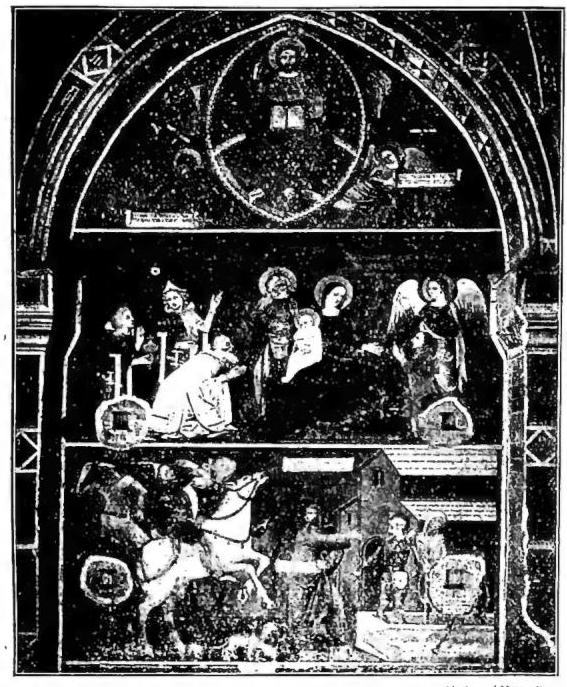
VEZZOLANO — The Redeemer among the symbols of the Evangelists; the Adoration of the Magi with the patron accompanied by an angel, and the apparition of the three skeletons to Charlemagne. Fourteenth-century frescoes in the cloister of the abbey.
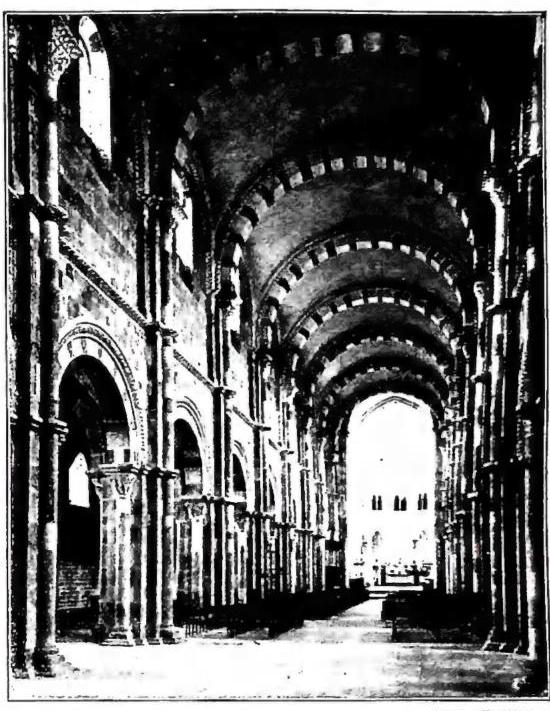
The monastic buildings, partly demolished as early as 1760, were sold; Prospero Merimée proposed their restoration in 1835, which was approved in 1837, and from 1840 the architect Viollet-le-Duc began repairing the church. In 1870, a relic of M. Maddalena donated to V. marked the beginning of new pilgrimages. The western façade was partly modified in the twelfth century and partly through Viollet-le-Duc’s restoration. It has three portals; in the tympanum of the central one is Jesus Christ among the symbols of the four Evangelists, followed by the Judgment; on the architrave, episodes from the life of Maddalena; in the vault, angels. Above, around and on the windows, are statues. The narthex consists of massive piers with columns and historiated capitals, depicting episodes from the Old and New Testaments and from the lives of saints. Around them, in eight compartments, are represented the various peoples to whom the apostolic mission will be directed; then the signs of the zodiac and the labors of the months. The right-hand portal contains scenes from the Savior’s infancy, while the left-hand one contains episodes following his resurrection. The interior of the Basilica has three naves, the central one very lofty and divided into ten bays; the capitals are historiated with scenes from the Old Testament and episodes from the lives of the saints intermingled with mythological scenes and scenes from human life. The choir is Gothic; five chapels open onto the ambulatory; beneath the choir is the crypt; from the southern transept one passes into the chapter house.
In the village of Saint-Père-sous-Vézelay there is a Gothic church preceded by a two-bay portico dating from the fourteenth century, with a central portal on which the Last Judgment is carved; the two founding spouses are also represented in the portico, and farther on a tomb is dated 1258; in a portal now walled up is the Crucifixion. The interior of the church has rib vaults, with an ambulatory onto which chapels open; in the lofty bell tower, at the four corners, are four angels.