
VICH, DIOCESE of. – City and diocese in the province of Barcelona in Spain.
It has an area of 3,367 sq. km. with a population of 250,246 inhabitants, almost all Catholic, distributed among 262 parishes served by 391 diocesan priests and 66 religious priests; it has a diocesan seminary, 19 male and 98 female religious communities (Ann. pont. 1953, p. 446). It is a suffragan of Tarragona.
V. is the ancient Roman “Ausa,” and the episcopal see was called Ausonensis until the 13th century. The first known bishop is Cinidius, who took part in the Council of Tarragona in 516; Aquilinus (589–99) attended the Third Council of Toledo, Guerricus the Eighth (653); Visefro sent a representative to the Thirteenth (683). The Saracen invasion then occurred, and V. was reconquered only in the time of Louis the Pious, passing under the archdiocese of Narbonne. In 888 Godomar was made bishop of V. Jorge was bishop between 915 and 938; Atto between 960 and 972; Oliva, abbot of Ripoll, between 1018 and 1046; then Peter Retorta in 1180. The bishops, who had already obtained the title of princes in the Carolingian age, had to contend for a long time with the claims of the Moncada family; in 1315 Bishop Berenguer Laguardia ceded the rights to King James I. Bishop Acisclo Moya de Contreras took part in the Council of Trent.
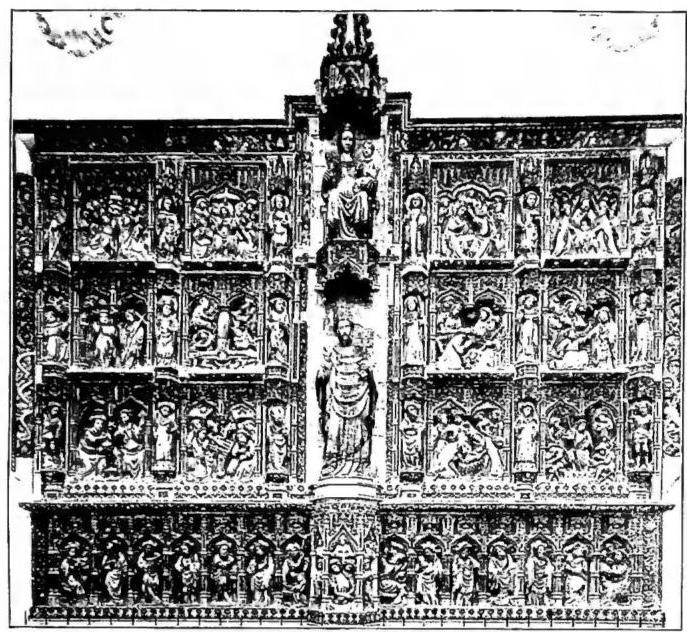
Cathedral rights were long disputed between the church of St. Peter and that of St. Mary Rotunda, where the bishop celebrated the first Mass of Christmas, while in St. Peter’s he celebrated the third. They remained assigned to St. Mary’s when the ancient church of 886 was rebuilt at the initiative of Canon William Bonfili and consecrated in 1180 by Bishop Retorta. The transept was added in 1401 by Bishop Diego De Heredia; the door called that of St. John, in 1585. The church underwent further transformations between 1633 and 1680; it was demolished in 1787 for the construction of the new cathedral, completed and reconsecrated on 15 September 1803. J. M. Sert decorated it with a cycle of frescoes, first from 1900 to 1915 and a second time from 1926 to 1930; but in 1936 the cathedral was burned and devastated; between 1940 and 1945 the building was restored and enlarged with an ambulatory and annexes. The interior, measuring 70 by 29 m., is divided into three naves by square pillars with gilded ribs; it has side chapels; the dome rises to a height of 35 m. in the transept. In a chapel on the left is the silver sarcophagus of Bishop Bernardo Calvé, who died in 1284, the work of Juan de Matons (1728). Noteworthy is the retablo of the high altar,
J. M. Sert began the new decoration of the basilica’s interior with the cycle concerning the Redemption, the Apostles, the Martyrs, and the Beatitudes; the work, interrupted in 1945 by his death, was continued by M. Massot. South of the cathedral is the 12th-century cloister with 14th-century upper galleries; here is the chapter house, formerly the chapel of the Holy Spirit, with apse and dome, the work of B. Ladernosa (14th century); there is also the chapel of St. Mary de la Redonda with a Baroque altar from 1632; along the walls are a Roman altar dedicated to Diana, sarcophagi, and the monument to the philosopher J. Balmes (v.), erected in 1865, with a statue by J. Bover.
North of the Cathedral is the Balmes Public Library. In the Episcopal Palace, Bishop B. José Morgades y Gili (1882–98) founded the Archaeological Museum, which contains a rich collection of paintings and sculptures, the panels of the great retablo of the Poor Clares, the work of L. Borrassà (1414), fabrics from the 10th to the 13th century, sacred vestments, including the cope of Bishop Bellera (1352–77), precious manuscripts, and liturgical furnishings. The Diocesan Archive is rich: it possesses 5 papyrus documents, 105 parchment codices, and 12 paper codices, all of great value. The Lapidary Museum is inside a Roman temple, transformed into a castle in the 9th century. In its Monserrato (v.), Ripoll (v.), and S. Juan de las Abadesas; the latter was one of the most distinguished monasteries in Spain, founded around the year 885 by Count Vifredo el Velloso and his wife Vinidilda. The church, in the form of a Latin cross and dedicated to St. John the Baptist, was consecrated on 24 June 887 by Bishop Godomar (E. Junyent, El necrologio del monasterio de San Juan de las Abadesas, in Analecta sacra Tarraconensia, 23 [1950], pp. 131–91); the cloister is Romanesque. The Seminary was established by Bishop Gaspare Gil (1635–38). V. was the seat of a university and obtained privileges in 1595 from Philip II and in 1702 from Philip V. Santos, called Miguel Argemir Trinitario (1591–1625), Vedruna (v.) were born in the diocese of V.; the tomb of St. CLARETIANI (v.), canonized in 1952, is in V. (AAS, 42 [1950], pp. 268–269, 314–16; 44 [1952], p. 345 ff.).