
POOR CLARES. - The name of the Second Order founded by s. Francesco d'Assisi with s. Chiara d'Assisi in 1212 and, at first, propagated especially by card. Ugolino (Gregorio IX). Apart from the original Formula vitae (not preserved) given by s. Francesco to s. Chiara and her first disciples, the Rules followed in the thirteenth century by the P.C. were four, of which two (the 3rd and 4th) are still in force.
The 1st, composed around 1219 by card. Ugolino, was entitled (because of the prohibition by the Fourth Lateran Council against making new rules) to s. Benedetto, without entailing his observance, as Innocenzo IV expressly declared to s. Agnese di Praga. This ficto iuris lasted until 1247, when Innocenzo IV, in promulgating the 2nd Rule, replaced the name of s. Benedetto with that of s. Francesco. The 3rd Rule is due to s. Chiara. Concerned by certain mitigations introduced by the 2nd Rule, it insists upon the strictest
poverty, silence, and fasting. It was approved by Innocenzo IV on 9 Aug. 1253. In 1263 Urbano IV gave the 4th Rule, in which the Order of S. Chiara is mentioned for the first time and common possessions are permitted. The P.C. who observe it are called Urbanists.
For practical government, some generals of the Franciscan Order and various cardinal protectors of the thirteenth and fourteenth centuries issued special regulations collected by p. Bughetti in Arch. franc. hist., 13 (1920), pp. 89-135. Besides poverty (absolute for the followers of the 3rd Rule), strict enclosure, extended in 1298 by Bonifacio VIII to all nuns, has been characteristic from the beginning.
Although of different origin, the Sorores Minores inclusae, instituted by b. Isabella di Francia, sister of s. Ludovico IX, may also be regarded as P.C.; their Rule was approved by Alessandro IV in 1259 and, in a second redaction, by Urbano IV in 1263. It was observed at Longchamps (Paris), in Rome (S. Silvestro in Capite and S. Lorenzo in Panisperna during the Middle Ages), and in four monasteries in England until 1539. It is no longer in use today.
Since the Order of the P.C. had undergone the deleterious influence of the age in the fourteenth century, s. Coletta undertook to reform the Order in the first half of the fifteenth century. The basis of the reform was the Rule of 1253 and the special constitutions drawn up by the general of the Franciscan Order, Guglielmo da Casale (1434), and approved by Pio II in 1458. The Colettane still flourish today.
In the sixteenth century, through the work of Maria Longo at Naples, the reform of the Capuchin P.C. arose, later spreading to other countries. They observe the Rule (3rd) of s. Chiara, the constitutions of s. Coletta, and certain usages received from the Capuchins. The Conceptionist P.C., founded by b. Beatrice Silva (d. c. 1490), although called in the first papal bulls of the Order of S. Chiara, have a Rule entirely their own, approved by Giulio II in 1511, and form a separate Order closely connected with the Order of Friars Minor. They are numerous especially in Spain. Various other branches exist, such as the Missionary P.C. of the Most Holy Sacrament (Berlinoro), the Poor P.C. of the Immaculate Conception (United States, Brazil), etc.
The Order of the P.C. is a contemplative Order, but in the course of time various monasteries have adapted themselves to the needs of times and places, especially from the nineteenth century onward. Thus the P.C. of Paenza have a secondary school for young ladies; the P.C. of Ratisbona and Riedenburg in Bavaria likewise run schools, while in Ireland various monasteries, besides schools, also manage girls’ orphanages, workshops, and other social works. These are, however, exceptions.
The P.C. spread rapidly. In 1228 there were already 24 monasteries, enumerated in a letter of the cardinal protector Rainaldo (Alessandro IV). They were all in Italy, but they soon appeared in other countries as well. In Spain the first foundations were at Zamora (1229?), Pamplona (1230), Barcellona and Plasencia (1233); in France at Reims (1237) and Bordeaux (1246); in Bohemia, through the work of b. Agnese di Boemia (v.), at Praga; in Germany at Ulma (1237), transferred in 1258 to Söflingen. At the end of the eighteenth century there were very many monasteries in all Catholic countries, but Josephinism, the French Revolution, secularization in Germany, and the Napoleonic suppression in Italy greatly reduced them. From the second half of the nineteenth century numerous monasteries revived and also spread to North America, while in South and Central America they had already existed under Spanish rule. In 1932 the P.C. numbered 630 monasteries, of which 137 were in Italy, 281 in Spain, 48 in France, 37 in Belgium, 4 in Holland, 11 in Germany, 16 in England, 10 in Ireland, etc., with nearly 13,000 religious.
By their original constitution and under current law (can. 500 § 2), they enjoy the privileges of exemption; in practice, however, they are for the most part under the jurisdiction of diocesan bishops, while some monasteries depend upon the Order of Friars Minor.
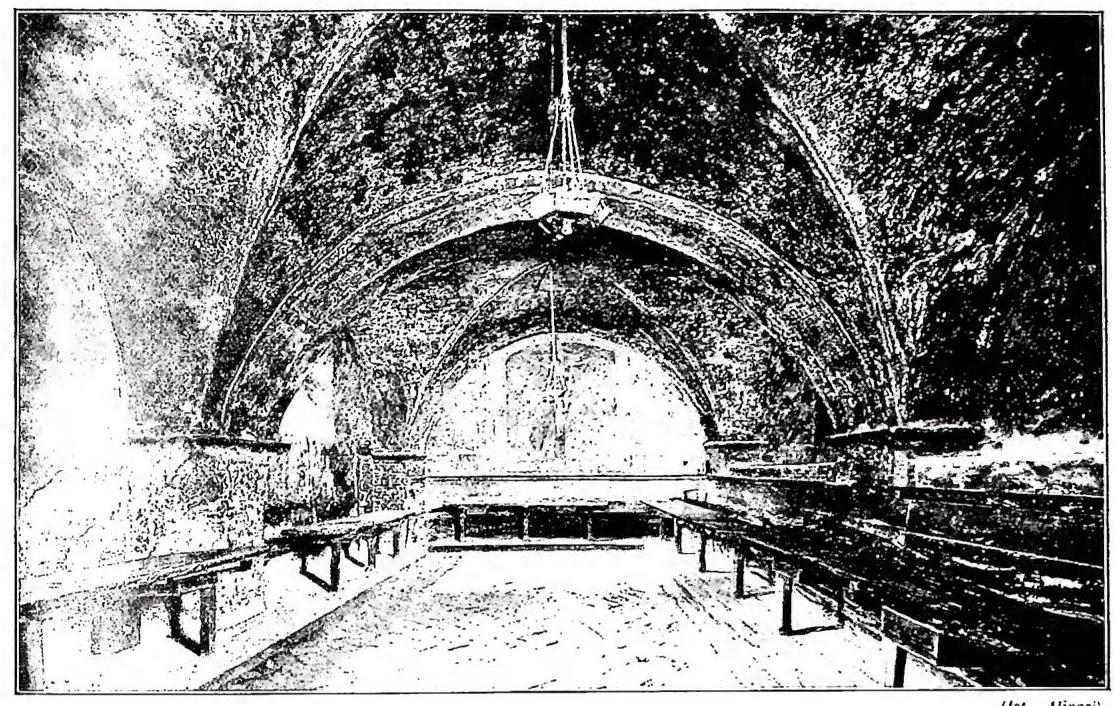
(phot. Alinari)
CLARISSE - Refectory of the convent of S. Damiano (13th century) - Assisi.
strength of character, for example, Caritas Pirckheimer, who at Norimberga successfully resisted the Protestants, and the C. of Ginevra (1534), but especially for holiness of life, such as the Saints Agnese, sister of s. Chiara, Elisabetta del Portogallo, Coletta, Caterina da Bologna, Veronica Giuliani; the Blessed Elena Enselmini, Agnese di Praga, Isabella di Francia, Margherita Colonna, Filippa Mareri, Battista Varani, Ludovica di Savoia, Margherita di Lorena, and many others. - See Plate CXII.