
ZAMORA, DIOCESI di. — Diocese and capital city of the province of the same name in Spain.
It has an area of 12,000 sq km and a population of 420,730 inhabitants, of whom 419,900 are Catholics, distributed among 250 parishes served by 242 diocesan priests and 47 religious priests; it has two seminaries, 5 male and 28 female religious communities; it is suffragan to Valladolid.
The diocese was established in 905, but following the invasion of the Moors in 999 there were no more bishops until the see was re-established under Callistus II. For a long time it was suffragan to Braga, then to Toledo, to Santiago in 1129, and in 1851 to Valladolid. Among its bishops are Attiliano in the 10th century, Rodrigo Sanchez de Arevalo (1467–68), and Diego Deza (1494).
The Cathedral, dedicated to the Savior, dates from the 12th century; its construction was begun by Alfonso VII in 1151, and it was consecrated in 1174 by Bishop Stefano. It is Romanesque, with three naves, a transept, a dome, and a bell tower rising to a height of 50 m. Between 1496 and 1506 it was enlarged at the expense of Bishop Msgr. Diego Meléndez Valdés. The Seminary was founded in 1721. Among the other churches are: the parish church of St. Peter, restored by Bishop Meléndez Valdés and transformed in the 17th century; the church of the Magdalene, a Romanesque building; St. Isidore, between the Romanesque and Gothic styles; St. Mary de la Orta; St. Cyprian; St. Andrew, with an adjoining monastery dating from the beginning of the 12th century; and St. Anthony, renovated, which contains an image of the Blessed Virgin.
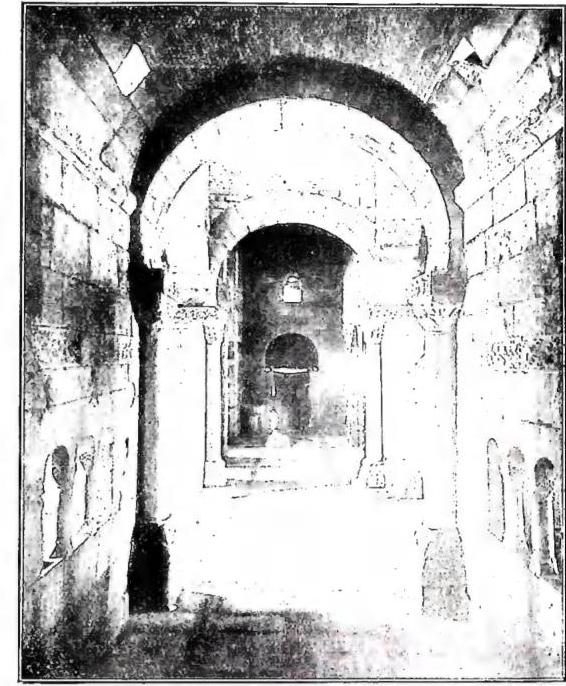
(photo Gudiol — Barcelona)
(photo Mas) ZAMORA, DIOCESI di — Interior of the Visigothic church of S. Pedro de la Nave — Zamora.
ZAMORA, DIOCESI di. — City and diocese of the department of Morelia, which comprises almost half of the State of Michoacán, in Mexico.
It has an area of 12,000 sq km and a population of 420,730 inhabitants, of whom 419,900 are Catholics, distributed among 56 parishes served by 176 diocesan priests; it has 7 male and 46 female religious communities and two seminaries (Ann. Pont. 1953, p. 462).
The city of Z., founded in 1540 by Antonio de Mendoza, was raised to the status of a diocese by Pope Pius IX when the city of Michoacán (Morelia), of which it is suffragan, became an archdiocese (8 May 1863). The Cathedral is dedicated to the Immaculate Conception and to St. Martin of Tours.