
DIOCESE OF BRAGA. - In northern Portugal, capital of a department in the province of Minho. Conquered by the Romans and called Bracara Augusta, it formed a conventus of Hispania Citerior (Pliny, Nat. hist., III, 3; IV, 20). Invaded by the Vandals in the 5th century and by the Arabs in 716, it was reconquered by Alfonso I the Catholic in the mid-8th century. Occupied by the Normans in the 11th century, it was conquered by Ferdinand I (1058–64). The first mention of a bishop of Braga named Paterno occurs at the Second Council of Toledo in 400. Among the bishops who followed were Balconio (415–17), Profuturo, to whom Pope Vigilius sent a letter in 538, St. Martin (569–79), St. Fructuosus (656–65), Peter (1071–91), and St. Gerard (1095–1108). Thereafter the list is complete; noteworthy among them is Peter of Giuliano (1273), who later became Pope John XXI (v.).
The diocese covers an area of 4,831 sq. km., with a population of 807,540, of whom 807,150 are Catholic; it comprises 830 parishes with 850 diocesan priests and 135 regular clergy. Four provincial councils were held in Braga in the years 1148, 1292, 1426, and 1566. It has a diocesan seminary founded in 1571 and a minor seminary since 1881. Since the time of Paschal II (1099–1118), Braga has been a metropolitan see. Its suffragan dioceses are Aveiro, Bragança, Coimbra, Lamego, Porto, Vila Real, and Viseu.
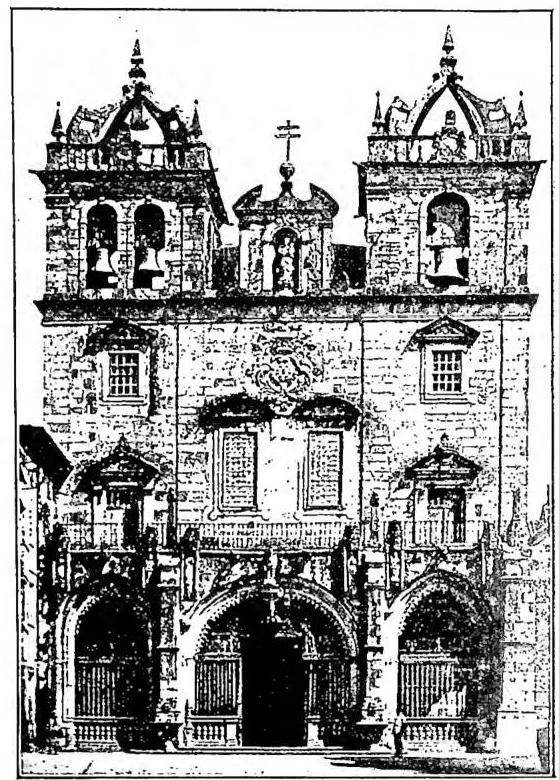
The present metropolitan cathedral stands on the site of the primitive cathedral destroyed by the Arabs; it was completed in the 12th century in a Cluniac Romanesque style, with a façade framed by two towers, a central nave with piers and columns, a transept with a dome at the crossing, and an apse flanked by four smaller apses, though much altered by 18th-century transformations.
The Gothic chapel of Nossa Senhora da Glória, erected by Archbishop G. Pereira (1326–48), who is buried there in a sculpted sarcophagus by Peri and Telo García. The external portico with its arches was added by Archbishop D. de Souza (1505–32). In the sacristy, the treasury is one of the richest in Portugal. It contains, among other things, an ivory casket, a Moorish work carved at the time of the Caliphate of Córdoba (early 11th century); a silver chalice known as that of St. Gerard; a crozier said to belong to three archbishops (12th century); 14th-century silver sculptures with enamel, 16th-century silver and gold antependia, and extremely rich sacred vestments.
In the suburb of Braga, at São Jerónimo Real, the church built by St. Fructuosus (650–65) and dedicated by him to St. Salvador de Montelios, now called St. Fructuosus, is now incorporated into the convent of St. Francis. From the Cronica da Soledade by Manoel de Monforte, it appears that the original plan was a Greek cross with a central dome, but it was sacked during the Arab period and rebuilt with heterogeneous materials in the 11th century. Six kilometers from Braga was the ancient Benedictine monastery of Tibães, with four cloisters and ceramic decorations depicting the life of St. Benedict, though much altered in the 17th–18th centuries.
LITURGY. — BRAGA has its own particular rite which is linked to ancient local usages. In 538 Pope Vigilius
(from E. Lavagnino, Gli artisti italiani in Portogallo, Roma 1918)
BRAGA – Cathedral, 12th century, transformed by Niccolò Nasoni (18th century).
BRAGA – The city has its own particular rite, which is linked to ancient local usages. In 538, Pope Vigilius, in response to a letter from Bishop Profuturus, issued disciplinary and liturgical instructions concerning the Mass and certain Sacraments to clarify a situation arising from the Priscillianist controversies. This liturgy comprises the Roman Canon and indigenous formulas or those drawn from other liturgies.
In the 7th century, it disappeared because the decrees of the Council of Toledo became law for the entire Iberian Peninsula; however, it resurfaced in the 12th century, so that when in 1570 St Pius V, with the bull Quam primum, abolished all particular rites except those in existence for at least two hundred years, the Braga rite remained in force. In 1880, in a dispute over the use of the Roman and Braga rites, the majority sided in favour of the latter. The synodal constitutions of 29 July 1918 imposed the liturgical books according to the particular rite upon the entire diocese. Benedict XV, with the bull Sedis huius of 14 May 1919, approved the new edition of the Braga breviary printed in the Vatican press, and Pius XI on 8 September 1924 approved that of the Missal.