
Coimbra, Diocese of. — In Portugal, it extends over 5,300 sq. km. and has 571,256 inhabitants, of whom 547,428 are Catholics; it comprises 254 parishes, served by 252 secular priests and 10 regulars.
This important diocese seems to be one of the oldest in Lusitania, yet reliable documents on its religious life and especially on its prelates before the 6th century are lacking. All the churches of that region were under the influence of the ancient metropolitan see of Emerita; hence Coimbra in early times received its ecclesiastical organization from Mérida.
The first known bishop is Lucentius, also called Lucecius in some manuscripts, who is recorded as present at the Council of Braga in 561 and again in 572 at the second council of the same metropolitan see, from which Coimbra, as today, then depended. The last Coimbra bishop during the Visigothic period is Emila, who appears in 693 among the fathers of the sixteenth Council of Toledo; after him there is a long interruption in the episcopate owing to the terrible Saracen invasion, which forced the clergy and a large part of the faithful to take refuge in the northern mountains of the peninsula. A bishop named Naustus is again recorded in the last decades of the 9th century, but neither he nor his successors were able to enter the diocese until the reconquest of the city and territory of Coimbra (which took place in 1058, or according to some chroniclers in 1064). A few years later the see was governed by the ill-famed Mauritius Burdinus, later archbishop of Braga and finally, in 1118, by the antipope Gregory VIII, created by the emperor Henry V. After the death of his successor at Coimbra there was a vacancy of the see for 31 years. Notable in the 16th century were the Augustinian bishops Giovanni VII Soares and Gaspar de Casale, who took part in the Council of Trent, and Emmanuel de Meneses, who died in the famous battle of Alcácer Quibir (1578) together with the last king of the dynasty, Sebastian, after whom Portugal fell under Spanish rule, an event that gave rise to religious diplomatic conflicts until recognition of the new Portuguese dynasty.
It was moved back to Lisbon by order of Don Alfonso IV, where it remained until 1354, before returning to Coimbra until 1377.
The "Biblioteca Geral" of the University, built by King João V (1717-28).
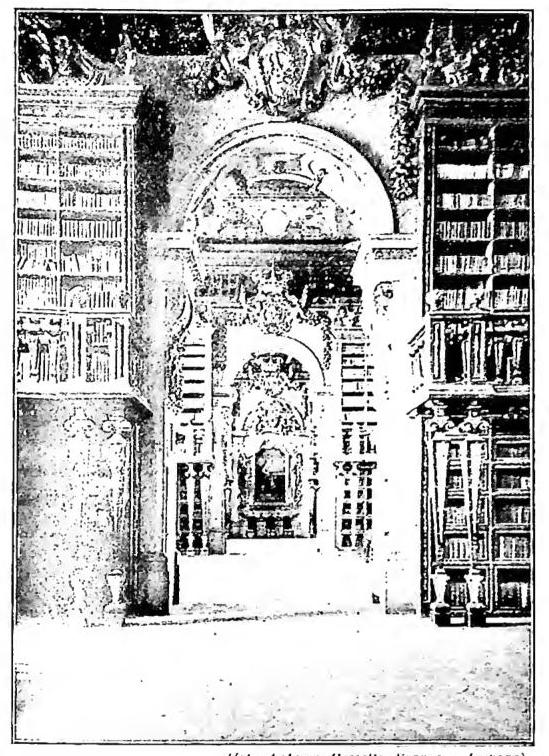
After the privileges granted in 1309 by Dinis, the structure of the University of Coimbra took shape on the model of the Studium of Bologna, branching into the four fundamental faculties: Theology, Canon Law, Civil Law, and Medicine.
In its secular life, several periods are noteworthy: that marked by the vigorous impulse given to national culture by João III; the new European orientation imprinted by João V; and the reform carried out by the Marquis of Pombal in the 18th century.
Subsequent reforms, more or less successful, have striven to modernize university teaching to adapt it to the new intellectual and social needs of the nation. Of the five faculties existing in the last century at the time of Passos Manuel's reforms, that is, in 1835, the Faculty of Theology was transformed into the Faculty of Letters in 1911, and that of Philosophy (of Pombaline memory) became the Faculty of Sciences. The other three were the Faculties of Law, Medicine, and Mathematics.
Currently, the University of Coimbra consists of: 1) the Faculty of Letters, a four-year program that grants the title of "licenciado" (required for secondary education) and "doutor"; 2) the Faculty of Law, which grants the title of "bacharel" to those who complete the four-year course, that of "licenciado" to bachelors who pass the fifth complementary year with a classification of at least 12/20, and that of "doutor"; 3) the Faculty of Medicine, with a six-year course, from which one graduates with the degree of "licenciado" or, by undergoing further examinations, the title of "doutor"; 4) the Faculty of Sciences, a four-year program or, for geographical engineers, a five-year program; 5) the School of Pharmacy.
All those who aspire to an academic career must possess the academic title of "doutor," which licentiates can obtain after passing various written and oral examinations.
The University of Coimbra, which still preserves characteristic traditional academic customs of secular memory and singular student practices, with the unmistakable Portuguese saudade, is today on the path to a radical architectural transformation; the new "university city" is in full fervor of construction, most modern and austere in its architectural lines, complete and modern in its new facilities. - Vedi Tav. CXXV.