
ENRICO V, IMPERATORE. – Son of the preceding and of Berta di Savoia, born 18 January 1081, died at Utrecht on 23 May 1123. Designated as heir in 1098 after the revolt of his brother Corrado, he was crowned king on 6 January 1099. An ambitious and unscrupulous prince, in 1104 he betrayed his father, forcing him to abdicate, and succeeded him in August 1106. Despite his protestations of loyalty to the Pope, with bold insouciance and contempt for canon law he began to appoint bishops and grant them investiture. The Church, which had already struggled so greatly against his father precisely to vindicate that freedom of investiture, could not remain passive, and the breach became inevitable.
E. then besieged Rome and seized it at the beginning of 1117, while the Pope took refuge in Benevento, and on Easter Day he had himself crowned again by an archbishop. In the following summer he returned to Germany, but, on learning of the election of the new pontiff Gelasio II (23 January 1118), he secretly returned to Rome in order to take him prisoner. Gelasio managed to escape, and E., disappointed and furious, then elected the antipope Gregorio VIII, whom Gelasio, from Capua, excommunicated together with E. To prevent the promulgation of the excommunication, the latter returned to Germany, whereupon Gelasio was able to return to Rome; but he was forced to leave it again and take refuge in France, where he died on 29 January 1119. Callisto II was elected to succeed him; although a faithful follower of the ideas of Gregorio VII, he nevertheless wished to reach an agreement with E. in order to restore peace. The German episcopate itself, which was beginning to understand the necessity of reform for the Church, encouraged him to continue along that path. For his part, at the Diet of Mainz (24 June 1119), E. also promised to make peace with the Pope. Legates of Callisto then met with E., and a preliminary agreement was reached through mutual promises, with decisions postponed until a direct conference between the Pope and the Emperor. The meeting took place at Mouzon, but for the tergi-
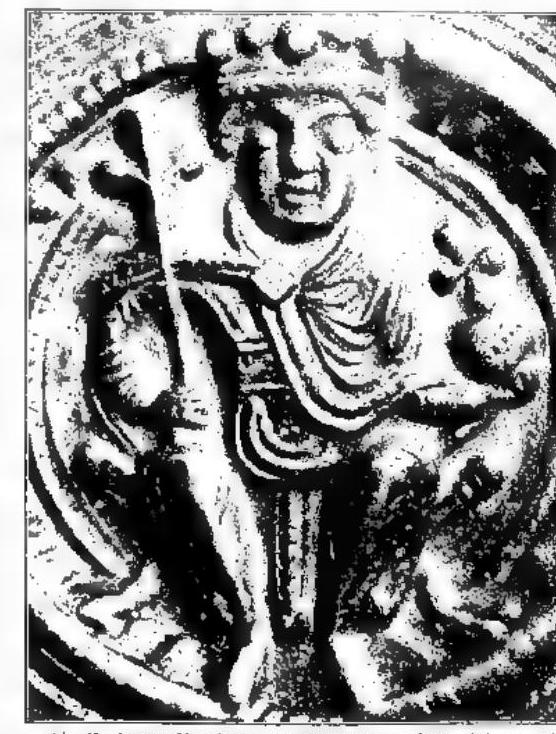
(from K. Langt, Munkunst des Mittelalters, Leipzig 1918, inv. 13) ENRICO VI, IMPERATORE – The emperor enthroned with the insignia of his authority. Silver coin (1100–07) – Berlin, Geldmuseum der Deutschen Reichsbank.
E. renounced every investiture by means of the ring and the pastoral staff, promised not to interfere in the elections of bishops, to restore to the Church all the goods that had been taken from it, and to assist it in its work of reform. For his part, the Pope granted that the elections of bishops should be held in the presence of the Emperor or his delegate, and that the regalia should be conferred by investiture with the sceptre. The peace was sealed by the celebration of a solemn Mass, during which E. was admitted to Communion and received the kiss of peace from Cardinal Lamberto of Ostia in the Pope’s name; the latter dispensed him from every other canonical penance. The struggle over investitures, which had afflicted the Church and the Empire for approximately 50 years, thus came to an end.
BIBLI: G. Meyer von Knoman, Jahrbücher des deutschen Rechts unter Heinrich IV und Heinrich V, 7 vols., Leipzig 1898-1909; E. Berthelsen, Das Wormser Konfrontat und seine Vorurhänder hinsichtlich Entstehung, Formulierung Rechtsgültigkeit, Breslau 1906; A. Fliche, L'Europe occidentale de 888 à 1125, Paris 1920, passim; A. Fliche-V. Martin, Hist. de l'Eglise, VIII, xv 1046, pp. 345-60.