
CAPUA, ARCIDIOCESI di. — In Campania, a short distance from the point where the Via Latina joins the Appian Way, C. must have received the Christian message at an early date.
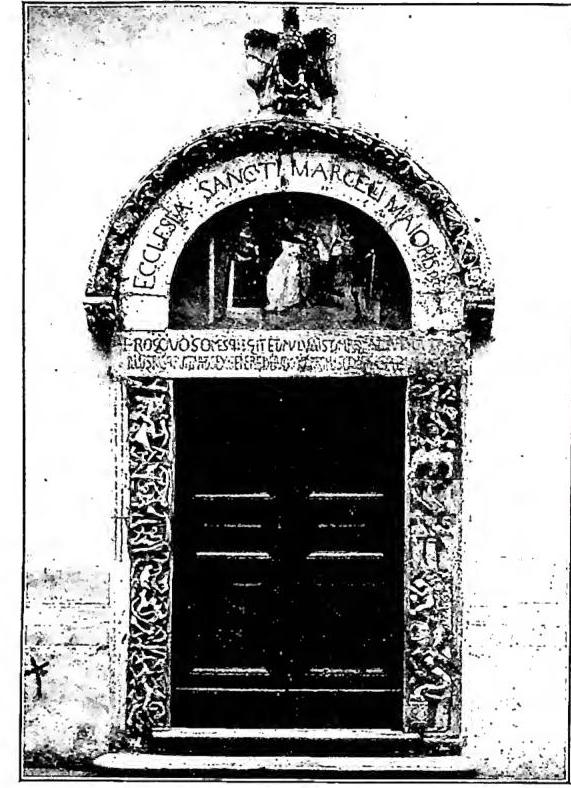
The church of C. had its martyrs, remembered in the Hieronymian Martyrology: Priscus, Lupolus, Sinotus, Marcellus, Rufus, Augustine, and Felicitas; the last two are said to have suffered martyrdom under Decius. In the present-day town of S. Prisco, near C., numerous Christian funerary inscriptions from the second half of the 4th century were discovered, and nearby ran the Via Aquaria, on which, on 1 September, St. Priscus was celebrated, whom tradition presents as the first bishop of C. The Lib. Pont. informs us that Constantine founded a basilica in C., endowing it with liturgical furnishings and rich possessions. In the church of S. Prisco, until 1766, there were preserved the 5th-century mosaics that decorated the apse and dome. The apse depicted apostles and martyrs, together with the local saints Priscus, Sinotus, Lupolus, Rufus, Marcellus, Augustine, and Felicitas, in the act of carrying their crowns; in the vault was the symbolic dove amid eight volumes symbolizing the Gospels and four prophets. In the dome, at the center, was the divine throne; in the lower zones, prophets, apostles, evangelists, and the Campanian martyrs Hippolytus (Ipolistus), Canio, Augustine, Marcellus, Lupolus, Rufus, Artemas and Euphemus, Eutyches and Sosso, Festus and Desiderius. The chapel beside the church of S. Prisco, dedicated to S. Matrona, still displays its 5th-century mosaics. In the vault, at the corners, are four large palm trees, and between them branches with clusters of grapes and birds; on the surrounding walls, on one, a medallion of Christ amid branches and vine leaves, and on the others the Evangelists’ symbols: specifically, the winged man on one, and on another the ox and the eagle at either side of a jewel-encrusted throne, with the symbolic dove on the backrest and a volume on the cushion. Also remembered are the 5th-century mosaic decorations of the apse of S. Maria Maggiore, in S. Maria Capua Vetere, and of the apse of the cathedral of the new C., dating from the 11th–12th centuries, likewise now lost; the paschal-candle candelabrum in the same Cathedral; the Exultet roll; the door of the church of S. Giovanni delle monache; and the portal of S. Marcello Maggiore. Also highly important are a 4th-century Christian sarcophagus in the courtyard of the church of S. Marcello, a series of funerary inscriptions from the 4th–6th centuries, and the Lectionary of the codex Fuldensis of 546.
The episcopal succession of the first six centuries is attested by reliable documents only from the first half of the 4th century: Proto or Praetorius (313), St. Germanus (519–20, 540–41), and Victor (541–54). The best known is Victor, a contemporary of Cassiodorus and Eugippius, the abbot of Lucullanum, especially on account of the codex Fuldensis, which he revised in the years 546 and 547.
Under St. Gregory the Great, because of the Lombard invasion, which had devastated and depopulated the Campanian metropolis, the clergy of C. lived as refugees in Naples. Once this had ended, C. became part of the duchy of Benevento. In 787 Charlemagne, at the request of Pope Hadrian, offered the city of C. to St. Peter, and from then on it was counted among the possessions of St. Peter, more in name than in fact. When the duchy of Benevento was divided into the two principalities of Benevento and Salerno, the gastaldate or county of C. was included in the latter (847); but Landone succeeded in making his domain independent of Salerno. From 899 to 980, moreover, the count of C., having become a prince, ruled C. and Benevento.
In 842, after C. had been destroyed by the Saracens, the bishop and count Landolf transferred his residence to the new city, situated approximately 5 km from the ancient one, on the site of ancient Casilinum, on the banks of the Volturno. Landolf I was succeeded by Landolf II; but Count Pandolf forced him to leave and return to the ancient city; then he sent his brother Landonulf to Rome, so that he might be consecrated bishop of the new C. Pope John VIII came to C. and divided the diocese of C. in two, consecrating Landolf II bishop of S. Maria Suricorum (ancient C., today S. Maria Capua Vetere), and assigning the new C. to Landonulf. In 882, after Pandonulf and Landonulf had been expelled, Landolf II returned as the sole bishop of the entire diocese; from then on the episcopal see was transferred to the new C. on the Volturno. Meanwhile, under the episcopate of Landolf, the new Cathedral had arisen there; it was consecrated by Otto and decorated with mosaics by Hugh. In 966 Pope John XIII, having come to C., raised it to a metropolitan see. Today it has as suffragans Isernia and Venafro, Calvi and Teano, Sessa Aurunca, Caserta, Cejazzo; it borders on Aversa, Cejazzo, Calvi and Teano. It has 110,000 inhabitants, 63 parishes, 129 diocesan priests, and 7 religious priests (1948).
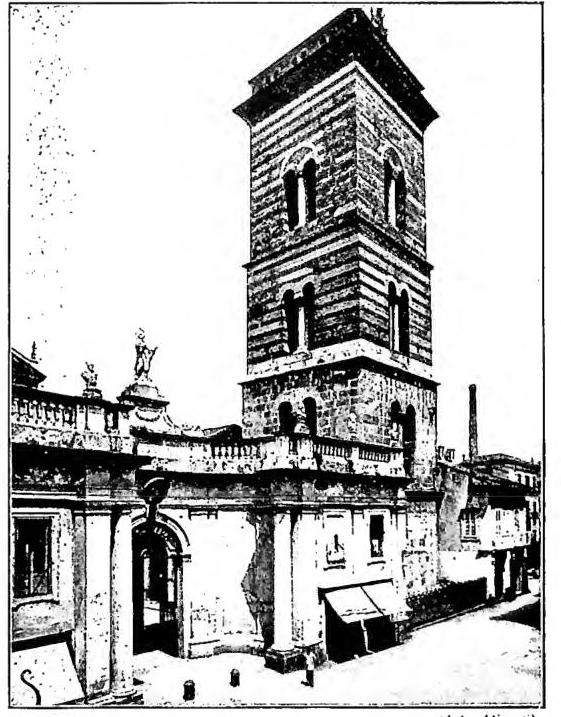
(Alinari photograph)
CAPUA – Bell tower (11th–12th centuries) of the Cathedral.
C. fu sede di tre sinodi: al primo, Synodus plenaria Capuensis (392), partecipò s. Ambrogio che ne segnò le direttive; nel secondo, del 7 marzo 1087, Desiderio, abate di Montecassino, accettò il papato con il nome di Vittore III (m. il 16 sett. 1087); nel terzo, 7 apr. 1118, furono condannati l'imperatore Enrico V e l'antipapa Maurizio Burdin (=Gregorio VIII, 1118-21). Presso C., s. Anselmo terminò, nel 1098, il Cur Deus homo.
Molti presuli hanno illustrato la sede capuana; tra gli antichi Vincenzo, Vittore, s. Germano, poi il card. s. Roberto Bellarmino (1602-1605) e il card. Alfonso Capecelatro (1880-1912). Va pure ricordato, Alessio Simmaco Mazzocchi (1684-1771), archeologo e filologo insigne.
Dei monumenti sacri di C., quelli dell'evo antico furono in gran parte distrutti nel sec. XVIII, quelli del medioevo durante l'ultima guerra.
II, 11, coll. 2064-84; id., Lectionnaire, ibid., VIII, 11, col. 2276-2283; J. Wilpert, Mosaiken, pp. 50, 51, 59, 229; id., Sarcofaes, tav. IX, 2, pp. 116, 232, 335, 10°, 13°. Domenico Mallardo