Machine translation of the 1948–1954 Italian original. The original text is authoritative.
«EXULTET». - È il precenio pasquale, il solenne Lucernarium proprio alla notte di Pasqua; in sostanza cero pasquale (v.) inserita nella proclamazione e nell'esaltazione dei Misteri della stessa notte, cioè della Resurrezione e della nostra Redenzione. L'elevazione della ferma e del contenuto, fa di esso un autentico capolavoro.
Già s. Agostino (De civet. Dei, XV, 22) parla di una lode del cero pasquale 5 s. Girolamo (Epist. 18: PL 30, 182 agg.) rimprovera il diacono Presidio di Piacenza per la eccessiva descrizione della natura, in specie delle api, nell'E. (CSEL, 6, p. 415). Ennodio di Pavia (opusc. 9 e 10) e il Gelasiannum (80) ce ne hanno conservato il testo. In Roma non c'era uso né della benedizione, né del cero pasquale, né dell'E. prima del sec. VIII (nel cosiddetto Gregoriano non si trova la formula); ai diaconi delle chiese suburbicarie fu data licenza di benedire il cero del sec. VI. Il formolario attuale dell'E., cantato dal diacono
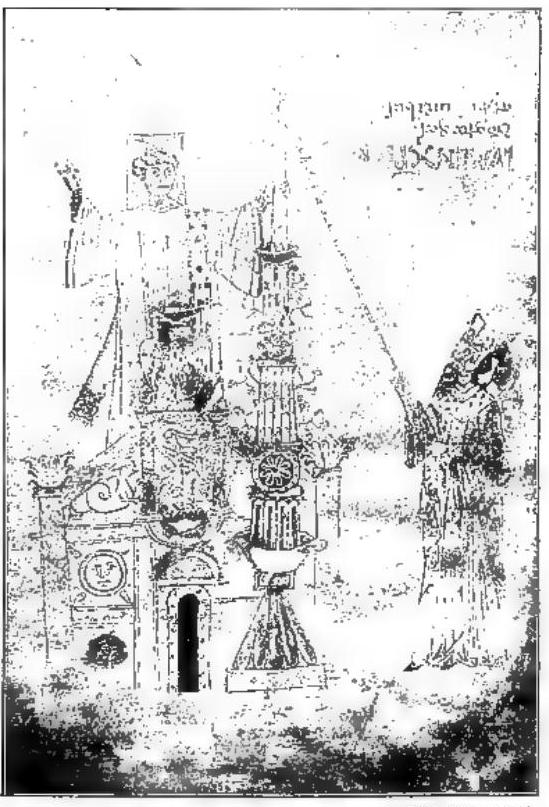
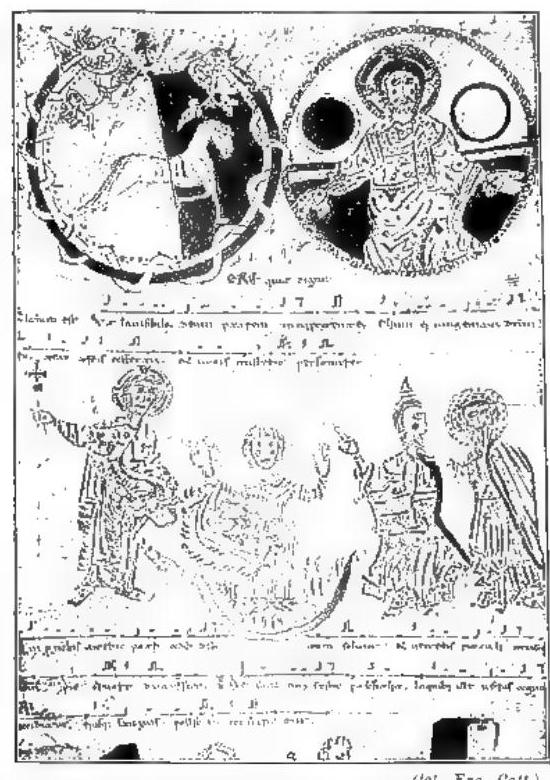
«EXULTET» - Accensione del cero. Miniatura dell'E. n. 1 (sec. XI). Mirabella Eclano, Archivio chiesa collegiato. (fot. Enc. Catt.)« EXULTET » - In alto : iniziale V con Alagna Dei e Cristo in aureola; sotto : Diocesà al Lambio. Minatura dell'E. n. 2 (sec. xixii) - Mirabella Eclano, Archivio chiesa collegiata.nell'ambone, si trova per la prima volta nel Sacramentario di Bobbio (sec. vii) sotto il titolo : « Benedictio cerei s. Augustini episcopi (quam) cum adhuc diaconus esset, cecinit », poi nel Missale Gallicum vetus (L. Muratori, Liturgia Romana vetus, II, Venezia 1748, pp. 783 e 845) e nel Missale Gothicum (ibid., 581 agg.), donde entrò nel supplemento del Sacramentario Adriano e così nella liturgia romana (per la critica del testo cf. L. Duchesne, Origines du culte chrétien, 5ª ed., Parigi 1925, p. 254). Alla lode unisce la preghiera per le autorità ecclesiastiche e civili. Anticamente i singoli passi erano ben illustrati.
Alcuni brani dell'E. un tempo erano oggetto di scuta discussione, come quello della « felix culpa », delle api come simbolo della verginità e maternità di Maria S.ma, ed altri, e perciò in molti manoscritti o mancano o sono cancellati. - Vedi tavv. LXI-LXII.
BIBL.: J. Braun, Osterpräconium und Osterhorzenweihe, in Stimmen aus Maria Laech, 36 (1899), p. 273 agg.; anon., Le miniature dei rotoli dell'E., Montecassino 1899; P. Latil, De praconio paschali, in Ephenerides liturgicus, 18 (1902), p. 123 agg.; A. Mercati, Paralipomena Ambrosiana (Studi e Testi, 12), Roma 1904, pp. 24-43; F. Di Capua, Il ritmo della prosa liturgica e il Praconium Paschale in Didaskaleion, nuova serie, 5 (1925), pp. 1-13; R. Buchwald, Osterluce und E., in Theologisch-praktische Quartalschrift, 80 (1927), pp. 240-49; B. Ebel, Zum Verständnis der E., in Liturgische Zeitschrift, 3 (1930-31), pp. 165-73; O. Casal, Der äuerliche Lichtgesang der Kirche, ibid., 4 (1931-32), pp. 170-191; B. Capelle, La procession du Lumen Christi au Samedi Saint, in Revue bénédict., 44 (1932), pp. 105-19; id., L'Exultet pascal oeuvre de si Ambroise, in Miscellanea Mercati, III, Città del Vaticano 1946, pp. 219-46. Filippo Oppenheim
Cite this article
“EXULTET.” Enciclopedia Cattolica, vol. V (1950), p. 566. Azione Romana digital edition, https://azioneromana.com/article/exultet.