
LITURGICAL ROLL. – The liturgical ceremonies of Holy Saturday gave rise in southern Italy to a particular practice: the texts for the blessings of the paschal candle and of the font, and for Holy Ordination, were written separately on distinct rolls, richly decorated and illustrated with pictures interspersed throughout the text. Only the most recent (Vat. lat. 3784 A) is without miniatures. There survive, whole or fragmentary, 31 l. r. dating from the 10th to the 14th century; of these, 28 contain the Exultet (v.) with the prayers that follow it, two the Benedictio fontis, and one the ceremonial of Ordinations (Pontifical). Their dimensions are unequal: the width varies from 20 to 50 cm., while the length reaches more than 5 metres.
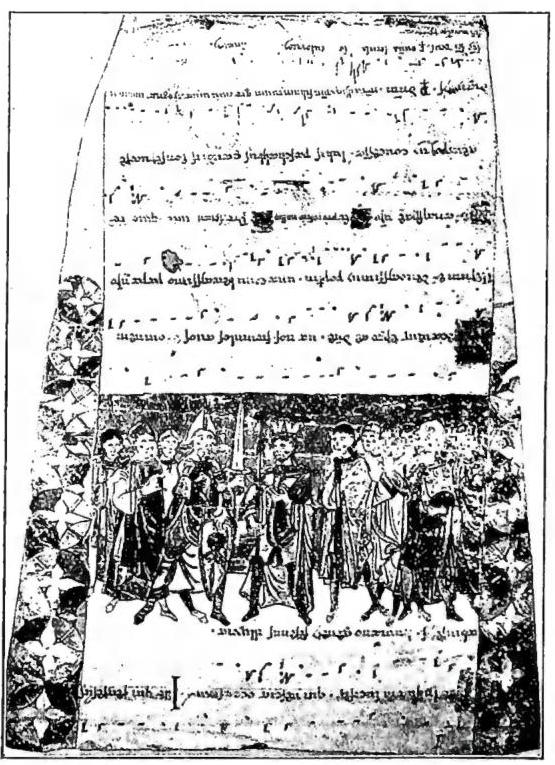
These l. r. – defined as “one of the most precious collections of graphic documents left by the Middle Ages” (Bertaux) – are of exceptional importance for the liturgy, for the history of the text, for the musical notation that accompanies it (often modified in order to introduce a new system), and for decoration, but above all for the nature and variety of the illustrative scenes. This is particularly true of those of the Exultet, in which the figures are arranged in the direction opposite to that of the writing,
so that the people – while the deacon performed the ceremony and the r. was slowly unrolled from the top of the ambo, remaining suspended on the outside – could successively contemplate the pictures as they came into view. It cannot be established when or where this practice originated, but it must be regarded as common to the entire region (at least in the case of the Exultet) and indeed exclusive to II. Of the surviving l. r., only two were written outside southern Italy, and these too are closely connected with it: one, preserved in the cathedral of Pisa, comes from a Benedictine monastery in central Italy dependent on Montecassino; the other, now in the Museo civico of Pisa, was produced in the 13th century by Tuscan artists on the model of an older monastic r., in Beneventan script, preserved in the same Museum. The names of popes and sovereigns added to the Orenus of an Exultet from Naples demonstrate its use in the 16th century; a r. was used in the cathedral of Salerno until our own times. As regards the text, it is interesting to note that the Vetus latina appears in the only Exultet of the 10th century, in 9 of those of the 11th century, and in one from the beginning of the 12th century (at Troia); in 3 of these 11 r. the primitive text was later replaced by the Vulgate. All the other 17 (from the mid-11th to the 14th century) have the Vulgate, sometimes preserving from the Vetus latina the biblical texts contained
in the praise of the bees. The figures are a commentary on and illustration of the text. In the benedictionals, the ceremony is represented in its various stages, followed by Moses bringing forth water, the wedding at Cana, the Baptism of the Lord, the Crucifixion, the Baptism administered by s. Peter and s. Andrew, and the Baptism of children. In the pontifical, which belonged to Bishop Landolfo I of Benevento (957–84), twelve pictures illustrate the ceremonies for the conferral of Orders.
The figures in the Exultet are highly varied. Here too some scenes from the Old Testament appear (the sin of Adam and the crossing of the Red Sea), but those taken from the Gospel predominate: the Annunciation, the Nativity, the Adoration of the Magi, the presentations in the Temple, the Samaritan woman, the healing of the blind man, the resurrection of Lazarus, the temptations of the Lord, the entry into Jerusalem, the Last Supper, the kiss of Judas, the Crucifixion, the descent into Limbo, the Resurrection, the appearance of the Risen One, the disciples of Emmaus, and the Transfiguration. In almost all the r. are depicted, in various forms, the symbols of the Tellus and of the Mater Ecclesia, nor is the “angelica turba” absent; the praise of the bees, a poetic composition attributed to s. Augustine, provides an opportunity for the lively and ingenuous representation of rustic scenes. Other pictures illustrate the ceremony itself of the blessing of the candle. Particularly important for costume and historical references are the figures of the pope, the emperor or king, the bishop, the people, and the exercitus. Sometimes the patron saint of the church or monastery is represented at the end, together with the author of the r. in the act of presenting it as an offering. Only some scenes, however, are found in almost all the r.; others are rare, and some are entirely unique. It is therefore impossible to speak of a genuine iconographic canon; this demonstrates the variety of the sources from which the artists drew. They fused local motifs with elements of Carolingian and Ottonian, Byzantine, and Oriental art, sometimes following the simple forms of local painting, sometimes adopting the more advanced forms introduced by Byzantine artists, producing in every case an original ensemble without parallel elsewhere.
(from Operne Rossetta..., Nuremberg 1881, plate facing 1st. 1*) ROTSVITA – R. offers the book of his own works to Emperor Otto. Wood engraving from the German school – Specimen of the Vatican Library.
11 (1909), Oct., pp. 43–54; P. Toesca, Storia dell'arte italiana, I, Turin 1927, p. 1050 and passim; E. Moneti, Considerazioni e ricerche sui r. liturgici miniati dell'Italia meridionale, in Scritti in onore di V. Federici, Florence 1946, pp. 241–53. Giulio Battelli