
SUPPLICA. - As a diplomatic term, it is the petition addressed to the sovereign in order to obtain a gracious concession. Concessions of various kinds made by the pope, as well as appointments to minor benefices reserved to the Holy See, were likewise preceded by a s.
At first, papal s. were drawn up directly by the persons concerned, but already in the 12th century there is mention of writers who kept their desks near the Lateran Palace in order to prepare the s., and in the 13th century the first collections of formularies appear: they ordinarily begin with “Supplicat Sanctitati Vestrae devotus orator vester,” which became their characteristic formula. In the 14th century the s. assumed an official character; their text was drawn up according to the style of the Curia, and the vice-chancellor himself or a referendary presented them to the pope, who approved them with the autograph formula “fiat ut petitur,” followed by the initial of his baptismal name; the date was added, marking the effective date of the concession. These details are of interest for the history of the Curia, because they mark the origin of offices that subsequently developed independently: the referendaries of the Segnatura and the datary. By the 15th century the procedure had become fixed, remaining so until the 19th century; the text prepared according to the prescribed style by the procurator, who represented the interested party in the Curia, was examined and signed by a referendary, and then presented by him for approval, which could be granted either by the pope with the now traditional formula, or, in certain matters, by the vice-chancellor, who used the formula “concessum ut petitur” followed by his signature, or by an authorized referendary, who, however, signed in the presence of the pope him-
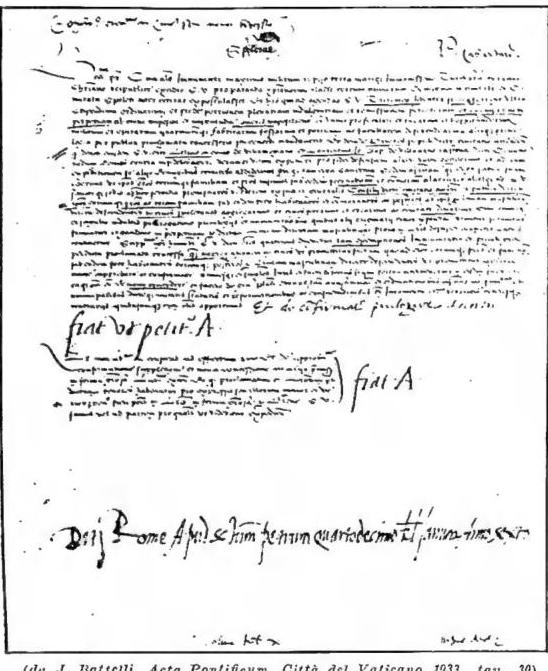
SUPPLICA – Original supplication of Lelio di Leone “de Villa Megiane” and Lorenzo di Giovanni Battista “de Villa Aque Castanee” of the Comitato Spoletino, in which they ask Paul III to confirm the immunities and privileges they had obtained for having fought against the Turks (19 Dec. 1539). The Pope’s double autograph signature is visible, one beneath the petition and the other beside the clauses: the abbreviation with which the Pope signs is the initial of his baptismal name (Alexander) – Archivio Segreto Vaticano, Paolo III supplic. orig.
The datarius added the date.
The s. therefore constitutes, after approval, the original of the grant, intended, however, for office use, since the dispatch of the definitive solemn act, that is, a bull or a brief, was necessary. In certain cases the pope granted that the sole signatura, that is, the s. signed by him, should be valid as the definitive document, without the dispatch of the solemn document being necessary: these s. are distinguished by their carefully executed external features, are often decorated with miniatures, and bear a special formula expressing their nature. Another type of s. begins with the words matu proprio: by means of it, a fictio iuris is employed to grant procedural facilitations to the beneficiary, as though the grant had been made on the pope’s initiative and not at his request. The s. were copied from as early as the 14th century into official registers, which today form in the Archivio Vaticano a series of 7,363 volumes, from the year 1342 to 1899. The apostolic nuncios too, for the faculties they received, approved s. following the usage of the popes and likewise had their own registers.