
BENEVENTANA, SCRITTURA AND MINIATURE. -
I. WRITING
The term “beneventana” denotes the calligraphic script used in Latin manuscripts of southern Italy and Dalmatia from the late 8th to the 13th century.The name, already attested in early examples and now commonly accepted in palaeographic terminology, is meant to indicate that the script originated and developed in the ancient Lombard duchy of Benevento; it has also been called Lombard, Langobardic, and even Neapolitan to stress its local character in contrast to the Carolingian minuscule, spread by the Normans and therefore termed “Frankish.” Mabillon called it Langobardica, confusing it with other Frankish scripts, and on his authority many older writers repeated this name; it has also been termed Longobardo-Cassinese or even Cassinese from the scriptorium where it attained its most perfected forms. Other names (Gothic cordelée and minuscule of southern Italy) have not gained acceptance.
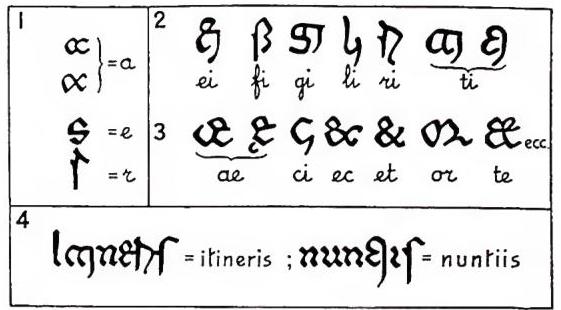
BENEVENTANA, SCRITTURA - Characteristic letters (n. 1); constant ligatures (n. 2); optional ligatures (n. 3); and the /s/ ligature on hard and sibilant sounds (n. 4).
The most important writing centres, from which the majority of surviving manuscripts derive, were Montecassino, Naples, Capua, Salerno, Benevento and Bari, where a particular type developed.
From the last decades of the 8th century, to which the earliest examples already display characteristic features, the script gradually acquired increasingly regular forms until it reached the height of calligraphic perfection in the 11th century; by the end of the 13th century its normal use had ceased. Four periods can be distinguished in its evolution: the beginnings (from the end of the 8th century to the end of the 9th), formation (from the end of the 9th to the whole of the 10th century), maturity (from the 11th to the end of the 12th century) and decline (from the end of the 12th to the whole of the 13th century).
Relating these periods to the history of Montecassino, the major cultural and literary centre of southern Italy, the first corresponds to a time of notable literary activity at the monastery, which however was expressed mainly in the forms of script inherited from previous centuries (especially uncial) and was anyway cut short in 883 by the Saracen destruction; the second period corresponds to the time when the monks were temporarily resident in Capua and, having returned to Montecassino in 949, experienced a difficult and troubled life; the third is the golden age that begins with Abbot Atenulf (1011–22) and Theobald (1022–35) and closes with Desiderius (1058–87) and Oderisius (1087–1105); the fourth is a time of decline for the monastery as well, following its previous splendour.
On the other hand, the vicissitudes of the monastery fairly faithfully reflect the cultural conditions of the entire region, so that by considering the genre and number of texts preserved in Beneventan manuscripts, arranged chronologically, one can gain a very interesting view of the cultural conditions of southern Italy. In this regard, it is significant that southern codices are important for the preservation of Latin classics, some of which (Varro, Tacitus, Hist., II, 1–4 and Ann., II, 11–16; Apuleius, etc.) are known only from copies made at Montecassino, while others have their most authoritative text in them (Ovid, Cicero).
General features. Even in the earliest examples the Beneventan script displays certain distinctive features, though these are best observed in their full development in 11th-century manuscripts.
Typical is the overall appearance, with the careful shading of individual letters, in which thick and thin strokes regularly alternate with constant uniformity. The vertical strokes of small letters (i, u, m, n) are broken in the middle, recalling forms and appearance that would later appear in Gothic script.
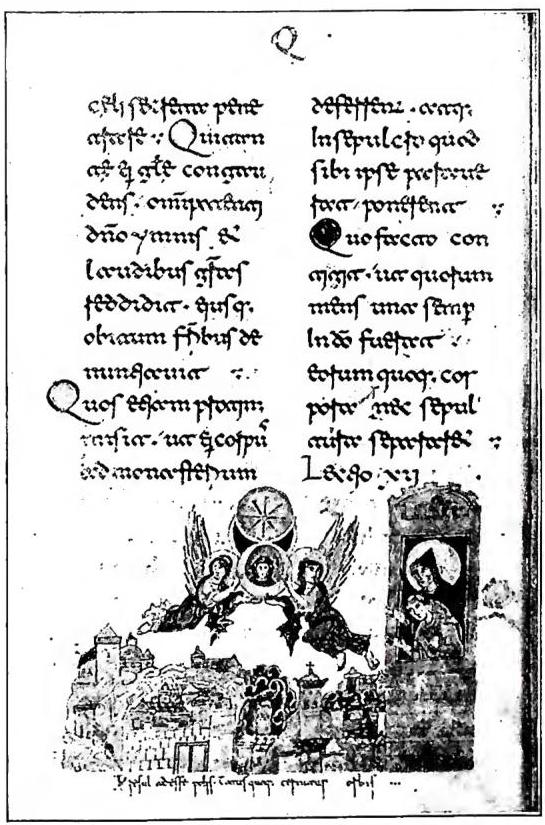
BENEVENTANA, WRITING AND MINIATURE - S. Benedict and the deacon Servandus see the soul of Germanus, Bishop of Capua, being carried up to heaven. Miniature from the 11th century from the Vita S. Benedicti — Vatican Library, cod. Vat. lat. 1202 f. 79.
Particularly characteristic (v. table, no. 1) are certain letters: a (at first open, resembling two c’s placed side by side, later closed and resembling an o joined to a c); e (with an ample head rising above the line); r (with a high head bent at an angle).
The letter i has two forms: a tall form when it is a semivowel or at the beginning of a word, and a small form in other cases.
In the ligature ti, the first form expresses the hard sound, the second the sibilant sound of the consonant (v. table, no. 4).
Abbreviations are also numerous: in addition to the forms common to all medieval scripts and others derived from the Irish system, some are distinguished by the very shape of the abbreviation sign or by the letters composing the compendium (especially characteristic are the apostrophe and a sign resembling a 3 placed high on the right, and a sign resembling a 2 placed above a letter, which indicate respectively = -s [us], -m, -r [er, ur]; oma, gloa, ama = omnia, gloria, anima).
The system of punctuation marks is quite distinctive. The suspending pause at the end of a period is usually indicated by a thin oblique stroke (virgula), sometimes accompanied by a dot; the medial pause by a simple dot; and the final pause by a triple mark, two dots and a comma arranged in a triangle or in a line. In direct or indirect interrogative sentences, there is a special mark (a small acute angle open to the right) placed over the word on which the interrogation rests; another special mark (a vertical stroke with a small arm to the right) indicates the words on which the voice rests in an assertive tone. Acute accents (sometimes also circumflex accents in properispomenon words) mark the tonic accent and the distinct pronunciation of two vowels that do not form a diphthong.
The varying degree of shading (which determines the general appearance of the script), the shape of the letters, the form and frequency of ligatures and abbreviations, as well as the use of punctuation marks and accents, are elements that allow one to evaluate the dating of a manuscript.
In the region of Bari and in Dalmatia, the Beneventan script presents a variety known as the Bari type, which is distinguished especially by its more rounded shading, without the strong breaks in the vertical strokes and without the excessive contrast between thick and thin strokes.
II. MINIATURE
Manuscripts from southern Italy present magnificent examples of decorative art such as few other regions attained in the early Middle Ages.In the 9th century, book ornamentation remained quite simple and crude, limited to monochrome and polychrome titles in large letters.
A notable advance occurred already in the following century with letters of more complex design, incorporating floral motifs and interlacings, in which a bird’s or dog’s head often appears; human figures are rare and reproduce Byzantine models.
The glorious period that began for Montecassino under Abbot Teobaldo (1022–35) likewise marked a decisive phase in the development of manuscript decoration at Montecassino itself and in other centers of the region, for renewed contacts with cultural centers in Germany (Ottonian art), England (Irish and Anglo-Saxon art), and the East introduced new elements that, through the work of skilled artists, led to the formation of an original and distinctive style.
Outstanding above all for the splendor of its full-page major initials is the monk Grimoald (ms. 109 of Montecassino). Human representations, however, remain crude, as in ms. 132 of Montecassino.
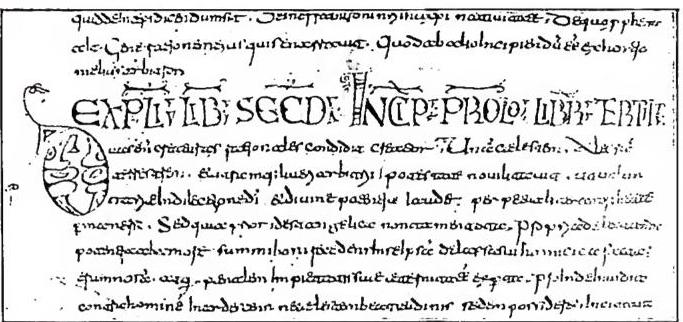
BENEVENTANA, SCRITTURA - B. of the first period (9th century). Miscellany from Cassino of the year 811-12 — Rome, Casanatense, cod. 641, fol. 23.
The magnificence of the colors and the gold used in lavish abundance with fine taste found its liveliest expression in the decoration of the time of Desiderius and, in particular, in the works of the monk Leo. The three sumptuous manuscripts bearing his name (Montecassino 98 and 99, Vat. lat. 1202) are among the finest products of the Cassinese school. The designs are always different, yet the decorative motifs follow a fixed pattern, with interlacings of ribbons and tendrils from which pink-colored dogs with claw-like circles unfold. Even the figures drawn by the monk Leo show a notable evolution that reveals his personal qualities as an artist.
After the age of Desiderius, there was only a monotonous repetition, almost uniformity of stamp, of the previous models, with heaviness of color and design.
A particular group of illuminated manuscripts is constituted by the Easter rolls, which, according to the usage of southern Italy, contained large figures to illustrate the liturgical text. These were painted in reverse to the writing because they were intended for the contemplation of the people while the deacon unrolled the scroll from the ambo. — V. Tav. LXXX.
(from F. Corte, C. Cipolla, C. Frati, Atlante autovagico artistico, Torino 1899)
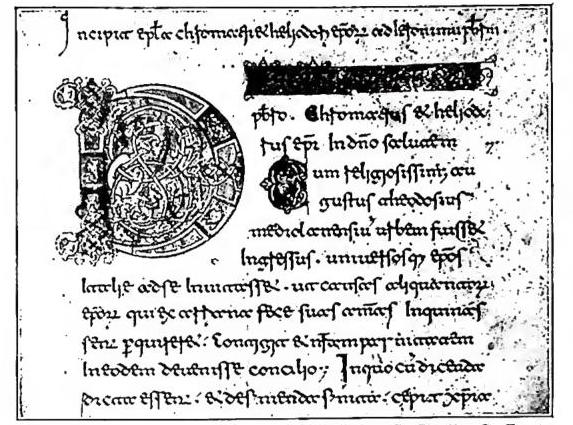
BENEVENTANA, SCRITTURA - B. of the 3rd period (12th century). Apocryphal letter of Chromatius and Heliodorus to St. Jerome — Naples, Biblioteca Nazionale, cod. VIII C4.
Cassinese codices, Montecassino (1893); A. M. Amelli, Sacred and profane miniatures of the year 1923 illustrating the medieval encyclopedia of Rabanus Maurus, ibid. 1896; M. Inguanez, Miniatures and other reproductions of the Regesto of S. Angelo in Formis, ibid. 1925; M. Inguanez and M. Avery, Cassinese miniatures of the 11th century illustrating the life of St. Benedict (cod. Vat. lat. 1202), ibid. 1934.
On Easter rolls: A. M. Latil, The Miniatures in the rolls of the Exultet, Montecassino 1899; E. Bertaux, op. cit., pp. 213-240; M. Avery, The Exultet Rolls of South Italy, in Illuminated manuscripts of the middle ages, A series issued by the Department of Art and Archeology of Princeton University, part 2°, Princeton 1936; cf. E. Moneti, Considerations and research on the illuminated liturgical rolls of southern Italy, in Scritti di Paleografia e Diplomatica in onore di V. FEDERICI, GIACOMO, Florence 1945, pp. 241-54. Giulio Battelli