
PALEOGRAPHY. – This term, improperly coined by B. Montfaucon for a treatise on Greek scripts (Palaeographia graeca, Paris 1708) and now established by usage, denotes “the critical study of ancient scripts,” with the aim of reading them accurately, determining the provenance and date of their products, and deriving from the graphic fact itself (independently of the content of the writing) historical elements that often are transmitted by no source. The vast and multifaceted field of scripts has not, however, been investigated equally; indeed, in very many cases, the examination devoted to them has not progressed beyond the empirical stage of correctly interpreting the signs (whether ideographic, symbolic, or alphabetic). Thus, in practice, the term p. refers only to the two branches in which it has established itself as an autonomous discipline: Greek and Latin scripts. The latter, above all, have offered scientific investigation fertile ground for results that, within a few years, have altered the very direction of scholarship.
I. HISTORICAL NOTES
If Greek paleography arose as an auxiliary discipline of philological studies (especially Byzantine studies), Latin paleography originated diplomatics (v.). Both, however, arose almost contemporaneously, between the end of the 17th century and the beginning of the 18th, in response to a “systematic” need: the first treatises, in fact (that of Mabillon [v.] for Latin paleography and that of Montfaucon for Greek paleography), essentially represent a classification of scripts. As early as 1727, however, Latin paleography took a step forward through the work of Scipione Maffei (v.), who, by affirming the unity of origin of the various types classified by Mabillon, introduced historicist criticism into the study of the graphic phenomenon. For a long time, however, paleographical scholarship remained anchored within these limits, restricting itself to refining and multiplying the categorization of scripts (a typical expression of this tendency is the imposing work of the Maurists R. P. Tassin and C. Toustain, Nouveau traité de diplomatique, Paris 1730–65): only in the second half of the 19th century did W. Wattenbach (Aulétius zur lateinischen Palaeographie, Leipzig 1866) and L. Delisle (Notice sur un manuscrit mérovingien contenant des fragments d'Eugippius, Paris 1875) bring to light the importance of studying graphic forms in their development, and Delisle in particular opened the way to fundamental investigations into individual scriptoria. Between the end of the 19th century and the beginning of the 20th, improved technical means and the studies of L. Traube and L. Schiaparelli determined the decidedly historical orientation of paleography, with results of the greatest importance, to which scholars from every country contributed. More recently, the French school has given new impetus to paleographical research by directing particular attention to the physiological element as a determining factor in the evolution of writing.II. SUBJECT MATTER OF P
In the strict sense, p. has as its subject the history of writing (Greek, Latin, etc.) in its development, from its origins (presupposing, however, that its alphabet has already been formed) up to the last stage that can be critically investigated (up to their extinction in the case of scripts that have now disappeared, and up to the present day in the case of those still in use); in practice, for Greek and Latin p., investigation stops at the sixteenth century, when printing brought about the gradual decline of bookhand. It is true that writing did not thereby cease, but its study does not present the same interest that it had in earlier periods; nor, on the other hand, could it proceed according to the same principles (the concept of a “writing center” no longer has any meaning; only the chancery tradition survives for some time; writing, no longer tied to a “school,” becomes increasingly personal and is profoundlymodified by the alternating use of different writing instruments). A further restriction arose with the establishment of papyrology and epigraphy, which also claimed for themselves the study of writing as such when traced on materials falling within their field of investigation. Today, however, the need to understand the graphic phenomenon in a unified sense is gaining ever greater recognition, so that p., while taking into account the transformations imposed by the writing material, also regards writing on papyrus and epigraphic material as falling within its field of competence.
P. also extends its examination to other subjects, particularly the system of abbreviations (v. ABBREVIATORE), diacritical and punctuation marks, numerical figures, tachygraphic and secret scripts, writing instruments and materials, as well as the processes by which the latter are prepared to receive writing.
III. DEVELOPMENT OF WRITING
Greek paleography essentially distinguishes only three types of script: uncial (v.), in majuscule form; cursive (v.), originally in majuscule form and later transformed into minuscule; and minuscule (v.), derived through a process of calligraphic development from the cursive. Latin paleography, on the other hand, presents a far more complex picture, traditionally outlined as follows: archaic capital gives rise to capital scripts (v.), both epigraphic and book scripts, and to the ancient cursive (also called by some “cursive capital”); from the latter a new cursive (v.) evolves, attaining minuscule forms, while in the realm of book scripts, through a process not yet clarified, uncial (v.) and half-uncial are formed. Cursive minuscule and half-uncial, influencing each other, give rise, for various reasons, to the national scripts (Visigothic [v.], Merovingian [v.], Beneventan [v.]: the history of the Insular scripts [v.] is different) and to the pre-Carolingian scripts, until Carolingian (v.) is definitively established. From this Gothic (v.) emerges in its various forms; finally, Humanistic (v.) represents, in book form, a return to Carolingian and, in cursive form, an evolution of cursive Gothic. It must be borne in mind, however, that the classification set out above follows empirical criteria and criteria of didactic practicality, which recent scholarship has subjected to complete revision.IV. PROBLEMS AND ORIENTATIONS
As paleographic studies have progressed, current terminology has revealed its inadequacy for designating a script which, because it is in a growing or declining phase of its development, or because forms different from those sanctioned by the canonization of a type have infiltrated it, does not display all and only the characteristics proper to that type. Hence a new tendency has gradually developed, aimed at fixing within extreme limits, represented by particular codices or documents, the fluctuating forms liable to be catalogued under a single name. The terms referring to another classification should be separated from the « proper » names of scripts, according to which alphabetical scripts are divided, on the basis of the relation of size and mutual proportion among the letters, into capitals (v.) and minuscules (v.), and, on the basis of ductus, into upright (or straight) and cursive scripts. The issue here is different; the possibility that these forms may coexist in time, or even within the same script (mixed), does not rule out an evolution from one to the other: scripts which appear in surviving monuments both with upright and with cursive ductus may have originated from two different scripts (as in the case of humanistic script), but they may also have developed as calligraphic scripts and then degenerated into cursives (as, essentially, in many notarial scripts), or may have originated as cursives and subsequently stabilized in upright forms (as in the case of Beneventan). Even more evident is the evolution from the capital (constant until the 3rd century A.D.) to the minuscule. In the transition from a cursive form to a straight one, or vice versa, the phenomenon is therefore localized within a single script; consequently, there are various separate problems, now largely resolved (uncertainties still persist concerning the ancient [capital] cursive in relation to the capital). In the evolution from the capital to the minuscule, however, one witnesses a phenomenon of a general character, and the related problem (which also concerns Greek p., although it has received a satisfactory formulation only in relation to Latin p.) remains sub iudice. For while the traditional approach tends to explain the phenomenon as a transformation that occurred within cursive script and was then extended to calligraphic script (ancient cursive - cursive minuscule - upright minuscule), the French paleographic school has recently explained it instead (though without absolutely demonstrating it) as a spontaneous process determined by a changed position of the scribe in relation to the writing material, developing in parallel and independently in the fields of book script and cursive script.The attempt to schematize the formative process of each script within a single paradigm gave rise to the concept of « usual script », that is, the script used by a person in daily practice, essentially individual in character, highly varied in type but almost always cursive. All tendencies may in practice act upon it, but it is above all those tendencies which find a common substratum among several scribes that modify it according to certain constant characteristics, until the « usual » script is transformed into « canonized » script (cancelleresca or book script), which may in turn be adopted as usual script, leaving the way open to further modifications. This is naturally an abstract formulation whose sole purpose is to establish a schema.
There are still very numerous particular problems that are unfamiliar, nor is it possible to recall them all. By way of example, mention may be made of one of the most debated, that concerning the origin of Carolingian script (v.), which is related to the no less controversial question of the so-called pre-Carolingian scripts. The phenomenon of a script which, coinciding with the rise of the Carolingian Empire, once again acquires that character of « universality » found in the scripts of the classical age, involves extra-paleographic factors and brings the scholar into the heart of history: hence the interest of the problem and the various solutions proposed. The unifying element of script, lost with the pre-Carolingian and national scripts (that is, subsequent to the formation of the minuscule), regained a real consistency at the end of the 8th century, which it retained in its broad outlines throughout the subsequent development of Latin p.; thus the minuscule on the one hand and Carolingian script on the other constitute the pivots (and therefore also the fundamental problems) in the history of Latin script, unlike Greek script, which has instead preserved its unifying character. This difference also accounts for the greater development achieved by studies of Latin p. in comparison with Greek p., and for the analytical orientation (investigations of individual writing centers, isolated phases of a single script, etc.) of the former in comparison with the latter.
2. MANUALS: of Greek and Latin p.: E. M. Thompson, Handbook of greek and latin palaeography, London 1893 (3rd ed., ibid. 1906); id., An introduction to greek and latin palaeography, Oxford 1912; A. Mentz, Geschichte der griechisch-römischen Schrift, Leipzig 1920. Of Greek p.: V. Gardthausen, Griechische Paläographie, Leipzig 1879 (2nd ed., 2 vols., ibid. 1911-13); W. Wattenbach, Anleitung zur griechischen Paläographie, 3rd ed., ibid. 1895; W. Schubart, Griechische Paläographie, Munich 1925; P. Maas, Griechische Paläographie, in A. Gercke and E. Norden, Einleitung in die Altertumswissenschaft, I, fasc. IX, 3rd ed., Leipzig 1927, pp. 69-81; A. Sigalas, Ἰστορία τῆς Ἑλληνικῆς τραπῆς, Thessalonica 1934. Of Latin p.: W. Wattenbach, Anleitung zur lateinischen Paläographie, 4th ed., Leipzig 1886; C. Paoli, Programma scolastico di p. latina e di diplomatica, I: P. latina, 3rd ed., Florence 1901; B. Bretholz, Lateinische Paläographie, 3rd ed., Leipzig 1926; P. Lehmann, Lateinische Paläographie bis zum Siege der karolingischer Minushel, in A. Gercke and E. Norden, op. cit., I, fasc. x, 3rd ed., ibid. 1927, pp. 38-68; A. C. Floriano Cumbreno, Curso general de Paleografía y Diplomática, 2 vols., Oviedo 1946; G. Battelli, Lezioni di p., 3rd ed., Vatican City 1949.
3. COLLECTIONS OF REPRODUCED CODICES: Codices graeci et latini photographice depicti, under the direction of P. Durrieu and subsequently of S. de Vries, Lyons 1897 ff. (ongoing: 30 vols. to date); Reproductions des manuscrits et miniatures de la Bibliothèque nationale, under the direction of H. Omont, Paris 1901 ff. (ongoing: 25 vols. to date); Codices e Vaticani selecti phototypice expressi, edited by the Vatican Library, Rome (subsequently Vatican City) 1902 ff. (ongoing: 27 vols. to date); Codices ex ecclesiasticis Italiae bibliothecis delecti phototypice expressi, edited by the Vatican Library, ibid. 1913 ff. (ongoing: 7 vols. to date).
4. GENERAL COLLECTIONS AND COLLECTIONS OF FACSIMILES: Greek and Latin: J. B. Silvestre, Paläographie universelle, II, Paris 1840 (English ed., London 1850); The Palaeographical Society, Facsimiles of manuscripts and inscriptions, edited by B. A. Bond, E. M. Thompson, G. F. Warner, 5 vols., in 2 series, London 1873–94 (Indices, there 1901); British Museum, Catalogue of ancient manuscripts, edited by E. M. Thompson and G. F. Warner, I: Codices graeci, there 1881; II: Codices latini, there 1884; G. Vitelli and C. Paoli, Collezione fiorentina di facsimili paleografici greci e latini, 4 vols., Florence 1884–97; The new Palaeographical Society, Facsimiles of ancient manuscripts, edited by E. M. Thompson, G. F. Warner, F. G. Kenyon, J. Parnell Gilson, 4 vols., in 2 series, London 1903–1930 (Indices of the 1st series, there 1914; of the 2nd, there 1932). Greek: W. Wattenbach, Scripturae graecae specimina, 3rd ed., Berlin 1897; S. De Vries, Album palaeographicum..., Leiden 1909. Other collections of more limited scope should also be noted: Sabas, Specimina palaeographica codicum Graecorum et Slavonicorum bibliothecae Mosquensis, 4 vols., Moscow 1863–64; W. Wattenbach, A. von Velsen, Exempla codicum graecorum litteris minusculis scriptorum, Heidelberg 1878; Facsimiles de manuscrits grecs desis de la Bibliothèque nationale du IXe au XIVe siècle, Paris 1890; Facsimiles des plus anciens manuscrits grecs en anciole et en minuscule de la Bibliothèque nationale du IVe au XIIe siècle, Paris 1892; G. Zereteli and S. Sobolevski, Exempla codicum graecorum litteris minusculis scriptorum..., 2 vols., Moscow 1911–13. For papyri: K. Wessely, Papyrorum scripturae graecae specimina, Leipzig 1900; T. Reinach, Papyrus grecs et dénoiques, Paris 1905; M. Norsa, Papiri greci delle collezioni italiane (Publ. della Scuola di filologia classica dell'Università di Roma, 2nd series), fasc. 1–III, Rome 1924–46. Latin: E. Monaci, Facsimili di antichi manoscritti..., Rome 1881–92; Archivio paleografico italiano, directed by E. Monaci, then by V. FEDERICI, GIACOMO, now by F. Bartoloni, Rome 1882 ff. (in progress: thus far 38 fascicles in 13 vols.); E. Chatelain, Paläographie des classiques latins, Paris 1884–1900; K. Wessely, Schrifttafeln zur älteren lateinischen Paläographie, Leipzig 1898; F. Carta, C. Cipolla, L. Frati, Monumenta palaeographica sacra..., Turin 1899; W. Arndt and M. Tangl, Schrifttafeln zur Erlernung der lateinischen Paläographie, fasc. I and II, 4th ed., and fasc. III, 2nd ed., Berlin 1904–1907; E. Monaci, Esempi di scrittura latina dal sec. I dell'era moderna al XVIII, Rome 1906; F. Steffens, Lateinische Paläographie, 2nd ed., Trier 1909 (reprint, Berlin 1920; French ed., Trier 1910); Exempla scripturarum edita consilio et opera procuratorum Bibliothecae et Tabularii Vaticani, Rome (later Vatican City) 1929 ff. (in progress: thus far 3 fascicles); M. Ihm, Palaeographia latina..., 1st series, 2nd ed., Leipzig 1931; F. Ehrle and P. Liebaert, Specimina codicum latinorum Vaticanorum, 3rd ed., Berlin 1932; V. FEDERICI, GIACOMO, La scrittura delle cancellerie italiane..., Rome 1934; F. Bartoloni, Esempi di scrittura latina dal sec. I a. C. al sec. XV..., there 1934; E. A. Lowe, Codices latini antiquiores, Oxford 1934 ff. (in progress: thus far 5 vols.); J. Mallon, R. Marichal, Ch. Perrat, L'écriture latine de la capitale romaine à la minuscule, Paris 1939; H. Förster, Mittelalterliche Buch- und Urkundenschriften..., Bern 1946.
5. HISTORY OF PALEOGRAPHIC STUDIES: L. Traube, Vorlesungen und Abhandlungen, I, Munich 1909, pp. 3–80.
6. PROBLEMS AND APPROACHES: G. Cencetti, Vecchi e nuovi orientamenti nello studio della p., in La Bibliofilia, 50 (1948), pp. 4–23. The theories of the French school are now summarized by C. Manaresi, Nuovi orizzonti sugli sviluppi della scrittura latina nei primi secoli della nostra era, in Acme, 3 (1950), pp. 383–409. On the concept of usual script cf. G. Cencetti, op. cit., and id., Note paleografiche sulla scrittura dei papiri latini dal I al III sec. d. C. (Memorie dell'Accod. delle Scienze dell'Istituto di Bologna. Classe di Scienze morali), Bologna 1950, p. 4, note 2, and passim. On the problem of the pre-Carolingian scripts and Caroline script V. most recently F. Bartoloni, Note paleografiche. Ancora sulle scritture precaroline, in Bullett. dell'Ist. storico ital. per il Medio Evo, 62 (1950), pp. 139–57. Alessandro Pratesi
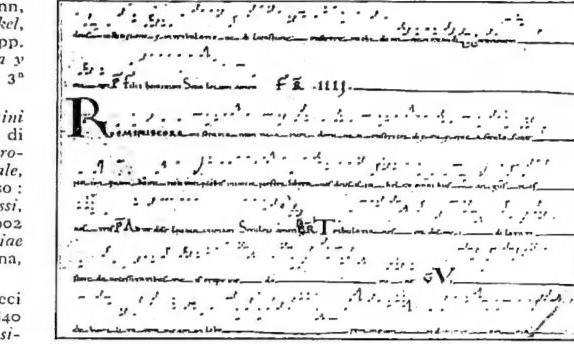
(for vatican di mano, A. P. Frères) PALEOGRAFIA MUSICALE - Aquitanian notation (11th century). Manuscript from St-Ytuxix—Paris, Bibliothèque nationale, ms. lat. 903, lower half of fol. 39'.