
DIPLOMATICA. — D. (from diploma, understood in the broad sense of “document”) is the science that studies public and private acts in order to determine the criteria required for establishing their authenticity. Diplomatic criticism contributes to historical criticism, but is not identical with it: thus a diplomatic “falsehood” may correspond to a historical truth, and vice versa. D. makes use of the assistance of other sciences, such as paleography, chronology, sphragistics, and the history of law.
The criticism of documents for the purpose of recognizing or denying their authenticity is very ancient: examples are cited from 590, 843, 1125, 1198 (the bull of l'anocenzo III to the archdeacon and canon of Milan [4 Sept.], in which rules are suggested for recognizing the characteristics that establish the authenticity of papal documents: Potthast, 365), 1289, and many others from the 14th and 15th centuries. Yet these always concerned (even in the case of Petrarch, who in 1361 dealt with alleged privileges of Julius Caesar and Nero) documents presented in court or in support of some right or privilege, on which criticism was exercised not in search of authenticity and truth, but in defense of a material interest; the same may be said of the bella diplomatica, which after the Peace of Westphalia flooded Germany with books and pamphlets: they were nothing more than the briefs of lawyers for and against cities and churches, from which the science received no impetus.
It was Mabillon (1632–1707) who gave the criticism of documents a scientific form and structure—that is, contrary to the practice hitherto prevailing, made it disinterested.
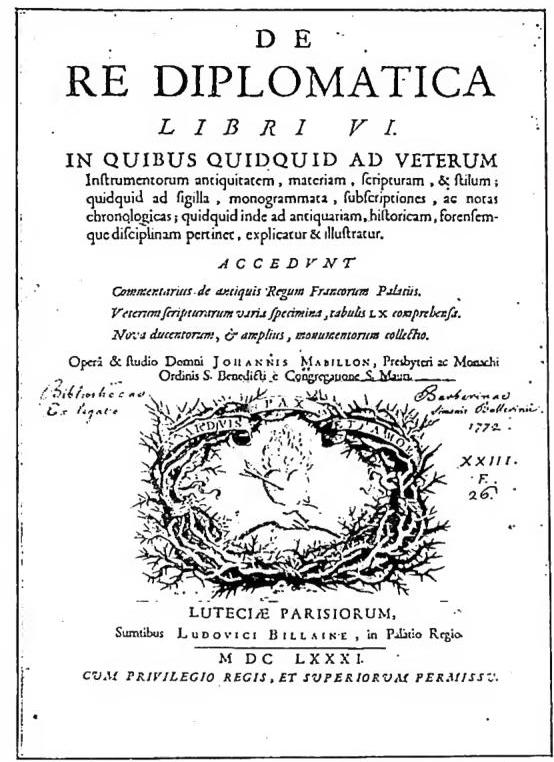
The Jesuit Daniele van Papenbroeck, in the preface to vol. II of the Acta SS. Aprilis (Antwerp ed. 1675, pp. 1–XXXI), had declared false the ancient documents of the French Benedictines, collected for about a century in the Congregation of S. Mauro, and especially those of the monastery of St-Denis, printed in 1625. Papenbroeck adhered to an excessively skeptical system and to Marsham’s aphorism that documents are the less reliable the more ancient they are. MABILLON, JEAN (v.) replied to the Jesuit in 1681 with the work De re diplomatica libri VI, in which he did not assume
Only a few Jesuits and one Protestant, the Englishman Hickes (1703), attempted to attack it; some Italians, such as Giusto Fontanini, Domenico Lazzarini, and others, also wrote against them. Mabillon was meanwhile preparing a second edition, published posthumously in 1709. Today it may be said that, as regards general diplomatics (the intrinsic and extrinsic characteristics of the document, the importance of chanceries, the principles of criticism, and the value of copies and originals), Mabillon remains authoritative, whereas he has been superseded in special diplomatics.
Between 1750 and 1765 two other Maurist fathers, R.-P. Tassin and C. Toustain, published the Nouveau traité de diplomatique, in 6 vols., with which they expanded and sought to deepen the work of their master. From Mabillon and the Nouveau traité there derived, until the middle of the nineteenth century, all the treatises on diplomatics published in France, Germany, and Italy.
In Italy, in 1727, Scipione Maffei, having observed that the practice of continually repeating what had already been written by others had become far too widespread, proposed a collection of documents of various origins and from various regions, assigning a prominent place to private charters: that is, he was contemplating an attempt at special diplomatics; Muratori, in dissertation XXXIV of the Antiquitates Italicae Medi Aevi: De diplomatibus et chartis antiquis dubiis aut falsis, gave various examples of forged documents, pointing out the criteria to which the scholar must adhere and showing how even a series of forgeries may constitute historical documentation if the reasons for the falsification are investigated. Chairs of diplomatics were also established in Italy, at the Universities of Bologna (1765), Naples, and Milan; among others, Angelo Fumagalli (v.) taught here. He was the author of 2 vols. of Istituzioni diplomatiche (1796, but published in 1802), still derived from the Nouveau traité, but rich in personal contributions concerning Italian documents, of which Fumagalli demonstrated an excellent knowledge also in the Antichità longobardiche milanesi (Milan 1792-93) and in the Codice diplomatico ambrosiano (there 1805).
In Germany, Cristoforo Gatterer, in the Elementa artis diplomaticae universalis (Göttingen 1765), attempted to classify scripts according to a system similar to that introduced by Linnaeus in the field of the natural sciences, calling the uncial ciceronium, the cursive svetonium, etc.; the strange attempt remained sterile, but the University of Göttingen, where Gatterer taught, became a seminary of excellent diplomatically trained scholars, assuring Germany a true primacy in this field.
The French Revolution brought studies of ancient documents to a halt; Napoleon himself confused diplomatics with diplomacy. The great revival came after the Restoration, with the new direction given to diplomatics, which was transformed from general into special. Historical institutes and the historical deputations and societies founded throughout Europe contributed particularly to this development, foremost among them the Ecole des Chartes of Paris (1821). In France, L. Delisle, N. de Wailly, Mas-Latrie, and A. Giry distinguished themselves; in Italy, G. Marini, C. Paoli, P. Torelli, G. Vittani, N. Barone, L. Schiaparelli, Garufi, Brandileone, Datta, and Russi; in Germany, Bresslau, Meister, Böhmer, Potthast, Pertz, Jaffé, Kehr, Voltelini, Pflug-Harttung, Sickel, Brunner.
Today the era of general diplomatics may be considered to have ended; it is merely a foundation and a precedent for special diplomatics, which tends to «consider documents in the light of our knowledge of the juridical, administrative, and economic conditions of the country and period, and to study them in relation to intellectual culture and civilization» (de Boijard).