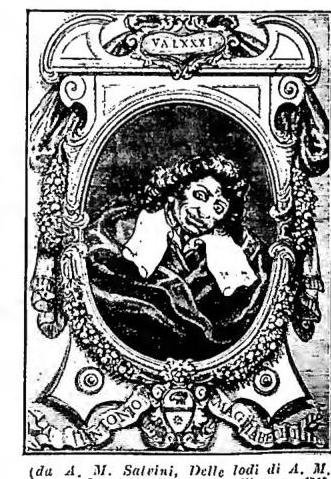
MAGLIABECHI, ANTONIO

Image from page 1092

MAGLIABECHI, ANTONIO. — Scholar and bibliophile, born in Florence on 28 October 1633, died there on 27 June 1714. Devoting himself to scholarly pursuits, he was appointed librarian of the Palatina Library by Grand Duke Cosimo III of Tuscany, a position he held until his death, remaining an ardent collector of books and manuscripts.

He was admired by his contemporaries for his exceptional memory and prodigious learning, which he generously placed at the disposal of scholars throughout Europe, though he was mocked for his deformed appearance and eccentric character. He bequeathed his rich library to the poor of Jesus Christ, which was to become the first nucleus of the future National Library. Reading and collecting books were the vocation of M., who left behind only letters and catalogues.

Article illustration
(from A. M. Sotelo), *Delle fedi di A. M. Orsolino* [soccele... Firenze IIIi] Magliabechi, Antonio - Engraved portrait by A. Monizuti.

(from *Catalogue d'une collection de manuscrits à miniatures des Xe-XVe siècles*, Amsterdam 1929, tav. 76)

**MAGISTRATE** — Miniature by Michele di Carrara (15th century) depicting an interrogation.

(In this second sense, for example, it is used in the new Italian Constitution (art. 101 et seq.). For the magistrate in this sense, see *GIUDICE*. Here, the term is considered in its broader meaning, inasmuch as it includes not only the judging magistrate but every citizen who, in varying degrees, participates in sovereignty, i.e., wields civil or military, legislative or executive, judicial or coercive power, which he exercises in the public interest (see also *PUBBLICO UFFICIALE*).

The competencies and functions of the magistrate may vary according to constitutions and forms of government. However, certain fundamental obligations must be common to all and remain constant. 1) First, it is necessary that whoever is invested with authority uphold the majesty of the laws through the wisdom of his decisions and ensure that the authority of the State, which entrusted him with this office, is respected in his own person. 2) Furthermore, he is obliged to render service to the State and, at the same time, to its citizens. If someone is called to a public office and recognizes that he possesses the necessary qualities—and the common good demands that service—he is legally bound, by the principle of legal justice, to accept II. This is indeed one of the ways in which the citizen contributes his labor for the common good. 3) As guardian of the laws, the magistrate must not abuse his mandate but must strive for the public good with care and vigilance, a sense of justice, and absolute disinterestedness. 4) As for knowledge, a general and remote preparation is not sufficient for the magistrate; rather, that proximate and immediate knowledge relevant to the office he holds is required. 5) It is hardly necessary to mention the issue of the high moral standards demanded of the magistrate. An example may be drawn from what Moses did (Ex. 18), when, in choosing the first magistrates of the Jewish people, he called to this office men who were wise and God-fearing, of known probity, and enemies of falsehood and avarice. 6) Regarding the magistrate’s conduct in the face of an unjust law that he is compelled to apply, what has been said about the judge applies.

BIBL.: U. E. Paoli, *M.* (diritto greco), in *Nuovo Digesto italiano*, VIII, pp. 3-5; A. De Dominicis, *Magistratus*, ibid., pp. 24-29; G. Pasquariello, *La magistratura*, Roma 1942; P. Guidi, *La legge ingiusta*, Roma 1948; W. J. King, *Moral aspects of dishonesty in public office*, Washington 1949. Luigi Morstabilini