
CRYPTOGRAPHY. - It is the study of secret or conventional and concealed writings, employed by two or more correspondents to conceal, wholly or in part, the content of dispatches from anyone who comes into possession of them illicitly. There is therefore military, diplomatic, commercial (banking) cryptography, etc.
Cryptography is of very ancient origin; it was used by the Spartans, the Carthaginians, and Julius Caesar. Its ancient use continued into the Middle Ages, when the most common system was the Byzantine one, consisting in the transposition of the letters of the alphabet. In this manner the letters were divided into three sections: α-β; κ-π; σ-ω. The first letter of each group was exchanged with the last; the second with the penultimate; the third with the third-to-last, and so on. The intermediate letters, namely 1 and ρ, were represented, the first by the koppa 4 and the second by the sampi 3. The central letters of the individual groups, namely ε, ν, ρ, remained unchanged. This system was very much in vogue in the subscriptions of inscriptions and codices, as can be seen in the many examples from the ninth to the fourteenth centuries. For example, St. Nilo Iuniore, founder of the abbey of Grottaferrata, in his codex B. a. XX, signed himself Νεχολχ instead of Νεβλω.
By contrast, cryptography was particularly developed by Renaissance diplomacy; it declined at the end of the eighteenth century and during the nineteenth, and gained new force after the Franco-Prussian War of 1870. Today it has become a science to which mathematicians of the highest standing contribute. Among the classics of cryptography are Leon Battista Alberti, G. B. della Porta (De furtivis literarum notis, Naples 1563), Gerolamo Cardano (De subtilitate, Lyon 1554), Trithemius (Polygraphia, Frankfurt 1550 and Steganographia, ibid. 1606-22), Blaise de Vigenère (Traicté des chiffres ou secrètes manières d'escrire, Paris 1586). Today the invention of new cryptographic systems, theoretically unlimited, is instead subject to the limitations imposed by the use of the telegraph and radiotelegraph, while concealed writings (with sympathetic inks and the like) are used only in espionage, by illegal associations (anarchists, etc.).
In cryptography, a distinction is made between: enciphering, carried out by the sender of the dispatch and consisting in transforming the plain text into secret or ciphered text (cryptogram), according to the rules agreed upon between him and his correspondent; deciphering, carried out by the recipient of the dispatch and consisting in transforming the received cryptogram into the original plain text according to the agreed rules (the reverse operation of the preceding one); and cryptanalysis, carried out by someone who is not the recipient of the dispatch and consisting in transforming the intercepted cryptogram into plain text without knowing the rules agreed upon between the correspondents.
Cryptographic systems may be classified into three groups: transposition, substitution, and mixed systems.
Transposition systems shift the letters of the plain text, according to a geometrical figure or a key, so as to produce an incoherent text.
Thus, for example, let the expression « abbiamo ricevuto » be the text to be enciphered, and let the literal key be the word « Carlo », and the numerical key the number 21.534, which contains all the numbers from 1 to 5 in an order different from their normal sequence. The sentence to be enciphered is then arranged beneath the key word, producing 3 words of five letters in the following manner:
CARLO
abbia
morice
evuto
Replacing the literal key with the numerical key (21.534), another 3 words of five letters are formed, taking them in their vertical arrangement, from top to bottom, according to
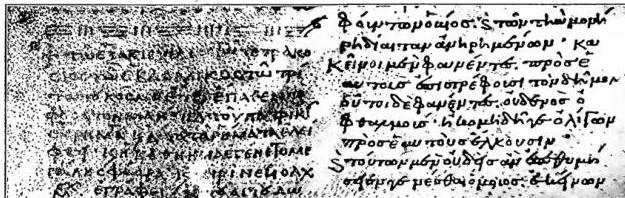
(photo: abbey of Grottaferrata)
CRYPTOGRAPHY — Cryptographic autograph signature of s. Nilo (1st column, penultimate line), founder of the abbey of Grottaferrata.
Codex Crypt. B. a. XX. f. 59° (beginning of the 11th century).
in the order indicated by the normal succession of the individual numbers forming the key-cipher. One then obtains:
| 2 1 5 3 4 | 1 | 2 | 3 | 4 | 5 |
|---|---|---|---|---|---|
| a b b i a | b | a | i | a | b |
| m o r i c | o | m | i | c | r |
| e v u t o | v | e | t | o | u |
Transposition systems can be used with special grilles (those of Cardano and Sacco), complicated by means of double transpositions, and can produce cryptograms that are genuinely difficult to decipher.
Substitution systems replace each letter, syllable, word, or entire sentence of the clear text with a letter or group of letters, a numeral or group of numerals. In the 16th century, signs of cabalistic appearance were sometimes substituted, but these were soon abandoned because of the inconvenience of their use. Such systems are the most effective for rendering the text obscure, but they have the drawback of requiring a written cipher, which may fall into the hands of the decipherer. There are three types:
a) monoalphabetic substitution: each letter of the clear text is replaced by another letter (the following one, the corresponding letter in the alphabet arranged in reverse order, and so forth). If pairs of numerals are used instead of letters, several two-digit numbers may be substituted for each clear letter, and homophones and nulls may be introduced.
| A | B | B | I | A | M | O | R | I | C | E | V | U | T | O |
|---|---|---|---|---|---|---|---|---|---|---|---|---|---|---|
| 18 | 24 | 11 | 02 | 05 | 20 | 84 | 99 | 87 | 01 | 64 | 03 | 22 | 37 | 98 |
| homophones | ||||||||||||||
| null |
With this system, if properly employed, cryptograms that are difficult to decipher can be obtained;
b) polyalphabetic substitution (invented by Della Porta and perfected by Vigenère and Delastelle). Each letter of the clear text is replaced by another letter derived from ever-different alphabets, that is, alphabets arranged in an order different from the normal one; in other words, if the word ROMA is to be enciphered, R will be replaced by a letter taken from the first cipher alphabet, O from the second, M from the third, and A from the fourth. The use of these systems requires special tables and keys. Modern cryptographic machines are based on the same systems, complicating them with an enormous number of keys and cipher alphabets, by means of which millions of different combinations are obtained;
c) repertoires or codes: each letter or word of the clear text is replaced by groups of letters or numerals selected from a repertoire that may vary greatly in size, from that of a small pocket slip to that of a large dictionary.
Mixed systems result from the combined use of transposition and substitution systems.
All systems can be complicated in various ways almost without limit; care must be taken only that the complication is substantive and not merely apparent, and that it does not create the possibility of errors in enciphering and deciphering.
Deciphering — While enciphering may be called a science, deciphering may be called an art, because, although based on certain mathematical and linguistic rules, it relies above all on the intuition and skill of the decipherer. Deciphering, as ancient as enciphering (a short treatise on deciphering by Cicco Simonetta, secretary to Francesco and Galeazzo Sforza, who lived from 1410 to 1480, is cited), drives enciphering toward continual progress; consequently, today, in the secrecy afforded by cryptographic systems, one no longer seeks absolute indecipherability, but resistance to deciphering for a more or less lengthy period according to the importance and nature of the dispatch.
Deciphering is based on three notions that the decipherer must possess: a) knowledge, where possible, of the subject dealt with in the dispatch; b) knowledge, therefore, of the type of language (diplomatic, military, commercial) and of the formulas, words, or phrases that may recur; c) statistical knowledge of the language used. By the statistics of a language is meant, in the present case, the frequency with which, in each language—or better still, in each type of language—letters and certain groupings of letters or certain words (conjunctions, auxiliary verbs, etc.) occur. In general, the longer the cryptogram, the more closely the statistics of its elements will approximate those of the language, and the less difficult its deciphering will be; for this purpose, several cryptograms enciphered by the same system are considered as a single cryptogram. There are, however, systems whose deciphering may be attempted even with only 30 or 40 elements.
For example, let the following cryptogram (monoalphabetic substitution) be given:
11. 22. 11. 08. 18. 38. 19. 43. 27. 19. 21. 39. 38. 27. 36. 18. 27. 41. 27. 39. 38. 11. 36. 18. 19. 36. 34. 11. 21. 27. 11. 36. 29. 08. 29. 34. 11. 24. 30. 11. 36. 36. 27.
of which the only certain information is that the language employed is Italian.
By making a statistical study of the two-digit numbers in order to determine their absolute and percentage frequency and which two-digit number follows each of them, one observes that 36 is followed by 36—that is, 36. 36. represents a double letter, which in Italian can only be a consonant; consequently, 11 and 27 must be two vowels. It is also seen that 39 is repeated twice followed by 38, whereas 38 occurs once preceded by another two-digit number; it is therefore likely that this is a compulsory sequence, in which case 39 will be Q and 38 U. It is also observed that the greatest frequency is that of 11 (seven times) and 27 (six times out of 43 two-digit numbers); from the frequency tables for the Italian language, one can therefore deduce that they respectively represent E and I.
One can thus begin making the substitutions:
11. 22. 11. 08. 18. 38. 19
e e u i q u i
27. 39. 38. 11. 36. 18. 19
i q u e e i e
11. 24. 30. 11. 36. 36. 27.
e e i
Observing now the series 27. 39. 38. 11., one notes that
i q u e
the sequence ique in Italian is extremely rare (“liquefare” and derivatives); it is therefore probable that i is the end of one word and QUE the beginning of another. QUE then begins questo or quello, or derivatives thereof, and since it is followed by 36. 18., it must be QUEST, because if it were quello there would have to be a double letter. Thus two further letters, S and T, have been acquired, and these are substituted for the corresponding two-digit numbers. It is then noted that 39. 38. 27.
q u i
is followed by 36. 18. 27., and therefore can be nothing other
s t i
than part of the words “acquisto” or “quistione.” By trying the first word, one deduces 19—A and 21—C. Thus, by continuing to make substitutions, the text “eventuali acquisti di questa specie sono permessi” is obtained in a short time.
Today deciphering is widely employed in all armies, but, if applied methodically, it can also yield a very rich harvest of historical information from the enciphered documents lying in all the archives.