
ALBERTI, LEON BATTISTA. – Humanist, born in 1404, perhaps in Genoa, into a Florentine family exiled from its homeland; died in Rome in 1472. A. was one of the highest personalities of humanism, owing to the versatility of his intellect, which led him to investigate every field of human knowledge.
1. PEDAGOGY
His father initiated him into physical exercises, in order to strengthen his body, and into the study of letters; as a young man, A. attended the school of Gasparino Barzizza. After his father’s death, he went to Bologna, where he began the study of canon law, without ever abandoning the study of letters (especially Greek), attending the lectures of Francesco Filelfo. As soon as he was twenty, he composed in Latin prose a comic jeu, entitled Philodoxios, or The Lover of Glory, which Poggio Bracciolini says was written senum eloquentia ac venustate and which some others believed and printed as the work of an ancient Latin comic poet. Under its allegorical guise, the jeu, representing A. himself, shows how an industrious and studious man can attain glory on an equal footing with the rich. At about twenty-four, A. also devoted himself to the study of physics and mathematics. In 1428 the Alberti family was able to return to Florence at the request of Pope Martin V, and Leon Battista was thus able to see the city of his ancestors. The Florentine environment must certainly have attracted him: Florence was not only the city of great masters in the various arts, but also nurtured within its midst the finest humanists of the age and was rich in commerce and industry. In short, Florence embodied a prosperous and varied popular life, and this must certainly have influenced the formation of the young A., in whose thought the humanist ideal merges with, indeed is realized in, an ideal of practical life, and the man of liberal culture is enriched by the positive values of life. Opposed by his relatives after his father’s death because he did not wish to enter commerce, feeling himself called to another office, A. entered the service of Cardinal Albergati at the age of twenty-four and subsequently that of the papal court, where he appears to have held, from 1432 onward, the office of apostolic abbreviator, an office he retained until 1464. He was with Pope Eugene IV in Florence at the time of the Council (1434–36), and in Bologna and Ferrara, coming into contact with the finest minds of the period. A. composed a series of works of a moral character which help us to understand his pedagogical thought more fully.In the treatise Della famiglia, in particular, he gives us pedagogical rules concerning the education of children, rules which, for the rest, are those ordinarily present in the humanist tradition and drawn from the same sources—Cicero, Quintilian, Plutarch—from which humanism had drawn and continued to draw them. But this matters only up to a point, because what counts in A.’s work is the new spirit stirring within it, the vision he has of human life.
In the treatise Della famiglia, A. imagines that several relatives have gathered around the deathbed of his father Lorenzo, to whom the father entrusts his sons Battista and Carlo. In the first book A. deals with “the duty of the old toward the young and of the younger toward their elders, and the education of children.” Elders must be prudent and well behaved toward the young; for their part, the younger must respect and venerate the elderly. Parents must exercise great diligence in raising their children and making them virtuous. For A., the family is the center of the individual’s life and the means through which the individual realizes himself. Since it is founded on nature, on the bond of blood, and on affection, the family, in the Albertian conception, is more important than the State, which, born from the union of several families, is founded on the interests of individuals and therefore often becomes a cause of division and hatred. Education, therefore, originates for A. in the family. The second book discusses marriage and love as a source of the spouses’ happiness. A. urges marriage, referring to the benefits that derive from it, but also advising one to consider whether the girl one wishes to marry is well-born and well brought up, making the beauty of a woman consist above all in her good conduct. In the third book Giannozzo degli Alberti, a steward, is introduced as speaker, and the most appropriate means by which provision may be made for the life of the family are discussed. It teaches how one
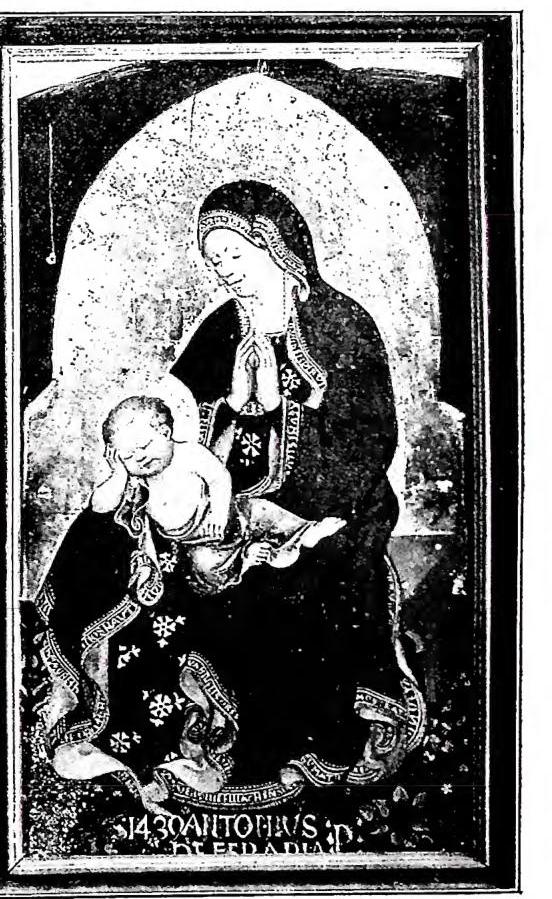
ALBERTI, ANTONIO — Madonna and Child (1439),
Urbino, Palazzo Ducale.
(propr. B. Degenhart)
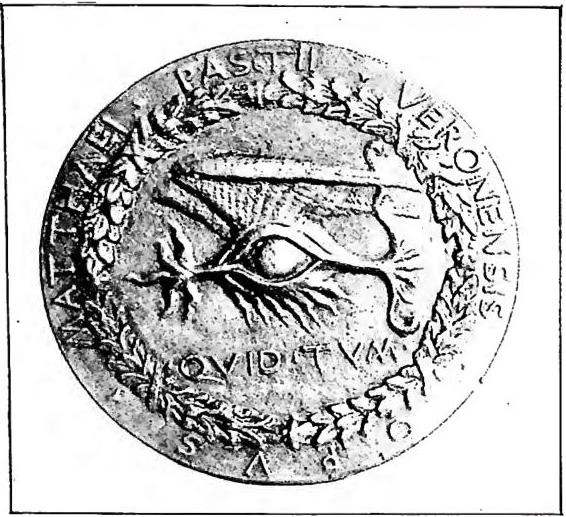
ALBERTI, LEON BATTISTA – Reverse of the medal of L. B. A.
with the emblem of the winged eye. Work by Matteo de' Pasti,
Florence, Museo Nazionale.
how money should be spent, what use should be made of the soul,
the body, and time, which are three things essentially
ours, and what relations should exist between husband and
wife. The latter will attend to the household and be a good
housekeeper, while the former will undertake to maintain
relations with men and to preserve the family’s honor and
prosperity. The fourth book deals with friendship, concerning
which it cites the opinions of Pythagoras, Plato, and
Aristotle. A friend is known in uncertain circumstances, and
the best means of gaining friendship are virtue, civil conduct,
and noble bearing. A. recommends keeping flatterers at a
distance and, when necessary, correcting one’s friends; he
also clarifies in what cases it may sometimes be appropriate
to sever a friendship. An enemy is conquered by honest
living; injuries, rather than removing enmities, sharpen them.
Besides the treatise On the Family, A. wrote an entire
series of moral works, such as On Tranquility of the Soul,
Theogenio, De Iciarchia, and Intercenales, in which the
pedagogical and moral principles expressed in his major work
are reaffirmed and often more fully developed and stated.
The dominant note in A.’s thought is that the end of human
life is action and exercise, not speculation and contempla-
tion. This does not mean that contemplation and speculation
should be banished; rather, they are insufficient when they
do not bend to what constitutes man’s civil life, for man
is what he wishes to be, what his will makes him. In A.,
man acquires awareness of his own will and power. Man,
insofar as he is will, is no longer subject to external and
superior forces, but becomes master of all spiritual and
material reality. Virtue is not a good that lies outside us,
but is within us, and one becomes virtuous by wishing to be
virtuous. Man is the author of his own good and evil, and
it is useless, A. says, to pray to the gods to intervene and
change those conditions that we have created through our
own action. God does not, in response to our prayers,
depart from the eternal order that established things. If we
thought otherwise, it would mean that we thought of the gods
as « nobis homunculis persimiles ».
This almost Aristotelian rigidity of the divinity does not
allow him to feel—and yet this cannot always be said—the
warmth and value of prayer and of the relationship that man
nevertheless feels and perceives with God, who is his father,
and a merciful father. For A., man is the fruit of his will
and his work; if he lacks mastery of himself, man becomes
the prey of fortune, which in itself has no reality, but is
precisely what we wish it to be. This thought, present in
the treatise On the Family, is perceptible throughout his
entire work.
Man, insofar as he is will, cannot be the prey of fortune,
and this is an intuition already present among the
pedagogues of humanism; but in A. it acquired a particular
value and significance, becoming almost the central point
around which all his thought moves. And what is true of
individuals is also true of peoples. If virtue rules in man,
as in nations, everything else obeys him. And, to possess
virtue, it is enough to wish for II. Virtue is the fruit of
the exercise of the spirit, which, through good actions,
conquers and recognizes itself as good. If man neglects good,
manly, and glorious deeds, « rimane misero e infelicissimo ».
Education, as can be seen, is identified in A. with exercise.
Man is insofar as he is never at rest and must always perfect
and improve himself; insofar as he makes himself an observer
and master of the world, and through inquiry and investigation
learns and affirms himself as a personality and as a value.
Now man does not acquire this knowledge from books, or only
from books; rather, it arises from exercise and contact with
men and things. We are insofar as we act. Education as the
fruit of exercise is a felicitous intuition in A., rich in
consequences for modern pedagogy.
our conquest, implies an ever-living and active participation
in knowledge, which exists not insofar as it becomes our
external ornament and empty display, but rather insofar as
it is our substance, our life, and our blood. Thus, in his
work Del Principe Gelasto, A. caricatures that type of
man of letters whose learning has not helped him improve
in life or understand life as action, as a duty toward the
family and society. Charon, therefore, rightly refuses to
carry Gelasto to the other shore, because his knowledge was
vain, in that it did not teach him how to live well, but
remained entirely external and was not translated into a
rule and conduct of life. A. does not reject abstraction
insofar as it is inquiry; indeed, he recognizes it as proper
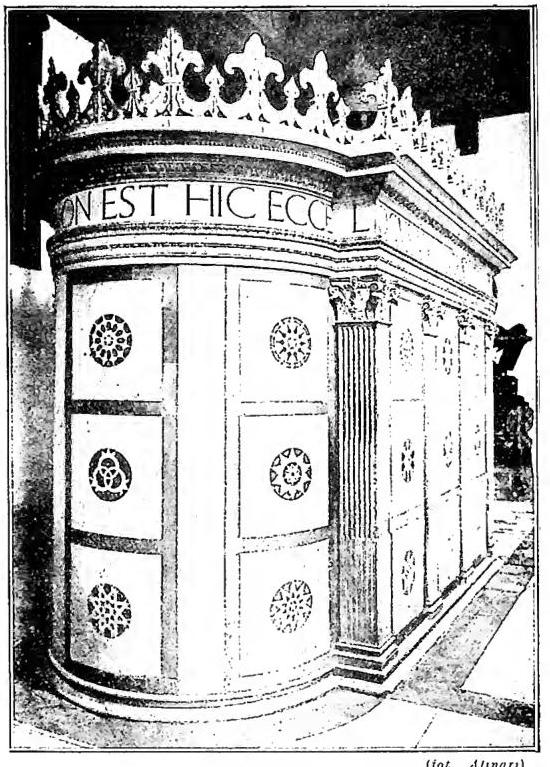
(phot. Almari) ALBERTI, LEON BATTISTA - Apse of the Holy Sepulchre in the Rucellai chapel - Florence, former church of S. Pancrazio.
This love of letters as both means and end in the formation of the virtuous man led him to conceive a program of studies which, in agreement with the other teachers and pedagogues of his time, was founded on the reading of the ancient orators, historians, and poets: Cicero, Livy, Sallust, Virgil, etc. Unlike the other pedagogues of his time, however, A. did not exclude the mother tongue from the education of the young, and he was one of the first Italians of the fifteenth century to affirm the value of the vernacular, not only by writing several of his works in the Tuscan language, but also by maintaining that if « the ancient Latin language » is very rich, « our Tuscan » should not, he argued, be held in such hatred.
For this purpose—that is, to affirm or impose the use of the vernacular—he promoted (1441), under the protection of the Medici, the certame coronario, in which A. himself took part with the fourth book of Della famiglia, which, as we know, deals with friendship.
2. ART
In addition to works of a pedagogical and moral character, A., a universal mind, wrote several works on painting and sculpture. The most important of these may be considered the treatise De re aedificatoria, which constitutes a personal and deliberate reworking of the work of the Roman Vitruvius. The De re aedificatoria is the first of the architectural treatises that culminate in those of the sixteenth century by Serlio, Vignola, and Palladio. A. was the most typical product of mature Florentine humanism, that is, the perceptive and exceedingly acute amateur who feels an inner need to investigate and experience everything for the sole purpose of understanding and intellectually enjoying it, rather than producing. And just as he was a musician and athlete, moralist and architect, painter and mathematician—as he thereby reduced making and knowing to a unity—so he declared practical translation of physical and mathematical science necessary for the painter, while at the same time postulating that the true architect should concern himself only with conceiving his buildings, without ever descending to their practical execution. If all this—and this is A.’s chief merit—definitively freed the figurative arts from the rank of « ars mechanica », in which medieval convictions had in a certain sense held them, on the other hand, as an artist A. failed in his true task, which is to give concrete and finished form to his work. Indeed, his buildings were never completed by him: hence the difficulties faced by criticism in defining his personality, and hence also the designation « non-artist » that Schlosser, a rigid proponent of Crocian schemas, attributed to him (v. CRITICA D'ARTE). A.’s first architectural undertaking was the transformation of the exterior of the medieval church of S. Francesco in Rimini (begun in 1450); the work was carried out by the Veronese Matteo dei Pasti. In the façade, which remained unfinished, A. adapted the scheme of the Roman triumphal arches to the requirements of the subject, creating the type of the church façade with two superimposed orders and demonstrating the contribution made by knowledge of antiquity to Renaissance architecture. On the sides, the series of deep arcades containing sarcophagi, while recalling the tombs attached to medieval churches, is inspired by Roman aqueducts. According to A.’s design, the church was to have a hemispherical dome.In completing the Gothic façade of S. Maria Novella in Florence, A. took up the scheme of the two superimposed orders and created the « voluta » between the upper part of the façade and the wider lower part. In Florence A. carried out work in the church of S. Pancrazio, including the entrance triforium, the free reproduction of the Holy Sepulchre, and others; in the church of the Annunziata, the « tribuna », a circular-plan structure covered by a hemispherical dome and surrounded by chapels. The façade of the Rucellai palace is attributed to him; it is characterized by the superimposition of the orders over the rustication of the facing.
In Mantua, two churches were erected by the Florentine Luca Fancelli according to A.’s designs: S. Sebastiano (begun in 1460) and S. Andrea (begun in 1472), both free interpretations of Roman buildings, the first with a centralized plan, the second with a rectangular plan. The correspondence between exterior and interior, between structure and architectural elements, makes S. Andrea the most complete expression of Albertian architectural thought, permeated by classical culture and grandeur. The church has a single nave, covered by a barrel vault, with lateral chapels, transept, dome, and apse. The rhythmic motif of the interior—the alternation of arches with solid wall sections framed by pilasters and divided into several levels—which Bramante would follow for the cross arms in his project for S. Pietro, is organically taken up in the façade, the prototype of the sixteenth-century façades with a single order. Vignola, in the church of the Gesù in Rome, so extensively imitated in the late sixteenth century and early Baroque, would develop the planimetric and spatial concepts expressed in S. Andrea.
A theorist and humanist, A. applied in his works fifteenth-century forms to schemes and structures of Roman classicism, which he employed originally for the architectural themes of his own time, with results that found their principal following after his death. - Vedi Tavv. XLIX-LII.