
Bologna, Archdiocese of. — The capital of the homonymous province and the principal city of one of the most fertile and historically rich regions, Emilia, Bologna currently has a population of 270,000 inhabitants. The diocese as a whole numbers 691,473, almost all of whom are Catholic. The city is densely packed with churches (over one hundred and thirty), still retaining a medieval appearance, and the diocese is likewise rich in convents and churches. The clergy are numerous: 568 diocesan priests and 190 regular clergy, with 425 parishes (1948). The patron saint is St. Petronius.
I. HISTORY
On the site of the Etruscan Felsina, as attested still today by the remains of its necropolis dating back to the 6th century B.C., the Romans founded a colony there in 189 B.C., Bononia (Livy, XXXVII, 57). Already of considerable economic importance under the Etruscans, it took on the aspect of a fortified camp because of its characteristic position as an outpost toward the Gauls. It became a municipium a century after its foundation, during the Social War, and was enrolled in the Lemonia tribe. In A.D. 53 it was destroyed by fire; Claudius rebuilt it at the intercession of the young Nero. It was in full decline in the 4th century (St. Ambrose, Epistolae, II, 8), but this did not prevent it from withstanding the onslaught of the Visigoths of Alaric in 410. After being sacked and half-destroyed, it rose again from its ruins through the work of its bishop St. Petronius (q.v.).The martyrs of B. are recalled at the end of the 4th century by Victricius of Rouen (De laude sanctorum: PL 20, 448, 453); they are the same ones that shortly afterward are pointed out by Paulinus of Nola: Vitalem, Agricolam, Proculumque Bononia condit. Carm. 37, 432 (ed. G. de Hartel, in CSEL, 30, II, p. 281). Of Vitalis and Agricola it is known that their relics were found in Bologna in the Iudaeorum quarter only at the time of St. Ambrose (Exhort. Virg., 1: PL 16, 336). In the 6th century they were venerated in a basilica to the east of the city, later the church of SS. Peter and Paul, from where
(courtesy of Dr. B. Degenhart)
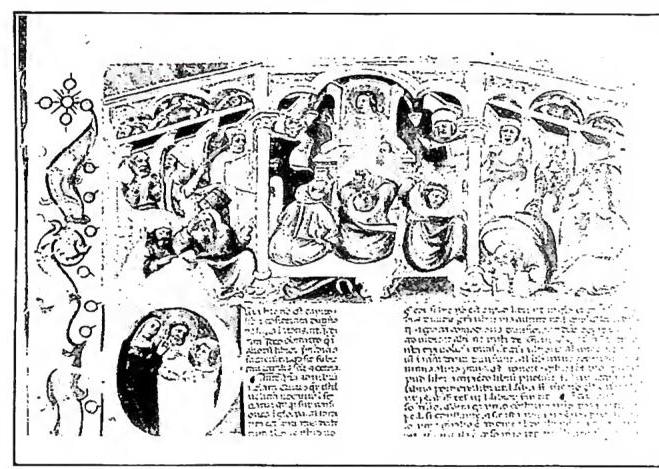
BOLOGNA — Christ among the Doctors. Miniature by Nicolò da Bologna (a. 1378) — Vatican Library, cod. Vat. Lat. 2598 (f. 1), containing: Lecturam Bartoli de Saxoferrato super I et II parte Inforliati.
Eighth in the series, in the catalogue discovered by Lanzoni, is St Petronius, who already seemed to his contemporaries worthy of comparison with the greatest bishops of Christendom: his episcopate unfolded between 430 and 450. He lost no time in restoring Bologna from the ruins to which Magnentius and Maximus had reduced II. Obtaining funds from the treasury, he distributed them to the Bolognese, rebuilt their houses, repaired the walls, and erected new churches. Among these was the extramural basilica of S. Stefano, to which a monastery was attached where he himself lived (F. Lanzoni, S. Petronio vescovo di B. nella leggenda e nella storia, Bologna 1907).
The early Middle Ages represent the period of greatest obscurity in the history of Bologna: in the Gothic age the city continued its political, and perhaps even religious, orientation toward Ravenna. From its proximity to the capital it drew its first revival, which became oppressive when, under Byzantine rule, Ravenna concentrated all initiative between the 6th and 7th centuries. The Lombards, driven back across the Panaro by Liutprand, who conquered the Exarchate, sacked Bologna in 727 or 728. The descent of the Franks and the protection of the Church assumed by the Carolingians wrested the city from the Lombards and granted it, with the Exarchate, to the Church: a dependence that was uncertain at first, which might rather be described as a dual subjection, to Ravenna and to Rome, and under Carolingian control. Bologna then became the seat of counts. But the scarcity of sources reveals only a shifting of relations among the powers and a contraction of the city within its walls (the square boundary marked by the so-called “four crosses”); there is reason, however, to see in pre-communal Bologna an independent development of life. This remained always under spiritual and political dependence on Ravenna, from which Bologna freed itself at the same time, the former with the Council of Guastalla in 1106, the latter with the fierce struggle against the empire of Henry V, culminating in the demolition of the fortress in 1114. Religious and civil autonomy, won together, laid the foundations for the formation of the commune. Yet the church of Bologna had already shown its own orientation at the time of the schism of Cadalus, remaining faithful to Alexander II. There is moreover an oscillation of fortunes that followed the fortunes of war and politics: if the Council of Guastalla in 1106 detached Bologna — and with it Modena, Parma, Reggio, and Piacenza — from the metropolitan jurisdiction of Ravenna, Paschal II, at the very end of his pontificate, re-subjected it, with a bull of 7 August 1118, to the ancient primate. The war that was to divide the two cities for ten years also left its mark on ecclesiastical relations. Then, while the free commune subjected lands and castles of the countryside, Bologna felt the renewed imperialist role of its illustrious neighbour: in 1132 it resisted Lothair, who was descending to aid his protégé Innocent II on his way to Rome, and forced him to encamp at Medicina; but under Frederick Barbarossa, the schism fomented by Cardinal Octavian brought an intruder to the Bolognese see, the canon Samuel, while the legitimate bishop Gerard was deposed at the synod of Lodi. The Bolognese schism was short-lived; it ended immediately after the Peace of Venice in 1177.
The commune was now considerably strengthened. One of the first to develop (it seems, from the very dawn of the year 1000), it did not fail, despite struggles and dissensions, to obtain imperial recognition. Governed in consular form, with a general assembly or Parliament and a major council, it then passed, like other Emilian and Lombard communes, to the podestà system. Perhaps already the seat of a law school in Roman times, through the personal work of a master, Irnerius, the rediscoverer of Roman law, Bologna had become, from the early 12th century, a centre of legal studies, until the time of Honorius III, who established there a school of theology; thus developed the University of Bologna, one of the most famous of the Middle Ages. It was already so flourishing in 1225 that Frederick II, in order to favour the new university he had founded in Naples, attempted to lure away en masse its lecturers and students with an interdict, but without success.
In those years, Bologna gave shelter to St Dominic and to St Francis: the former, drawn by the fame of the Studium, founded there a community of his Order of Preachers (and the Commune granted him the church of S. Nicolò alle Vigne), the latter, by the vastness and moral needs of the student body as well as of the population, spent a period of fervent preaching there. At Bologna, during the Chapter of his Order, St Dominic died on 6 August 1221: and both then and the following year, on account of the canonization decreed by Gregory IX, the commune arranged solemn celebrations.
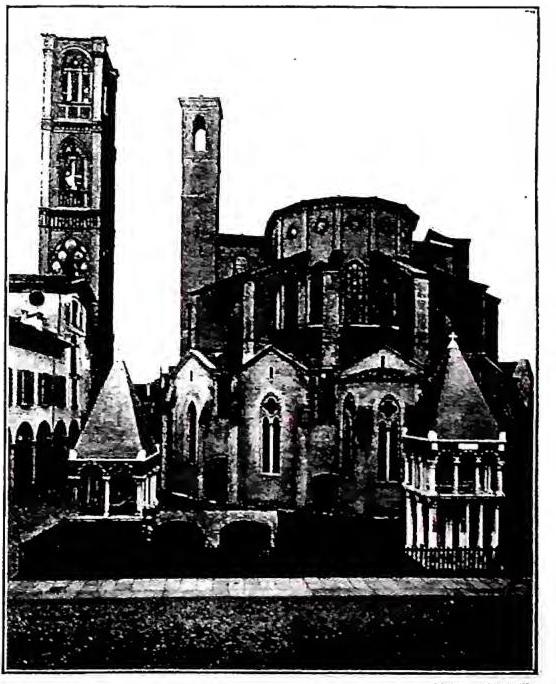
BOLOGNA - Apse of the church of S. Francesco (1263).
Rudolf of Habsburg, renouncing in 1274 in favor of the Papal States his imperial rights over the lands of the ancient Exarchate, paved the way for this outcome, which was confirmed at the beginning of the new century by the appointment of Cardinal Orsini as legate. Amidst storms and calm, the Church’s dominion would last until 1859 and the plebiscites, initially in the form of high patronage, rendered feasible by the decline of the commune due to internal strife and ecclesiastical influence.
Beneath the Church’s protection and upon the ruins of communal institutions, the preeminence of certain noble families laid the foundations for signorial rule in Bologna as well.
In 1337, Taddeo Pepoli, after a failed attempt by his father Romeo, had himself proclaimed signore. The Pope countered by forcing him to recognize himself, not as signore, but as vicar, thereby exercising power in the name of the Church. Pepoli’s successors, too, were compelled to follow this example despite the Bolognese spirit of autonomy. When Taddeo died in 1347, his sons sold the city a few years later to the Milanese archbishop, Giovanni Visconti. After Visconti’s death in 1354, the signoria was effectively exercised by one of his loyalists, Giovanni di Oleggio, a cruel and avaricious man. With the restoration of the goods and authority of the Holy See pursued by Cardinal Albornoz, on the eve of the Popes’ return from Avignon, Bologna fell in 1360 and papal rule was reinstated.
Peace, however, lasted only a few years: in 1376 the city declared itself an independent republic. Attempts were made to undermine its freedom, but drawing on the still unquenched spirit of autonomy, figures such as Giovanni Bentivoglio and Carlo Zambeccari rose in the late fourteenth and early fifteenth centuries. The conquest of Bologna by Gian Galeazzo Visconti, Count of Virtù, who sought to expand his state beyond the domains of his ancestors, ended with his death, and the city returned to the Church.
It was precisely in those years that civic pride and Bologna’s desire not to be second even to Rome inspired the grand construction of S. Petronio. Bishop Bartolomeo Raimondi laid its first stone on 30 June 1390, but the work did not proceed with the same vigor due to ongoing disputes and severe economic difficulties.
Rebellions and unrest continued: through daring acts and abuses, but also losses and massacres, the Bentivoglio signoria took hold for nearly a century, from 1446 to 1462, when Sante governed with skill, bringing Bologna to the agreements of 1447 with Nicholas V, which granted the city quasi-independence. Thus, the Bolognese Renaissance reached its peak in splendor and artistic achievement. From 1462 to 1507, under the rule of Giovanni II Bentivoglio, this splendor continued and was completed. Yet the life and political action of the Bolognese signore ended in sadness, bloodshed, and cowardice, as he fled before the armies of Julius II and negotiated with the French. During this period, Bolognese sentiments against the Church’s authority flared anew, as seen in the episode involving Albergati (q.v.).
Toward the end of the century, in 1483, Cardinal della Rovere, the future Julius II, served as cardinal legate of Bologna and long held the see in commendam. New clashes arose with the central authority in the early sixteenth century when the Bentivoglio made their final two attempts to regain control of the city between 1507 and 1511, ending with the destruction of their palace and the statue of Julius II sculpted by Michelangelo.
Months of unusual fervor followed the coronation of Emperor Charles V in S. Petronio by Clement VII; these were the two sessions of the Council of Trent, transferred to Bologna in 1547. At that time, Bishop Alessandro Campeggi invited the Jesuits to the city.
(photo Alinari)
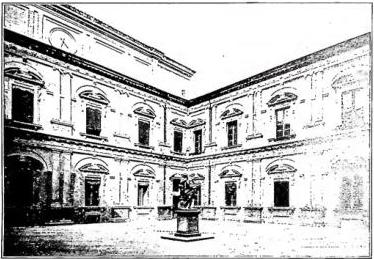
BOLOGNA - Courtyard of the University Palace (16th century).
On 10 December 1582 Gregory XIII, a Bolognese, raised Bologna—by then the second city of the Papal State—to an archiepiscopal see. Thus ended the formal dependence on Ravenna, which had caused so much suffering to the Bolognese in the Middle Ages. The dioceses of Imola, Cervia, Modena, Reggio, Parma, Piacenza and Crema became suffragans of the new metropolitan.
Throughout the 17th century the see of St Petronius was occupied by some of the most illustrious names of the Roman aristocracy: Borghese, Ludovisi, Colonna, Boncompagni. Giacomo Boncompagni built the great sanctuary of the Madonna della Guardia, which his successor, Cardinal Prospero Lambertini, completed. Lambertini, a Bolognese who became a cardinal in 1726, then bishop of Ancona and transferred to Bologna in 1731, is the greatest figure in the city’s clergy. The impetus he gave to studies, his revival of convents and churches, and his juridical wisdom and sagacity have never been forgotten. As Pope from 1740 to 1758, Benedict XIV remained titular archbishop of Bologna for another fourteen years, showering the beloved city with the benefits of his office, especially on the University and the Academy of Sciences, the most active cultural centres of the mater studiorum.
The 18th century was a golden age for Bologna in art and science. Alongside notable painting activity, the work of the century’s foremost musicologist, Fr Giambattista Martini, and the many scholars who illuminated the revived University and Academy—thanks to the tireless and intelligent efforts of Luigi Ferdinando Marsili even before Lambertini’s time—there were numerous scientists who brought distinction to the city: from the great naturalist Ulisse Aldrovandi and the eminent physician Marcello Malpighi to Luigi Galvani, the founder of electrical studies.
Under Archbishop Andrea Giovanetti the armies and spirit of the Revolution swept into the Romagna; the diocese then suffered the suppression of convents, the loss of ecclesiastical property and the reduction in the number of parishes. After 1800 convents and churches were rebuilt, until the suppression of the religious congregations following Italian unification.
When Clement VIII restored Cervia to Ravenna and raised Modena, Parma and Piacenza to archiepiscopal status as seats of autonomous governments, the metropolitan authority of the Bolognese church was confined to Faenza and Imola, and for a time to the newly created diocese of Borgo San Donnino. The revolutionary wind reached Bologna. After the initial shock and indignation at the bloodshed came patriotic fervour, political awakening and admiration for Napoleon, whom Bologna welcomed with extraordinary enthusiasm. The city was happy to take its share in the formation of the democratic states that paved the way for the Kingdom of Italy. There were also signs of autonomy when Bologna seemed destined to head a State of the Legations, a plan that the consummate skill of Cardinal Consalvi dismantled, restoring for another forty years the old structure of the ecclesiastical state.
In the Risorgimento Bologna, a centre of liberal plots and conspiracies for all the Romagna since the Restoration, played a major part in the 1831 revolution of Central Italy. When the revolt broke out in Modena through the efforts of Ciro Menotti, Bologna rose on 4 February, spreading the movement to the Romagna, the Marches and Umbria. The ephemeral government of the United Provinces had Bologna as its capital, until Austrian intervention once again dashed the liberals’ hopes. Yet Bologna remained steadfast in its ardour for freedom and unity against the Austrians, a spirit it demonstrated on the battlefields of 1848 and especially in the fight at La Montagnola against Welden’s strong forces.
Bibliographical compilations: L. Manzoni, Saggio di una bibliografia storica bolognese, Bologna 1888; L. Frati, Opere della bibliografia bolognese che si conservano nella Biblioteca Municipale di Bologna, 2 vols., ibid. 1888-89.
Historiography: L. degli Alberti, Hist. di Bologna, Bologna 1541-1591; C. Ghirardacci, Della Historia di Bologna, I, ibid. 1596; II, ibid. 1657; III, ed. A. Sorbelli, ibid. 1928; S. Muzzi, Annali della città di Bologna dalla sua origine al 1796, 9 vols., ibid. 1840-49; N. Rodolico, Dal Comune alla Signoria: Saggio sul governo di Taddeo Pepoli, ibid. 1898; A. Gaudenzi, L’origine dello studio di Bologna, ibid. 1901; Studi e Memorie per la storia dell’Università di Bologna, ibid. 1907 ff.; A. Hessel, Geschichte der Stadt Bologna von 1116 bis 1280, Berlin 1910; Lanzoni, pp. 778-90; A. Gaudenzi, Il monastero di Nonantola, il ducato di Persiceto e la chiesa di Bologna, Rome 1916; A. Vincenzi, Il passaggio di Bologna dal dominio pontificio ai re d’Italia, Bologna 1921-22; G. Zaccagnini, La vita dei maestri e degli scolari nello studio di Bologna durante il Rinascimento, Geneva 1926;
P. Sella, La diocesi di Bologna nel 1300, in Atti e memorie della Deputazione di storia patria per le Romagne, 18 (1929), pp. 97-155; G. Zaccagnini, Storia dello studio di Bologna durante il Rinascimento, Geneva 1930; P. Ducati, Storia di Bologna, I: L’età antica, Bologna 1937; A. Sorbelli, Storia di Bologna, II: Dalle origini del cristianesimo agli albori del Comune, ibid. 1938; F. Filippini, S. Petronio vescovo di Bologna, ibid. 1948 (with list of holders of the see of Bologna).
Pier Fausto Palumbo
II. ART
I. Architecture. — The oldest churches still extant in Bologna all bear witness to the wide infiltration of Lombard Romanesque style: indeed, nothing remains of the buildings which tradition would have erected by Bishop Zama (4th century) and his first successors; the oldest architectural complex is therefore constituted by the Stefanian buildings, whose primitive nucleus is thought to date from the time of St Petronius. These buildings underwent remodelling in the Lombard period, until they received their definitive arrangement in the Romanesque age: the churches of SS Peter and Paul, of the Crucifix, of St Stephen, the Oratory of the Cross, Pilate’s Courtyard and the adjoining cloister display clear Lombard-Romanesque elements, to which is joined a new search for elegance in decoration. To the same period belong the churches of SS Vitalis and Agricola in Arena, of St John on the Mount and the cathedral of St Peter, of which the tower and the Lion Doors remain. Lombard-Romanesque architecture thus left in Bologna a notable complex of religious buildings, which shared in common the use of brick both in structure and decoration, the absence of ribs in the vaults, and the presence of bell towers adjacent to the churches, on the model of those in Ravenna.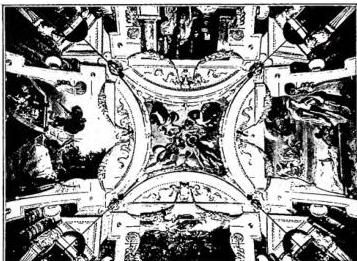
BOLOGNA - Ceiling of the assembly hall in the University palace, with stuccoes and frescoes by Pellegrino Tibaldi (16th century).
The scarcity of marble in the Bolognese region seems to have contributed to the lack of interest among local craftsmen in the art of sculpture; thus, one can speak of a local plastic tradition only with regard to the typical ornamentation in terracotta. In fact, the principal works of sculpture at all times have been produced by non-Bolognese artists.
After the rare examples of sculpture from the Lombard period, mostly of an ornamental character (Pilate’s basin; the arch of Folcherari’s tomb, in S. Domenico; the cross of S. Giovanni in Monte, 8th century), plastic production becomes more abundant with the penetration of the Lombard-Romanesque style (sarcophagus of the SS. Vitale and Agricola, in S. Pietro; the roadside cross of “Petrus Alberici cum patre,” in S. Petronio; stuccoes with the symbols of the Evangelists and the Resurrection, in S. Stefano, 13th century; wooden Crucifixion in the crypt of S. Pietro), though it generally does not reach a high quality. Of particular importance in the 13th century is the area of S. Domenico, the work of Fra Guglielmo.
In the 14th century, a flourishing of funerary monuments, based on the scheme of the sarcophagus decorated with reliefs on the front and sides, documents the influx of Gothic styles (tomb of T. Pepoli, in S. Domenico; monument to G. da Legnano and the presumed L. Pini, in the Civic Museum), later interpreted with rare elegance by the Venetians Jacobello and Pierpaolo dalle Masegne in the marble pulpit in S. Francesco (1388). The preciousness of their work is reflected in the reliquaries of S. Domenico (1383) and S. Petronio (1380). Venetian Gothic also asserted itself at the end of the century through the numerous sculptors who worked on the socle of the façade or the lateral panels of S. Petronio, and it merged, together with Tuscan elements, in the mediocre sculpture of Andrea da Fiesole. Jacopo della Quercia decorated the main portal of S. Petronio from 1425 to 1438 and vigorously imposed the new plastic ideals. Numerous Tuscan sculptors followed, such as Niccolò di Pietro Lamberti, Pagno di Lapo, D. Rosselli, and A. di Duccio, who dominated the field in Bologna in the second half of the 15th century, definitively establishing the Tuscan Renaissance manner. Francesco di Simone, in the Tartagni monument in S. Domenico (1477), substituted the traditional motif of the sarcophagus with the scheme of a tabernacle funerary monument, inspired by the Maruppini tomb of Desiderio.
After the mid-century, Niccolò dell’Arca arrived in Bologna, whose sculpture exerted a very broad influence on the developments of Bolognese plastic art, since it synthesized, in an original way, Gothic-Burgundian elements and the complex figurative culture of Ferrara and Emilia (cf. the Pietà, in S. Maria della Vita, 1485). Epigones of the tradition of the Emilian sculptors of the 15th century in Bologna in the 16th century are Vincenzo Onofri (Pietà, in S. Petronio) and Alfonso Lombardi (Pietà, in S. Pietro), who attempted to achieve new monumental values by approaching the models of Raphael and Michelangelo. The art of the first half of the 16th century is, moreover, dominated by Michelangelesque ideals, to which the noble expressiveness of Andrea Sansovino was sought to be united. The presence of Tribolo, who worked in S. Petronio (1525), helped to validate this direction, and the host of mediocre craftsmen (such as Saccadenari, P. de’ Rossi, A. Aspertini, G. da Treviso, L. Casario, Zaccaria da Volterra), to whom we owe the panels of the minor doors of the church, repeated and deformed with extreme monotony the models of the great art of the time. The same presuppositions are reflected in Montorsoli’s high altar in the church of the Servi (1558). A certain originality, however, is shown by the woodcarvers of the da Formigine family, of which Andrea is the greatest representative; they summarize the tradition of woodcarving, which had produced outstanding works in the choir stalls of S. Francesco (1407), S. Petronio (1468–77), and S. Domenico (1528–40).
The 17th century is represented only by the Decollation of St. Paul (1641) in the church of the same name, by the Bolognese Algardi, who, more than affirming Baroque achievements, demonstrates the links of his sculpture with the painting of his fellow-countrymen the Carracci. Algardian in style is Camillo Mazza in the reliefs of S. Pietro and the church of the Cappuccini. In the 18th century, G. Mazza and A. Piè show, in the interiors of S. Maria di Galliera, S. Maria della Vita, and della Santa, that they share in the rich and elegant taste of the time; but they then revert to the Emilian naturalistic tradition in the human grace of their Madonnas or the liveliness of their Nativity figurines. Nor did Giacomo de Maria, a pupil of Canova, disdain the art of the figurine, with which Neoclassicism briefly penetrated Bologna; it was succeeded by that veristic trend that has left ample testimony in numerous tombs in the monumental cemetery.
3. Painting. - Painting in Bologna was, through the centuries, essentially “sacred,” not so much in subject matter as in the spirit of religiosity that permeates, more or less sincerely, the artists.
Alongside the scant and mediocre remains of 13th-century painting (frescoes now in the Museum of S. Stefano and in S. Vittore), the 14th century offers a rich
the documents of miniature art are most abundant, since Bologna was the most distinguished centre of miniature painting in the 13th century; the traditional Byzantine manner soon gave way, in the decoration of manuscripts, to frequent naturalistic touches and a lively illustrative vein, making it easy for the new Tuscan and Giottesque idiom to take root, while Gothic models remained sparse and of limited importance. To this day, no historical substance can be attributed to the figures of Oderisi da Gubbio and Franco Bolognese, whom some have sought to identify with the divergent trends in miniature painting of the second half of the 13th century; these trends are instead subsumed, at the dawn of the 14th century, in Niccolò di Giacomo, who pushes narrative fluency and expressive force almost to the point of caricature. The miniature tradition, combined with Sienese elements from S. Martini, flowed into the painting of Vitale da Bologna, the leading artistic personality of the first half of the 14th century; while the Giottesque-Rimini style is clearly evident in Jacopo Avanzi, identified by some with the “Cugino dei Romagnoli.” Various artists link themselves to the style of these painters: Andrea da Bologna, Simone dei Crocifissi, the painters of the Pomposa stories, Lippo di Dalmasio, who extends the grace of Vitale into the early 15th century.
In the first half of the 15th century, pictorial production follows the premises of the previous century with Pietro Lianori and Orazio di Jacopo; Michele di Matteo di Calcina and Michele di Matteo da Modena, however, represent the international taste of Gentile da Fabriano. By the mid-century, Bolognese painting comes into contact, through the altarpiece of A. and B. Vivarini and through Marco Zoppo, with the conclusions of Mantegna’s Paduan art and with the constructive breadth of Piero della Francesca: these elements, combined with the precious colour and dramatic violence of Ferrara, are confirmed by F. del Cossa (active in Bologna from 1472 to 1478), whose school remained productive until the end of the 15th century, and by the sojourn of Ercole de’ Roberti (1482–86). With L. Costa, Ferrarese motifs are modified in contact with the personality of Francesco Raibolini, called il Francia: he was the most representative painter of late 15th-century Bologna, and his art, marked by a religious lyricism and an ecstatic grace, determined a distinctive physiognomy of painting for nearly two centuries; Amico Aspertini echoed its graceful forms in the 16th century.
For these aspects of Bolognese art, the altarpiece of St Cecilia (1516) in S. Giovanni in Monte by Raphael enjoyed enormous success: Raphael’s style triumphed undisputed for the first three decades of the century and then remained fundamental in the eclectic direction of the rest of the 16th century; even painters from outside, such as G. da Treviso, G. da Carpi, il Garofalo, l’Ortolano, conformed to it, while with Bagnacavallo, Biagio dalle Lame, G. da Cotignola, and I. da Imola it degenerated into the feeblest Mannerism, of which Prospero Fontana was the epigone. Alongside Raphael’s ideals stand those of Michelangelo, represented by the frescoes of P. Tibaldi, and the host of mediocre eclectics working at the end of the century (such as Sabatini, Samacchini, Aretusi, Cesi) also tried to avail themselves of Venetian pictorial values and Correggesque modes: the latter dominate in the workshop opened (1572) by the Flem
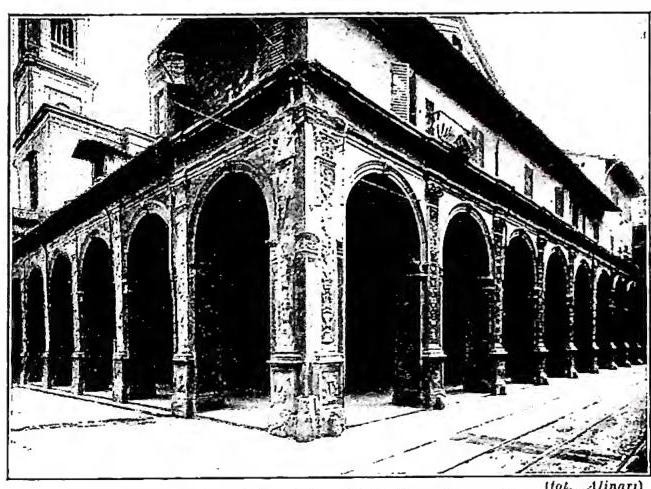
BOLOGNA - Portico of the church of S. Bartolomeo (16th century).
The painting of Bologna underwent a profound renewal at the end of the century through the work of the Carracci, who reacted against the sterile, conformist monotony that preceded them by enthusiastically returning to the great models of the 16th century: Roman experiences were programmatically fused with Venetian and Correggesque ones, achieving lively and original results in decorative and landscape painting, more so than in canvases of sacred subjects.
The tradition of Reni persisted into the 18th century with Carlo Cignani; but the 18th century was characterized by the fanciful decorations of the scenographers Bibbiena and V. Maria Bigari: perspective backdrops opened the ceilings of churches through the work of the “quadraturisti” (most notable the Haffner brothers), and the “figuristi” painters (the greatest of whom was M. A. Franceschini) completed the decoration. Among the most splendid examples are the interiors of the church of the
Santa, of the Madonna di Galliera, and of S. Paolo. Gaetano Gandolfi was an epigone of this current, reviving his color in the Venetian manner of Tiepolo. A completely different position is offered by Giuseppe M. Crespi, called lo Spagnolo, who summarized the innovative experiences of the 17th century and renewed them with profound pictorial sincerity.
In the first half of the 19th century, the perspective tradition continued to thrive with Basoli, Cocchi, Ferri, Solmi, and Fancelli, while painters such as Muzzi and Busi reworked the distant premises of the Carracci. The realist trend, however, was represented by Luigi Serra; at the end of the century, Samoggia, Casanova, and Sezanne attempted to renew medieval and 15th-century motifs romantically in the decoration of the chapels of S. Francesco.
The complex of buildings, which still retains the name of S. Stefano, is one of the most interesting and characteristic. It consists of four main churches, oratories, and cloisters, erected between the 5th and 17th centuries. Important restorations were carried out in 1880 and 1924. It still preserves some of the oldest relics of the Bolognese Church, and since some of the buildings were constructed to recall the places of the Saviour’s Passion, it was also called Jerusalem.
The cult of Our Lady was especially fostered by the care of the cardinal and bishop of Bologna, B. NICCOLÒ ALBERGATI. During his tenure the sacred image was, on the occasion of a public calamity, carried for the first time in solemn procession to the city below (5 July 1433). The image was crowned in 1603 by the archbishop of Bologna, ALFONSO PALEOTTI, and a second time in 1857 by Pius IX.
The ancient church, repeatedly restored, was replaced by the present one, designed by Carlo Francesco Dotti (1723–1763), in the typical dissocial form with transverse arms forming a cross and an elliptical dome. In recent years the painter Giuseppe Cassiolo has decorated the dome.
The sanctuary is connected to Bologna by a monumental portico three and a half kilometres long, with 666 arches and 15 chapels (1673–1734). In 1931, for greater convenience of access, a cable car was built up to the sanctuary.
The church was rebuilt in the 16th century and remodeled in 1535.
The abbey of SS. Nabore and Felice, where Gratian lived in the 12th century, was for some time united with that of S. Procolo. By 1432 it already belonged to the Congregation of S. Giustina. In 1436, Eugenius IV separated it from S. Procolo.
VI. UNIVERSITY
It shares with Paris the primacy among the medieval university cities. It earned the title of Alma mater studiorum and, on the city’s seals and coins, the motto Bononia docet.1. The ancient Studium. — The earliest traces of the Studium are to be sought in the second half of the 11th century with the private teaching of Pepo: its foundation is traditionally dated around 1088, and thus in 1888 the “eighth centenary of the origins of the Studium” was celebrated. Irnerius (q.v.), lucerna iuris, was the brilliant man who immediately gave solid consistency to the teaching entrusted to him, hastening the decline of Ravenna in this field as well. With his disciples Bulgarus, Martinus, Jacobus, and Hugo, he inaugurated that glorious school of Glossators which was to give new life to Roman law. Meanwhile, Gratian (q.v.) compiled the Decretum in 1151.
According to Odofredus himself, in the 13th century the Studium Generale of Bologna counted no fewer than 10,000 students, drawn from every part of the world. Unlike that of Paris, which was a corporation of professors (Universitas Magistrorum), the Studium of Bologna was constituted by the corporation of students (Universitas scholarium). And there were two Universitates: that of the Italians or claramontani, and that of the foreigners or ultramontani, subdivided into nationes. A document from 1265 lists, for the ultramontani, 13 nations: French, Spanish, Provençal, English, Picard, Burgundian, Poitevin, Gascon, Touronian, Cenomanian, Catalan, Hungarian, Polish, and German; but later their number was doubled.
Hence the government of the Studium was entrusted to two rectors, elected by the students themselves. The rectors held civil jurisdiction, and in some cases even criminal jurisdiction, over the members of the corporation. Frederick Barbarossa, who invited the doctores of the Bolognese Studium to the Diet of Roncaglia (1158) to establish the rights of the Empire, promulgated there the Authentica Habita in favor of foreign jurist students, from which medieval school legislation drew its inspiration. Thus, once the corporate constitution of the students was recognized, the Studium constituted an autonomous organization, with offices and magistrates independent of the communal authority, almost a commune within another commune.
To the original chairs or faculties of the legists (civil and canon law) were gradually added those of medicine and the arts (which seem to have existed already as faculties by 1268), while the faculty of Theology was established by Pope Innocent VI with the bull Quasi lignum vitae, from Avignon on 21 June 1360 (Bull. Rom., IV, Turin 1859, pp. 517-19); but for political reasons it was inaugurated only on 2 June 1364. Modeled on the Parisian faculty, this faculty was placed directly under the bishop; it constituted a university of masters rather than of students, who belonged to the university of the artists (Savigny).
From the second half of the 13th century, colleges of doctors also appeared, including doctors not attached to the Studium. These colleges had their own statutes and the privilege of conferring degrees; they lasted until the Napoleonic age.
The first statutes of the two universities of jurists, now lost, were composed by the rectors and students in 1252, who bound themselves by oath to observe them, as is evident from the brief of approval by Innocent IV (12 Jan. 1253). Those of 1317 and 1432 survive, as do the statutes of the university of medicine and the arts from 1405, with reforms from 1442, and the statutes of the faculty of Theology (published by Cardinal Ehrle), the most interesting and complete of all those drawn up by the other theological faculties derived from Paris. Also preserved are the statutes of the college of doctors of civil law (1397, with additions from 1438 to 1499), of the college of canon law (1460 and 1466), and of the college of medicine and the arts (1378, 1395, 1410). All these statutes were repeatedly approved by the Popes, e.g., by Pius IV in 1563.
The right of inspection and supervision was reserved by Honorius III in 1219 to the archdeacon, who, as in Paris, took the title of chancellor; for theology, however, supervision belonged to the bishop. A glory for the Studium was that the various collections of Decrees (q.v.) were promulgated with bulls addressed “to the masters and students of the Studium of Bologna.”
At first the professors were chosen and paid by the students, but in the 14th century they began to be stipended by the Commune, and in the 16th century their chairs were gathered into a single building, for which, on a design by Antonio Terribilia, the Palazzo dell’Archiginnasio was erected in 1562-63. Gregory XV granted them jubilee after 40 years of teaching (bull of 11 Aug. 1621), and Benedict XIV reduced the period to 30 years (brief of 18 Sept. 1748).
The corporate constitution persisted for a long time; but later the government of the Studium passed from the corporation to the Commune, and from the Commune to the Papal State, which from the beginning of the 17th century (after 1604) exercised its authority through the cardinal legates pro tempore, who thus became perpetual rectors of the university.
About twenty colleges for poor lay students (the ecclesiastics resided in religious houses) had the status of pious works, e.g., the Collegio Gregoriano, established by Pope Gregory XI with the bull Res sanctissima (Avignon, 18 Dec. 1372) with extensive regulations (Bull. Rom., IV, Turin 1859, pp. 542-60), and the Collegio Montalto, founded by Sixtus V in 1586 for fifty young men from the Marca.
2. The modern University. — With the growing demands of culture from the 15th century onward, the old chairs were subdivided and new ones established. In 1711 Luigi Ferdinando Marsili founded the Istituto delle Scienze, which later merged with the Accademia dei Pittori, Scultori ed Artisti, and at the beginning of the 19th century was incorporated into the University.
With the French invasion, the Studium underwent a series of transformations until it became the present national university.
3. Its importance for European culture. — For its Studium Bologna earned the title of learned, of seat and mother of the laws; hence it had its coins struck with the proud words: Petrus relique pater - legum Bononia mater. “We jurists must never be so ungrateful as to forget that the jurisprudence of our own day is the daughter of the Studium of Bologna” (Savigny, p. 547).
Its organization served as a model for almost all other medieval universities, French, Spanish, German, Polish, Hungarian, Swedish; the rise of these did not diminish its great importance. Popes and emperors vied in endowing it with privileges, exemptions, and immunities. Its masters attained world renown, and among its alumni are counted not a few saints.
Its history is narrated by Albano Sorbelli and Luigi Simeoni (Storia dell’Università di Bologna, 2 vols., Bologna 1940-47), and its contribution to the history of culture and universal civilization by Carlo Calcaterra (Alma Mater Studiorum, Bologna 1948). — See PL. CVI-CVII.