
ORTOLANO, GIOVAN BATTISTA BENVENUTI, called l'. — Painter, born in Ferrara to Francesco di Benvenuto around 1485 (in 1512 he was over 25) and died no earlier than 1525. His formation, thoroughly Padan, brought together diverse elements that almost never achieved a perfect fusion, although in recent times modern criticism has been able to recognize works of vigorous expressive individuality among a certain group of paintings attributed to O.
Initially under the influence of Boccaccino (see the ingenuous Nativity from the Davis bequest in the Metropolitan Museum of New York), then of Roberti and Lorenzo Costa (the lunette of the Pietà, with a unified, greenish-blue sky background, in the Pinacoteca of Ferrara, and the altarpiece of the Nativity, in the Roman Galleria Doria, where the Glory of angels above is a reminiscence of Raphael’s S. Cecilia), the Ferrarese master subsequently approached Mazzolino in the exuberance of his greens and vermilions (Christ and the Adulteress in the collection of Viscount Lee of Fareham at Richmond, Surrey); but in his mature period he alternated typological affinities with Garofalo and those with Dosso Dossi, which partly explains the attribution to these two masters of several works now regarded as certainly by O. His art, between Garofalo’s aestheticizing purism and Dosso’s romantic fervor, introduces into the sixteenth-century Ferrarese school a lively accent of rustic gravity and artisan geniality, even if expressed through forms of an idealized classicism; and he is distinguished from the other contemporary painters of the Po Valley by the solid, rounded modeling of his masses, intensely illuminated, by the raw profiling of his contours, and by the wealth of his enamel-like coloring (R. Longhi defined him as: “a classicist in intention, but a naturalist in grain and temperament; one might almost be tempted to call him the Moretto of Ferrarese painting”). Among his most characteristic and accomplished works should be mentioned: the Nativity in the Louvre, with its deeply devout and idyllic concentration; the calm, intimate Circumcision
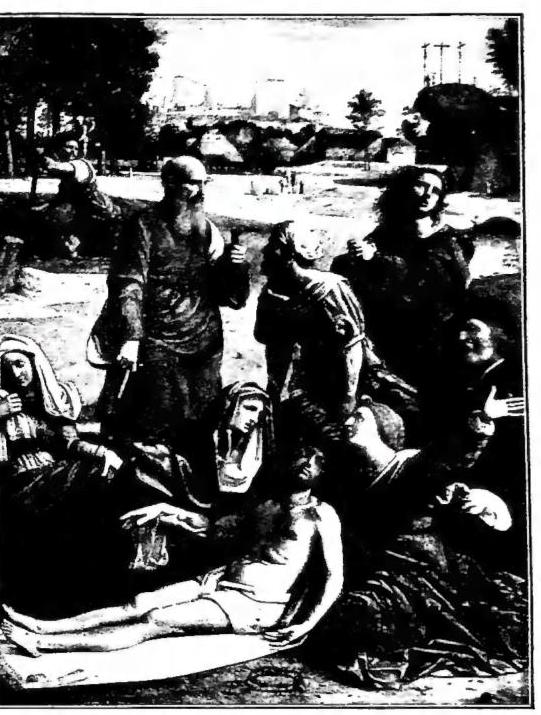
from the Patrizi collection, in Rome; the slender S. Sebastian and the almost Giambellinesque one; the most noble S. Nicholas in the Pinacoteca Capitolina; the Crucifixion in the Pinacoteca di Brera; the moving, majestic Deposition in the Galleria Borghese (a replica exists in the Museum of Naples), and above all the altarpiece with SS. Sebastian, Roch and Demetrius, in the National Gallery in London, where O.’s art acquires an epic pulse, conjuring dreams of ancient and pious chivalric deeds amid the coppiced woods.