Machine translation of the 1948–1954 Italian original. The original text is authoritative.
NICOLA, bishop of MIRA, saint. — N. was born at Patara, in Lycia, and was bishop of Mira around the middle of the 4th century. He is one of the most popular saints in both the Greek and Latin Churches; but there are no positive data concerning his life. The hagiographers wove a biography of St N. of Mira by attributing to him much of the life of another Nicola, called Sionita, who in the 6th century founded a monastery at Sion near Mira and later became bishop of Pinara in Lycia (d. 12 December 564).
In the «Praxis de Stratelate» it is related that the Saint rescued three officers from mortal danger in the time of Constantine; this narrative was disseminated under Justinian. At Rome, at the beginning of the 8th century, his image was reproduced on the wall of the left aisle of S. Maria Antiqua; he is haloed, of senile appearance, wearing a white tunic, a black penula, and the sacred pallium, with the inscription O ALTOC NIKOAAOC (Wilpert, Mosaiken, p. 708), and stands between St Athanasius and St Erasmus. At Rome there are no fewer than 26 churches dedicated in his honour and a hospital (C. Huelsen, Le Chiese di Roma, Florence 1927, pp. 389-408). At the Lateran, Pope Niccolò I (858-67) erected a basilica to the Saint of Mira; Callistus II, after Worms, rebuilt it and ordered it to be frescoed; the image of the Saint was placed in the apse, with a book in his right hand and a pastoral staff in his left (Wilpert, Mosaiken, p. 163, fig. 43; G. B. De Rossi, Esame storico ed archeologico dell'immagine di Urbano II papa e delle altre antiche pitture nell'oratorio di S. Nicola entro il Palazzo Lateranense, in Studi in Italia, 1881, pp. 1-61). The chapel was destroyed in the time of Benedict XIV. Moreover, in the time of Leo IV (847-55), two oratories dedicated to St N. are known: one near the basilica of S. Lorenzo in Agro Verano (Lib. Pont., II, p. 112), and the other near the titular church of SS. Quattro Coro-
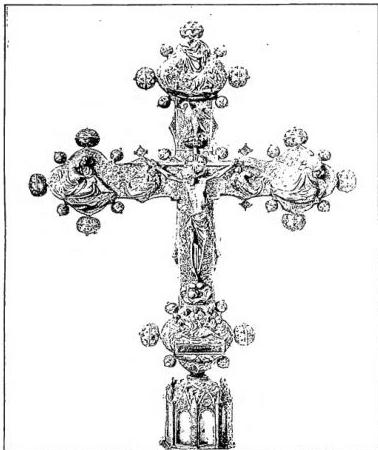
NICOLA da GUARDIAGRELE — Processional cross in repoussé silver (1431), Guardiagrele, church of S. Maria Maggiore.
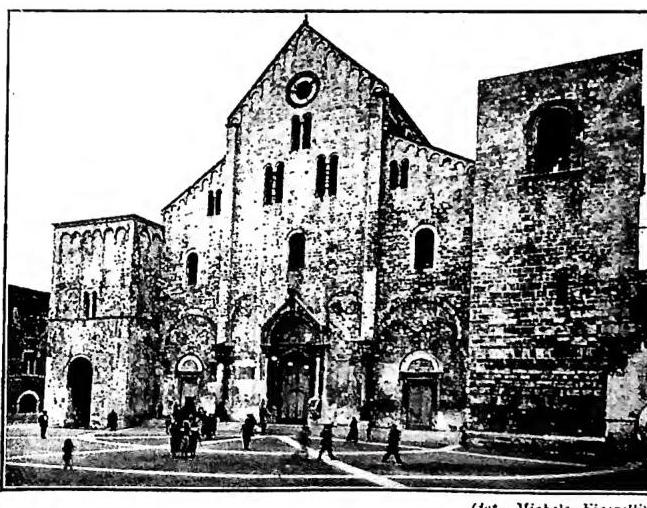
nati on the Caelian (ibid., p. 116); a third oratory was erected by Niccolò I (858-67) near the diaconia of S. Maria in Cosmedin (ibid., p. 161). In the restoration of the oratory of S. Lorenzo at the «Sancta Sanctorum» of the Lateran, carried out at the order of Honorius III (1216-27), there is a mosaic image of St N., still of senile appearance, bearded and wearing the mitre (Wilpert, Mosaiken, pp. 179-80 and fig. 56). At Constantinople, the church at Blachernae was erected by Justinian (Procopius, De aedificiis, I, 6); an oratory in the imperial palace was built by Basil the Macedonian; his nativity was celebrated in Constantinople with great solemnity (Synax. Constantinopol., Brussels 1900, p. 284). Between France and Germany, no fewer than 2,000 churches dedicated in his honour can be counted; England has approximately 400; Iceland approximately 40. In the East, his mosaic image was in the church of S. Luca in Phocis (11th century). His iconography developed still further after the translation of his relics to Bari (by some merchants, on 9 May 1087), where a sumptuous basilica was erected in his honour and St N. became the patron of the city. It is found, for example, in the grotto of S. Stefano at Vasto near Otranto (12th century). Devotion to St N. manifested itself in every way, not only through liturgical celebrations, but also by choosing him as patron of confraternities of young men, schoolboys, bakers, and boatmen; he is even the patron of prisoners; he is preferred as a baptismal name, and so forth. The enormous devotion aroused in Apulia after the translation of 1087 caused the jealousy of Benevento, which, having a church dedicated to St N., would have liked pilgrims to prefer it; the «adventus S. Nicolai in Beneventum» (BHL 6206) was even written to exalt the merits of this city in contrast to Bari’s lack of hospitality. The iconography is oriented toward the representation of the legends of the three maidens saved from dishonour, and of the three youths who were killed and resurrected; the account of the miracle of the precious vessel (BHL 6172) is merely an adaptation of a miracle attributed to St Menas in a Greek text (BHG 1258). The oldest legend concerning St N. in the West is represented by an 11th-century manuscript in the Karlsruhe Library (BHL 6119). A portable mosaic image attributed to the 13th century was stolen from the Museum of Vich (Roulin, Tableau
(phot. Alinari)
Cite this article
“NICOLA, VESCOVO DI MIRA, SANTO.” Enciclopedia Cattolica, vol. VIII (1952), p. 1082. Azione Romana digital edition, https://azioneromana.com/article/nicola-vescovo-di-mira-santo.