Machine translation of the 1948–1954 Italian original. The original text is authoritative.
VASTO, DIOCESE of. – City and diocese in the province of Chieti. The diocese is under the perpetual administration of the archbishop of Chieti ([v.] there for the relevant statistical data).
HISTORY. - It was the ancient Historium, one of the principal cities of the Frentani, already a Roman municipium destroyed by Sulla and fortified anew by Theodoric. The origin of the diocese is controversial, since not all scholars, including Kehr (op. cit. in the bibliography, p. 268 ff.), admit the existence of a bishopric before the 19th century. Lanzoni, on the other hand (I, pp. 318 and 377), mentioning the disputed letter of Gelasius I (492–96; Jaffé-Wattenbach, 677), maintains that at that time the see was vacant. In this letter the Pontiff orders a bishop Celestine, whose see is unknown, to choose and appoint the deacon Giuliano in the « ecclesia beat Eleutherii, quae in Stoniensium civitatis parochia probatur esse constructa », as visitor and not as « cardinalis pontificis ». Jaffé too seems to give « Stoniensium » the precise meaning of « Histoniensium » and « parochia » the meaning of diocese. Nevertheless, assuming that the diocese existed as early as the 5th century, it is very strange that, to this day, not even a single name or event has been preserved that directly or indirectly suggests the historical reality of the Histonian diocese. The Franks of Pippin passed through the city (802), erasing even its name (v. is a corruption of «gastaldato», which was governed by Aymone, Pippin’s captain); the Saracens passed through it several times (842, 851, and in the following centuries), as did the Hungarians (937), in addition to the various feudal lords (Caldora, Guevara, D'Avalos, etc.); there were also cataclysms of every kind. Yet never has the silence of the sources been more complete. As for Eleutherius, venerated in the city since the 5th century, he is the well-known bishop and martyr claimed by several places, whom Lanzoni (I, p. 268 ff.) would identify with the famous martyr Liberale.
In 1853 Pius IX, at the urging of Ferdinando II of Bourbon, by the bull Adeo late dioecesanum Teatini elevated V. Chieti, of whose archdiocese it had always formed part, and assigned its jurisdiction to the metropolitan of Teate, who from then on also assumed the title of bishop of
V. MONUMENTS
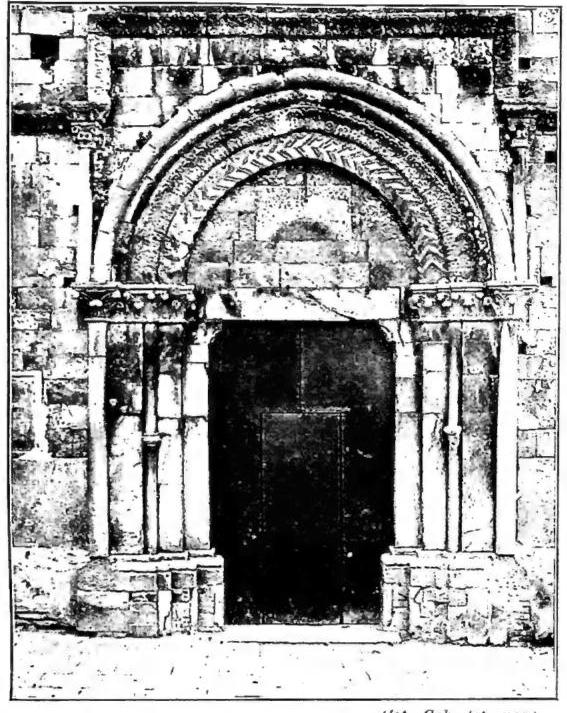
As a result of the repeated disasters that devastated the city, everything that still survives is almost everywhere concealed by Baroque and modern superstructures, which bear witness to the latest alterations undergone by the sacred buildings. The Cathedral, originally dedicated to s. Margherita, then to s. Agostino, and since 1808 to s. Giuseppe, was perhaps built before the year 1000, but was rebuilt in the 13th century and then destroyed once again by the Saracens (1566); it was restored in 1668. The façade, largely preserved, has the fine portal by Ruggiero De Fragenis (1293), in forms suggestive of the Gothic; the interior, however, was badly rebuilt in 1890. The church of S. Pietro belongs to the same period; it was built over the remains of a temple of Ceres and completely rebuilt in 1754. Here too the main portal and the side portal are preserved, works of the same De Fragenis (1293), to whom the portal of the little church of S. Antonio, now Baroque, also seems attributable. A Madonna and Child and a Crucifixion were sculpted in the lunette. The Neoclassical interior preserves a sixteenth-century Madonna del Rosario, a painting by the eighty-year-old Fil. Palizzi (Ecce Agnus Dei), and another by Fr. Paolo Palizzi (Il cieco di Gerico, 1853). Another Romanesque church was S. Maria Maggiore (11th century), which, after being rebuilt and enlarged in the 18th century, has lost every reminiscence of its origins, except for the 14th-century base of the bell tower. The interior is noteworthy for the chapel of the Spina, donated in the 16th century by the D'Avalos, which inspired a painting formerly kept there and attributed to Titian; for a 15th-century canvas of the Madonna del Gonfalone, a Sposalizio di s. Caterina by Paolo Veronese (?), and a gilt-copper monstrance from the school of Nicola da Guardiagrele. Finally, noteworthy is the collection preserved in the Museo civico, which, among prehistoric and pre-Roman objects, contains remains of destroyed medieval sacred buildings and good modern works.
BIBL.: Ughelli, X, p. 116 ff.; Moroni, XXXVI (1846), p. 153; LXXXVIII (1858), pp. 185-208; L. Marchesani, Storia di V., Naples 1838; N. A. De Vincentiis, V. e il gabinetto archeol., Teramo 1904; L. Anelli, Ricordi di stor. vastese, 3ª ed., there 1906; id., Historium e il V. attraverso i secoli, there 1929; P. F. Kehr, Italia Pont., Berlin 1900, IV, 1, pp. 318 and 377; Cottineau, II, col. 3230; I. C. Gavini, Storia dell'architett. in Abruzzo, Milan-Rome n.d., p. 435 ff. and passim; V. BAZZANO, Abruzzo e Molise, Turin 1927; P. Sella, Rationes decimorum Italiae; Aportium-Molisium (Studi e testi, 69), Vatican City 1936, p. 291 and passim. Pasquale Testini
Cite this article
“VASTO, DIOCESI DI.” Enciclopedia Cattolica, vol. XII (1954), p. 643. Azione Romana digital edition, https://azioneromana.com/article/vasto-diocesi-di.