
VELI. - The veils that adorned Christian basilicas certainly derive from common usage in patrician dwellings and Roman public buildings.
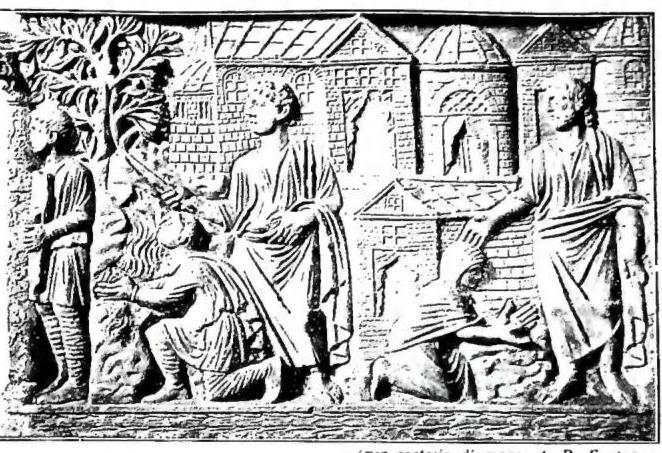
VELI - Early Christian basilicas with doors adorned with V. (4th century), Side of the sarcophagus, formerly Lateranense 174, now moved to the Grotte Vaticane. Basilica di S. Pietro.
The entrance doors had them both as protection (s. Paolino, Poém., XVIII, 30) and as simple ornament (ibid., XIV, 98), expressing that allegorical meaning given by the apostle Paolo in his epistle to the Ephesians (3, 14). The entrances, in fact, were either fitted with wooden or bronze leaves, or, in their absence, were protected by heavy curtains; in either case, the arch or lintel was always fitted on the outside with a single, or more often double, v., which was raised by knotting it in the center, or by suspending it from two hooks fixed in the side jambs. Since no specimen has survived, what is known is deduced from written sources and surviving depictions. Typical illustrative examples are offered by the scene on the ivory Reliquary of Samagher, the Lateranense sarcophagus no. 174 (Wilpert, Sarcofagi, tav. 121, 2-3), and the mosaics of the dome of S. Giorgio in Salonicco. V. can be seen at the entrance of churches, as in a panel of the door of S. Sabina, in the church incised on a sepulchral slab, now in the Museo cristiano lateranense, and in the mosaics of Ravenna. Subdeacons and doorkeepers were assigned to the duty of raising the door-curtains before distinguished persons (see illustration at V. STOFFE, vol. XI, col. 1355).
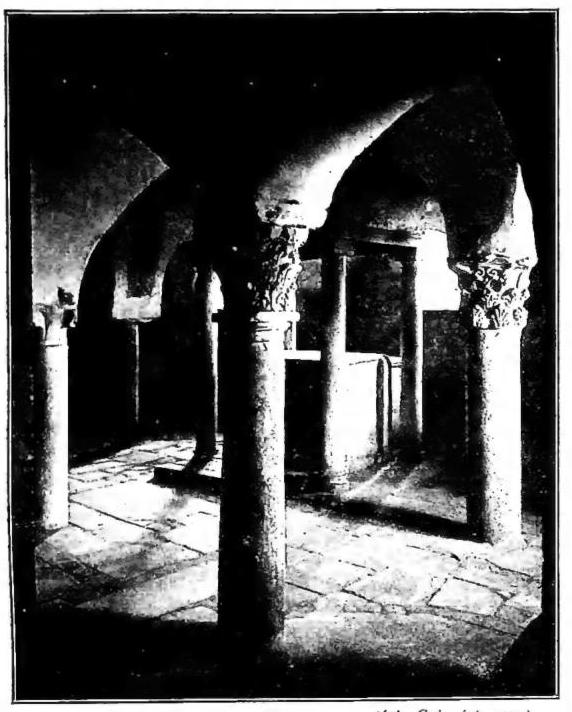
Other types of v., each with its own characteristics, were intended for the intercolumniations of the naves (suspension hooks or side rings sometimes remain), the presbytery, the altar, the ciborium (they are also called cortinae and tetracela), the portico, the narthex, and the sacristy. It is said that Costantino was the first to donate gold-bordered V. Costantinopoli. Certainly, in the era of peace, the pontiffs made gifts of all sorts of V. (single, double, quadruple, etc.) to the churches of Roma, and from the precise description often given by the Liber Pontificalis, it is possible to determine the number and in part the very quality of the fabrics.
Concerning the number, this source is not always precise: sometimes the vela intended for the intercolumniations are in greater quantity, and then they are easily understood to be indicated also for the doors, or for the presbytery, or around the altar. Concerning the quality, a precious source is the list contained in the Charta Cornutiana (Lib. Pont., I, p. CXLVII), which enumerates donations from the second half of the 5th century. Pope Adriano I (772-95) offered 20 V. de stauracim seu tyrea to each of the Roman titular churches (Lib. Pont., I, p. 504). Pope Pasquale I offered a series of V. S. Maria in Domnica, to S. Cecilia in Trastevere, and to S. Maria Maggiore (ibid., II, pp. 55-56, 61). The vela were mostly of linen or silk, which in turn took on specific names depending on the purity of the weave (linea pura, olosirica = all silk), the poorer quality (tramosirica, subserica = half-silk or silk derivatives?), and the applied decorations (paragaudata = trimmed with galloon, loricata, auroclava paragaudata, paragaudata persica, ro-
A quality of V. that was certainly finer or of a different shape from the ordinary kind must have been the paratura, intended, that is, as decoration for major feasts; and the so-called cortinae, which in their lavish decoration (cf., e.g.: Lib. Pont., II, 107, n. 9 ff.) bear witness to the high degree of perfection of Eastern manufactures.
Directly derived from the liturgical use of v., but with purely decorative aims and as substitutes for real ones, are the large decorations with painted draperies on the side walls of basilicas, in the lower zone of the apse and presbytery, and on the vaults of domes. Among the very numerous examples still surviving in the East and in the West, that of S. Maria Antiqua in Roma may serve for all, where one finds the full range of decorative motifs that made the delicacy of the various indigenous and imported products even more precious.